
The Cyrillic script is named after Saint Cyril, a missionary from Byzantium who, along with his brother, Saint Methodius, created the Glagolitic script in about 863. The modern Cyrillic script developed from the Early Cyrillic script, which was created by scholars at the Preslav Literary School, established in 886 in Pliska (Плиска), the capital of the First Bulgarian Empire (AD 681-1018) by a decree of Boris I of Bulgaria (Борис I). It was moved to Veliki Preslav (Велики Преслав), the new capital, in 893, and is also known as the Pliska Literary School or the Pliska-Preslav Literary School.
The Early Cyrillic script was based on the Greek uncial script with ligatures and extra letters from the Glagolitic and Old Church Slavonic scripts for sounds not used in Greek. The earliest known text in Cyrillic is an inscription dating to 921 AD, which was found near Preslav in what is now northeastern Bulgaria. Other early Cyrillic texts have been found in the same area.
The Cyrillic script was first used to write Old Church Slavonic, the liturgical language of many Christian Orthodox churches and the first Slavic language to be written. Regional phonetic and grammatical variations in written Church Slavonic started to appear from the 12th century, and gradually literary versions of the different Slavic languages, such as Bulgarian and Russian, emerged. Later, the Cyrillic alphabet was adapted to write many languages spoken across northern and central Asia from Azerbaijan to Mongolia.
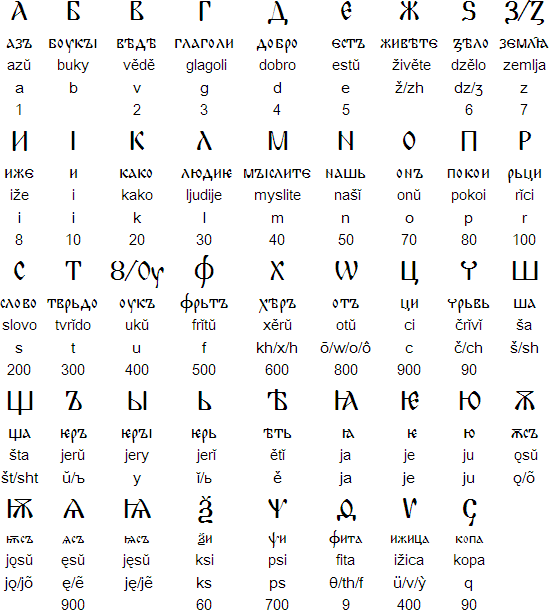
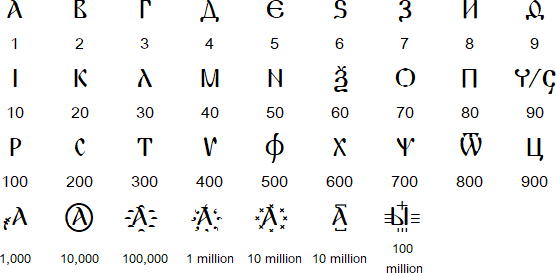
The letters had numeric values, the order of which came from the Greek alphabet.
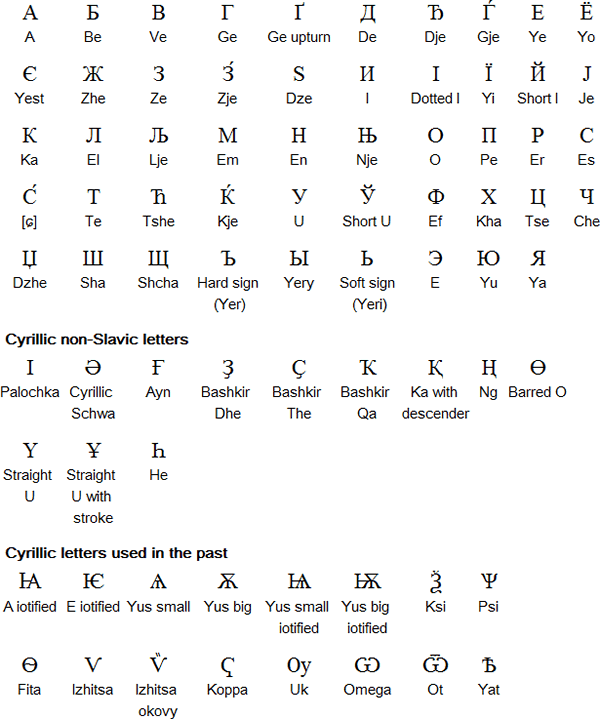
This chart shows most of the Cyrillic letters currently in use, plus ones that are no longer used, with their names.
The Cyrillic alphabet has been adapted to write more than 120 different languages, mainly in Russia, Central Asia and Eastern Europe. In many cases additional letters are used, some of which are adaptations of standard Cyrillic letters, while others are taken from the Greek or Latin alphabets.
Abaza, Abkhaz, Adyghe, Aghul, Akhvakh, Akkala Sámi, Aleut, Altay, Alyutor, Andi, Archi, Assyrian / Neo-Assyrian, Avar, Azeri, Bagvalal, Balkar, Baraba Tatar, Bashkir, Belarusian, Besermyan, Bezhta, Bosnian, Botlikh, Budukh, Bulgarian, Buryat, Chamalal, Chechen, Chelkan, Chukchi, Chulym, Chuvash, Crimean Tatar, Dargwa, Daur, Dolgan, Dungan, Enets, Erzya, Even, Evenki, Gagauz, Godoberi, Hinukh, Hunzib, Ingush, Interslavic, Itelmen, Juhuri, Kabardian, Kaitag, Kalderash Romani, Kalmyk, Karaim, Karakalpak, Karata, Karelian, Kazakh, Ket, Khakas, Khanty, Khinalug, Khorasani Turkic, Khwarshi, Kildin Sámi, Kili, Komi, Komi-Permyak, Komi-Yazva, Komi-Zyrian, Koryak, Krymchak, Kryts, Kubachi, Kumandy, Kumyk, Kurdish, Kyrgyz, Lak, Lezgi, Lingua Franca Nova, Lithuanian, Ludic, Macedonian, Mansi, Mari, Moksha, Moldovan, Mongolian, Montenegrin, Nanai, Negidal, Nenets, Nganasan, Nivkh, Nogai, Old Church Slavonic, Oroch, Orok, Oroqen, Ossetian, Pontic Greek, Romanian, Rushani, Russian, Rusyn, Rutul, Selkup, Serbian, Shor, Shughni, Siberian Tatar, Sirenik, Slovio, Soyot, Tabassaran, Tajik, Talysh, Tat, Tatar, Teleut, Ter Sámi, Tindi, Tofa, Tsakhur, Tsez, Tsudaqar, Turkmen, Tuvan, Ubykh, Udege, Udi, Udmurt, Ukrainian, Ulch, Urum, Uyghur, Uzbek, Veps, Votic, Wakhi, West Polesian, Xibe, Yaghnobi, Yakut, Yazghulami, Yukaghir (Northern / Tundra), Yukaghir (Southern / Kolyma), Yupik (Central Siberian)
Information about the history of the Cyrillic alphabet
http://en.wikipedia.org/wiki/Cyrillic_script
http://en.wikipedia.org/wiki/Early_Cyrillic_alphabet
http://www.volgawriter.com/VW%20Cyrillic.htm
http://en.wikipedia.org/wiki/Cyrillic_alphabets
https://r12a.github.io/scripts/cyrillic/
Free Cyrillic fonts
http://www.wazu.jp/gallery/Fonts_CyrS.html
http://www.fingertipsoft.com/ref/cyrillic/fontlist.html
http://www.typography.com/collections/cyrillic/
http://kodeks.uni-bamberg.de/AKSL/Schrift/RomanCyrillicStd.htm
ALPHABETUM - a Unicode font
for ancient scripts, including Classical & Medieval Latin, Ancient Greek, Etruscan, Oscan, Umbrian, Faliscan, Messapic, Picene, Iberian, Celtiberian, Gothic, Runic, Old & Middle English, Hebrew, Sanskrit, Old Nordic, Ogham, Kharosthi, Glagolitic, Anatolian scripts, Phoenician, Brahmi, Imperial Aramaic, Old Turkic, Old Permic, Ugaritic, Linear B, Phaistos Disc, Meroitic, Coptic, Cypriot and Avestan.
https://www.typofonts.com/alphabetum.html
A-chik Tokbirim, Adinkra, ADLaM, Armenian, Avestan, Avoiuli, Bactrian, Bassa (Vah), Beitha Kukju, Berati, Beria (Zaghawa), Borama / Gadabuursi, Carian, Carpathian Basin Rovas, Chinuk pipa, Chisoi, Coorgi-Cox, Coptic, Cyrillic, Dalecarlian runes, Elbasan, Etruscan, Faliscan, Fox, Galik, Georgian (Asomtavruli), Georgian (Nuskhuri), Georgian (Mkhedruli), Glagolitic, Global Alphabet, Gothic, Greek, Hurûf-ı munfasıla, Irish (Uncial), Kaddare, Kayah Li, Khatt-i-Badíʼ, Khazarian Rovas, Koch, Korean, Latin, Lepontic, Luo Lakeside Script, Lycian, Lydian, Manchu, Mandaic, Mandombe, Marcomannic Runes, Marsiliana, Medefaidrin, Messapic, Mongolian, Mro, Mundari Bani, Nag Chiki, Naasioi Otomaung, N'Ko, North Picene, Novo Tupi, Nyiakeng Puachue Hmong, Odùduwà, Ogham, Old Church Slavonic, Oirat Clear Script, Ol Chiki (Ol Cemet' / Santali), Old Italic, Old Nubian, Old Permic, Ol Onal, Orkhon, Osage, Oscan, Osmanya (Somali), Pau Cin Hau, Phrygian, Pollard script, Quốc âm tân tự, Runic, Székely-Hungarian Rovás (Hungarian Runes), South Picene, Sutton SignWriting, Sunuwar, Tai Viet, Tangsa, Todhri, Toto, Umbrian, (Old) Uyghur, Vellara, Veso Bey, Wancho, Yezidi, Zoulai
Page last modified: 28.11.24
[top]

Note: all links on this site to Amazon.com


You can support this site by Buying Me A Coffee, via PayPal or Patreon, or by contributing in other ways.
If you find all the adverts annoying, there is now an Ad-free version of Omniglot which you can access for a small monthly or annual donation.

This website and its content is copyright of Simon Ager - © Simon Ager 1998-2026. All rights reserved. All images were created by me, unless otherwise indicated. More details

[top]


