
The Latin, or Roman, alphabet was originally adapted from the Etruscan alphabet during the 7th century BC to write Latin. Since then it has had many different forms, and been adapted to write many other languages.
According to Roman legend, the Cimmerian Sibyl, Carmenta, created the Latin alphabet by adapting the Greek alphabet used in the Greek colony of Cumae in southern Italy. This was introduced to Latium by Evander, her son. 60 years after the Trojan war. There is no historical evidence to support this story, which comes from the Roman author, Gaius Julius Hyginus (64BC - 17AD).
[top]
Archaic Latin alphabet, Basque-style lettering, Carolingian Minuscule, Classical Latin alphabet, Fraktur, Gaelic script, Merovingian, Modern Latin alphabet, Roman Cursive, Rustic Capitals, Old English, Sütterlin, Visigothic Script
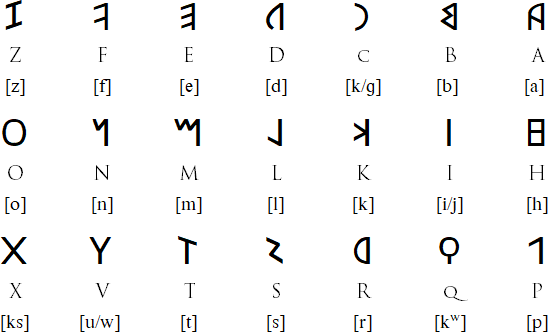
The earliest known inscriptions in the Latin alphabet date from the 6th century BC. It was adapted from the Etruscan alphabet during the 7th century BC. The letters Y and Z were taken from the Greek alphabet to write Greek loan words. Other letters were added from time to time as the Latin alphabet was adapted for other languages.
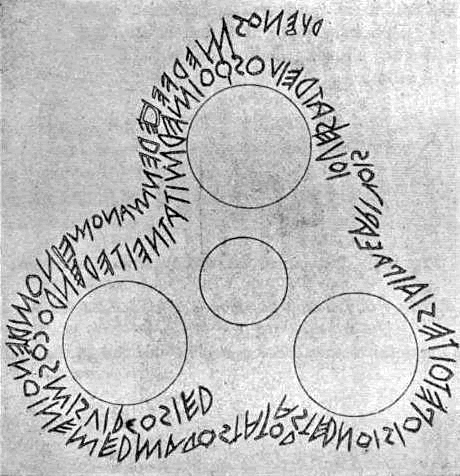
This is a version of the earliest known text in Latin. It is known as the Duenos inscription, and was found on the Quirinal Hill in Rome by Heinrich Dressel, a German archaeologist, in 1880. It is thought to date from the 7th to 5th century BC.
Source and more information:
https://en.wikipedia.org/wiki/Duenos_inscription

Opnēs hemones decnotāti et iovesi louberoi et parēs gnāscontor, rationes et comscientiās particapes sont, quois enter sēd comcordiās studēōd agontinom est.

Obnēs homenēs degnetāte et iouse leiberei et parēs gnāscontor, ratiōnes et cōnscientiaī particepēs sont, queis enter sēd concordiaī studeōd agondom est.
Old Latin translations by Giorgio Nagy
All human beings are born free and equal in dignity and rights. They are endowed with reason and conscience and should act towards one another in a spirit of brotherhood.
(Article 1 of the Universal Declaration of Human Rights)
Archaic Latin alphabet, Basque-style lettering, Carolingian Minuscule, Classical Latin alphabet, Fraktur, Gaelic script, Merovingian, Modern Latin alphabet, Roman Cursive, Rustic Capitals, Old English, Sütterlin, Visigothic Script
[top]
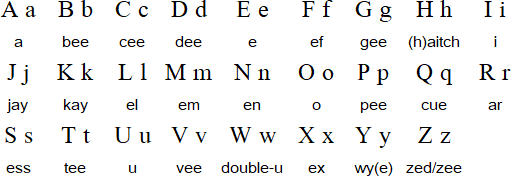
The modern Latin alphabet is used to write hundreds of different languages. Each language uses a slightly different set of letters, and they are pronounced in various ways. Some languages use the standard 26 letters, some use fewer, and others use more.
This is the modern Latin alphabet as used to write English.
Archaic Latin alphabet, Basque-style lettering, Carolingian Minuscule, Classical Latin alphabet, Fraktur, Gaelic script, Merovingian, Modern Latin alphabet, Roman Cursive, Rustic Capitals, Old English, Sütterlin, Visigothic Script
Many languages supplement the basic Latin alphabet with a variety of accented letters:

Note: the names of these accents varies from language to language. In Czech, for example, the caron is known as a háček [ˈɦaːtʃɛk], which means 'little hook'.
These accented letters can have a number of different functions:
How to type accented letters in Windows, Mac and HTML

Eth, Thorn, Yogh and Wynn were used in Old English; Eth and Thorn are also used in Icelandic; the long s was used in English and other languages to write non-final esses until about the late 18th / early 19th century; the dotted upper case i and dotless lowercase i are used in Turkish, and the schwa is used in Azeri. The other letters are used in various other languages, particularly those spoken in West Africa.
These are used in a number of languages including French, German, Icelandic, Croatian and Dutch:
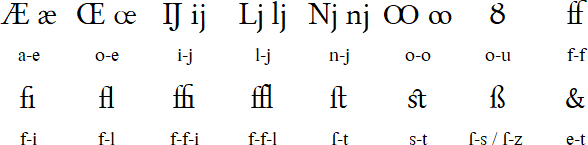
Click here to find out how to type ligatures in Windows, Mac and HTML
Further information about diacritics and their usage
http://www.phon.ucl.ac.uk/home/wells/dia/diacritics-revised.htm,
Download charts for Latin alphabets (Excel)
Latin alphabet | Latin language | Phrases | Numbers | Time | Tower of Babel | Articles | Links | Learning materials
Latin language resources on Amazon
Languages written with the Latin alphabet
Information about the Latin alphabet
https://en.wikipedia.org/wiki/Latin_alphabet
https://en.wikipedia.org/wiki/History_of_the_Latin_script
http://la.raycui.com/alphabet.html
http://mysite.du.edu/~etuttle/classics/latalph.htm
http://guindo.pntic.mec.es/jmag0042/LATIN_PALEOGRAPHY.pdf
A-chik Tokbirim, Adinkra, ADLaM, Armenian, Avestan, Avoiuli, Bactrian, Bassa (Vah), Beitha Kukju, Berati, Beria (Zaghawa), Borama / Gadabuursi, Carian, Carpathian Basin Rovas, Chinuk pipa, Chisoi, Coorgi-Cox, Coptic, Cyrillic, Dalecarlian runes, Elbasan, Etruscan, Faliscan, Fox, Galik, Georgian (Asomtavruli), Georgian (Nuskhuri), Georgian (Mkhedruli), Glagolitic, Global Alphabet, Gothic, Greek, Hurûf-ı munfasıla, Irish (Uncial), Kaddare, Kayah Li, Khatt-i-Badíʼ, Khazarian Rovas, Koch, Korean, Latin, Lepontic, Luo Lakeside Script, Lycian, Lydian, Manchu, Mandaic, Mandombe, Marsiliana, Medefaidrin, Messapic, Mongolian, Mro, Mundari Bani, Nag Chiki, Naasioi Otomaung, N'Ko, North Picene, Novo Tupi, Nyiakeng Puachue Hmong, Odùduwà, Ogham, Old Church Slavonic, Oirat Clear Script, Ol Chiki (Ol Cemet' / Santali), Old Italic, Old Nubian, Old Permic, Ol Onal, Orkhon, Osage, Oscan, Osmanya (Somali), Pau Cin Hau, Phrygian, Pollard script, Quốc âm tân tự, Runic, Székely-Hungarian Rovás (Hungarian Runes), South Picene, Sutton SignWriting, Sunuwar, Tai Viet, Tangsa, Todhri, Toto, Umbrian, (Old) Uyghur, Vellara, Veso Bey, Wancho, Yezidi, Zoulai
ALPHABETUM - a Unicode font
for ancient scripts, including Classical & Medieval Latin, Ancient Greek, Etruscan, Oscan, Umbrian, Faliscan, Messapic, Picene, Iberian, Celtiberian, Gothic, Runic, Old & Middle English, Hebrew, Sanskrit, Old Nordic, Ogham, Kharosthi, Glagolitic, Anatolian scripts, Phoenician, Brahmi, Imperial Aramaic, Old Turkic, Old Permic, Ugaritic, Linear B, Phaistos Disc, Meroitic, Coptic, Cypriot and Avestan.
https://www.typofonts.com/alphabetum.html
[top]

You can support this site by Buying Me A Coffee, and if you like what you see on this page, you can use the buttons below to share it with people you know.

If you like this site and find it useful, you can support it by making a donation via PayPal or Patreon, or by contributing in other ways. Omniglot is how I make my living.

Note: all links on this site to Amazon.com


[top]


