
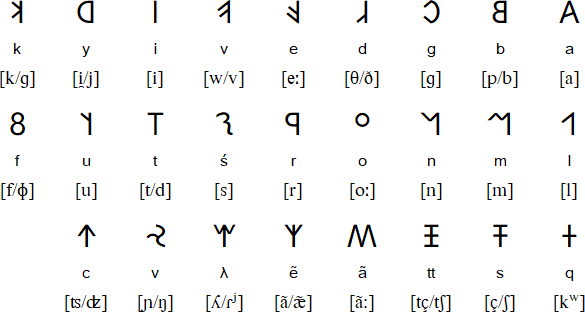
The Lydian alphabet was adapted from an archaic version of the Greek alphabet. The majority of letters are based on Greek letters, though ten of them were new inventions to write sounds unique to Lydian. The pronunciation of some of the letters, the one transliterated as y for example, is uncertain.
Approximately 100 Lydian inscriptions and bits of graffiti dating from the 5th and 4th centuries BC are known. A number of Lydian coins from the 7th century BC have also been found. The inscriptions are mainly epitaphs on graves typically beginning with eś w?naś (this grave).
Lydian, a member of the Anatolian branch of Indo-European languages that was spoken in western Anatolia (modern Turkey) up to about the 1st Century BC, when the Lydians adopted Greek as their language.
Download a Lydian alphabet chart (Excel)
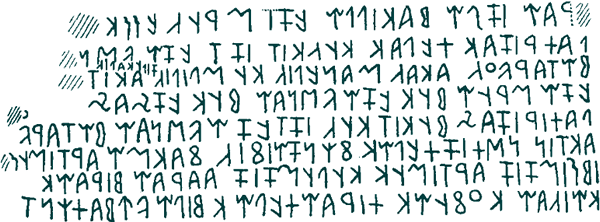
[o]ṛaλ islλ bakillλ esṭ mrud eśśk [vãnaś]
3 laqrisak qelak kudkit ist esλ vãṇ[aλ]
4 bλtarvod akad manelid kumlilid silukalid akit ṇ[ãqis]
5 esλ mruλ buk esλ vãnaλ buk esνaν
6 laqirisaν bukit kud ist esλ vãnaλ bλtarvọ[d]
7 aktin nãqis qelλk fẽnsλifid fakmλ artimuś
8 ibśimsis artimuk kulumsis aaraλ biraλk
9 kλidaλ kofuλk qiraλ qelλk bilλ vcbaqẽnt
Am 5. im (Monat) Marh.aðo-n, im Jahre 10 Artaxerxes des Königs,
2 in Sardes, in diesem Monat, die Stele und die Gruft (? und) die Säule,
3 das Grundstück und der Vorraum gegenüber der Grabkammer (?), dieser Vorraum von jetzt ab
4 dem Mane, Sohn des Kumli Sirukai (gehören wird). Und wer gegenüber dieser Stele oder
5 der Gruft oder der Säule gegenüber dem Vorraum bei der Gruft,
6 danach wer also beschädigen oder zerschlagen wird, welchen Teil auch immer davon,
7 die Artemis von Kolo und Ephesus soll sein Hof und Haus,
8 Habe, Boden und Wasser, welchen Teil auch immer zerstören, (ihm und) seinen Erben.
Source: http://titus.uni-frankfurt.de/didact/idg/anat/lydbeisp.htm
Information about the Lydian language and alphabet
http://www.maravot.com/Lydian.html
http://en.wikipedia.org/wiki/Lydian_language
https://www.britannica.com/topic/Lydian-language
https://www.palaeolexicon.com/Lydian
https://sardisexpedition.org/en/essays/latw-melchert-lydian-language
https://hrenologia.substack.com/p/something-new-in-lydian-anatolian
Carian, Hittite, Lycian, Lydian
A-chik Tokbirim, Adinkra, ADLaM, Armenian, Avestan, Avoiuli, Bactrian, Bassa (Vah), Beitha Kukju, Berati, Beria (Zaghawa), Borama / Gadabuursi, Carian, Carpathian Basin Rovas, Chinuk pipa, Chisoi, Coorgi-Cox, Coptic, Cyrillic, Dalecarlian runes, Elbasan, Etruscan, Faliscan, Fox, Galik, Georgian (Asomtavruli), Georgian (Nuskhuri), Georgian (Mkhedruli), Glagolitic, Global Alphabet, Gothic, Greek, Hurûf-ı munfasıla, Irish (Uncial), Kaddare, Kayah Li, Khatt-i-Badíʼ, Khazarian Rovas, Koch, Korean, Latin, Lepontic, Luo Lakeside Script, Lycian, Lydian, Manchu, Mandaic, Mandombe, Marsiliana, Medefaidrin, Messapic, Mongolian, Mro, Mundari Bani, Nag Chiki, Naasioi Otomaung, N'Ko, North Picene, Novo Tupi, Nyiakeng Puachue Hmong, Odùduwà, Ogham, Old Church Slavonic, Oirat Clear Script, Ol Chiki (Ol Cemet' / Santali), Old Italic, Old Nubian, Old Permic, Ol Onal, Orkhon, Osage, Oscan, Osmanya (Somali), Pau Cin Hau, Phrygian, Pollard script, Quốc âm tân tự, Runic, Székely-Hungarian Rovás (Hungarian Runes), South Picene, Sutton SignWriting, Sunuwar, Tai Viet, Tangsa, Todhri, Toto, Umbrian, (Old) Uyghur, Vellara, Veso Bey, Wancho, Yezidi, Zoulai
Page last modified: 22.05.26
[top]

You can support this site by Buying Me A Coffee, and if you like what you see on this page, you can use the buttons below to share it with people you know.

If you like this site and find it useful, you can support it by making a donation via PayPal or Patreon, or by contributing in other ways. Omniglot is how I make my living.

Note: all links on this site to Amazon.com


[top]


