
Greek belongs to the Hellenic branch of the Indo-European language family. It is spoken mainly in Greece and Cyprus, and also in Australia, Albania, Italy, Ukraine, Turkey, Romania and Hungary. It is an official language in Greece and Cyprus, and is recognised as a minority language Albania, Armenia, Hungary, Italy, Romania, Turkey and Ukraine [source].
In 2012 there were about 13.1 million speakers of Greek worldwide, including 10.7 million in Greece, 1.1 million in Cyprus, and 15,200 in Albania. There were about 238,000 Greek speakers in Australia in 2016, and in 1987 there were about 20,000 Greek speakers in Italy [source].
[top]
Greek was first written in Mycenae with a script known as Linear B, which was used between about 1500 and 1200 BC. This variety of Greek is known as Mycenaean. On Crete another script, known as the Cypriot syllabary, was used to write the local variety of Greek between about 1200 and 300 BC.
The Greek alphabet has been in continuous use since about 750 BC. It was developed from the Canaanite/Phoenician alphabet and the order and names of the letters are derived from Phoenician. The original Canaanite meanings of the letter names was lost when the alphabet was adapted for Greek. For example, alpha comes for the Canaanite aleph (ox) and beta from beth (house).
When the Greeks adapted the Phoenician alphabet to write their language they used five of the Phoenician consonants to represent vowel sounds: yodh (𐤉) [j] became Ι (iota), waw (𐤅) [w] became Υ (upsilon), 'aleph (𐤀) [ʔ] became Α (alpha), 'ayin (𐤏) [ʕ] became Ο (omicron), and he (𐤄) [h] became Ε (epsilon). New letters were also devised: Φ (phi), Χ (chi) and Ψ (psi). The result was the world's first fully phonemic alphabet which represented both consonant and vowel sounds.
At first, there were a number of different versions of the alphabet used in various different Greek cities. These local alphabets, known as epichoric, can be divided into three groups: green, blue and red. The blue group developed into the modern Greek alphabet, while the red group developed into the Etruscan alphabet, other alphabets of ancient Italy and eventually the Latin alphabet.
By the early 4th century BC, the epichoric alphabets were replaced by the eastern Ionic alphabet. The capital letters of the modern Greek alphabet are almost identical to those of the Ionic alphabet. The minuscule or lower case letters first appeared sometime after 800 AD and developed from the Byzantine minuscule script, which developed from cursive writing.
Today the Greek alphabet is used only to write Greek, however at various times in the past it has been used to write such languages as Lydian, Phrygian, Thracian, Gaulish, Hebrew, Arabic, Old Ossetic, Albanian, Turkish, Aromanian, Gagauz, Surguch and Urum.
[top]
This alphabet is based on inscriptions from Crete dated to about 800 BC. Greek was written mainly from right to left in horizontal lines at this time. It is uncertain what names were given to the letters, and some letters had more than one form.
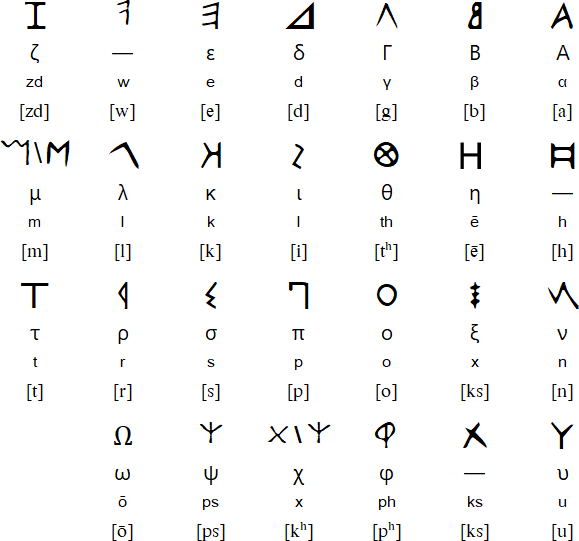
Source: http://www.carolandray.plus.com/Eteocretan/archaic_alpha.html
[top]
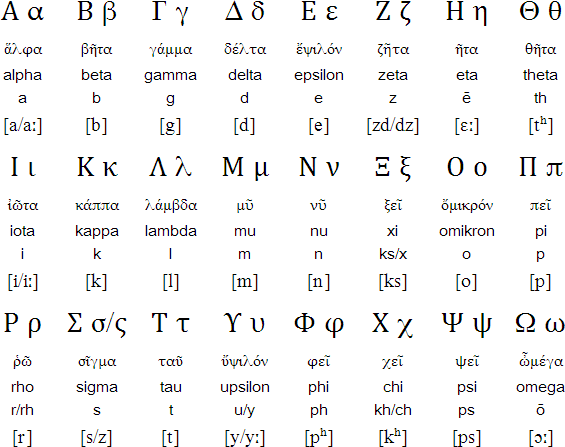
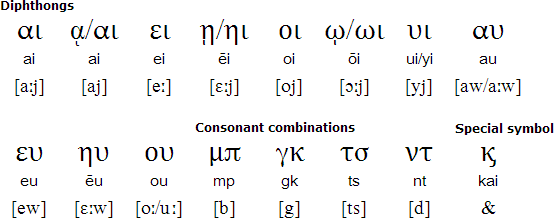
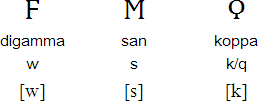
Learn the Classical Greek alphabet
[top]
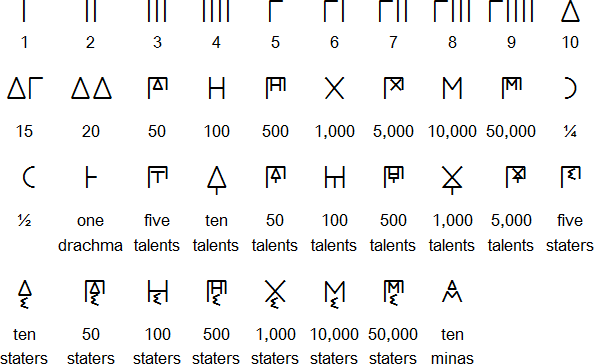
The Ancient Greeks had two numeric systems: the Acrophonic or Attic system used the letters iota, delta, gamma, eta, nu and mu in various combinations. These letters were used as they represented the first letters of the number names, with the exception of iota: Γέντε (gente) for 5, which became Πέντε (pente); Δέκα (Deka) for 10, Ηἑκατόν (Hektaton) for 100, Χίλιοι (Khilioi) for 1,000 and Μύριον (Myrion) for 10,000. This system was used until the first century BC.
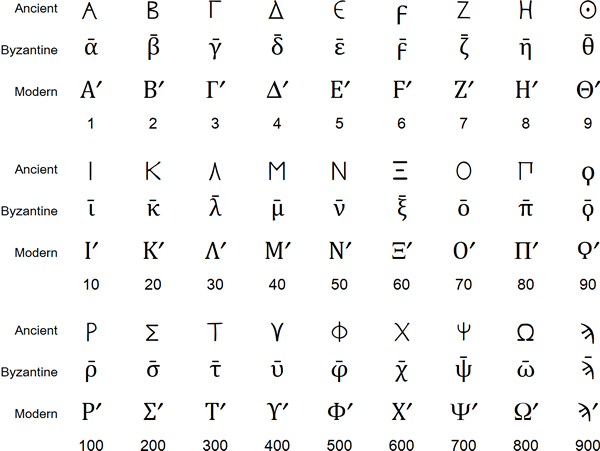
The Acrophonic system was replaced by an alphabetic system that assigned numerical values to all the letters of the alphabet. Three obsolete letters, digamma, koppa and sampi, were used in addition to the standard Greek letters, and a apostrophe-like numeral sign was used to indicate that letters were being used as numerals.
[top]
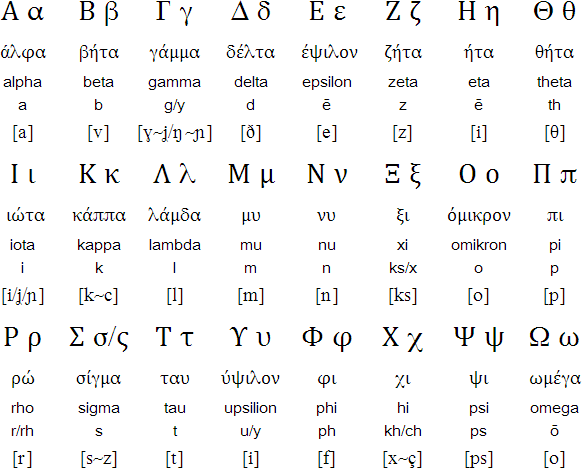
Hear the Modern Greek alphabet
Hear a recording of the Greek alphabet by Vasiliki Baskos of learn-greek-online.com
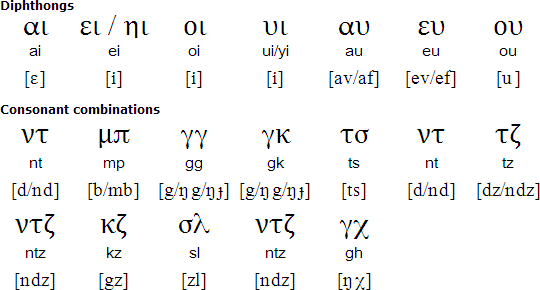
Hear a recording of Modern Greek pronunciation by Vasiliki Baskos of learn-greek-online.com
Download Greek alphabet charts in Excel, Word or PDF format
[top]

Óli i ánthropi yeniúnde eléftheri ke ísi stin aksioprépia ke ta dhikeómata. Íne prikizméni me loyikí ke sinídhisi, ke ofílun na simberiféronde metaksí tus me pnévma adhelfosínis.
A recording of this text by Eυτυχία Παναγιώτου (Eftychia Panayiotou)
Another recording of this text by Χρήστος Παπαδόπουλος (Christos Papadopoulos)


Font from: http://boboss.gr/2009/12/13/greek-handwriting-font/
All human beings are born free and equal in dignity and rights. They are endowed with reason and conscience and should act towards one another in a spirit of brotherhood.
(Article 1 of the Universal Declaration of Human Rights)
Corrections and notes on pronunciation provided by Δημήτρης Χριστούλιας (Dimitris Christoulias)
[top]
Information about Greek | Phrases | Numbers | Family words | Time | Idioms | Proverbs | Tongue twisters | Tower of Babel | Articles | Links | Learning materials | Books about the Greek alphabet
Information about Greek (Ancient and Modern) | Phrases | Numbers | Tower of Babel
[top]
Information about the Greek language
http://en.wikipedia.org/wiki/Greek_language
http://greek-language.com
http://multipedia.com
Information about Greek numbering systems
http://www-history.mcs.st-and.ac.uk/HistTopics/Greek_numbers.html
http://en.wikipedia.org/wiki/Greek_numerals
http://en.wikipedia.org/wiki/Attic_numerals
http://www.mathsisgoodforyou.com/
numerals/greeknums.htm
Online Greek lessons
http://www.ilearngreek.com (Modern)
http://www.greece.org/gr-lessons/ (Modern)
http://www.xanthi.ilsp.gr/filog/ (Modern)
http://en.wikibooks.org/wiki/Modern_Greek (Modern)
http://polymath.org/greek.php (Modern)
http://greek.pgeorgalas.gr (Modern)
https://www.learnwitholiver.com/greek/ (Modern)
http://www.theonlinegreektutor.com/blog/ (Modern)
http://ilovelanguages.org/greek.php (Modern)
https://www.alphabetagreek.com/ (Modern)
http://www.greekpod101.com/ (Modern)
http://www.kypros.org/LearnGreek/ (Modern/Ancient)
http://www.ibiblio.org/koine/greek/lessons/ (New Testament)
http://socrates.berkeley.edu/~ancgreek/ (Ancient)
http://www.textkit.com (Ancient)
Ask Greek - the place to ask questions about the Greek language
https://learn-greek-online.com/ask-greek/
Learn Greek Online via Skype
https://learn-greek-online.com/
- Learn Greek online with GreekPod101
- Learn Greek with Glossika
- Greek Electronic talking dictionaries
- Greek learning software
- Find Greek Tutors with LanguaTalk
ALPHABETUM - a Unicode font
for ancient scripts, including Classical & Medieval Latin, Ancient Greek, Etruscan, Oscan, Umbrian, Faliscan, Messapic, Picene, Iberian, Celtiberian, Gothic, Runic, Old & Middle English, Hebrew, Sanskrit, Old Nordic, Ogham, Kharosthi, Glagolitic, Anatolian scripts, Phoenician, Brahmi, Imperial Aramaic, Old Turkic, Old Permic, Ugaritic, Linear B, Phaistos Disc, Meroitic, Coptic, Cypriot and Avestan.
https://www.typofonts.com/alphabetum.html
Cypriot Greek, Greek, Griko, Pontic Greek, Tsakonian, Yevanic
Arvanitic, Bactrian, Cypriot Arabic, Cypriot Greek, Greek, Griko, Karamanli Turkish, Tsakonian
A-chik Tokbirim, Adinkra, ADLaM, Armenian, Avestan, Avoiuli, Bactrian, Bassa (Vah), Beitha Kukju, Berati, Beria (Zaghawa), Borama / Gadabuursi, Carian, Carpathian Basin Rovas, Chinuk pipa, Chisoi, Coorgi-Cox, Coptic, Cyrillic, Dalecarlian runes, Elbasan, Etruscan, Faliscan, Fox, Galik, Georgian (Asomtavruli), Georgian (Nuskhuri), Georgian (Mkhedruli), Glagolitic, Global Alphabet, Gothic, Greek, Hurûf-ı munfasıla, Irish (Uncial), Kaddare, Kayah Li, Khatt-i-Badíʼ, Khazarian Rovas, Koch, Korean, Latin, Lepontic, Luo Lakeside Script, Lycian, Lydian, Manchu, Mandaic, Mandombe, Marsiliana, Medefaidrin, Messapic, Mongolian, Mro, Mundari Bani, Nag Chiki, Naasioi Otomaung, N'Ko, North Picene, Novo Tupi, Nyiakeng Puachue Hmong, Odùduwà, Ogham, Old Church Slavonic, Oirat Clear Script, Ol Chiki (Ol Cemet' / Santali), Old Italic, Old Nubian, Old Permic, Ol Onal, Orkhon, Osage, Oscan, Osmanya (Somali), Pau Cin Hau, Phrygian, Pollard script, Quốc âm tân tự, Runic, Székely-Hungarian Rovás (Hungarian Runes), South Picene, Sutton SignWriting, Sunuwar, Tai Viet, Tangsa, Todhri, Toto, Umbrian, (Old) Uyghur, Vellara, Veso Bey, Wancho, Yezidi, Zoulai
Page last modified: 08.06.25
[top]

Note: all links on this site to Amazon.com


You can support this site by Buying Me A Coffee, via PayPal or Patreon, or by contributing in other ways.
If you find all the adverts annoying, there is now an Ad-free version of Omniglot which you can access for a small monthly or annual donation.

This website and its content is copyright of Simon Ager - © Simon Ager 1998-2026. All rights reserved. All images were created by me, unless otherwise indicated. More details

[top]


