

The Phoenician alphabet developed from the Proto-Canaanite alphabet, during the 15th century BC. Before then the Phoenicians wrote with a cuneiform script. The earliest known inscriptions in the Phoenician alphabet come from Byblos and date back to 1000 BC.
The Phoenician alphabet was perhaps the first alphabetic script to be widely-used - the Phoenicians traded around the Mediterraean and beyond, and set up cities and colonies in parts of southern Europe and North Africa - and the origins of most alphabetic writing systems can be traced back to the Phoenician alphabet, including Greek, Etruscan, Latin, Arabic and Hebrew, as well as the scripts of India and East Asia.
Phoenician, a Northern Semitic language which originated in about the 11th century BC in what is now Lebannon, Syria and Israel, an area then known as Pūt in Phoenician and Ancient Egyptian, Canaan in Biblical Hebrew, Old Arabic and Aramaic, and Φοινίκη (Phoiníkē) / Phoenicia in Greek and Latin.
Phoenician spread around the Mediterranean, particularly to Tunisia, southern parts of the Iberian peninsula (modern Spain and Portugal), Malta, southern France and Sicily, and was spoken until the 2nd century AD.
A variant of Phoenician, known as Punic, was spoken in Carthage, a Phoencian colony in what is now Tunisia, until the 6th century AD.
The native name for the language was (𐤃𐤁𐤓𐤌) 𐤐𐤍𐤍𐤌 \ 𐤊𐤍𐤀𐤍𐤌 ((dabari-m) Pōnnīm / Kana'nīm), which means "Punic/Canaanite (speech)"
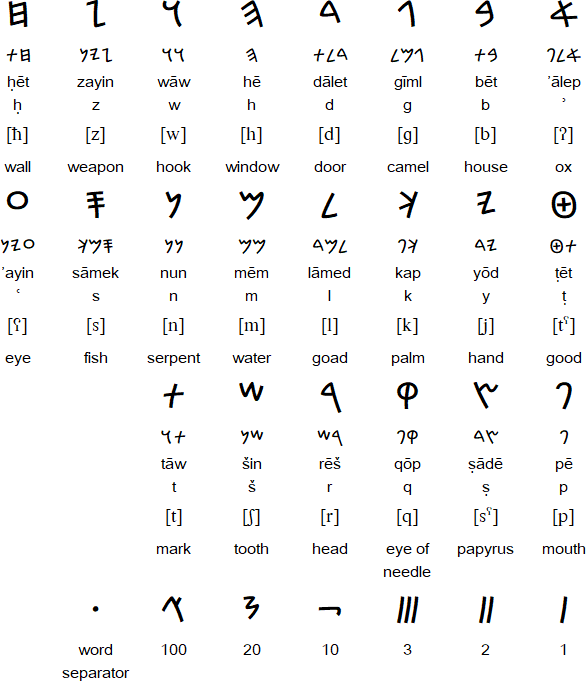
Download an alphabet chart for Phoenician (Excel)
Information about Phoenician | Numbers
Information about the Phoenician alphabet and language
http://phoenicia.org/alphabet.html
http://en.wikipedia.org/wiki/Phoenician_alphabet
http://near-eastern-history.suite101.com/article.cfm/the_phoenician_alphabet
http://www.phoenician.org/alphabet.htm
About Phoenica
http://phoenicia.org
ALPHABETUM - a Unicode font
for ancient scripts, including Classical & Medieval Latin, Ancient Greek, Etruscan, Oscan, Umbrian, Faliscan, Messapic, Picene, Iberian, Celtiberian, Gothic, Runic, Old & Middle English, Hebrew, Sanskrit, Old Nordic, Ogham, Kharosthi, Glagolitic, Anatolian scripts, Phoenician, Brahmi, Imperial Aramaic, Old Turkic, Old Permic, Ugaritic, Linear B, Phaistos Disc, Meroitic, Coptic, Cypriot and Avestan.
https://www.typofonts.com/alphabetum.html
Ancient Berber, Arabic, Aramaic, Chorasmian, Elymaic, Hatran, Hebrew, Manichaean, Nabataean, North Arabian, Pahlavi, Palmyrene, Parthian, Phoenician, Paleo-Hebrew, Proto-Sinaitic / Proto-Canaanite, Psalter, Punic, Sabaean, Samaritan, Sogdian, South Arabian, Syriac, Tifinagh, Ugaritic
Akkadian, Amharic, Arabic (Algerian), Arabic (Bedawi), Arabic (Chadian), Arabic (Egyptian), Arabic (Gulf), Arabic (Hassaniya), Arabic (Hejazi), Arabic (Lebanese), Arabic (Modern Standard), Arabic (Moroccan), Arabic (Najdi), Arabic (Sudanese), Arabic (Syrian), Aramaic, Argobba, Assyrian / Neo-Assyrian, Canaanite, Chaha, Chaldean Neo-Aramaic, Ge'ez, Hadhramautic, Harari, Hebrew, Himyaritic, Jewish Neo-Aramaic, Maltese, Mandaic, Nabataean, Neo-Mandaic, Phoenician, Punic, Qatabanic, Razihi, Sabaean, Sabaic, Silt'e, Syriac, Tigre, Tigrinya, Turoyo, Ugaritic, Western Neo-Aramaic
Page last modified: 06.01.26
[top]

You can support this site by Buying Me A Coffee, and if you like what you see on this page, you can use the buttons below to share it with people you know.

If you like this site and find it useful, you can support it by making a donation via PayPal or Patreon, or by contributing in other ways. Omniglot is how I make my living.

Note: all links on this site to Amazon.com


[top]


