
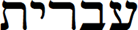
 Hebrew (עברית)
Hebrew is a member of the Canaanite group of Semitic languages. It was the language of the early Jews, but from 586 BC it started to be replaced by Aramaic. By 200 AD use of Hebrew as an everyday language had largely ceased, but it continued to be used for literary and religious functions, as well as a lingua franca among Jews from different countries.
During the mid-19th century the first efforts were made to revive Hebrew as a everyday language. One man who played a major role in these efforts was Eliezer Ben Yehuda (1858-1922), who was the first to make exclusive use of Hebrew in his home, and encouraged the use of Hebrew among others, as well as its use in schools.
Today Hebrew is spoken by some 5 million people mainly in Israel, where it is an official language along with Arabic. and a further 2 million people speak the language in Argentina, Australia, Brazil, Canada, France, Germany, Palestinian West Bank and Gaza, Panama, the UK and USA.
The first alphabet used to write Hebrew emerged during the late second and first millennia BC. It is closely related to the Phoenician alphabet. The modern Hebrew alphabet was developed from an alphabet known as Proto-Hebrew/Early Aramaic.
The Hebrew alphabet is also known as the Hebrew Square Script, the square script, the block script, the Jewish script or Ktav Ashuri (כְּתָב אַשּׁוּרִי - Assyrian script).
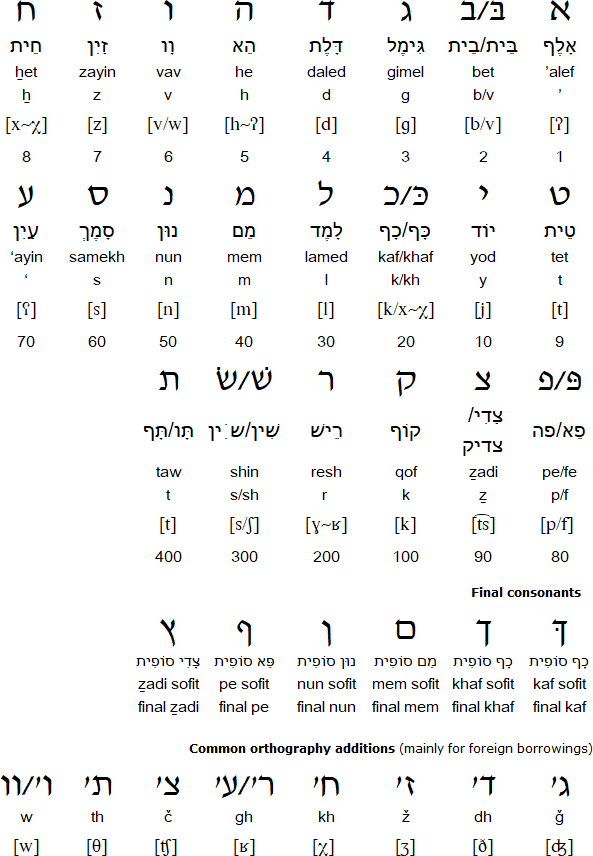
This system of indicating vowels was devised by the Masoretic scholars in Tiberias in around 750 AD. It is known as Tiberian vocalization, Tiberian pointing, or Tiberian niqqud, or נִיקוּד טְבֵרִיָנִי in Hebrew.
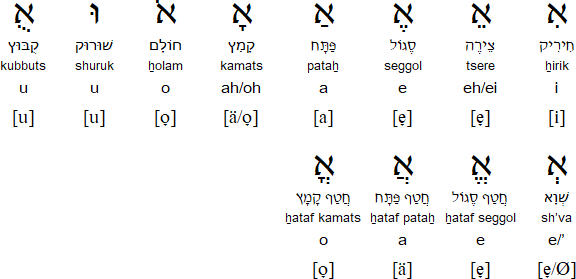
Hear the Modern Hebrew alphabet, with example words:

Biblical or Classical Hebrew is the form of Hebrew used in Israel and Judah from about the 10th century BC until the 2nd century AD. Texts include the Hebrew Bible, and other religious and historical writings. It was written without vowel indication at first, and over time some consonants, known as matres lectionis, came to be used to indicate vowels.
Biblical Hebrew was first written with the Phoenician script, which developed into the Paleo-Hebrew script by the 10th or 9th century BC. By the 6th century BC the Aramaic script began to replace the Paleo-Hebrew script.
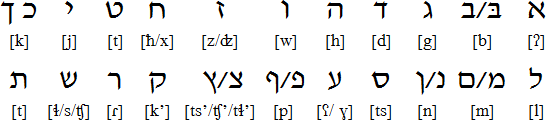
Source: https://en.wikipedia.org/wiki/Biblical_Hebrew
Hear the Biblical Hebrew alphabet:
This is the reconstructed pronunciation of the Hebrew used between 750-950 AD by Masoretic scholars living in the Jewish community of Tiberias in ancient Judea.
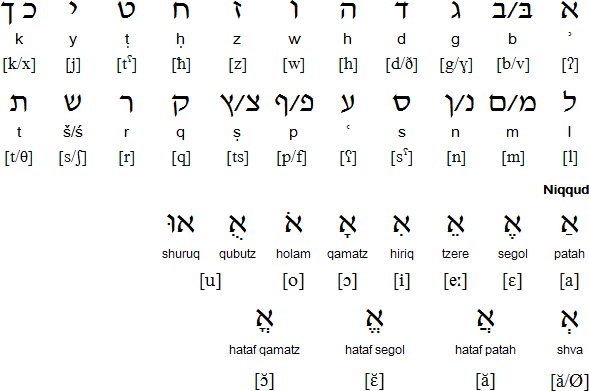
Source: https://en.wikipedia.org/wiki/Tiberian_Hebrew
Hear the Tiberian Hebrew alphabet:
The Rashi style is used mainly to write commentaries on texts. It is named after Rabbi Shlomo Yitzchaki (1040-1105 AD) a.k.a. Rashi, one of the greatest medieval Jewish scholars and Bible commentators. Rashi did not use the Rashi sytle to write his commentaries but it is named in honour of him.

Download a Hebrew alphabet chart in Word or PDF format


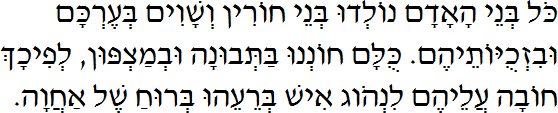
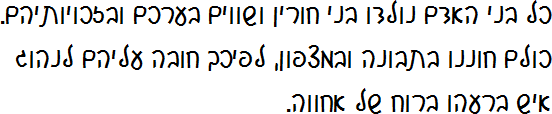
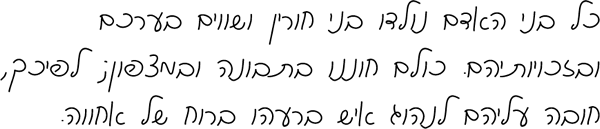
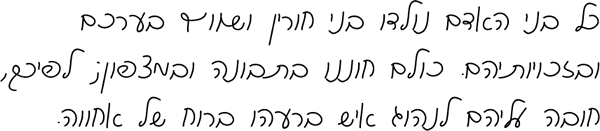
Kol benei ha'adam noldu benei xorin veshavim be'erkam uvizxuyoteihem. Kulam xonenu batevuna uvematspun, lefixax xova 'aleihem linhog ish bere'ehu beruax shel axava.
A recording of this text by גל ויסברג (Gal Weisberg)
Another recording of this text by Tal Barnea

Kol benei ha'adam noldu benei xorin veshavim be'erkam uvizxuyoteihem. Kulam xonenu batevuna uvematspun, lefixax xova 'aleihem linhog ish bere'ehu beruax shel axava.
All human beings are born free and equal in dignity and rights. They are endowed with reason and conscience and should act towards one another in a spirit of brotherhood.
(Article 1 of the Universal Declaration of Human Rights)
Corrections and text samples provided by Tal Barnea
Information about Hebrew | Phrases | Numbers | Time | Tower of Babel | Articles | Hebrew links | Hebrew learning materials
Information about the Hebrew language and alphabet
http://en.wikipedia.org/wiki/Hebrew_language
http://judaism.about.com/od/hebre1/Hebrew.htm
http://www.jewishvirtuallibrary.org/
jsource/judaica/ejud_0002_0008_0_08629.html
Modern Hebrew lessons and courses
http://www.zigzagworld.com/hebrewforme
http://www.hebrewpodcasts.com
http://www.ulpan.net
http://hebrewspeaker.blogspot.com
http://www.linguanaut.com/learn_hebrew.htm
http://foundationstone.com.au
http://www.hebraico.pro.br
http://polymath.org/hebrew.php
http://www.hebrewpod101.com/
https://tlv1.fm/podcasts/streetwise-hebrew-show/
Biblical Hebrew lessons and courses
http://www.netwaysglobal.com
http://www.shalom.50megs.com
http://www.hebrew4christians.net
http://visualhebrew.blogspot.ie/
Learn Hebrew online with HebrewPod101
Practical Hebrew - learn to speak the Hebrew that really matters
Learn Hebrew with Ling
Learn Hebrew with dictionaries, online courses and easy Hebrew magazines
Free Hebrew fonts
http://www.wazu.jp/gallery/Fonts_Hebrew.html
http://opensiddur.org/tools/fonts/
http://oketz.com/fonts/
http://www.daniella.co.il/daniella/bloog/font/Hebrew-font-page1.htm
Akkadian, Amharic, Arabic (Algerian), Arabic (Bedawi), Arabic (Chadian), Arabic (Egyptian), Arabic (Gulf), Arabic (Hassaniya), Arabic (Hejazi), Arabic (Lebanese), Arabic (Modern Standard), Arabic (Moroccan), Arabic (Najdi), Arabic (Sudanese), Arabic (Syrian), Aramaic, Argobba, Assyrian / Neo-Assyrian, Canaanite, Chaha, Chaldean Neo-Aramaic, Ge'ez, Hadhramautic, Harari, Hebrew, Himyaritic, Jewish Neo-Aramaic, Maltese, Mandaic, Nabataean, Neo-Mandaic, Phoenician, Punic, Qatabanic, Razihi, Sabaean, Sabaic, Silt'e, Syriac, Tigre, Tigrinya, Turoyo, Ugaritic, Western Neo-Aramaic
Aramaic, Bukhori, Domari, Hebrew, Jewish Neo-Aramaic, Judeo-Arabic, Judeo-Persian, Juhuri, Knaanic, Ladino, Mozarabic, Yiddish, Yevanic
Ancient Berber, Arabic, Aramaic, Chorasmian, Elymaic, Hatran, Hebrew, Manichaean, Nabataean, North Arabian, Pahlavi, Palmyrene, Parthian, Phoenician, Paleo-Hebrew, Proto-Sinaitic / Proto-Canaanite, Psalter, Punic, Sabaean, Samaritan, Sogdian, South Arabian, Syriac, Tifinagh, Ugaritic
ALPHABETUM - a Unicode font
for ancient scripts, including Classical & Medieval Latin, Ancient Greek, Etruscan, Oscan, Umbrian, Faliscan, Messapic, Picene, Iberian, Celtiberian, Gothic, Runic, Old & Middle English, Hebrew, Sanskrit, Old Nordic, Ogham, Kharosthi, Glagolitic, Anatolian scripts, Phoenician, Brahmi, Imperial Aramaic, Old Turkic, Old Permic, Ugaritic, Linear B, Phaistos Disc, Meroitic, Coptic, Cypriot and Avestan.
https://www.typofonts.com/alphabetum.html
Page last modified: 21.08.25
[top]

You can support this site by Buying Me A Coffee, and if you like what you see on this page, you can use the buttons below to share it with people you know.

If you like this site and find it useful, you can support it by making a donation via PayPal or Patreon, or by contributing in other ways. Omniglot is how I make my living.

Note: all links on this site to Amazon.com


[top]




Shipping time world-
wide is typically 6 days.