
Yiddish is a Germanic language with about three million speakers, mainly Ashkenazic Jews, in the USA, Israel, Russia, Ukraine and many other countries. The name Yiddish is probably an abbreviated version of ייִדיש־טײַטש (yidish-taytsh), which means "Jewish German".
There have been Jews in area that is now Germany since Roman times. A distinct Jewish culture known as Ashkenazi, or Germanic Jewry, appeared by the 10th century. Ashkenaz was the medieval Hebrew name for Germany, though the Ashkenaz area also included parts of northern France and later spread to Eastern Europe.
The everyday language of the Ashkenazic Jews was Middle High German. They also used Hebrew and their German included Hebrew words and phrases. From the 13th century they started to use the Hebrew script to write their language, which linguists refer to as Judeo-German or occasionally Proto-Yiddish. The earliest known fragment of Judeo-German is a rhyming couplet in a Hebrew prayer book dating from 1272 or 1273.
During subsequent centuries, Judeo-German gradually developed into a distinct language, Yiddish, with two main dialects: Western Yiddish, which was widely spoken in Central Europe until the 18th century, and Eastern Yiddish, which was spoken throughout Eastern Europe and Russia/USSR until World War II. As a result of the Holocaust, Jewish communities throughout Europe were destroyed and the use of Yiddish as an every-day language went into sudden decline.
Eastern Yiddish is divided into the following dialects: Central Yiddish (Poylish). Southeastern Yiddish (Ukraynish), Northeastern Yiddish (Litvish), and a normalized official Standard Yiddish (Yivo).
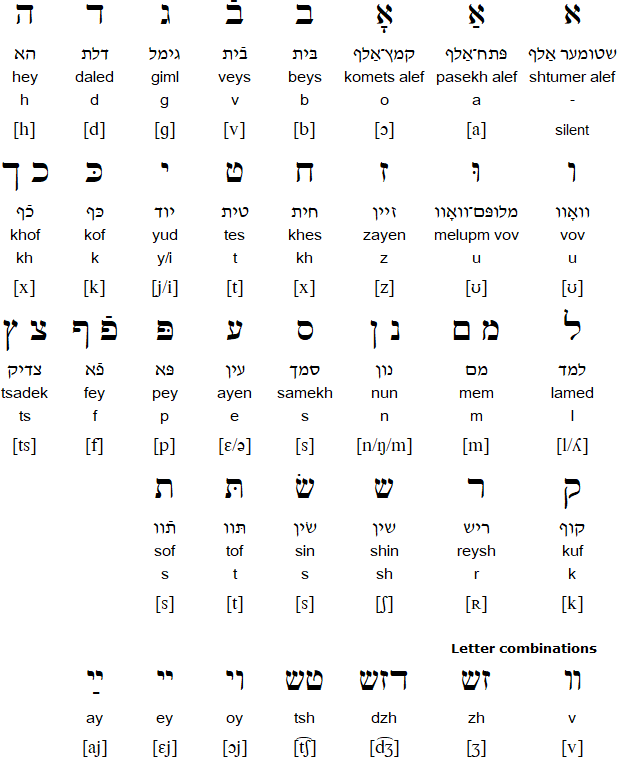
Source: https://www.yivo.org/yiddish-alphabet, with Yiddish script letter names from Michael Peter Füstumum
Hear how to pronounce Yiddish letters:

Yeder mentsh vert geboyrn fray un glaykh in koved un rekht. Yeder vert bashonkn mit farshtand un gevisn; yeder zol zikh firn mit a tsveytn in a gemit fun brudershaft.
Hear a recording of this text by Tobi Ash (in Central Yiddish (Poylish))
All human beings are born free and equal in dignity and rights. They are endowed with reason and conscience and should act towards one another in a spirit of brotherhood.
(Article 1 of the Universal Declaration of Human Rights)
Details provided by Alain Vatteville
Information about the Yiddish language
http://en.wikipedia.org/wiki/Yiddish
http://www.ibiblio.org/yiddish
http://yiddish.haifa.ac.il
http://www.usa-people-search.com/content-the-jewish-culture-and-the-yiddish-language.aspx
The Dora Teitelboim Center for Yiddish Culture
http://www.yiddishculture.org
Online Yiddish lessons
http://www.yiddishbookcenter.org/a-shmek-yidish
http://www.yiddishpop.com
http://www.surfacelanguages.com/language/Yiddish
http://yiddishacademy.com
Yiddish alphabet with sound files
http://www.yivo.org/index.php?tid=57&aid=275
Online Yiddish dictionaries
http://www.yiddishdictionaryonline.com
http://www.cs.uky.edu/~raphael/yiddish/dictionary.cgi
http://www.cs.uky.edu/~raphael/yiddish/harkavy/index.utf8.html
http://www.yiddishslangdictionary.com/
http://www.pass.to/glossary/Default.htm
http://yiddishculturaldictionary.org/
Yiddish words and phrases
http://www.linguanaut.com/english_yiddish.htm
http://www.sbjf.org/sbjco/schmaltz/yiddish_phrases.htm
http://kehillatisrael.net/docs/yiddish/yiddish_pr.htm
The Yiddish Voice - Yiddish radio station
http://www.yv.org
Lithuanian Yiddish Bible Translations
http://defendinghistory.com/lithuanian-yiddish-bible-translations
Free Hebrew fonts
http://babel.uoregon.edu/yamada/fonts/hebrew.html
http://www.breslov.com/hebrew
Jewish Language Research Website
http://www.jewish-languages.org
Information about Yiddish | Phrases | Numbers | Family words | Tower of Babel | Books about Yiddish on: Amazon.com and Amazon.co.uk [affilate links]
Afrikaans, Alsatian, Bavarian, Cimbrian, Danish, Dutch, Elfdalian, English, Faroese, Flemish, Frisian (East), Frisian (North), Frisian (Saterland), Frisian (West), German, Gothic, Gottscheerish, Gronings, Hunsrik, Icelandic, Limburgish, Low German, Luxembourgish, Mòcheno, Norn, Norwegian, Old English, Old Norse, Pennsylvania German, Ripuarian, Scots, Shetland(ic), Stellingwarfs, Swabian, Swedish, Swiss German, Transylvanian Saxon, Värmlandic, Wymysorys, Yiddish, Yola, Zeelandic
Aramaic, Bukhori, Domari, Hebrew, Jewish Neo-Aramaic, Judeo-Arabic, Judeo-Persian, Juhuri, Knaanic, Ladino, Mozarabic, Yiddish, Yevanic
Page last modified: 05.03.22
[top]

Why not share this page:

If you like this site and find it useful, you can support it by making a donation via PayPal or Patreon, or by contributing in other ways. Omniglot is how I make my living.
Note: all links on this site to Amazon.com


Get a 30-day Free Trial of Amazon Prime (UK)
If you're looking for home or car insurance in the UK, why not try Policy Expert?
[top]


