
Scots is a West Germanic language is spoken by about 1.5 million people in Scotland, and also Northern Ireland, where it is known as Ulster Scots or Ullans. Scots is descended from the language of the Angles who settled in northern Britain, in an area now known as Northumbria and southern Scotland, in the 5th century AD. The language was originally known as 'Inglis' and has been influenced by Gaelic, Norse, Latin, Dutch, Norman French, French and English.
By the 14th century Scots was the main language of Scotland and was used in literature, education, government and in legal documents. This was the period when Scots literature began to take off and notable literary works include Barbour's Brus, Whyntoun's Kronykil and Blin Harry's Wallace.
From the 16th century English gradually began to replace Scots as the main written language in Scotland, although most people continued to speak Scots. After James VI of Scotland became James I of the United Kingdom in 1603, he stopped supporting Scots writers, and English became the language of government and polite society in Scotland.
Since the 1990s there has been limited use of Scots in education, the media and in literature. In 1983 a Scots translation of the New Testament was published and 1985 the saw the publication of the SNDA's Concise Scots Dictionary.
Scots is also known as braid Scots, Doric, Scotch or Lallans. Some people classify it as a dialect of English, and while it is closely related to English dialects spoken in Northumbria, it has had it's own literary tradition since the 14th century.
The UK government accepts Scots as a regional language under the European Charter for Regional or Minority Languages, and the Scottish Executive recognises and respects Scots (in all its forms) as a distinct language, and does not consider the use of Scots to be an indication of poor competence in English.
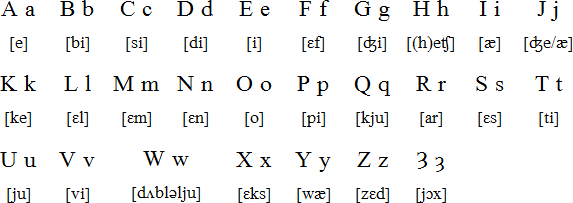
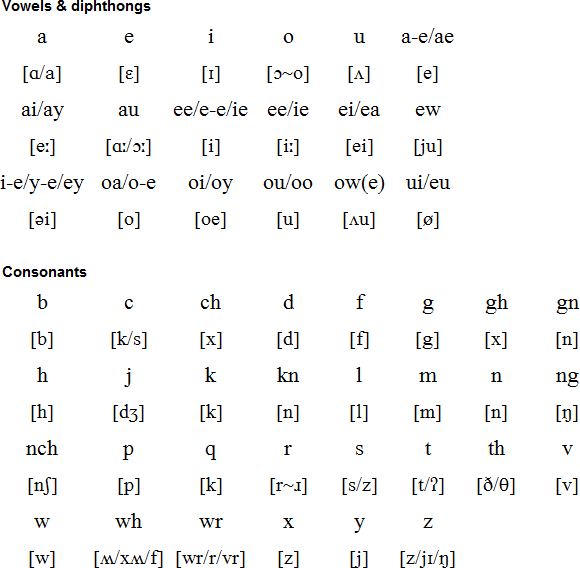
The Scots Leid Associe wis foondit in 1972 an ettles tae fordle Scots in leeteratur, drama, the media, eddication an in ilka day uiss. Akis Scots wis ance the state langage o Scotland, it's a vailid pairt o wir heirskip an the associe taks tent tae the fact that it shoud can tak its steid as a langage o Scotland, alang wi Gaelic an Inglis.
The Scots Language Society was founded in 1972 and exists to promote Scots in literature, drama, the media, education and in every day usage. Since Scots was once the state language of Scotland, it is a valid part of our heritage and the society recognises that it should be able to take its place as a language of Scotland, along with Gaelic and English.
Aw human sowels is born free and equal in dignity and richts. They are tochered wi mense and conscience and shuld guide theirsels ane til ither in a speirit o britherheid.
All human beings are born free and equal in dignity and rights. They are endowed with reason and conscience and should act towards one another in a spirit of brotherhood.
(Article 1 of the Universal Declaration of Human Rights)
If you find this difficult to understand, I have translated into English.
Information about Scots | Phrases | Numbers | Time | Family words | Books about Scots on: Amazon.com and Amazon.co.uk [affilate links]
Information about Scots
http://www.scots-online.org
http://www.lowlands-l.net/anniversary/scots-info.php
http://en.wikipedia.org/wiki/Scots_language
http://en.wikipedia.org/wiki/Modern_Scots
https://sites.google.com/site/scotsthreip/
http://mindyerlanguage.scot
Scots phrases
http://www.linguanaut.com/english_scots.htm
http://www.scots-online.org/grammar/goamins.htm
Scots Dictionaries
http://www.dsl.ac.uk
http://www.scots-online.org/dictionary/
Articles in Scots
http://www.thenational.scot/author/rab_wilson
Scotstext - a collection of poetry and other writing in Scots
http://www.scotstext.org
The Scots Language Centre
http://www.scotslanguage.com
The Scots Leid Associe / The Scots Language Society
http://www.lallans.co.uk
Scots Education Resources
http://www.scotseducation.co.uk
Scottish Corpus of Texts and Speech
http://www.scottishcorpus.ac.uk
Scottish Language Dictionaries
http://www.sldl.org.uk
Itchy Coo - Braw Books for Bairns o Aw Ages
http://www.itchy-coo.com
Afrikaans, Alsatian, Bavarian, Cimbrian, Danish, Dutch, Elfdalian, English, Faroese, Flemish, Frisian (East), Frisian (North), Frisian (Saterland), Frisian (West), German, Gothic, Gottscheerish, Gronings, Hunsrik, Icelandic, Limburgish, Low German, Luxembourgish, Mòcheno, Norn, Norwegian, Old English, Old Norse, Pennsylvania German, Ripuarian, Scots, Shetland(ic), Stellingwarfs, Swabian, Swedish, Swiss German, Transylvanian Saxon, Värmlandic, Wymysorys, Yiddish, Yola, Zeelandic
Languages written with the Latin alphabet
Page last modified: 04.07.23
[top]

Note: all links on this site to Amazon.com


You can support this site by Buying Me A Coffee, via PayPal or Patreon, or by contributing in other ways.
If you find all the adverts annoying, there is now an Ad-free version of Omniglot which you can access for a small monthly or annual donation.

This website and its content is copyright of Simon Ager - © Simon Ager 1998-2026. All rights reserved. All images were created by me, unless otherwise indicated. More details

[top]


