
Cimbrian is a Germanic language spoken by about 2,230 people in northeast Italy in the Sette and Tredici Comuni (Sieben and Dreizehn Gemainde) south of Trent, in some towns of Giazza (Glietzen, Ljetzen), Roana (Rabam), Lusern and in Venetia Province.
Cimbrian is taught in primary schools, but it is in danger of becoming extinct because it is being displaced by the neighbouring Venetian language, which is increasingly used as a domestic language and by Italian, which is used in public.
The first text written in Cimbrian, a religious hymn, appeared at the end of 16th century. The first evidence of Cimbrian presence in northern Italy dates back to 1287. The Cipolla brothers picked up and transcribed some local tales and songs. Local legends attribute the modern Cimbrians' lineage to the Cimbrian marauders that the Roman general Gaius Marius defeated in 102 BC at Campi Raudii, near Vercelli, however it is more probable that today's Cimbrians are descended from Lombard invaders, who invaded northern Italy in 588 AD.
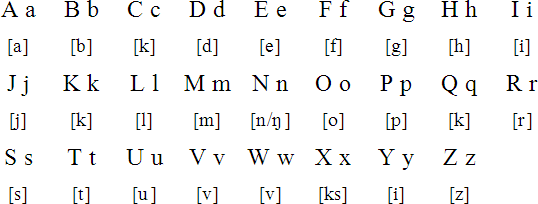
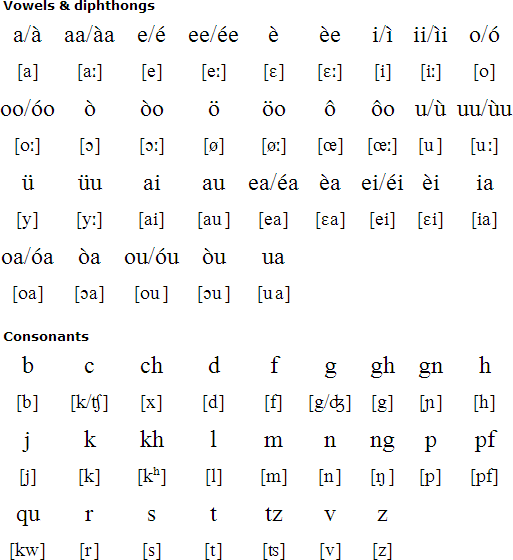
Christus ist au gestanden
Von der marter alle,
Daz sollen bier alle froalich sayn
Christus bil unser troast sayn.
A recording of this text by Crawford J. Bennett, Jr.
Christ is risen again
from all the tortures,
so we are rejoicing
Christ will be our consolation.
(Early Cimbrian hymn)
Information provided by G. Garella with corrections and additions by Michael Peter Füstumum .
Information about Cimbrian | Phrases | Numbers
Information about Cimbrian
https://en.wikipedia.org/wiki/Cimbrian_language
http://www.cimbri.it
http://www.cimbridelcansiglio.it/pagina/000245/000229.htmlbr />
http://www.ethnologue.com/language/CIM
Online Cimbrian course (in German and English)
http://titus.fkidg1.uni-frankfurt.de/didact/zimbr/cimbrian.htm
Afrikaans, Alsatian, Bavarian, Cimbrian, Danish, Dutch, Elfdalian, English, Faroese, Flemish, Frisian (East), Frisian (North), Frisian (Saterland), Frisian (West), German, Gothic, Gottscheerish, Gronings, Hunsrik, Icelandic, Limburgish, Low German, Luxembourgish, Mòcheno, Norn, Norwegian, Old English, Old Norse, Pennsylvania German, Ripuarian, Scots, Shetland(ic), Stellingwarfs, Swabian, Swedish, Swiss German, Transylvanian Saxon, Värmlandic, Wymysorys, Yiddish, Yola, Zeelandic
Languages written with the Latin alphabet
Page last modified: 06.11.22
[top]

Note: all links on this site to Amazon.com


You can support this site by Buying Me A Coffee, via PayPal or Patreon, or by contributing in other ways.
If you find all the adverts annoying, there is now an Ad-free version of Omniglot which you can access for a small monthly or annual donation.

This website and its content is copyright of Simon Ager - © Simon Ager 1998-2026. All rights reserved. All images were created by me, unless otherwise indicated. More details

[top]


