
These are questions submitted by visitors to Omniglot. I post them here because I don't know the solutions. Please copy me in on your suggestions/solutions so that I know when puzzles have been solved (feedback[at]omniglot[dot]com)a.
If you have a puzzle, please post it on the Omniglot Facebook page.
Michael S. Sanders sent in the image below. He believes it to be an archaic form of Samaritan. Can you identify and/or decipher it? If you can help, please contact Michael at: mike.sanders@ancientcultures.net
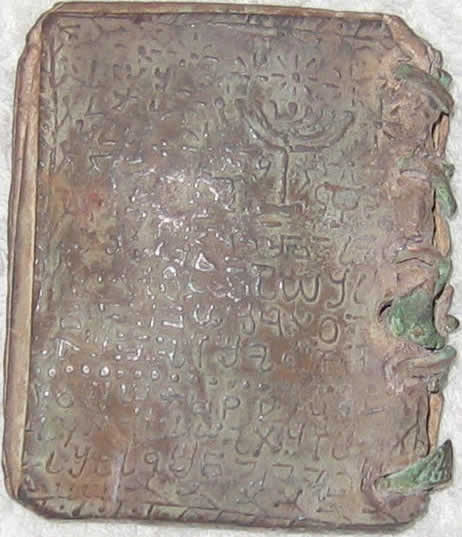
According to TJ, the inscription is in Samaritan and the plate is made of copper. Steve N. is sure the script is the Aramaic/Proto-Hebrew alphabet.
The inscription below comes from a standing stone in Aberdeenshire, Scotland. If you have any suggestions what script it is and/or what it means, please contact Robbie T. Pict at: robbie.pict@homecall.co.uk
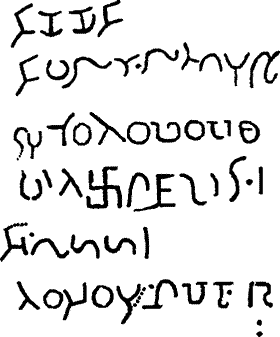
According to TJ, the writing looks like a combination of Hebrew and/or Greek, though more like Hebrew.
According to Steven, the symbols are a combination of cursive Hebrew and Anglo-Saxon/Norse runes. The location of the stone (Scotland and the clearly Hebrew cursive letters on the stone and the swastika symbol all support this). The Hebrew letters do not appear to represent the Hebrew language.
The writing on this knife is in the Arabic script. Do you know what language it's in, what it says, or can you provide any other information about the origins of the knife? Please send your suggestions to Janet Creamer at: janet_creamer@hotmail.com

Here's a photo of the knife on which the inscription appears.
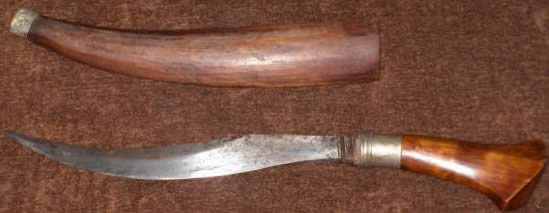
According to TJ, the inscription appears to be in Malay.
Aizuddin, Malaysia writes:
The shape of the knife maybe from Southeast Asia, but I dont think the writing
on the knife is Malay. The Malay version of Arabic script is quite different,
and even I can read it, I'm quite sure it is not a Malay words.
According to Toulouse Ng, the Arabic text is:
اِ(؟ِ)ـوـ/ـعـكَـ/گي نِ اَمَنِمِڠ گ/كَ كَـ/گنِ اِنَنِ اِڠدِـ/ـ(؟ِ)ـس
Transliteration: i?i(w/’)(ka/g)y ni amaniming g/ka (ka/g)ni inani ingdi(?)s
A friend of Peter Coan found several pages written in an unknown language stuck in an old (1850s) diary she recently bought. If you can identify the writing system and/or the language, please contact Peter at: salon310@yahoo.com
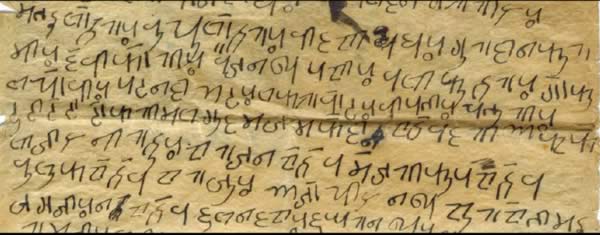
According to TJ, the writing is in a cursive form of Devanagari.
According to Christopher Miller this script is very clearly a version of Kaithi, though in a rather unusual angular hand. It has the split ‹l› shape (a bit like a C followed closely by a 7) typical of Gujarati and some Kaithi varieties, but not yet merged into a theta shape as in other Kaithi varieties. The ‹h› is not an 'S' shape with a disconnected downstroke on the left, as in Gujarati, but a instead is fully connected, typical for Kaithi. It has the typical Kaithi ‹w› with an underdot (here a circle) to distinguish it from the otherwise identical ‹b› letter, whereas in Gujarati script the two letters have quite distinct shapes. And the most diagnostic giveaway feature is the shape of the ‹r›, which in Kaithi looks like '7' rather than the Gujarati '2' shape.
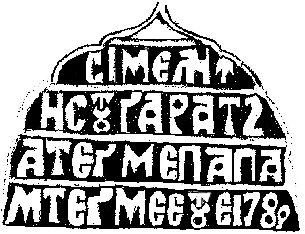
If you can decipher the writing below, which appears on a tray bought in Turkey about 40 years ago, please contact Bill Steltzer at Steltzjr@aol.com
This looks like an old version of the Cyrillic alphabet to me, and the language might possibly be some form of Church Slavonic.
Here's a possible transliteration:
Simezht
Nstoüo garatz
ateg mepapa
mteg meetüo eitho
According to Prof. Dr. Sebastian Kempgen of the University of Bamberg, the inscription might be Greek, in which case it could read:
CIMELH (L and H are written as a ligature I) / SIMELI
HS TOU GARAT / IS TOU GARAT
ATEGMEPAPA / ATEGMELAPA
MTEGMEE TOU E 1788
The last letter in line two is not clear. Also, in the third line, one character could be a capital P or a capital L.
Pavel Petrov is sure that the language is Slavic and has provided the following possible version of the text:
симеёт-и-с-оут-и а-рать-а-те-име-папа-м те имеюте 1789
Some (men) plough, but those (who are) called popes own. 1789
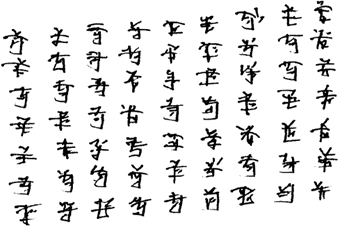
This text was found by someone in California. If you have any suggestions about what writing system or language this is, please write to: orio_3@yahoo.com
Suggestions (from Rudi Cheb): the script is very likely some kind of Chinese writing or maybe Nüshu.
The photos below were sent in by Mark Muehlhaeusler who came across this manuscript while cataloguing Oriental manuscripts at Utah University Library. Nothing is known of the provenance of the manuscript, but since it is housed with a collection that was acquired in Egypt, it is likely that the item hails from there (note the scarab and the 'cartouches').
If you can identify the script, please contact Mark at: mark.muehlhaeusler@utah.edu
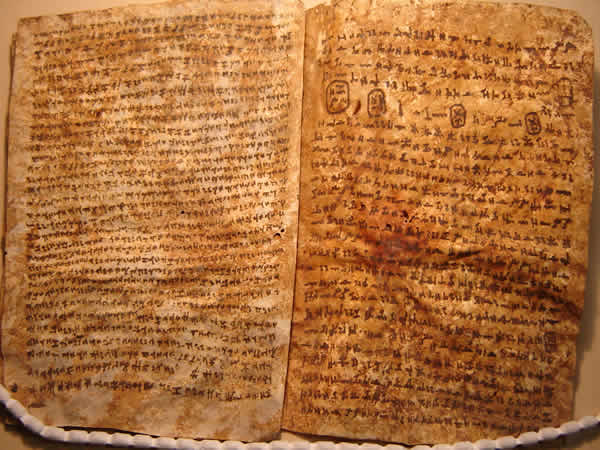
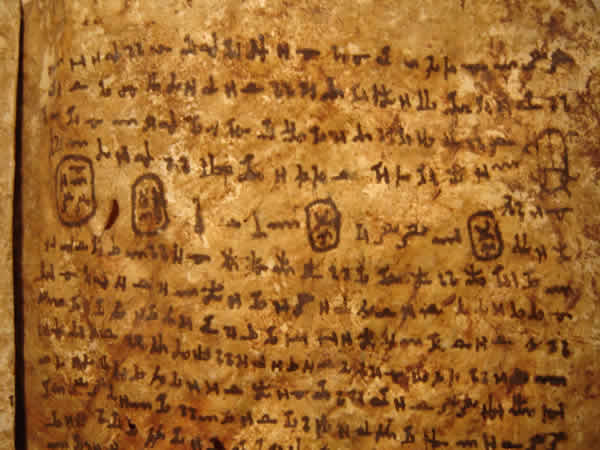
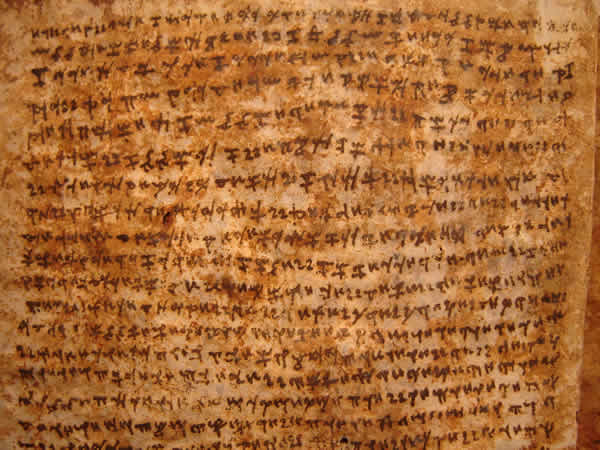
The writing looks like some variety of Amharic or Ge'ez, according to Evans Knight.
TJ suggests that the writing is either in the Egyptian Demotic script or the Meroitic Demotic script. The cartouches and some of the symbols indicate this.
Does anybody have and ideas about the symbols on this metal fish? If you do, please contact Aaron Wobrock at: grovepointmooon@hotmail.com
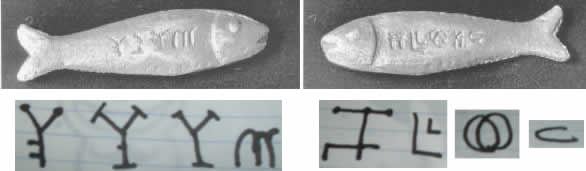
Stephan Glöckner thinks the symbols might be in the Vai script.
Can anybody help Patrick Bushell identify these characters that appear on date a bronze crotal bell? If you can help, please write to patrick.bushell@btinternet.com
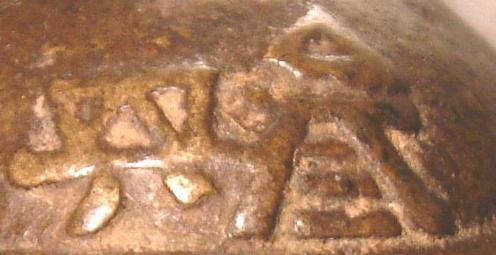
According to Toulouse Ng, "The characters are read from right to left. The first character is like "叁 sān", which is the complex form of writing the number "3" in Chinese. For the next character, I've never seen it before. It somehow looks like a combination of characters "皿 mǐn" (vessel) and "兴 xìng" (happy). The word doesn't even exist in my dictionary.
Can anybody decipher the symbols on the left of this postcard? If you can, please contact Pat at: pm2jr@prodigy.net
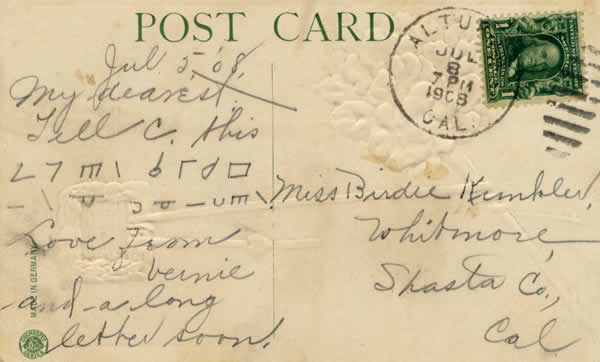
According to Dolly Hayde, most, if not all, the symbols on the postcard appear to hobo signs.
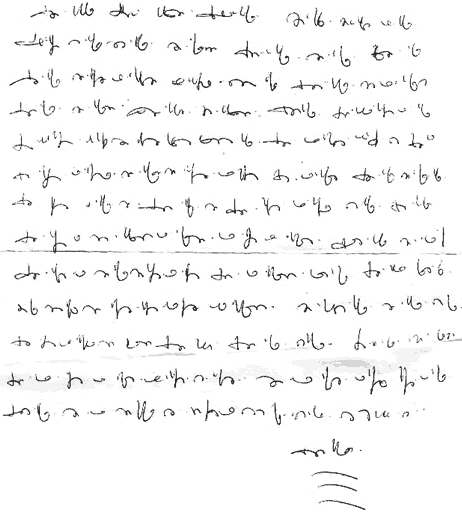
Ken Dillon sent in these examples of an early form of shorthand dating from about 1850. If you can decipher them, please write to Ken at: ken.dillon@dillonsbooksearch.com
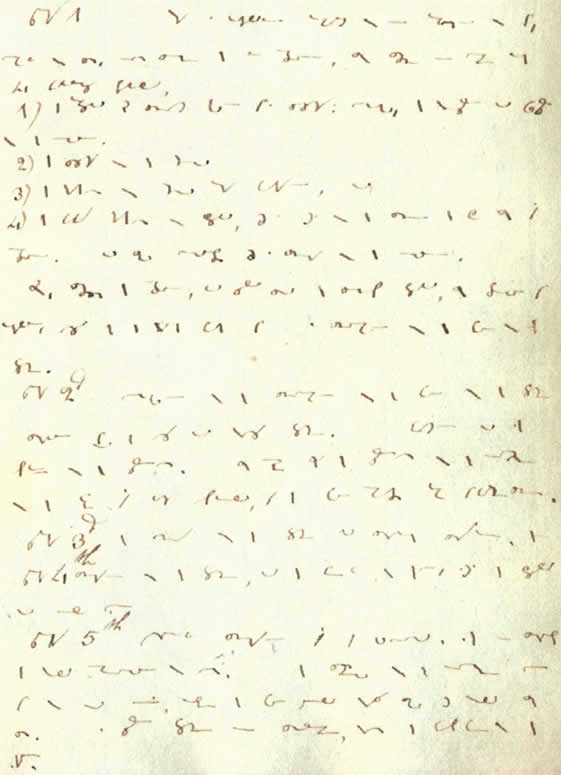
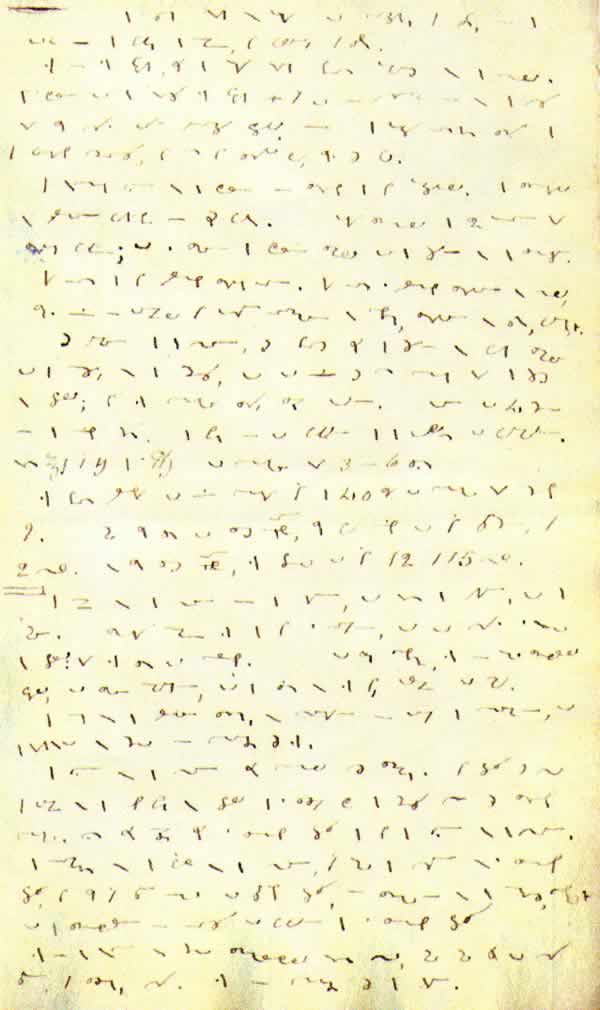
Pierre Lombardini, who works in a bookshop, found the following note in one of his books. He thinks it is some kind of shorthand. Can anybody identify and/or decipher it? If you can, please write to: pierre@harringtonbooks.co.uk.
The writing on this plaque is in the Armenian alphabet. If you can read it, please contact Norman Silver at NormanSilver@homechoice.co.uk.
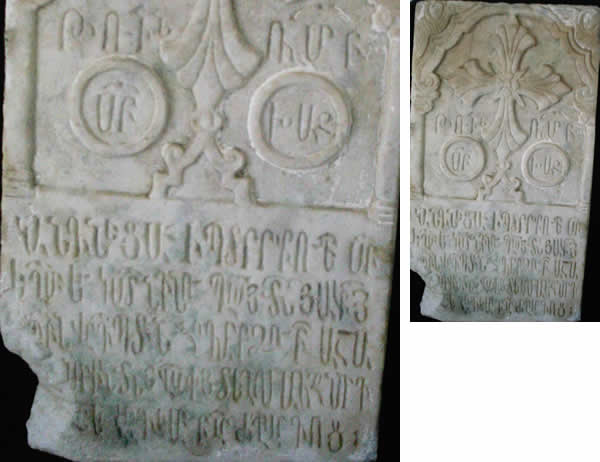
According to Armen Mahseredjian, the stone is a prayer for blessings because of the use of the words God and bless in the text, and the cross at the top in Armenian is called a Khach kar.
Can anyone identify the characters in this inscription? They appear to be in some form of Chinese Seal Script. Please send your suggestions to Scott Anderson at scott@backlandoutdoors.com.
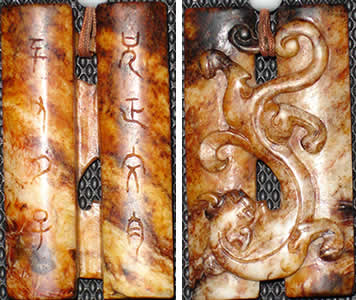
According to Carl Mashthay, the characters on the right are 兄正文肉 (xiōng zhēng wén ròu) = 'older brother upright/regulate writing flesh'. The ones on the left are possibly 千 (父/又) (夕/月) 子 (qiān, fù/yòu, xì/yuè, zì) = 'thousand (father/also) (evening/moon/month) child' - the two in the middle are unclear.
Attempted translations:
'An (upright) older brother can regulate whatever is written and whatever is alive.'
'Thousands of fathers can spend their evenings with their children.'
Can anybody decipher this writing which appears on an envelope and letter sent in by Cynthia (ddcchughes@att.net)?
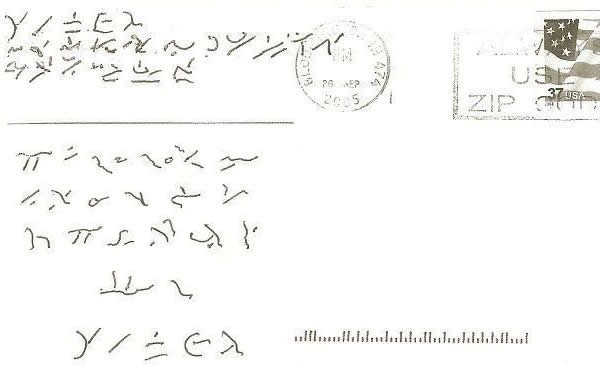
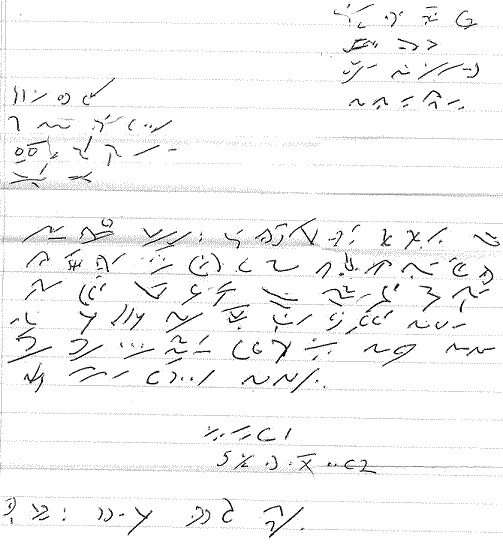
This inscriptions comes from an outcrop of rocks near the Great Circle Earthworks built by the Hopewell Indians in Ohio. The writing system looks like Cherokee. Can anybody decipher it? If you can, please contact Brandon Long at longster23@yahoo.com
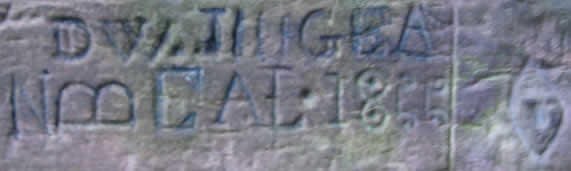
Evans Knight is sure that the inscription isn't Cherokee.
Can anybody decipher the writing on this sword? The alphabet is Burmese. Please send your solutions to: Charles Sirico at: charles.sirico@ngc.com
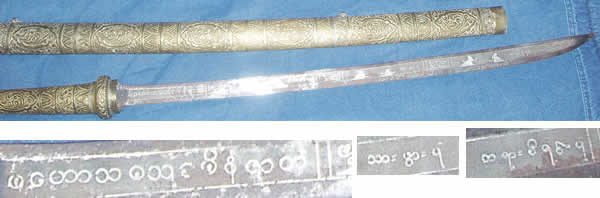
Can anybody decipher this inscription? If you can, please write to Mitchell Chen at mmitchellchen@gmail.com
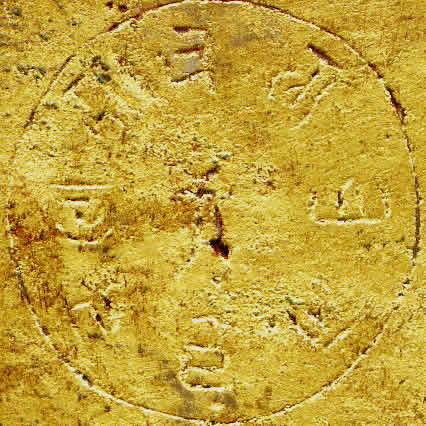
According to Christopher Miller this script might be Kaithi.
Can anybody decipher the inscription on this glass coin? Please
send your suggestions to

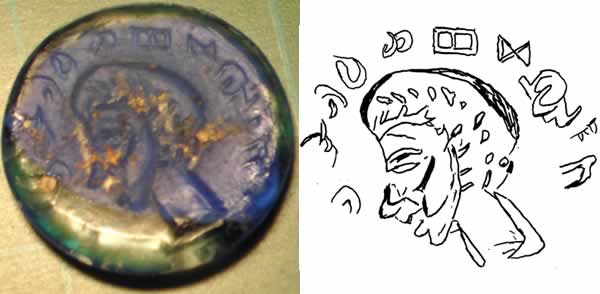
The script might be an Old Italic alphabet - Oscan, Faliscan or South Picene maybe.
Jason Massia suggests that the symbols might by zodiac signs.
The inscription on this bone sent in by Jeff Carroll (carrollj@tca.net) looks like Hebrew to me. Can anybody work out what it says?
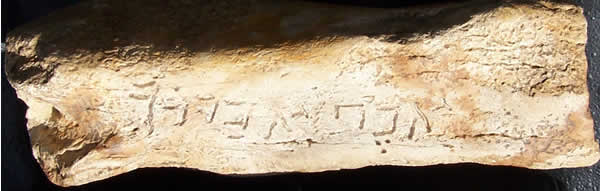
According to Steven, the script and language are definitly Hebrew. The first word says eh-kef which means pressure or urgency.
One possible reading of the inscription is "אכפ צא בדמך" (ehkef tza b'damcha) which could be translated as "Urgent; go out in your blood", though this is not certain due to the lack of clarity of some of the letters. A Hebrew speaker would not need or use vowel points except in maintaining the pronunciation of the biblical text and this leads him to believe that this is a fake.

Can anyone decipher the writing below? It looks like Japanese to me, but I can't make out what it says. If you have any ideas, please write to Royce Lee at: royce.lee@usask.ca
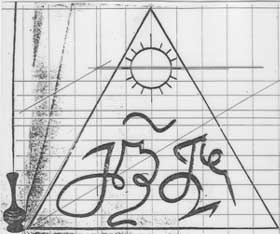 This image was sent in by Pamela (pam@mpcnet.com.br), who
has provided the following background information about it:
This image was sent in by Pamela (pam@mpcnet.com.br), who
has provided the following background information about it:
This symbol belongs to the Aquarian Order. It is called the "Triangle of Light" or the "Seal of the Agharta". The founder and Master Serge Raynaud de la Ferrière, must have received it from an Aghartian messenger, when he was initiated both in India and Tibet, around 1950, but he died in 1962 and left nothing written about it
In one of his books he mentions Saint Germain, who mentions a triangular altar: Athanor. Saint Germain studied the Zohar, the Torah and all the saintly scriptures. He was also influenced by the Zoroastrian tradition, where "Atar" is the symbolic aspect of Fire, just like in the Hindu treatise Atharva-Veda. In this last book, the Seal of God has a sun on it and is called "Sûryachandra-masâbhya".
The writing inside the triangle might be भानु (bhanu) which means sun, as does 'sûrya' in the name 'Sûryachandra-masâbhya'. Nikhil is unsure which script the writing is in.
According to TJ, the writing looks more like "Chuurya" (sun) in Tamil.
This photo was sent in by Brigid Roche (brigidr@eircom.net). Brigid believes that her father found the stone during his travels in Persia. Can anyone decipher the inscription? If you can please write to Brigid.
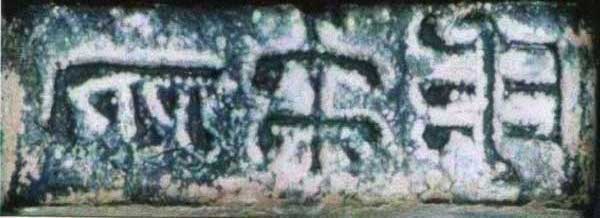
The same image flipped over.
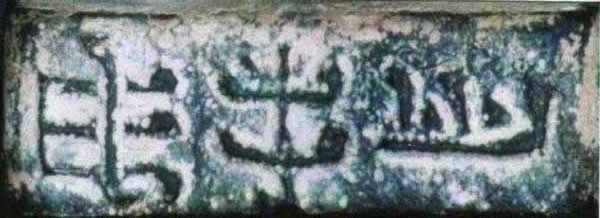
Suggestions (from Tom Howard): the character look like they are in a form of Seal Script. The one on the left looks like zi3 (child), one of the other character might be kong3, which combined with the zi gives Confucius.
Suggestions (from Rudi Cheb): The middle character looks like the Chinese "chu1" (to exist, to happen, to occur etc.) the other characters could be some other script such as Nestorian, Ancient Uighur, Soghdian etc. It was not uncommon for Nestorian Christians in Turkestan to use several scripts in their holy scriptures.
According to Michael DePaula the first character most resembles "shan1" which means "mountain", however the little markings between the three prongs lead him to believe that they are shorthand for other characters that would have appeared there had there been enough space to write small enough. If correct, this would open up the possibility for the characters "bin1" (the name of a state during the Zhou Dynasty [1500BC - 500BC]), and "you1" (which means deep/secluded). Finally, if the character exceeds the top edge of the block, it would appear to be similar to "han2" which means a letter/envelope.
The middle character appears to be chu1, (which means to go/come out of, or exceed). However, he sees what appears to be smaller markings up top as well, making him believe that this is the same, but older version of chu1.
The final character is a mystery since he's never seen an old form of "cheng2", which means "to bear, to hold/carry" or "to undertake".
Some possible interpretations:
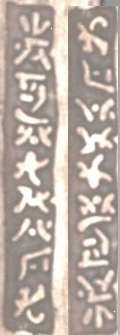
Can anybody identify the symbols on this sword? If you can, please write to:
[top]

Why not share this page:

If you like this site and find it useful, you can support it by making a donation via PayPal or Patreon, or by contributing in other ways. Omniglot is how I make my living.
Note: all links on this site to Amazon.com


Get a 30-day Free Trial of Amazon Prime (UK)
If you're looking for home or car insurance in the UK, why not try Policy Expert?
[top]


