
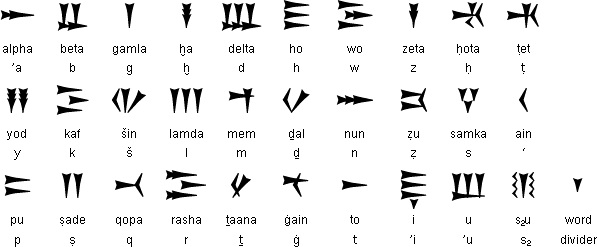
Ugaritic cuneiform was named after Ugarit, the city state where it was used in what is now Syria. It was probably created sometime during the 14th century BC.
Ugaritic, a Semitic language closely related to Phoenician which was spoken in the city state of Ugarit in northern Syria. Ugarit flourished from the 14th century BC until 1180/70 BC, when it was destroyed.
The city was rediscovered in 1928 by a peasant whose plow uncovered an ancient tomb near Ras Shamrah in northern Syria. A group of French archaeologists led by Claude F.A. Schaeffer started excavating the city in 1929.
Information about the Ugaritic alphabet and language
http://en.wikipedia.org/wiki/Ugaritic_alphabet
http://en.wikipedia.org/wiki/Ugaritic_language
Information about the city of Ugarit
http://en.wikipedia.org/wiki/Ugarit
Ugaritic fonts
https://www.wazu.jp/gallery/Fonts_Ugaritic.html
http://reinhold.kainhofer.com/rk_fonts/rkaf_ugaritic.html
ALPHABETUM - a Unicode font
for ancient scripts, including Classical & Medieval Latin, Ancient Greek, Etruscan, Oscan, Umbrian, Faliscan, Messapic, Picene, Iberian, Celtiberian, Gothic, Runic, Old & Middle English, Hebrew, Sanskrit, Old Nordic, Ogham, Kharosthi, Glagolitic, Anatolian scripts, Phoenician, Brahmi, Imperial Aramaic, Old Turkic, Old Permic, Ugaritic, Linear B, Phaistos Disc, Meroitic, Coptic, Cypriot and Avestan.
https://www.typofonts.com/alphabetum.html
Akkadian, Amharic, Arabic (Algerian), Arabic (Bedawi), Arabic (Chadian), Arabic (Egyptian), Arabic (Gulf), Arabic (Hassaniya), Arabic (Hejazi), Arabic (Lebanese), Arabic (Modern Standard), Arabic (Moroccan), Arabic (Najdi), Arabic (Sudanese), Arabic (Syrian), Aramaic, Argobba, Assyrian / Neo-Assyrian, Canaanite, Chaha, Chaldean Neo-Aramaic, Ge'ez, Hadhramautic, Harari, Hebrew, Himyaritic, Jewish Neo-Aramaic, Maltese, Mandaic, Nabataean, Neo-Mandaic, Phoenician, Punic, Qatabanic, Razihi, Sabaean, Sabaic, Silt'e, Syriac, Tigre, Tigrinya, Turoyo, Ugaritic, Western Neo-Aramaic
Akkadian, Elamite, Hittite, Old Persian Cuneiform, Sumerian, Ugaritic
Ancient Berber, Arabic, Aramaic, Chorasmian, Elymaic, Hatran, Hebrew, Manichaean, Nabataean, North Arabian, Pahlavi, Palmyrene, Parthian, Phoenician, Paleo-Hebrew, Proto-Sinaitic / Proto-Canaanite, Psalter, Punic, Sabaean, Samaritan, Sogdian, South Arabian, Syriac, Tifinagh, Ugaritic
Page last modified: 15.03.23
[top]

You can support this site by Buying Me A Coffee, via PayPal or Patreon, or by contributing in other ways.
If you find all the adverts annoying, there is now an Ad-free version of Omniglot which you can access for a small monthly or annual donation.

Note: all links on this site to Amazon.com



[top]


