
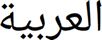
The Arabic script evolved from the Nabataean Aramaic script. It has been used since the 4th century AD, but the earliest document, an inscription in Arabic, Syriac and Greek, dates from 512 AD. The Aramaic language has fewer consonants than Arabic, so during the 7th century new Arabic letters were created by adding dots to existing letters in order to avoid ambiguities. Further diacritics indicating short vowels were introduced, but are only generally used to ensure the Qur'an was read aloud without mistakes.
There are two main types of written Arabic:
Each Arabic speaking country or region also has its own variety of colloquial spoken Arabic. These colloquial varieties of Arabic appear in written form in some poetry, cartoons and comics, plays and personal letters. There are also translations of the Bible into most varieties of colloquial Arabic.
Arabic has also been written with the Hebrew, Syriac and Latin scripts.
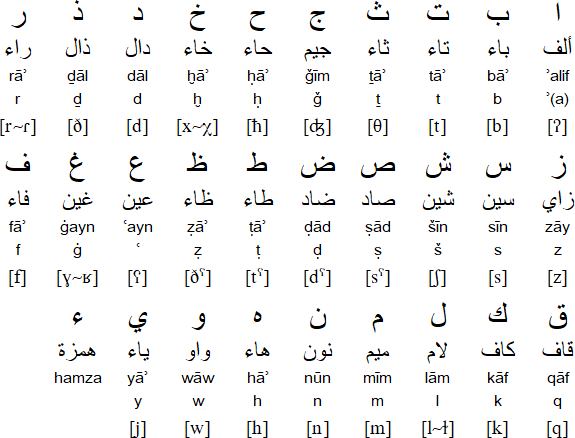
The transliteration of consonants used above is the ISO version of 1984. There are various other ways of transliterating Arabic.
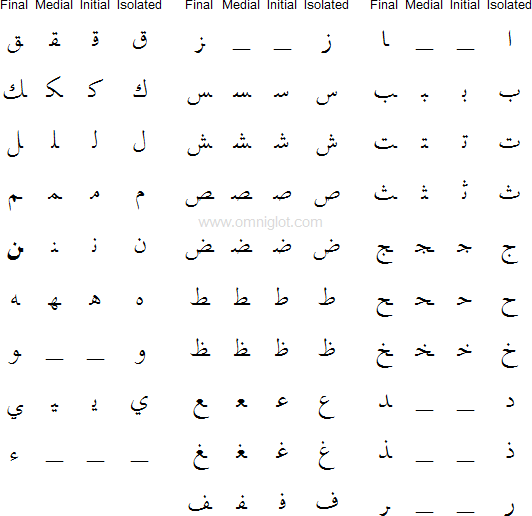
This chart shows how the letters change in different positions
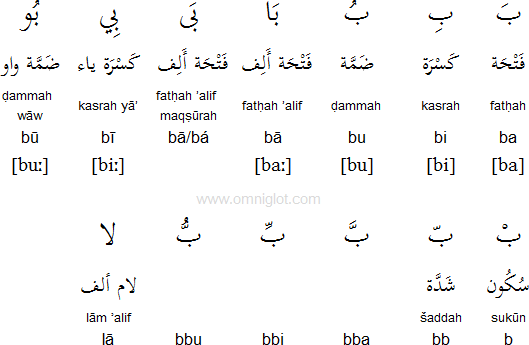
Hear how to pronounce the Arabic letters:
When chatting online some Arabic speakers write in the Latin alphabet use the following letters:
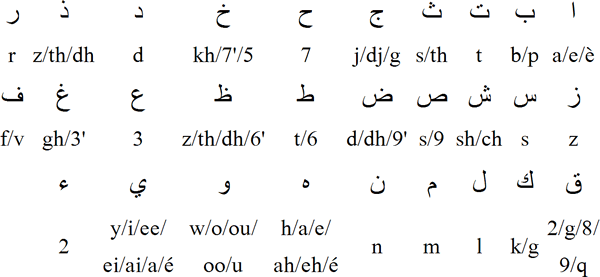
More details
https://en.wikipedia.org/wiki/Arabic_chat_alphabet
https://books.google.co.uk/books
Download an Arabic alphabet chart in Word or PDF format
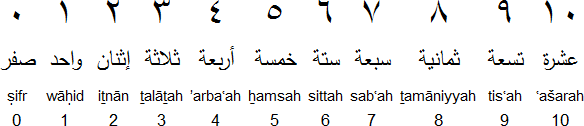
These numerals are those used when writing Arabic and are written from left to right. In Arabic they are known as "Indian numbers" (أرقام هندية / arqa-m hindiyyah). The term 'Arabic numerals' is also used to refer to 1, 2, 3, etc.
Arabic is a Semitic language with about 221 million speakers in Afghanistan, Algeria, Bahrain, Chad, Cyprus, Djibouti, Egypt, Eritrea, Iran, Iraq, Israel, Jordan, Kenya, Kuwait, Lebanon, Libya, Mali, Mauritania, Morocco, Niger, Oman, Palestinian West Bank & Gaza, Qatar, Saudi Arabia, Somalia, Sudan, Syria, Tajikistan, Tanzania, Tunisia, Turkey, UAE, Uzbekistan and Yemen.
There are over 30 different varieties of colloquial Arabic which include: Algerian, Bedawi, Chadian, Cypriot, Egyptian, Gulf, Hassaniya, Hejazi, Lebanese, Libyan, Modern Standard, Moroccan, Najdi, Sudanese, Syrian, Tunisian
For a full list of all varieties of colloquial Arabic click here (format: Excel, 20K).
Source: www.ethnologue.com


Yūladu jamī‘u n-nāsi aḥrāran mutasāwīna fī l-karāmati wa-l-ḥuqūq. Wa-qad wuhibū ‘aqlan wa-ḍamīran wa-‘alayhim an yu‘āmila ba‘ḍuhum ba‘ḍan bi-rūḥi l-ikhāʼ.
Listen to a recording of this text by زين العابدين شبيب (Zein Al-A'bideen Shabeeb)
All human beings are born free and equal in dignity and rights. They are endowed with reason and conscience and should act towards one another in a spirit of brotherhood.
(Article 1 of the Universal Declaration of Human Rights)
Information about Arabic | Phrases | Numbers | Tower of Babel | Articles | Links | Arabic courses on: Amazon.com and Amazon.co.uk [affilate links]
Online Arabic lessons
http://mylanguages.org/learn_arabic.php
http://ilovelanguages.org/arabic.php
http://lingohut.com/en/l69/learn-arabic
http://www.madinaharabic.com
http://arabicspeaker.blogspot.com
http://www.dalilusa.com/arabic_course/intro.asp
http://www.learnarabic.com
http://www.arabicpod101.com/
Talk In Arabic (affiliate link)
- Learn Arabic online with ArabicPod101
- TalkInArabic.com - learn colloquial Arabic of Algeria, Egypt, Iraq, the Levant, Morocco, Saudi Arabia, Sudan or Tunisia

- eArabic Learning - Learn Arabic Online with Live Teachers
- Learn Arabic with Glossika
- Arabic Genie - a quick and easy way to learn the Arabic alphabet
Find Arabic Tutors with LanguaTalk
Arabic courses and other resources available on Amazon
How to read handwritten Arabic
https://autolingual.com/handwritten-arabic/
Algerian, Bedawi, Chadian, Cypriot, Egyptian, Gulf, Hassaniya, Hejazi, Lebanese, Libyan, Modern Standard, Moroccan, Najdi, Sudanese, Syrian, Tunisian
Akkadian, Amharic, Arabic (Algerian), Arabic (Bedawi), Arabic (Chadian), Arabic (Egyptian), Arabic (Gulf), Arabic (Hassaniya), Arabic (Hejazi), Arabic (Lebanese), Arabic (Modern Standard), Arabic (Moroccan), Arabic (Najdi), Arabic (Sudanese), Arabic (Syrian), Aramaic, Argobba, Assyrian / Neo-Assyrian, Canaanite, Chaha, Chaldean Neo-Aramaic, Ge'ez, Hadhramautic, Harari, Hebrew, Himyaritic, Jewish Neo-Aramaic, Maltese, Mandaic, Nabataean, Neo-Mandaic, Phoenician, Punic, Qatabanic, Razihi, Sabaean, Sabaic, Silt'e, Syriac, Tigre, Tigrinya, Turoyo, Ugaritic, Western Neo-Aramaic
Adamaua Fulfulde, Aer, Afrikaans, Arabic (Algerian), Arabic (Bedawi), Arabic (Chadian), Arabic (Egyptian), Arabic (Gulf), Arabic (Hassaniya), Arabic (Hejazi), Arabic (Lebanese), Arabic (Libyan), Arabic (Modern Standard), Arabic (Moroccan), Arabic (Najdi), Arabic (Sudanese), Arabic (Syrian), Arabic (Tunisian), Arwi, Äynu, Azeri, Balanta-Ganja, Balti, Baluchi, Beja, Belarusian, Bosnian, Brahui, Chagatai, Chechen, Chittagonian, Comorian, Crimean Tatar, Dameli, Dargwa, Dari, Dhatki, Dogri, Domari, Gawar Bati, Gawri, Gilaki, Hausa, Hazaragi, Hindko, Humburi Senni, Indus Kohistani, Kabyle, Kalkoti, Karachay-Balkar, Karakalpak, Kashmiri, Katë, Kazakh, Khowar, Khorasani Turkic, Khwarezmian, Konkani, Koyraboro Senni, Kumzari, Kurdish, Kyrgyz, Lezgi, Lop, Luri, Maasina Fulfulde, Maba, Maguindanao, Malay, Malay (Terengganu), Mandinka, Marwari, Mazandarani, Mogholi, Morisco, Mozarabic, Munji, Noakhailla, Nubi, Ormuri, Palula, Parkari Koli, Pashto, Persian/Farsi, Punjabi, Qashqai, Rajasthani, Rohingya, Salar, Saraiki, Sawi, Serer, Shabaki, Shina, Shughni, Sindhi, Somali, Soninke, Tatar, Tausūg, Tawallammat Tamajaq, Tayart Tamajeq, Ternate, Torwali, Turkish, Urdu, Ushoji, Uyghur, Uzbek, Wakhi, Wanetsi, Wolof, Xiao'erjing, Yidgha
Ancient Berber, Arabic, Aramaic, Chorasmian, Elymaic, Hatran, Hebrew, Manichaean, Nabataean, North Arabian, Pahlavi, Palmyrene, Parthian, Phoenician, Paleo-Hebrew, Proto-Sinaitic / Proto-Canaanite, Psalter, Punic, Sabaean, Samaritan, Sogdian, South Arabian, Syriac, Tifinagh, Ugaritic
Page last modified: 19.09.25
[top]

You can support this site by Buying Me A Coffee, and if you like what you see on this page, you can use the buttons below to share it with people you know.

If you like this site and find it useful, you can support it by making a donation via PayPal or Patreon, or by contributing in other ways. Omniglot is how I make my living.

Note: all links on this site to Amazon.com

[top]


