
Somali is a member of the Lowland East Cushitic branch of the Afro-Asiatic language family. It is spoken mainly in Somalia, and also in Djibouti, Ethiopia, Kenya, Yemen, and in (the Republic of) Somaliland, an unrecognised de facto sovereign state between Djibouti, Ethiopia and Somalia. It is an offical language in Somali and in the Somali Region of Ethiopia, a major national language in Djibouti, and a recognised minority language in Kenya. There are a total of about 21.8 million Somali speakers, including about 7.8 million in Somali.
[top]
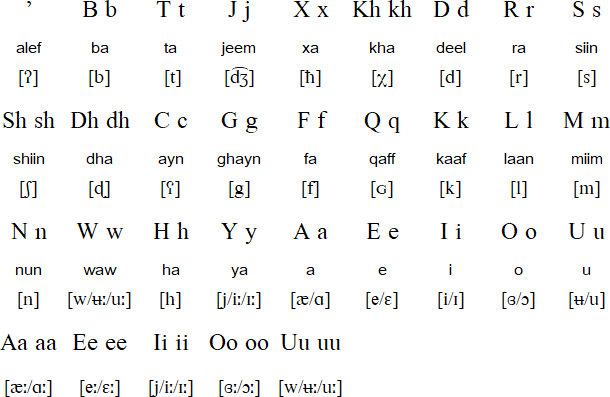
Somali has been written with a number of different scripts, including the Arabic script, the Latin alphabet, and the Borama / Gadabuursi, Osmanya and Kaddare alphabets. The current official script for Somali is the Latin alphabet.
[top]
In 1961 both the Latin and Osmanya scripts were adopted for use in Somalia, but in 1969 there was a coup, with one of its stated aims the resolution of the debate over the country's writing system. The Latin alphabet was finally adopted in 1972 and at the same time Somali was made the sole official language of Somalia. Shire Jama Ahmed (Shire Jaamac Axmed / شيري جامع أحمد) is credited with the invention of this spelling system, and his system was chosen from among eighteen competing new orthographies.
Hear how to pronounce Somali:
Aadanaha dhammaantiis wuxuu dhashaa isagoo xor ah kana siman xagga sharafta iyo xuquuqada Waxaa Alle (Ilaah) siiyay aqoon iyo wacyi, waana in qof la arkaa qofka kale ula dhaqmaa si walaaltinimo ah.
Hear recording of this text by Abdisalam Farah
All human beings are born free and equal in dignity and rights. They are endowed with reason and conscience and should act towards one another in a spirit of brotherhood.
(Article 1 of the Universal Declaration of Human Rights)
[top]
The Arabic script was first introduced in the 13th century by Sheikh Yusuf al-Kowneyn to aid Koranic teaching. In the 19th century Sheikh Uways al-Barawi improved the writing of Somali with the Arabic script and based it on the Maay dialect of Southern Somalia. A Somali linguists, Muuse Xaaji Ismaaciil Galaal, radically altered the spelling conventions for Somali written with the Arabic script and introduced a set of new symbols for the vowels in the 1950s.
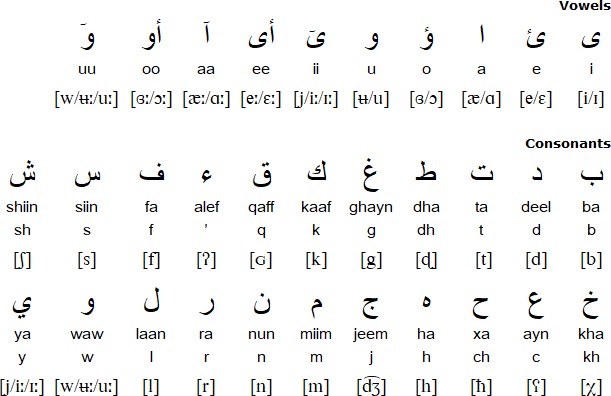
Source: http://www.afrikanistik-online.de/archiv/2010/2723
Download alphabet charts for Somali
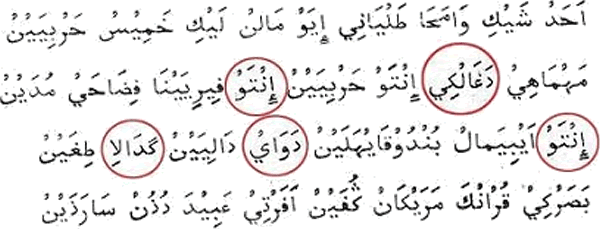
Source: https://www.somalinet.com/forums/viewtopic.php?t=378236
Information about Somali | Osmanya alphabet | Borama / Gadabuursi alphabet | Kaddare alphabet | Phrases | Numbers | Tower of Babel | Books about Somali on: Amazon.com and Amazon.co.uk [affilate links]
Information about the Somali language and alphabets
http://en.wikipedia.org/wiki/Somali_language
http://en.wikipedia.org/wiki/Somali_phonology
http://www.ethnologue.com/language/som
http://en.wikipedia.org/wiki/Kaddare_alphabet
http://www.skyknowledge.com/kaddare.htm
http://www.dm.unipi.it/~jama/alif/qaamuus/gogoldhig.html
Somali lessons
http://www.digitaldialects.com/Somali.htm
http://learn101.org/somali.php
http://mylanguages.org/somali_audio.php
http://www.linguistics.universityofqaran.com/gpage2.html
http://www.youtube.com/user/AfSomali/videos
http://polymath.org/somali.php
Somali phrases
http://quizlet.com/63160/somali-useful-phrases-flash-cards/
http://ilanguages.org/somali_phrases.php
http://polymath.org/somali_phrases_list.php
http://learn101.org/somali_phrases.php
https://wikitravel.org/en/Somali_phrasebook
Online Somali dictionaries
https://www.somalinet.com/qaamuus-soomaali/
http://www.freelang.net/online/somali.php
https://www.lexilogos.com/english/somali_dictionary.htm
Online Somali radio and news
http://somaliradio.net
http://radiomuqdisho.net/
http://www.radiofreesomalia.com/
http://www.bbc.co.uk/somali
http://www.voasomali.com
Somalinet - a Somali portal (in Somali & English)
http://www.somalinet.com
Afaan-Oromo, Afar, Awngi, Beja, Blin, Daasanach, Dirasha, Gawwada, Hadiyya, Iraqw, Maay Maay, Rendille, Saho, Sidama, Somali, Southern Oromo, Waata, Xamtanga, Yaaku
Adamaua Fulfulde, Aer, Afrikaans, Arabic (Algerian), Arabic (Bedawi), Arabic (Chadian), Arabic (Egyptian), Arabic (Gulf), Arabic (Hassaniya), Arabic (Hejazi), Arabic (Lebanese), Arabic (Libyan), Arabic (Modern Standard), Arabic (Moroccan), Arabic (Najdi), Arabic (Sudanese), Arabic (Syrian), Arabic (Tunisian), Arwi, Äynu, Azeri, Balanta-Ganja, Balti, Baluchi, Beja, Belarusian, Bosnian, Brahui, Chagatai, Chechen, Chittagonian, Comorian, Crimean Tatar, Dameli, Dargwa, Dari, Dhatki, Dogri, Domari, Gawar Bati, Gawri, Gilaki, Hausa, Hazaragi, Hindko, Humburi Senni, Indus Kohistani, Kabyle, Kalkoti, Kanembu, Karachay-Balkar, Karakalpak, Kashmiri, Katë, Kazakh, Khowar, Khorasani Turkic, Khwarezmian, Konkani, Korandje, Koyra Chiini, Koyraboro Senni, Kumzari, Kurdish, Kyrgyz, Lezgi, Lop, Luri, Maasina Fulfulde, Maba, Maguindanao, Malay, Malay (Terengganu), Mandinka, Marwari, Mazandarani, Mogholi, Morisco, Mozarabic, Munji, Noakhailla, Nubi, Ormuri, Palula, Parkari Koli, Pashto, Persian/Farsi, Punjabi, Qashqai, Rajasthani, Rohingya, Salar, Saraiki, Sawi, Serer, Shabaki, Shina, Shughni, Sindhi, Somali, Soninke, Tatar, Tausūg, Tawallammat Tamajaq, Tayart Tamajeq, Ternate, Torwali, Turkish, Urdu, Ushoji, Uyghur, Uzbek, Wakhi, Wanetsi, Wolof, Xiao'erjing, Yidgha
Languages written with the Latin alphabet
Page last modified: 15.01.24
[top]

Note: all links on this site to Amazon.com


You can support this site by Buying Me A Coffee, via PayPal or Patreon, or by contributing in other ways.
If you find all the adverts annoying, there is now an Ad-free version of Omniglot which you can access for a small monthly or annual donation.

This website and its content is copyright of Simon Ager - © Simon Ager 1998-2026. All rights reserved. All images were created by me, unless otherwise indicated. More details

[top]


