

The Etruscan language was spoken by the Etruscans in Etruria (Tuscany and Umbria) until about the 1st century AD. After which it continued to be studied by priests and scholars, and it was used in religious ceremonies until the early 5th century AD. The emperor Claudius (10 BC - 54 AD) wrote a history of the Etruscans in 20 volumes, however none of these volumes survive.
Etruscan was related to Raetic, a language once spoken in the Alps, and also to Lemnian, once spoken on the island of Lemnos. It was also possibly related to Camunic, a language once spoken in the northwest of Italy.
The Etruscan alphabet developed from a Western variety of the Greek alphabet brought to Italy by Euboean Greeks. The earliest known inscription dates from the middle of the 6th century BC. Most Etruscan inscriptions are written in horizontal lines from right to left, but some are boustrophedon (running alternately left to right then right to left).
More than 10,000 Etruscan inscriptions have been found on tombstones, vases, statues, mirrors and jewellery. Fragments of an Etruscan book made of linen have also been found. Etruscan texts can be read: i.e. the pronunciation of the letters is known, though scholars are not sure what all the words mean.
No major literary works in Etruscan have survived, however there is evidence for the existence of religious and historical literature and drama. It is also possible that the Etruscans had a notation system for music.
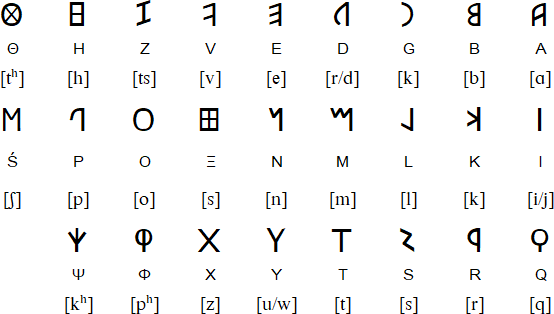
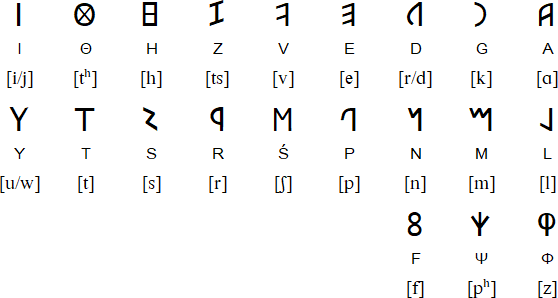

Download an alphabet chart for Etruscan (Excel)
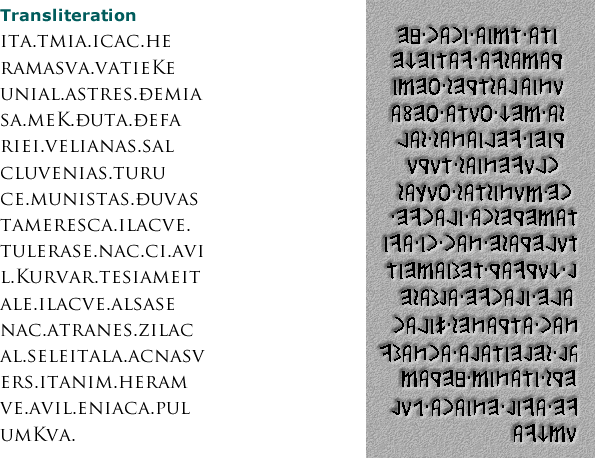
This temple and (this) statue have been dedicated to Uni / Astarte. Thefariei Velianas, head of the community, donated it for the worship of our peoples. This gift of this temple and sanctuary and the consecration of its boundaries during his three year term in the month of Xurvar (June?) in this way, and in Alsase (July?) this record together with the divinity/statue shall thus be buried by order of the Zilach that the years may outlast the stars.
Source: http://www.mysteriousetruscans.com/language.html
Information about Etruscan | Numbers
Information about the Etruscan language and alphabet
http://en.wikipedia.org/wiki/Etruscan_language
https://it.wikipedia.org/wiki/Lingua_etrusca
http://www.mysteriousetruscans.com/language.html
https://www.britannica.com/topic/Etruscan-language
http://www.languagesgulper.com/eng/Etruscan.html
Etruscan vocabulary
http://etruskisch.de/pgs/vc.htm
http://diachronica.pagesperso-orange.fr/TMCJ_vol_3.2_Fournet_Etruscan.pdf
Etruscan Foundation - an organisation dedicated to the study of the cultural and history of the Etruscans: http://www.etruscanfoundation.org
The Mysterious Etruscans
http://www.mysteriousetruscans.com/
Etruscan font
http://www.dafont.com/etruscan.font
http://www.fontspace.com/dave-bastian/etruscan
ALPHABETUM - a Unicode font
for ancient scripts, including Classical & Medieval Latin, Ancient Greek, Etruscan, Oscan, Umbrian, Faliscan, Messapic, Picene, Iberian, Celtiberian, Gothic, Runic, Old & Middle English, Hebrew, Sanskrit, Old Nordic, Ogham, Kharosthi, Glagolitic, Anatolian scripts, Phoenician, Brahmi, Imperial Aramaic, Old Turkic, Old Permic, Ugaritic, Linear B, Phaistos Disc, Meroitic, Coptic, Cypriot and Avestan.
https://www.typofonts.com/alphabetum.html
A-chik Tokbirim, Adinkra, ADLaM, Armenian, Avestan, Avoiuli, Bactrian, Bassa (Vah), Beitha Kukju, Berati, Beria (Zaghawa), Borama / Gadabuursi, Carian, Carpathian Basin Rovas, Chinuk pipa, Chisoi, Coorgi-Cox, Coptic, Cyrillic, Dalecarlian runes, Elbasan, Etruscan, Faliscan, Fox, Galik, Georgian (Asomtavruli), Georgian (Nuskhuri), Georgian (Mkhedruli), Glagolitic, Global Alphabet, Gothic, Greek, Hurûf-ı munfasıla, Irish (Uncial), Kaddare, Kayah Li, Khatt-i-Badíʼ, Khazarian Rovas, Koch, Korean, Latin, Lepontic, Luo Lakeside Script, Lycian, Lydian, Manchu, Mandaic, Mandombe, Marsiliana, Medefaidrin, Messapic, Mongolian, Mro, Mundari Bani, Nag Chiki, Naasioi Otomaung, N'Ko, North Picene, Novo Tupi, Nyiakeng Puachue Hmong, Odùduwà, Ogham, Old Church Slavonic, Oirat Clear Script, Ol Chiki (Ol Cemet' / Santali), Old Italic, Old Nubian, Old Permic, Ol Onal, Orkhon, Osage, Oscan, Osmanya (Somali), Pau Cin Hau, Phrygian, Pollard script, Quốc âm tân tự, Runic, Székely-Hungarian Rovás (Hungarian Runes), South Picene, Sutton SignWriting, Sunuwar, Tai Viet, Tangsa, Todhri, Toto, Umbrian, (Old) Uyghur, Vellara, Veso Bey, Wancho, Yezidi, Zoulai
Page last modified: 15.03.23
[top]

Note: all links on this site to Amazon.com


You can support this site by Buying Me A Coffee, via PayPal or Patreon, or by contributing in other ways.
If you find all the adverts annoying, there is now an Ad-free version of Omniglot which you can access for a small monthly or annual donation.

This website and its content is copyright of Simon Ager - © Simon Ager 1998-2026. All rights reserved. All images were created by me, unless otherwise indicated. More details

[top]


