
Udmurt is a member of the Permic branch of the Uralic language family. It is spoken by about 270,000 people mainly in the Russian Republic of Udmurtia (Удмуртия / Удмурт Элькун), where it is a co-official language with Russian. It is also spoken in the Tatarstan republic.
Udmurt is also known as Votiak or Votyak, and is closely related to Komi and Komi-Permyak. Dialects include Northern Udmurt, Middle Udmurt, Southern Udmurt and Besermyan. The Northern, Middle and Southern dialects are more or less mutually intelligible, while the Besermyan dialect is more distinct, and has much influence from Turkic languages. Udmurt is written with the Cyrllic alphabet.
Udmurt is used to some extent as a language of instruction in schools, though only in primary schools in rural areas. There are several hours a day of Udmurt broadcasts on the radio and TV, and there are a number of newspapers and magazines in Udmurt.
Udmurt first appeared in writing in 1726 in a dictionary produced by Daniel Gottlieb Messerschmidt (1685–1735), a German physician, naturalist and geographer, who used the Latin alphabet to write Udmurt. However, the dictionary was not published at the time, and remained largely unknown until it was rediscovered and published in 2001. A number of other books about Udmurt were published during the 18th and 19th centuries using the Latin alphabet with various spelling systems.
The first books written in Udmurt or including texts in Udmurt appeared in the late 18th century. The earliest is a multilingual collection of poems that appeared in 1769 and contined a poem in Udmurt written in the Cyrillic alphabet.
The first grammar of Udmurt was published in 1775. It was written in Russian, and used the Cyrillic alphabet to write Udmurt. Other Udmurt grammars and dictionaries were published towards the end of the 18th century, and they used various Cyrillic orthographies to write Udmurt. Other ways of writing Udmurt with the Cyrillic alphabet were used during the early 20th century. and the current alphabet developed during that time.
There were proposals to switch to the Latin alphabet for Udmurt during the 1920s and 1930s. A unified Latin alphabet for Udmurt and the closely-related Komi language was created and approved in 1931, and it was used for Komi from 1932. However, it was not adopted in Udmurtia due to negative attitudes of the regional authorities and lack of funding, and the Cyrillic alphabet continued to be used.
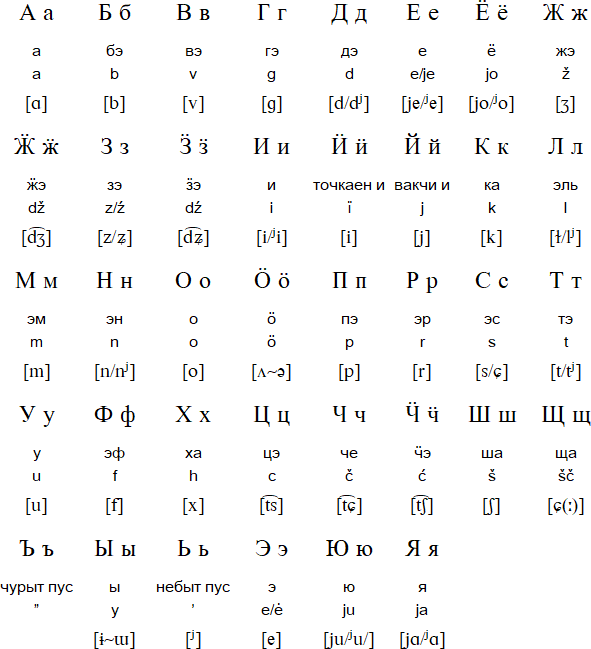
Download an alphabet chart for Udmurt (Excel)
Information about Udmurt pronunciation compiled by Wolfram Siegel, with corrections by 이윤호 (Yun-ho Lee)
Элькун азьмуртлэн резеденцияз кун кивалтон езъёслэн ыстэм муртъёссы, муницип кылдытъёслэн но ёрос администрациослэн торооссы, райпоослэн кивалтӥсьёссы гуртъёсын нимаз адямиосын поттэм ваньбурез басьтон но ас понназы ужась хозяйствоосты азинтон ужпумъёсты эскеризы. Та кенешын ик калыклэсь сӥльзэ но йӧлзэ басьтонэз умойгес радъянъя элькун конкурслы йылпумъянъёс лэсьтэмын.
This is a song by Ivan Belosludtsev (Иван Белослудцев) & 4CP from Udmurtia that was entered in the Liet International song contest in 2012.
Information about Udmurt | Phrases | Numbers
Information about Udmurt and Udmurtia
http://en.wikipedia.org/wiki/Udmurt_language
https://en.wikipedia.org/wiki/Udmurt_alphabets
https://www.ieas-szeged.hu/finugrevita/languages.html
https://idel-ural.org/en/archives/the-udmurt-language/
http://en.wikipedia.org/wiki/Udmurtia
Besermyan, Komi, Komi-Permyak, Komi-Yazva, Komi-Zyrian, Udmurt
Languages written with the Cyrillic alphabet
Page last modified: 24.03.26
[top]

Note: all links on this site to Amazon.com


You can support this site by Buying Me A Coffee, via PayPal or Patreon, or by contributing in other ways.
If you find all the adverts annoying, there is now an Ad-free version of Omniglot which you can access for a small monthly or annual donation.

This website and its content is copyright of Simon Ager - © Simon Ager 1998-2026. All rights reserved. All images were created by me, unless otherwise indicated. More details

[top]


