
Evenki is a Northern Tungusic language spoken mainly in northern China, and also in Russia and Mongolia. In China Evenki was spoken by about 11,000 in 2007 in Inner Mongolia, Heilongjiang province and Xinjiang Uyghur Autonomous Region. In the Russian Federation Evenki was spoken by about 4,800 people in 2010 in the Sakha and Buryatia republics, and in Amur, Irkutsk, Magadan and Sakhlin provinces. There are also some speakers of Evenki in Selenge province of Mongolia.
Approximately 45% of the Evenki people consider Evenki their mother tongue. Most of the speakers are elderly and the younger generation lack a thorough knowledge of the language. This is because until 1980 the Russian government tried to suppress the Evenki language, but since then Evenki has been taught in schools.
Evenki, which is also known as Evenk, Avenki, Avenk or Tungus, has much in common with Mongolian and related languages. It has been strongly influenced by Yakut, Buryat and Russian.
Until the 1930s, the Evenki people were mainly nomadic hunters and reindeer herders. Today hunting and reindeer herding are still important, but they are also involved in argriculture and industry.
The English word "shaman" comes from the Evenki word meaning "holy man".
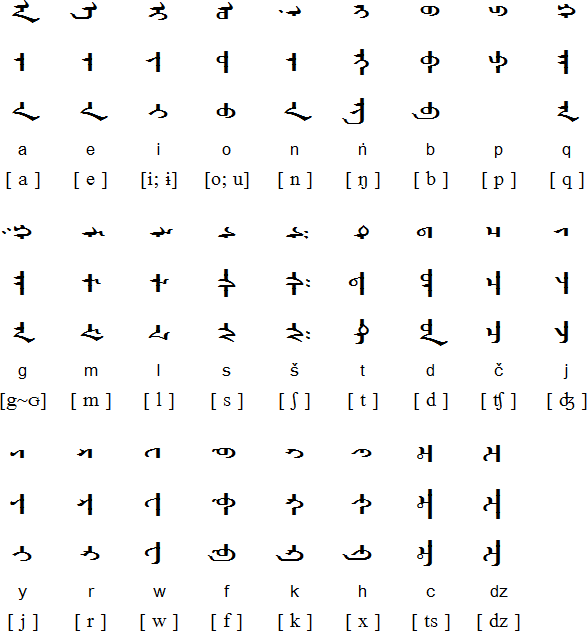
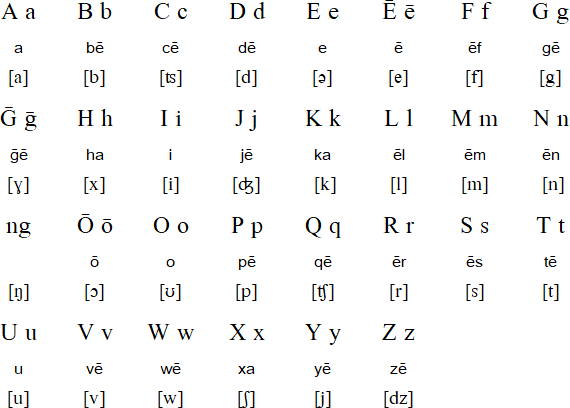
Evenki was first written during the 1920s with a version of the Cyrillic alphabet. In China it is written the Latin alphabet, and used to be written with the Traditional Mongolian script.
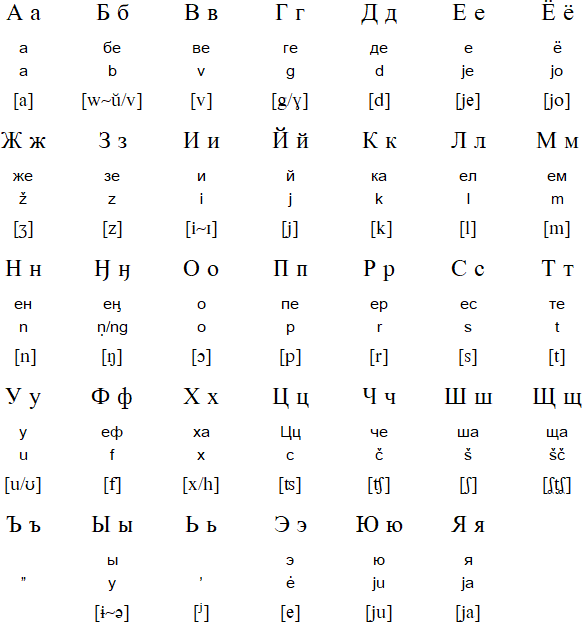
The letters щ, ъ and ь are only used in Russian names and loanwords.
Information on pronunciation compiled by Wolfram Siegel
Download alphabet charts for Evenki (Excel)
Упкат илэл ты̄нмукирди, урэ̄лди мэ̄нңи са̄рича̄ди балдыдяра. Нуңартын дялитви, һалдяндыви биси, мэмэгӣлвэр аяралды̄дяна тэдет о̄мамачитын.
Upkat ilel tyynmukirdi, ureeldi meenŋi saaričaadi waldydjara. Nuŋartyn djalitvi, haldjandyvi bisi, memegiilver ajaraldyydjana tedjet oomamačityn.
All human beings are born free and equal in dignity and rights. They are endowed with reason and conscience and should act towards one another in a spirit of brotherhood.
(Article 1 of the Universal Declaration of Human Rights)
Information about Evenki | Numbers
Information about the Evenki language and people
http://en.wikipedia.org/wiki/Evenki_language
https://www.ethnologue.com/language/evn
http://www.spri.cam.ac.uk/resources/rfn/evenki.html
Evenki lessons
http://www.evengus.ru/index.html
Online Evenki dictionaries
http://tung.by.ru
https://www.evengus.ru/razgovornik/vstrecha/
https://kaikki.org/dictionary/Evenki/index.html
https://www.freelang.net/dictionary/evenki.php
Even, Evenki, Jurchen, Kili, Manchu, Nanai, Negidal, Oroch, Orok / Uilta, Oroqen, Udege Ulch, Xibe
Alasha, Barin, Buryat, Chakhar, Evenki, Jarud, Khamnigan Mongol, Khorchin, Mongolian
Abaza, Abkhaz, Adyghe, Aghul, Akhvakh, Akkala Sámi, Aleut, Altay, Alyutor, Andi, Archi, Assyrian / Neo-Assyrian, Avar, Azeri, Bagvalal, Balkar, Baraba Tatar, Bashkir, Belarusian, Besermyan, Bezhta, Bosnian, Botlikh, Budukh, Bulgarian, Buryat, Chamalal, Chechen, Chelkan, Chukchi, Chulym, Chuvash, Crimean Tatar, Dargwa, Daur, Dolgan, Dungan, Enets, Erzya, Even, Evenki, Gagauz, Godoberi, Hinukh, Hunzib, Ingush, Interslavic, Itelmen, Juhuri, Kabardian, Kaitag, Kalderash Romani, Kalmyk, Karaim, Karakalpak, Karata, Karelian, Kazakh, Ket, Khakas, Khanty, Khinalug, Khorasani Turkic, Khwarshi, Kildin Sámi, Kili, Komi, Koryak, Krymchak, Kryts, Kubachi, Kumandy, Kumyk, Kurdish, Kyrgyz, Lak, Lezgi, Lingua Franca Nova, Lithuanian, Ludic, Macedonian, Mansi, Mari, Moksha, Moldovan, Mongolian, Montenegrin, Nanai, Negidal, Nenets, Nganasan, Nivkh, Nogai, Old Church Slavonic, Oroch, Orok, Ossetian, Pontic Greek, Romanian, Rushani, Russian, Rusyn, Rutul, Selkup, Serbian, Shor, Shughni, Siberian Tatar, Sirenik, Slovio, Soyot, Tabassaran, Tajik, Talysh, Tat, Tatar, Teleut, Ter Sámi, Tindi, Tofa, Tsakhur, Tsez, Tsudaqar, Turkmen, Tuvan, Ubykh, Udege, Udi, Udmurt, Ukrainian, Ulch, Urum, Uyghur, Uzbek, Veps, Votic, Wakhi, West Polesian, Xibe, Yaghnobi, Yakut, Yazghulami, Yukaghir (Northern / Tundra), Yukaghir (Southern / Kolyma), Yupik (Central Siberian)
Languages written with the Latin alphabet
Page last modified: 15.09.25
[top]

You can support this site by Buying Me A Coffee, and if you like what you see on this page, you can use the buttons below to share it with people you know.

If you like this site and find it useful, you can support it by making a donation via PayPal or Patreon, or by contributing in other ways. Omniglot is how I make my living.

Note: all links on this site to Amazon.com


[top]


