
Bashkir is a member of the Kypchak-Bolgar group of the Turkic languages. It is spoken in the southwest of Russian Federation, mainly in the Republic of Bashkortostan, and also in Tatarstan, Chelyabinsk, Orenburg, Tyumen, Sverdlovsk and Kurgan provinces. In 2010 there were about 1.1 million speakers of Bashkir in Russia, and another 100,000 in Kazakhstan and a number of other countries. Bashkir has been a statutory provincial language in the Bashkortostan Republic since 1925.
There are three groups of Bashkir dialects: southern, eastern and northwestern. The language is also known as Bashkort, Bashqort or Basquort.
Bashkir first appeared in writing in a Runic alphabet during the 9th century AD. It was written with the Arabic alphabet between the 10th century and 1928, when it was replaced by the Latin alphabet, which itself was replaced by the Cyrillic alphabet in 1940.
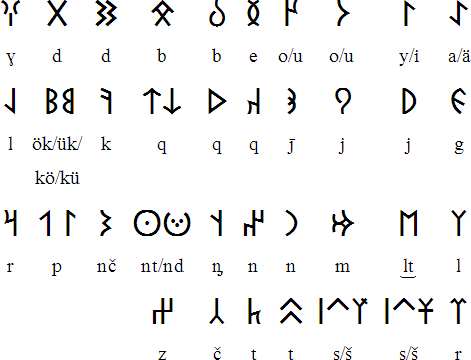
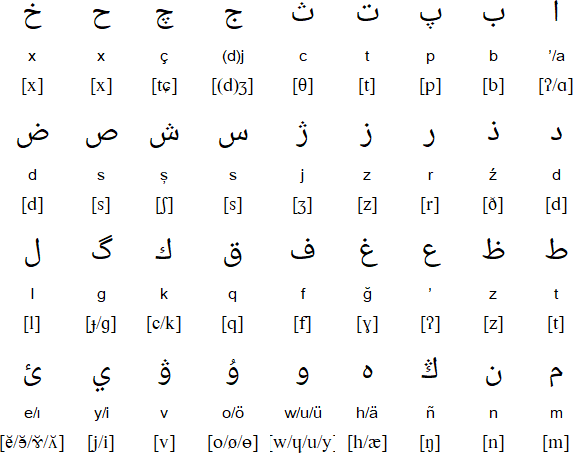
Source: https://ba.wikipedia.org/wiki/Башҡорт_алфавиты
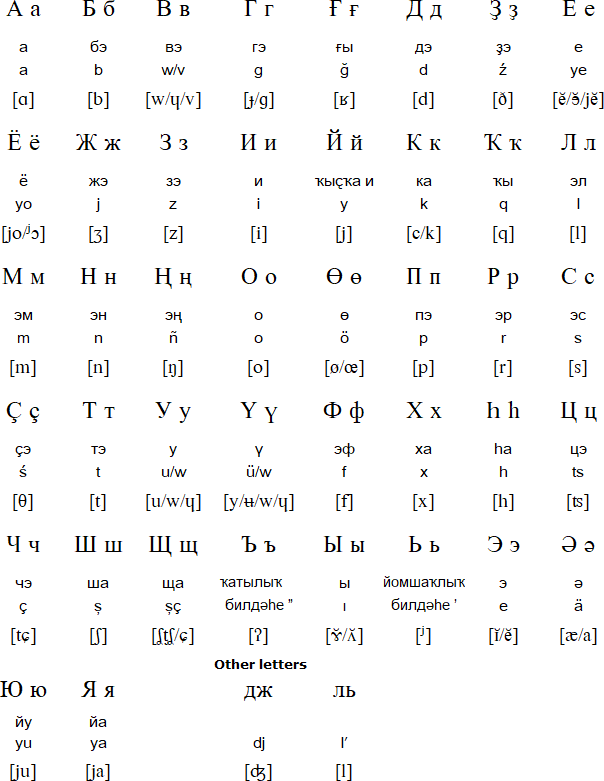
The letters ё, ц, ч and щ are used in Russian loanwords and names. The letters ь and ъ are used to denote a glottal stop in Arabic loanwords (e.g. мөьмин), or to separate iotated letters from consonants (e.g. донъя).
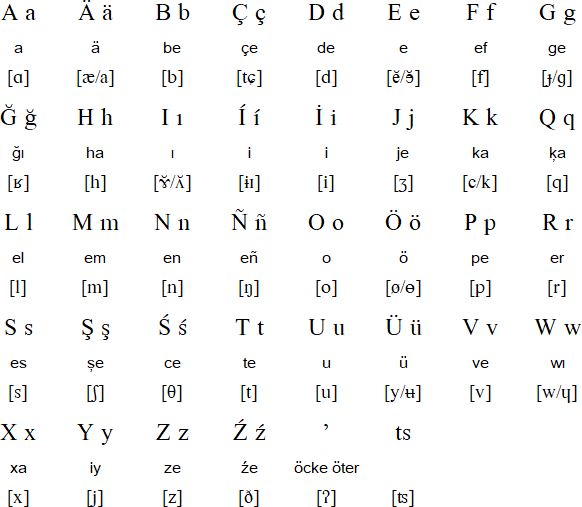
Download alphabet charts for Bashkir (Excel)
Details provided by Wolfram Siegel, Michael Peter Füstumum, 이윤호 and Haqmar. With corrections by bababashqort.
Барлыҡ кешеләр ирекле, дәрәжәләре һәм хоҡуҡтары тигеҙ булып тыуалар. Улар аҡыл һәм выждан эйәһе һәм бер-береһенә ҡарата ҡәрҙәшлек рухында хәрәкәт итергә тейештәр.
Barlıq keşelär irekle, däräjäläre häm xoquqtarı tiñ bulıp tıwalar. Ular aqıl häm wıjdan eyähe häm ber-berehenä qarata qärźäşlek ruxında xäräkät itergä teyeştär.
Transliteration by bababashqort
All human beings are born free and equal in dignity and rights. They are endowed with reason and conscience and should act towards one another in a spirit of brotherhood.
(Article 1 of the Universal Declaration of Human Rights)
Information about Bashkir | Phrases | Numbers | Tower of Babel
Information about the Bashkir language
http://members.lycos.nl/bashkort/tele/bashlaung.htm
http://www.peoples.org.ru/eng_bashkir.html
http://en.wikipedia.org/wiki/Bashkir_language
http://tel.bashqort.com
Bashkir folk songs
http://yir.atspace.com
Altay, Äynu, Azerbaijani, Bashkir, Chagatai, Chelkan, Chulym, Chuvash, Crimean Tatar, Dolgan, Fuyu Kyrgyz, Gagauz, Ili Turki, Karachay-Balkar, Karaim, Karakalpak, Karamanli Turkish, Kazakh, Khakas, Khalaj, Khorasani Turkic, Krymchak, Kumandy, Kumyk, Kyrgyz, Lop, Nogai, Old Turkic, Qashqai, Romanian Tatar, Salar, Shor, Siberian Tatar, Soyot, Tatar, Teleut, Tofa, Turkish, Turkmen, Tuvan, Urum, Uyghur, Uzbek, Western Yugur, Yakut (Sakha)
Abaza, Abkhaz, Adyghe, Aghul, Akhvakh, Akkala Sámi, Aleut, Altay, Alyutor, Andi, Archi, Assyrian / Neo-Assyrian, Avar, Azeri, Bagvalal, Balkar, Bashkir, Belarusian, Bezhta, Bosnian, Botlikh, Budukh, Bulgarian, Buryat, Chamalal, Chechen, Chelkan, Chukchi, Chulym, Chuvash, Crimean Tatar, Dargwa, Daur, Dolgan, Dungan, Enets, Erzya, Even, Evenki, Gagauz, Godoberi, Hinukh, Hunzib, Ingush, Interslavic, Itelmen, Juhuri, Kabardian, Kaitag, Kalderash Romani, Kalmyk, Karaim, Karakalpak, Karata, Karelian, Kazakh, Ket, Khakas, Khanty, Khinalug, Khorasani Turkic, Khwarshi, Kildin Sámi, Kili, Komi, Koryak, Krymchak, Kryts, Kubachi, Kumandy, Kumyk, Kurdish, Kyrgyz, Lak, Lezgi, Lingua Franca Nova, Lithuanian, Ludic, Macedonian, Mansi, Mari, Moksha, Moldovan, Mongolian, Montenegrin, Nanai, Negidal, Nenets, Nganasan, Nivkh, Nogai, Old Church Slavonic, Oroch, Orok, Ossetian, Pontic Greek, Romanian, Rushani, Russian, Rusyn, Rutul, Selkup, Serbian, Shor, Shughni, Siberian Tatar, Sirenik, Slovio, Soyot, Tabassaran, Tajik, Talysh, Tat, Tatar, Teleut, Ter Sámi, Tindi, Tofa, Tsakhur, Tsez, Turkmen, Tuvan, Ubykh, Udege, Udi, Udmurt, Ukrainian, Ulch, Urum, Uyghur, Uzbek, Veps, Votic, Wakhi, West Polesian, Xibe, Yaghnobi, Yakut, Yazghulami, Yukaghir (Northern / Tundra), Yukaghir (Southern / Kolyma), Yupik (Central Siberian)
Languages written with the Latin alphabet
Page last modified: 25.03.25
[top]

You can support this site by Buying Me A Coffee, and if you like what you see on this page, you can use the buttons below to share it with people you know.

If you like this site and find it useful, you can support it by making a donation via PayPal or Patreon, or by contributing in other ways. Omniglot is how I make my living.
Note: all links on this site to Amazon.com


[top]


