Strength

Words for strength and related things in Celtic languages.

Strength

Words marked with a * are reconstructions.

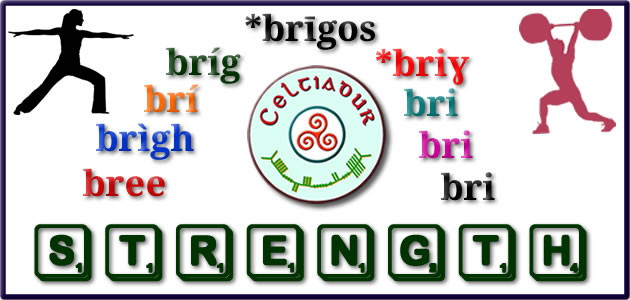
Proto-Celtic *brīgos = strength
*brīga = power, worth
Gaulish *brīgos = strength
Old Irish (Goídelc) bríg [bʲrʲiːɣ / bʲrʲiːɣʲ] = force, power, value, virtue, strength, vigour, vitality
brígach = powerful, mighty, strong
brígmar = powerful
Middle Irish (Gaoidhealg) bríg, brigh = power, strength, force, authority, vigour, virtue, might, value, worth, advantage, meaning
brígach = powerful, mighty, forceful
brígda = strong, vigorous
brígmar = powerful, strong, vigorous, lively, efficacious
brígrad = power, force
Irish (Gaeilge) brí [brʲiː] = strength, vigour; force, significance; influence, merit
bríoch = strong, vigorous, efficacious
bríochmar = strong, viorous
bríochtach = strong, vigorous person
Scottish Gaelic (Gàidhlig) brìgh [brʲiː] = essence, gist, matter, pith, purport, substance; meaning, sense, significance; point (of an argument); energy, force
brìghealachd [brʲiː.əLəxg] = substance, juiciness, pithiness, significance (in mathematics)
brìgheil [brʲiː.al] = meaningful, significant
brìoghmhor [brʲiː(v)ər] = meaningful, energetic, substantial, pithy
Manx (Gaelg) bree = power, energy, stamina, vigour, virtue, initiative, validity, animation, inwardness, glow, exhalation, drift, essence, gist, effect
breeagh = inspiring, vigorous
breeoil = dynamic, energetic, essential, impulsive, valid, vibrant, vigorous, active, powerful
Proto-Brythonic *briɣ = honour, dignity (?)
Middle Welsh (Kymraec) bri = honour, dignity, reputation, fame
Welsh (Cymraeg) bri [briː] = honour, dignity, reputation, fame, prestige, esteem, power, authority, importance, value, popularity
briaeth = honour, dignity
briol = honourable, reverent, dignified
Middle Cornish (Cernewec) bry = account, value, worth, price
Cornish (Kernewek) bri = distinction, esteem, importance, relevance, reputation, value, prominence
fowt bri = insignificance
heb bri = irelevant
Old Breton (Brethonoc) bri = importance, weight, authority
Middle Breton (Brezonec) bry = respect, consideration
Breton (Brezhoneg) bri [briː] = dignity, honour, respect, consideration
brient = privilege, prerogative
brientek [bri.ˈɛn.tek] = privileged
brientin = = privileged, aristocrat

Etymology: possibly the Proto-Indo-European *bʰrḗǵʰ-o-s, from *bʰerǵʰ- (to rise, ascend, to be elevated, up high). Words from the same roots, via Gaulish, include brio (vigour, vivacity) in English, briu (energy, push, courage) in Catalan, brio (vivacity, liveliness) in Italian, brío (vigour, mettle, zeal) in Spanish, and brio (brilliance, panache) in French [Source].

Words from the same PIE roots include barrow, burrow, bury, effort, force and fort in English, and brenin (king), bwrw (to hit, strike, cast) in Welsh [Source].

Proto-Celtic *nertom = strength, power
Celtiberian Nerto- = strength (?)
Gaulish Nerto- = strength (?)
Old Irish (Goídelc) nert [n͈ʲer͈t] = power, strength
nertaid [ˈn͈ʲer͈tɨðʲ] = to strengthen
Middle Irish (Gaoidhealg) nert, nnert, nirt = strength, might, power, ability, significance
nertaid = to strengthen, confirm, exhort, urge
nertaigid = to strengthen, confirm, encourage, grow strong, side with support
Irish (Gaeilge) neart [nʲaɾˠt̪ˠ / n̠ʲæɾˠt̪ˠ] = strength, force, power, ability, plenty
neartaigh = to strengthen
neartaitheach = strengthening, reinforcing
neartaitheoir = strengthener, abettor
neartmhaire = vigorousness, strength
neartmhar = strong, vigorous, powerful
neartú = strengthening, reinforcement, support
Scottish Gaelic (Gàidhlig) neart [̪nʲɛRʃd] = might, strength, force, energy, power, (alcoholic) proof, majority, most
neartachadh [n̪ʲɛRʃdəxəɣ] = strengthening, building up, making strong
neartaich strengthen, build up, make strong
neartaiche = strengthener, emphasiser
neartail = mighty, powerful, emphatic, forcible
neartmhor = mighty, powerful, emphatic, forcible
neartmhorachd = robustness, vigour
Manx (Gaelg) niart = strength, power, force
niartaght = strength
niartal = cogent, forcible, mighty, potent, powerful, strong
niarteyder = strengthener
Proto-Brythonic *nerθ [nɛrθ] = strenght, force, power
Old Welsh (Kembraec) nerthi = to strengthen, reinforce, fortify
Middle Welsh (Kymraec) nerth, nyrth = force, strength, power, might
nerthawc, nerthawg, nerthog = strong, mighty, powerful
nerthawl, nerthol = strong, mighty, powerful
nerthu = to strengthen, reinforce, fortify
nerthyd, nerthwr = fortifier, supporter, helper
Welsh (Cymraeg) nerth [nɛrθ] = force, strength, power, might, energy, vigour, hardness
nerthedig = strong, strengthened
nerthog = strong, mighty, powerful, potent
nerthol = strong, mighty, powerful, potent
nerthu = to strengthen, reinforce, fortify, aid, help, exhort, urge
nerthwr, nerthydd = fortifier, supporter, helper
Middle Cornish (Cernewec) nerth = might, power, strength, force
Cornish (Kernewek) nerth [nɛrθ] = energy, force, might, power, strength
nertha = to strengthen
nerthek = energetic, powerful, robust
Old Breton (Brethonoc) nerth = force, energy
Middle Breton (Brezonec) nerz, nerh = force, energy
nerzus, nerhus = vigorous, robust, energetic
Breton (Brezhoneg) nerzh [nɛrs] = force, energy
nerzhan nerzhañ [ˈnɛrzan / ˈnɛrzã] = to strengthen, reinforce
nerzhder = vigueur
nerzhek = drastic
nerzhekaat = to give energy
nerzhelour = dynamic
nerzhus = vigorous
nerzhusaat = to strengthen oneself

Etymology: possibly the Proto-Indo-European *h₂ner-to- (virile, strong), from *h₂nḗr- (man, vital, energy). Words from the same roots include njer (man, human, person) in Albanian, άντρας [ˈandras] (man, husband) in Greek, noras (wish, desire, will, intention) in Lithuanian, nêr (lord, chief) in Welsh, and the name Nero [Source].

Old Irish (Goídelc) láitir = strong, powerful
Middle Irish (Gaoidhealg) láitir, laitir [ˈl͈aːdʲərʲ] = strong, powerful
Irish (Gaeilge) láidir [ˈl̪ˠɑːdʲəɾʲ / ˈl̪ˠaːdʲəɾʲ] = strong, powerful, durable, tough, solid, forcible, loud
láidreacht = strength
láidrigh = to strengthen
Scottish Gaelic (Gàidhlig) làidir [l̪aːdʲɪrʲ] = strong, potent, emphatic, robust, substantial
làidireachd = strength
làidireach = strong, potent, emphatic
làidrich = make strong, strengthen
Manx (Gaelg) lajer = strong, potent, vigorous, hard, heavy, powerful, stark
lajeragh = to strengthen, strengthening
lajerid = potency, powerfulness, strength, vigour
lajerys = cogency, force, might, prowess, strength

Etymology: unknown [Source].

Irish (Gaeilge) cadrán = hardness, stubborness, obstinacy
cadránta = hard, unfeeling, stubborn, obstinate
cadrántacht = hardness, stubborness, obstinacy
Proto-Brythonic *kadarn = strong, powerful, mighty (?)
Middle Welsh (Kymraec) cadarn, kadarn, katarnn = strong, powerful, mighty
cadarnhau, kadarnaha = to strengthen, secure, fortify, safeguard
kedernyt, kedernit, cedernyt = strength, power, potency, might
Welsh (Cymraeg) cadarn [ˈka(ː)darn] = strong, powerful, mighty, firm, fast
cadarnhad = confirmation
cadarnhau = to strengthen, secure, fortify, safeguard
cadernid = strength, power, potency, might
Middle Cornish (Cernewec) cadarn = strong, stout, valiant

Etymology: from Proto-Celtic *katus (battle), from Proto-Indo-European *kéh₃tus (battle), from *keh₃- (to fight). Words from the same roots include Hader (dispute, quarrel) and hadern (to quarrel, bicker, struggle) in German, and words for battle in Celtic languages [Source].

Proto-Celtic *kriɸmos = strong (?)
Proto-Brythonic *krɨβ̃ = strong
Middle Welsh (Kymraec) cryf, kryf = strong, powerful, vigorous
cryfder = strength, power, might
Welsh (Cymraeg) cryf [krɨːv / kriːv] = strong, powerful, vigorous, intoxicating, tough, rich, fruitful, intense
cryfder = strength, power, might
cryfhau = to strengthen
Old Cornish crif = strong, mighty, vigorous, hardy
Middle Cornish (Cernewec) cref, crŷf, crif, crev = strong, mighty, vigorous, hardy
Cornish (Kernewek) krev = forceful, powerful, robust, strong, substantial
krevder = intensity, strength
Middle Breton (Brezonec) cref, creff = strong, powerful
Breton (Brezhoneg) kreñv [ˈkrẽ(w)] = strong, solid
kreñvaat [krẽˈfɑːt] = to strengthen, reinforce
kreñvder [ˈkrẽ(w)dɛr] = strength, power, might
kreñvlec’h = stronghold, fortress

Etymology: from Proto-Celtic *kriɸ- (body) from Proto-Indo-European *krep- (body). Words for body in Celtic and other languages come from the same roots [Source].

Proto-Celtic *trexsnos = strong
*trexsos = stronger
Gaulish Trexius, Trexa, Trenus = personal names
Primitive Irish ᚈᚈᚏᚓᚅᚐᚂᚒᚌᚑᚄ (ttrenalugos), ᚈᚏᚓᚅᚐᚌᚒᚄᚒ (trenagusu) = (?)
Old Irish (Goídelc) trén [tʲrʲeːn] = strong
treise = power, strength
Middle Irish (Gaoidhealg) trén = strong, powerful, strong man
treise = strength, vigour, power
Irish (Gaeilge) tréan = strong man, warrior, champion, strength, power, intensity, plenty, abundance
tréaniarracht = strong, forcible, attempt
treise = strength, power, dominance, force, emphasis
treisigh = to strengthen, reinforce, fortify
treisiúil = strong, forceful, vigorous
Scottish Gaelic (Gàidhlig) trèine [treːnə] = might, power
treise [treʃə] = strength, vigour
treun [treːn] = champion, hero, brave, strong, sturdy
treunar [treːnər] = strong man, champion, hero; very brave, heroic
treunas = might, power
treuntachd = boldness, courage
treuntas = strength, power, magnanimity
Manx (Gaelg) trean = brave, firm, heroic, intensive, mighty, stout, valiant
treanid = braveness, exploit, feat heroics, might, strength, valour
Proto-Brythonic *trex = stronger
Middle Welsh (Kymraec) trech = stronger, mightier, greater, superior, better
Welsh (Cymraeg) trech [treːχ] = stronger, mightier, greater, superior, better
trechedd = supremacy, dominance
trechu = to defeat, overcome, overpower
Cornish (Kernewek) trygh = conquest, victory, superior, triumphant, victorious
trygher = victor
tryghi = to conquer, vanquish
Middle Breton (Brezonec) trech = victorious, victory
trechy, trechiff = to conquer, prevail, overcome
Breton (Brezhoneg) trec’h [briː] = superior, victorious, victory
trec’hadeg = triumph
trec’hadenn = success
trec’hedigezh = defeat
trec’her = winner
trec’hin, trec’hiñ = to conquer, prevail, overcome
trec’hus = victorious

Etymology: the Proto-Indo-European *(s)treg- (to be stiff, rigid, strong) or *treg- (strength). Words from the same roots include þróttur (strength, vigour, energy) in Icelandic, and idrott (sport, physical education) in Swedish [Source].

The Fastest Way to Learn Japanese Guaranteed with JapanesePod101.com

Sources: Wiktionary, Am Faclair Beag, Online Manx Dictionary, Teanglann.ie, eDIL – Electronic Dictionary of the Irish Language, In Dúil Bélrai English – Old Irish glossary, Geiriadur Prifysgol Cymru, Gerlyver Kernewek, Dictionaire Favereau, TermOfis, English – ProtoCeltic WordList (PDF), Etymological Dictionary Of Proto Celtic

Unlimited Web Hosting - Kualo

Birch (trees)

Words for birch (genus Betula) in Celtic languages.

Birch Trees

Words marked with a * are reconstructions.

Proto-Celtic *betwiyos / *betuyā = birch (tree)
Gaulish betulla, *bitu, *betua = birch
Old Irish (Goídelc) beithe = birch (tree)
Middle Irish (Gaoidhealg) beithe. beith = birch tree, birch wood, the letter b in Ogham (ᚁ)
beithech = birch land, grove of birch
beithe-luis(-nin) = Ogham alphabet (ᚁᚂᚅ) – named after the first few letters
Irish (Gaeilge) beith = birch (tree), letter B in Ogham (ᚁ)
beith gheal = silver birch (Betula pendula)
beitheach = covered or planted with birches
Scottish Gaelic (Gàidhlig) beithe [behə] birch, the letter B in Ogham, birch wood/forest
beith-gheal = silver birch
beith luis nuin = ABC
Manx (Gaelg) beih = birch (tree)
beih argid = silver birch
beihagh = birch, birchen
Proto-Brythonic *bedu = birch (tree)
Middle Welsh (Kymraec) bedw, bedỽ = birch
bedwen = birch tree
bedwaỽt = song of the birch, song of good omen
betuerỽ = birch grove, place abounding with birch trees
betguos, bedwes = birch grove
Welsh (Cymraeg) bedw [ˈbɛdʊ / ˈbeːdu] = birch, birch grove, maypole, birch-rod
bedwen = birch tree
bedw arian = silver birch
bedwerw = birch grove, place abounding with birch trees
bedwos, bedwes = birch grove
Old Cornish bedewen = birch
Middle Cornish (Cernewec) bedewen = birch tree, poplar tree, aspen tree
Cornish (Kernewek) besow = birches
besowen = birch (tree)
besow arghas = silver birch
Old Breton (Brethonoc) bedu = birches
beduan = birch
Middle Breton bezu = birches
bezuenn = birch
Breton (Brezhoneg) bezv [ˈbɛ(z)w] = birches
bezvenn [ˈbe(z).vɛn] = birch
bezveg [ˈbe(z).vɛk] = birch grove
bezvenneg = birch grove
bezvennek = abounding in birches

Etymology: from Proto-Indo-European *gʷetu-yo-s, from *gʷet- (resin, gum) [source]. Words from the same Proto-Celtic roots, via Gaulish *bitu/betua and Latin *betius, include betulla (birch) in Italian, bouleau (birch) in French, bedoll (birch) in Catalan, bétula (birch) in Portuguese, βετούλη (vetoúli – birch) in Greek, and abedul (birch) in Spanish. The botanical Latin name for the genus Betula (birch) also comes from the same roots [source].

Sources: Wiktionary, Etymological Dictionary Of Proto Celtic, In Dúil Bélrai English – Old Irish glossary, eDIL – Electronic Dictionary of the Irish Language, Teanglann.ie, Am Faclair Beag, An etymological dictionary of the Gaelic language, Fockleyreen: Manx – English Dictionary, Online Manx Dictionary, Gaelg Corpus, Geiriadur Prifysgol Cymru, Lexicon cornu-britannicum : a dictionary of the ancient Celtic language of Cornwall, Gerlyver Kernewek, Devri : Le dictionaire diachronique du breton, Geriafurch, TermOfis

Oak (trees)

Words for oak (tree) and related things in Celtic languages.

Here be trees!

Words marked with a * are reconstructions.

Proto-Celtic *daru [d̪ˠaɾʲ] = oak
Gaulish Dervo = used in placenames
Old Irish (Goídelc) dair [d̪ˠaɾʲ] = oak
Middle Irish (Gaoidhealg) dair, daur = an oak, the letter D in the Ogham alphabet (ᚇ)
dairbre, dairbhre = an oak, oakling, a grove of oak grees, an oak wood
dairde, daurde = oaken
dair-ḟid, dauruth = an oak wood
Irish (Gaeilge) dair [d̪ˠaɾʲ] = oak, the letter D in the Ogham alphabet (ᚇ)
dairbhre = oaks, oak-grove
daireach = planted with / full of oaks
doire [ˈd̪ˠɛɾʲə] = oak-wood; wood, grove, thicket
Scottish Gaelic (Gàidhlig) dair [darʲ] = oak (archaic), the letter D, ᚛ᚇ᚜ in Ogham
dairbhre = oak, nursery or grove of oaks
darach [darəx] = oak, oaken, made of oak; ship (poetic)
darag [darag] = small/dwarf oak, stunted/branchy tree (which is not useable for working)
Manx (Gaelg) darragh = oak, oaken, oak grove, oak wood
darrag = oak, beam, cast (fishing), snood, hairline
darree = oak
Proto-Brythonic *dar [ˈdar] = oak tree
Middle Welsh (Kymraec) dar, dâr = oak
derwd(y) = oak house, oratory, prayer house, coffin
derwin, deruin = make of oak, oaken, abounding in oaks, strong, robust, oak timber
Welsh (Cymraeg) dâr [ˈdaːr] = oak tree, foremost warrior, leader, mighty lord
derw = oak trees
derwen [ˈdɛrwɛn] = oak tree
derwin = make of oak, oaken, abounding in oaks, strong, robust, oak timber
der(w)lwyn = oak grove, oak wood
Old Cornish dar = oak
Middle Cornish (Cernewec) dar = an oak
Cornish (Kernewek) dar [daːr / dæːr] = oak
derwen = oak tree
derw = oak trees
Old Breton daeru = oaks
Middle Breton (Brezonec) deru = oaks
Breton (Brezhoneg) dar [dɑːr] = oak
derv [ˈdɛrw/ˈdɛː.ro] = oaks
dervenneg = with oak trees
dervoed [dɛʁwət] = oak grove, oak wood

Etymology: from the Proto-Indo-European *dóru (tree) [source].

Words from the same Proto-Celtic root possibly include làrix (larch) in Catalan, lariks (larch) in Dutch learag (larch) in Scottish Gaelic, larch in English, Lärche (larch) in German, and lærk (larch) in Danish [source].

Words from the same PIE root include δόρυ (dóry – spear) in Greek, dervà (tar, resin) in Lithuanian terva (tar) in Finnish, dearbh (sure, certain) in Irish, tree, trim, and trough, true in English, and trä (wood) in Swedish [source].

Proto-Celtic *tannos = green oak
Gaulish *tannos = oak
Old Irish (Goídelc) tinne = holly, elder
Middle Irish (Gaoidhealg) tinne = holly, elder, the letter t in the Ogham alphabet (ᚈ)
Irish (Gaeilge) tinne = the letter t in the Ogham alphabet (ᚈ)
Scottish Gaelic (Gàidhlig) teine/tinne [tʲenə] = gorse, whin, furze (archaic), the letter t (ᚈ) in Ogham
Welsh (Cymraeg) taneru, tener(i)o = to tan (hide)
tanerdy = tannery
tanerwr = tanner (of hides)
Old Cornish tannen = oak (?)
Middle Cornish (Cernewec) tonnen = bark
glastanen, glastennen, glastan = (scarlet) oak
Cornish (Kernewek) glastanen gelyn = holly/holm oak
glastanen gork = cork oak
Middle Breton (Brezonec) glastann(enn) = holm oak(s)
Breton (Brezhoneg) tann [tānː] = sessile oaks
tannañ = to tan
glastann = holm oaks

Note: the Welsh words were borrowed from English tanner, which ultimately comes from Proto-Celtic *tannos, via French, Latin and Gaulish.

Etymology: from Proto-Celtic *(s)tannos, the Proto-Indo-European *(s)dʰnwos/*(s)dʰonu (fir). Words from the same Proto-Celtic roots, via Gaulish and Latin tannum (oak bark), include tan (pulped oak bark used in the tanning process of leather) in French, tano (stem, slip) in Galician, tanería (tannery), Tannenbaum (fir tree, Christmas tree) in German, θάμνος (thámnos – bush) in Greek, and tan, tannery, tannin (tannic acid) in English.

Words from the same PIE roots include thanë (cranberry bush) in Albanian, and धनु (dhanu – bow) in Sanskrit. [source].

The Fastest Way to Learn Japanese Guaranteed with JapanesePod101.com

Sources: Wiktionary, Etymological Dictionary Of Proto Celtic, In Dúil Bélrai English – Old Irish glossary, eDIL – Electronic Dictionary of the Irish Language, Teanglann.ie, Am Faclair Beag, An etymological dictionary of the Gaelic language, Fockleyreen: Manx – English Dictionary, Online Manx Dictionary, Gaelg Corpus, Geiriadur Prifysgol Cymru, Lexicon cornu-britannicum : a dictionary of the ancient Celtic language of Cornwall, Gerlyver Kernewek, Devri : Le dictionaire diachronique du breton, Dictionnaires bilingues de Francis Favereau / Edition Skol Vreizh, TermOfis

Unlimited Web Hosting - Kualo

Fields, Meadows and Pastures

There are a number of words for fields, meadows and pastures in Celtic languages. Some appear only or mainly in placenames. Here’s a selection:

Roman Camp

Words marked with a * are reconstructions.

Old Irish (Goídelc) achad = expanse of ground; pasture, field; field of battle
Middle Irish (Gaoidhealg) achad = expanse of ground; pasture, field
Irish (Gaeilge) achadh [ˈaxə/ˈaxuː] = field (archaic, used mainly in placenames)
Scottish Gaelic (Gàidhlig) achadh [axəɣ] = field, plain, meadow; cornfield newly cut or ready for reaping
achadh-feòir = hayfield
achadh-guail = coalfield
bàn-achadh = fallow field

Etymology: unknown, possibly related to the Latin acnua (a measure or piece of land, 120 feet square) [source].

Proto-Celtic *gortos = fence, enclosure, pen
Old Irish (Goídelc) gort = field, orchard, crop
Middle Irish (Gaoidhealg) gort = field (arable or pasture land), field of battle, land, territory, standing corn
guirtine = a little garden
Irish (Gaeilge) gort [ɡɔɾˠt̪ˠ] = (cultivated) field, orchard, (standing) crop
gortbhriseadh = tilling a field, tillage
gortghlan = to clear (a field) of weeds, to weed out
gortghlanadh = clearance (of a field), weeding
gortghlantóir = weeder
Scottish Gaelic (Gàidhlig) gort [gɔrˠʃd] = standing corn; enclosure; small field
Proto-Brythonic *gorθ = field
Welsh (Cymraeg) garth = field, close, enclosure, fold, pen, yard; fort
garthan = entrenchment, encampment, camp, stronghold, field of battle
gartheiniad = camp defender
Cornish (Kernewek) gorth = field
Old Breton orz = field
Breton (Brezhoneg) garz = field

Etymology: from the Proto-Indo-European *ǵʰortós (enclosure, hedge) [source], which is also the root of words yard and garden in English, via the Proto-Germanic *gardaz (enclosure, court, yard, garden) [source].

Old Irish (Goídelc) macha = milking-yard
Middle Irish (Gaoidhealg) macha, machad = an enclosure for milking cows, a milking-yard or field
Irish (Gaeilge) machaire = plain; stretch of level ground, links, course; field
Scottish Gaelic (Gàidhlig) machair [maxɪrʲ] = extensive low-lying fertile plain, level country; extensive beach; ow and level part of a farm
Manx (Gaelg) magher = field, fertile land, campaign, chase, machar, sphere

Etymology: possibly from the Latin mācĕria (wall, enclosure) [source].

Proto-Celtic *rowesyā- = field, open ground
Old Irish (Goídelc) róe [r͈oːi̯] = battle-field, level piece of ground, fight, battle
Middle Irish (Gaoidhealg) róe, roe = a level piece of grand, a battle field, battle, a rout, fight
Irish (Gaeilge) [rˠeː] = stretch of ground, level ground, field
Scottish Gaelic (Gàidhlig) raon [rˠɯːn] = field, (piece of) ground; plain; zone, area; field (of expertise); ambit
Manx (Gaelg) rheam = gamut, range, field, monarchy
Old Breton runt = mound
Breton (Brezhoneg) run = mound, hill

Etymology: from the Proto-Indo-European *Hrew(H)os (open space, field). The English words rustic and rural come from the same root, via Latin [source].

Proto-Celtic *kagyom = pen, enclosure
Gaulish cagiíun / *kagyom = enclosure
Old Irish (Goídelc) cai = field, orchard, crop
Irish (Gaeilge) [kʲeː] = quay
Scottish Gaelic (Gàidhlig) cidhe [kʲi.ə] = quay
cidhe-tìreachaidh = wharf
cidhe-bathair = goods wharf
Manx (Gaelg) keiy = jetty, quay(side), wharf
Proto-Brythonic *kaɨ = animal pen, enclosure, field
Middle Welsh (Kymraec) kay / kae = field, enclosure
Welsh (Cymraeg) cae [kaːɨ̯ / kai̯] = hedge, hedgerow, fence; field, enclosure; circle, sphere; barrier, obstruction
caead = lid, cover, shutter, flap, shell, case, enclosure, case, wall, fence, hedge, field, buckle, clasp, fastener, valve
caeadu = to bind, cover (a book), stop, close
cei [kei̯] = quay
Cornish (Kernewek) ke = hedge, fence
kay = quay
Old Breton cai = hedge
Middle Breton quae = hedge
Breton (Brezhoneg) kae [kɛː] = hedge, quay

Etymology: from the Proto-Indo-European *kagʰyóm (enclosure, hedge) [source], which is also the root English words quay and hedge [source].

The Irish, Scottish Gaelic and Manx words for quay come from the same Proto-Celtic root, via the Anglo-Norman kay, cail (quay, wharf) and Gaulish [source]. The Welsh and Cornish words for quay also come from the same Proto-Celtic root, via Middle English, Old French and Gaulish [source].

Words from the same Proto-Celtic root, via Gaulish *kagyom and Latin caium (storehouse, shop, workshop, quay, wharf) include quai (quay, wharf, platform) in French, quay in English, кей (kej – quay, pier, wharf, jetty) in Bulgarian, and cais (quay, pier, wharf, platform) in Portuguese [source].

Proto-Celtic *magos = plain, field
Gaulish *magos = field
Old Irish (Goídelc) mag [maɣ] = plain, field
ármag, árbach, ármach = field of slaughter, battlefield
Middle Irish (Gaoidhealg) mag, maig = plain, open stretch of land
Irish (Gaeilge) [mˠɑː / mˠæː] = plain
Scottish Gaelic (Gàidhlig) magh [mɤɣ] = level country, plain
Magh Meala = Land of (Milk and) Honey (in mythology)
Magh Meall = elysium
magh na bàire = the plain of battle
Manx (Gaelg) magh = plain
Middle Welsh (Kymraec) mais, maes, meys = open country, plain, field
Welsh (Cymraeg) maes [maːɨ̯s / mai̯s] = open country, level land, plain; field; battle, victory, supremacy; out, away, off, outside, out of doors
maesol = rural, agrarian
maestref = suburb, country town, village, hamlet
maestrefol = suburban
Middle Cornish (Cernewec) maes, mes, meas, meys = open country, plain, field
Cornish (Kernewek) mes = open country
mestrev = suburb
mesya = to field
Old Breton maes = countryside, outside
Breton (Brezhoneg) maez = countryside, open field, outside, wide

Etymology: possibly from the Proto-Indo-European *meǵh- (great) [source].

Proto-Celtic *klowni = meadow
Old Irish (Goídelc) clúain = meadow
Middle Irish (Gaoidhealg) clúain, clóin = meadow, pasture-land, glade
Irish (Gaeilge) cluain = meadow
Scottish Gaelic (Gàidhlig) cluain [kl̪uən̪ʲ] = green field, pasture, meadow
Old Welsh clun = meadow, moor
Middle Welsh (Kymraec) clun = meadow, moor
Welsh (Cymraeg) clun [klɨːn / kliːn] = meadow, moor; brake, brushwood

Etymology: possibly from the Proto-Indo-European *klopni (wet).

Old Irish (Goídelc) áirge [ˈaːrʲɣʲe] = a place for milking cows
Middle Irish (Gaoidhealg) áirge, arigi, airge = a place for milking cows, byre, cowshed, herd of cattle
áirgech = having numerous herds, herdsman
Irish (Gaeilge) áirí = milking-place, herd (of cows), ground manured in previous year; ground from which potatoes have been cropped
Scottish Gaelic (Gàidhlig) àirigh [arʲɪ] = hill pasture, bothy, sheiling, pastoral summer residence
àirigheach [aːrʲɪjəx] = bounding in hill pastures. bothies or shielings
àirigheachd [aːrʲɪjəxg] = transhumance
Manx (Gaelg) eairee = hill pasture, shieling

Etymology: from Old Irish árach, from ad·rig (to tie, bind). The Faorese word ærgi [ˈaɹt͡ʃɪ] (a pasture for cattle to graze over the summer with a hut where the people tending them live meanwhile; a shieling, saeter) also come from the same roots [source].

Words marked with a * are reconstructions.

Sources: Wiktionary, Am Faclair Beag, Online Manx Dictionary, Teanglann.ie, eDIL – Electronic Dictionary of the Irish Language, In Dúil Bélrai English – Old Irish glossary, Geiriadur Prifysgol Cymru, Gerlyver Kernewek, Lexicon Cornu-britannicum: A Dictionary of the Ancient Celtic Language of Cornwall, Dictionaire Favereau, TermOfis, Le dictionnaire diachronique du breton, Etymological Dictionary Of Proto Celtic

The Fastest Way to Learn Japanese Guaranteed with JapanesePod101.com

Death

Words for death and related things in Celtic languages.

Death

Words marked with a * are reconstructions.

Proto-Celtic *bāstom / bāssom = death
*bayeti = to die
*batom = death, pestilence
*dībatom = extinction, extinguisment
Gaulish dib = ?
Old Irish (Goídelc) bás [baːs] = death
baïd [ˈba.əðʲ] = to die
bath = death
díbad = extinction, quenching, estate of deceased
Middle Irish (Gaoidhealg) bás(a), báas = death
básaid, basat = to kill, put to death
básaigid, bäsaiged = to kill put to death, slay
básaire = executioner
básamuil = mortal
bath, baath, báth = death, destruction
díbad, dibud, dibath = destruction, extinction, quenching
Irish (Gaeilge) bás [bˠɑːsˠ / bˠæːsˠ] = death
básachán = dying, feeble, creature
básadóir = executioner
básaigh = to put to death, execute, die
básmhaireacht = mortality
básmhar = mortal
básúil = deathlike, deadly
díobhadh = elimination, extinction
díobhaí = without issue, extinct
Scottish Gaelic (Gàidhlig) bàs [baːs] = death, fatality, decease, demise
bàsachadh [baːsəxəɣ] = (act of) dying, expiring
bàsail [baːsal] = deadly, fatal, death-like
bàsaire [baːsɪrʲə] = executioner
bàsmhor [baːs(v)ər] = mortal, deadly, fatal, lethal
bàsmhorach [baːsvərəx] = mortal
bàsmhorachd [baːsvərəxg] = mortality, deadliness, lethalness
diobhadh† = destruction, death, inheritance
Manx (Gaelg) baase [bɛːs] = death
baasoil = deadly, deathlike, fatal
baasoiley = deadly
baasoilid = deadliness, mortality
Proto-Brythonic *bad = ?
Middle Welsh (Kymraec) bad, bat = plague, pestilence, death
Welsh (Cymraeg) bad = plague, pestilence, death
Old Cornish badus = lunatic
Middle Cornish (Cernewec) badus = lunatic
Cornish (Kernewek) badus = lunatic
Old Breton (Brethonoc) bat = ?
Middle Breton (Brezonec) bad(ou) = dizziness
badet = dazzled
Breton (Brezhoneg) bad [bɑːt] = daze
badañ = to daze
badet = stupefied

Etymology: from the Proto-Indo-European *gʷeh₂- (to go, step, stand) [source].

Proto-Celtic *marwos = dead
*marwāti = to die, kill
*marwonatus, *marwonatā = elegy, eulogy
Gaulish *maruos = dead
Old Irish (Goídelc) marb = dead; mortified, insensible, spiritually dead; inanimate; stagnant (water)
marbaid = to die, kill
marbán = corpse, dead person
marbdae = mortal, lifeless, inanimate
mart = death, dead animal, slaughtered cow or ox
Middle Irish (Gaoidhealg) marb = dead (person), mortal, mortified, insensible, spiritually dead, dying, lifeless, unconscious
marbaid = to kill, slay
marbnad, marbna, marbnadh = elegy
Irish (Gaeilge) marbh [ˈmˠɑɾˠəvˠ / ˈmˠarˠuː / ˈmˠarˠu] = dead person, death, defunct
marbhán = dead person, corpse, lethargic person, sultry weather
marbhánta = lifeless, spirtless, lethargic, dull, stagnant, airless, sultry, oppressive
marbhlann = morgue
marbhna = elegy
marfach = killing, slaying, carnage, slaughter, deadly, fatal, lethal
marfóir = killer
Scottish Gaelic (Gàidhlig) marbh [marav] = dead person, the dead
marbhach [maravəx] = deadly, mortal
marbhachadh [maravəxəɣ] = (act of) killing
marbhadair, marbhaiche = killer, slayer, murderer
marbhadh [maravəɣ] = (act of) killing
marbhan [maravan] = corpse
marbhrann [maravrən] = elegy
Manx (Gaelg) marroo = dead, lifeless, inanimate, glassy (look), muggy, dull, dud, stagnant, defunct, mortified, slaughtered, departed, deceased, killed, extinct
marrooagh = deadly, fatal, lethal, overpowering, internecine
marvaanagh = mortal, earthborn, fatal, vile
merriu = (the) dead, dead men, departed souls
Proto-Brythonic *marw = dead
*marwọd [marˈwɔːd] = to die
*marwnad = elegy (?)
Middle Welsh (Kymraec) marw, maru = dead, deceased, inanimate, spiritually dead
maru, merwi, marw = to die, expire, cease to exist, vanish, fade away
marwnad, marwnat = elegy, dirge, funeral song, epitaph
marwavl, marwawl, marwol = mortal, transitory, transient
Welsh (Cymraeg) marw = dead, deceased, inanimate, spiritually dead, insensible, lifeless, dull, languid
marwolaeth = death, decease, demise; suffering, tribulation; deadly plague or pestilence, fatal disease
marw(af), merwi = to die, expire, cease to exist, vanish, fade away
marwaidd = lifeless, languid, torpid, listless, dull, slugglish, drowsy, numb
marwnad [ˈmar.(w)nad] = elegy, dirge, funeral song, epitaph
marwol = mortal, transitory, transient
Middle Cornish (Cernewec) marow = dead, deceased, lifeless
marwel, merwel = to die, become lifeness
Cornish (Kernewek) marow = dead (person), switched off
marwel = mortal
marwostel = mortgage
marwostla = to mortgage
mernans = death
merwel = to decease, die, pass away
Middle Breton (Brezonec) marf, maru = death
maruel = mortal
meruell, meruel = to die
Breton (Brezhoneg) marv [mɑːro/ˈmarw] = death
marvedigezh = extinction
marvel = mortal
marvelezh = mortality
marvenn = necrosis
marveenniñ = to necrotize, become gangrenous
marvus = mortal, perishable
mervel [mɛr.vɛl] = to die, pass away, become insensible, extinguish

Etymology: from Proto-Indo-European *mr̥wós (dead), from *mer- (to die, disappear) [source]. Words from the same roots include morbid, moribund, mortal, mortgage, murder, nightmare and postmortem in English, мереть (to die, stand still, sink) in Russian, mìrt (to die, stop working) in Latvian, and mir̃ti (to die) in Lithuanian [source].

Proto-Celtic *ankus = death
Old Irish (Goídelc) éc = death
Middle Irish (Gaoidhealg) éc, ec = death
Irish (Gaeilge) éag = Death, numbness, powerlessness
éagach = deceased (person)
éagbhás = dead-and-alive person
éaglach = (state of) extinction, death
éagmhar = fatal, causing death
Scottish Gaelic (Gàidhlig) eug [eːg] = death, Death, ghost, spectre
eug-lios = burial ground, churchyard, cemetery
eugach [iəgəx] = deathly, death-like, ghastly
eugachdainn [eːgəxgɪnʲ] = (act of) perishing, giving up the ghost
eugail [iəgal] = deathly, death-like, ghastly
Middle Welsh (Kymraec) agheu, angheu, aghev = death, decease, demise
Welsh (Cymraeg) angau = death, decease, demise, annihilation, cessation, mortal danger
Old Cornish ancou = death
Middle Cornish (Cernewec) ancow = death
Cornish (Kernewek) ankow = death
Old Breton (Brethonoc) ancou = Death
Middle Breton (Brezonec) ancou, ancquou, anquou = Death
Breton (Brezhoneg) ankoù [ˈãŋkow/ˈãŋku] = Death, skeleton

Etymology: from Proto-Indo-European *neḱ- (to perish, disappear). Words from the same PIE roots include innocent, necropolis, nectar, noxious and nuisance in English, nuocere (to harm, injure, damage) in Italian, nuire (to harm, spoil) in French, anegar (to inundate, flood, drown) in Spanish, éacht (slaying, slaughter, feat, exploit) in Irish, aeth (pain, woe, grief, sorrow) in Welsh, and related words in the other Celtic languages [source].

The Fastest Way to Learn Japanese Guaranteed with JapanesePod101.com

Sources: Wiktionary, Etymological Dictionary Of Proto Celtic, In Dúil Bélrai English – Old Irish glossary, eDIL – Electronic Dictionary of the Irish Language, Teanglann.ie, Am Faclair Beag, An etymological dictionary of the Gaelic language, Fockleyreen: Manx – English Dictionary, Online Manx Dictionary, Gaelg Corpus, Geiriadur Prifysgol Cymru, Lexicon cornu-britannicum : a dictionary of the ancient Celtic language of Cornwall, Gerlyver Kernewek, Devri : Le dictionaire diachronique du breton, Dictionnaires bilingues de Francis Favereau / Edition Skol Vreizh, TermOfis

Unlimited Web Hosting - Kualo

Streams and Currents

Words for stream, current and related things in Celtic languages.

Cwm Idwal

Words marked with a * are reconstructions.

Proto-Celtic *srutom = stream, river; flow, current
Gaulish srut(u)a = torrent, stream, watercourse
Old Irish (Goídelc) sruth [sruθ] = stream, river, current; strait
Middle Irish (Gaoidhealg) sruth = stream, river, current, torrent, strait
Irish (Gaeilge) sruth [sˠɾˠʊ(h)] = stream, current, flow
sruthach = streaming, flowing, full of streams
sruthaigh = to stream, flow
sruthaire = stroller, vagabond, unbidden guest
sruthaireacht = (act of) roaming, vagabondage, (act of) scrounging
sruthán = (small) stream, rivulet, brook, gush, flow
sruthánach = abounding in streams, streaming
sruthlán = streamlet, rill
Scottish Gaelic (Gàidhlig) sruth [sdruh] = stream, current
sruthlag [sdrul̪ˠag] = runnel, streamlet
sruthan [sdruhdan] = long stream of words, long-winded talk
sruthach [sruhəɣ] = flowing, streaming, flow
sruthan [sdruhan] = brook, streamlet
sruthadair [sdruhədɪrʲ] = streamer
Manx (Gaelg) stroo [struː] = current, stream, race, watercourse, tide-race, tidal flow
strooan = brook, creek, river, rivulet, stream, waterway
strooaney = flowing, streamed
strooanagh = full of streams, streaming
Proto-Brythonic *frud = stream, river; flow, current
Middle Welsh (Kymraec) frut, ffrwt, ffryt = swift stream, torrent, flood, current
Welsh (Cymraeg) ffrwd [fruːd] = swift stream, torrent, flood, current
ffrwdel = leaves and branches piled together in a flooded river
ffrwd fâl, ffrwd y felin = mill-stream
ffryd(i)af, ffrydio, ffrydu = to flow, stream, gush, purl, shed
ffrydiedig = flowing, shed
ffrydiog = streaming, flowing
ffrydiol = flowing, streaming, gushing, fluid
ffrydiolrwydd = fluidity
ffrydlif, ffrwdlif = stream, streaming flood, torrent, current, tide
Old Cornish frot = stream
Middle Cornish (Cernewec) frot = strait, channel
Cornish (Kernewek) fros = current, flow
fros tredan = electric current
frosa = to flow
Old Breton (Brethonoc) frud, frut = torrent, stream
Middle Breton (Brezonec) froud = torrent, stream/td>
Breton (Brezhoneg) froud [fruːt] = torrent, stream

Etymology: from the Proto-Indo-European *srew- (to flow, stream). Words from the same PIE root include rheum, rhythm and stream in English, and Strom (large river, stream, current) in German [source].

Proto-Celtic *nantos / nantus = stream, valley
Proto-Brythonic *nant [ˈnant] = stream, river, valley
Gaulish *nanto = valley
Middle Welsh (Kymraec) nant [ˈnant] = river, stream, brook
Welsh (Cymraeg) nant [ˈnant] = river, stream, brook, rivulet; torrent, ditch, valley, glen, dale; ravine, gorge
nentig, nennig = small stream
Old Cornish nans = stream
Cornish (Kernewek) nans [nans / nænz] = dale, valley
Old Breton (Brethonoc) nant = valley
Middle Breton (Brezonec) nant, ant = valley
Breton (Brezhoneg) (n)ant [(n)ãnt] = valley with watercourses (archaic, used in place names)

Etymology: possibly from Proto-Celtic *nemetom (sacred place, sanctuary), from the Proto-Indo-European *nem- (to give, take, distribute) [source].

The Francoprovençal word nant (stream) comes from the same Proto-Celtic roots [source], as does the French place name Nanterre [source], the Irish word neimheadh (sanctuary, privilege of rank, holy thing), and the Breton word neved / neñved (sanctuary) [source].

Words from the same PIE root include numb, number in English. nemen (to take, grasp, grab) in Dutch, nehmen (to take, hold, grasp) in German, nimh (poison, venom) in Irish and Scottish Gaelic [source].

Irish (Gaeilge) fobhar = well, stream
Middle Welsh (Kymraec) guuer, gouer, gofer = stream
gouerei, goferu, goveru = to derive, emanate, gush, stream, run, cause to flow, pour
Welsh (Cymraeg) gofer = overflow of a well, stream, effluence, duct, stream, brook, rill, rivulet
goferaf, goferu = to derive, emanate, gush, stream, run, cause to flow, pour
goferllyd = oozy, marshy
Old Cornish guuer = brook, stream
Middle Cornish (Cernewec) gover = brook, stream
Cornish (Kernewek) gover = brook, stream
Old Breton (Brethonoc) gouher = stream
Middle Breton (Brezonec) gouuer, gouer, gouvea = stream
Breton (Brezhoneg) gou(v)er [ˈɡuː(v)ɛr] = stream, streamlet
gouverian, gouveriañ = to irrigate

Etymology: unknown [source].

Proto-Celtic *wētā, *wēttā = swamp, stream
Old Irish (Goídelc) féith [fʲeːθʲ] = vein, sinew, kidney
Middle Irish (Gaoidhealg) féith, feith = kidney, fibre, sinew, vein, artery, vessel
féithech = sinewy, veined
Irish (Gaeilge) féith [fʲeː(h)] = sinew, muscle, vein, soft seam in bogland, vine
féitheach = sinewy, muscular, veined, ribbed, swampy
féitheog = (small) sinew, muscle, vein
féitheogach = sinewy, muscular, brawny
Scottish Gaelic (Gàidhlig) fèith [feh] = muscle, sinew, vein, stagnant channel in a bog (often overgrown with moss and dry in summer)
fèith-dhìreach = gullet, oesophagus
fèith-lùthaidh = sinew, tendon
fèitheach [fɛː.əx] = muscled, muscly, sinewy, veiny
fèitheag [fɛː.ag] = small muscle, sinew or vein
Manx (Gaelg) feh = nerve, sinew, tendon
fehagh = sinewy
Middle Welsh (Kymraec) guyth, gwyth, gỽyth = vein, sinew, nerve, stream
gúithén, gwythen = vein, blood-vessel, artery, muscle
gwythiennawc, gwythennoc = veined, full of veins, venous, striated
Welsh (Cymraeg) gŵyth [ɡuːɨ̯θ/ɡʊi̯θ] = vein, sinew, nerve, stream, brook, ditch, gutter, drain, channel, firth, estuary
gwythennus = full of veins, veined, veiny
gwythïen, gwythen = vein, blood-vessel, artery, muscle, siney, (harp) string
gwyth(i)ennog = veined, full of veins, venous, striated
Old Cornish guid = channel, pipeline, vein
Middle Cornish (Cernewec) gwyth, goth = channel, pipeline, vein
Cornish (Kernewek) gooth = channel, pipeline, vein
Old Breton (Brethonoc) goed, guoeth = stream
Middle Breton (Brezonec) goazz, goaz, gouaz = stream
Breton (Brezhoneg) gwazh [ɡwaːs] = stream, canal, channel, washhouse, marshy meadow
gwazheg = watered, marshy
gwazhell = watered land
gwazhenn = vein
gwazhian, gwazhiañ = to dig a stream, to make a bed, to water
gwazhiennek = veined

Etymology: possibly from the Proto-Indo-European *weyh₁- (to whither), which is also the root of výsti (whither) in Lithuanian, and vissna (to wilt, whither) in Swedish [source].

The Fastest Way to Learn Japanese Guaranteed with JapanesePod101.com

Sources: Wiktionary, Am Faclair Beag, Online Manx Dictionary, Teanglann.ie, eDIL – Electronic Dictionary of the Irish Language, In Dúil Bélrai English – Old Irish glossary, Geiriadur Prifysgol Cymru, Gerlyver Kernewek, Dictionaire Favereau, TermOfis, English – ProtoCeltic WordList (PDF), Etymological Dictionary Of Proto Celtic

Unlimited Web Hosting - Kualo

Rivers & Stars

Words for rivers & stars in Celtic languages.

Cwm Idwal

Proto-Celtic *abonā / *abū = river
*abonko- = beaver
Gaulish ambe = river
Old Irish (Goídelc) ab [au̯v] = river
Middle Irish (Gaoidhealg) ab = river
Irish (Gaeilge) abhainn [əunʲ / əun̠ʲ / oːn̠ʲ] = river
craobh-abhainn = affluent, tributary
tréig-abhainn = distributary
Scottish Gaelic (Gàidhlig) abhainn [a.ɪn̪ʲ] = river, stream
abhainneach = fluvial, pertaining to or abounding in rivers
abhainn-deighe = river of ice, glacier
capall-aibhne = hippopotamus
con-abhainn = confluence
leas-abhainn = tributary
tur-abhainn = seasonally dry river
Manx (Gaelg) awin [aunʲ / ˈawənʲ] = river
awiney = freshwater, riverside; of a river
broogh awin = river bank, riverside
beeal/cass awin = estuary, river mouth
crouw-awin = confluence
Proto-Brythonic *aβon [aˈβoːn] = river
Middle Welsh (Kymraec) afon, avon, auon = river
Welsh (Cymraeg) afon [ˈaːvɔn / ˈavɔn] = river, stream, brook
afonfarch = hippopotamus
afonig = rivulet, stream, book
afonog = having (many) rivers or streams; fluvial
Old Cornish auon = river
Middle Cornish (Cernewec) avon = river
Cornish (Kernewek) avon, awon [ˈavɔn] = river
Middle Breton aven, avon = river
Breton (Brezhoneg) aven [ˈɑː.ven] = river

Etymology: from the Proto-Indo-European *h₂ep-h₃ōn-, from *h₂ep- (water, body of water) [source]. The names of the river Avon in England and the river A’an (Avon) in Scotland were borrowed from Proto-Brythonic [source].

Words from the same PIE roots include aven (sinkhole, pot hole) in French, avenc (chasm, gulf sinkhole) in Catalan, abeneiro (black alder tree) in Galician, amieiro (alder) in Portuguese, अप् (ap – water, Virgo) in Sanskrit, and possibly words for ape in English and other Germanic languages [source].

Proto-Celtic *rēnos = river, waterway
Gaulish Rēnos = River Rhein (?)
Old Irish (Goídelc) rían [r͈ʲiːa̯n] = sea, ocean, path, course, way, manner
Middle Irish (Gaoidhealg) rían = sea, ocean (poetic/archaic); course, route, path, way, manner, state
Irish (Gaeilge) rian = course, path, mark, trace, track, vigour
rianach = having tracks, paths
rianaí = wayfarer, wanderer, tracker, tracer, genealogist
rianaigh = to mark out, trace, indent, chart, track
rianaíocht = wayfaring, wandering
comhrian = corresponding course, contour
trasrian
Scottish Gaelic (Gàidhlig) rian [r̪ʲian] = method, mode, system, arrangement, control, management, order, sense
rianachd = administration
rianadair = arranger, controller, governor
rianail = orderly, methodical
rianaire = administrator
co-rian = system
mì-rian = confusion, disorder
Manx (Gaelg) rane = stanza, track, verse

Etymology: from the Proto-Indo-European *h₃reyH-nós, from *h₃reyH- (to flow, stream) [source]. Names for the river Rhine in many languages come from the same roots, via the Latin Rhēnus and Gaulish [source]

Proto-Celtic *sterā = star
Middle Irish (Gaoidhealg) ser = star
Proto-Brythonic *ster = stars
Welsh (Cymraeg) sêr [seːr] = stars
Cornish (Kernewek) ster = stars
Breton (Brezhoneg) ster [ˈsteːr] = stars, river

Etymology: from the Proto-Indo-European *h₂stḗr (star), from *h₂eh₁s- (to burn) [source]. It’s possible that the Breton word for ster comes from two different roots, and the river one is not cognate with words for star in other Celtic languages.

Words marked with a * are reconstructions.

Sources: Wiktionary, Am Faclair Beag, Online Manx Dictionary, Teanglann.ie, eDIL – Electronic Dictionary of the Irish Language, In Dúil Bélrai English – Old Irish glossary, Geiriadur Prifysgol Cymru, Gerlyver Kernewek, Dictionaire Favereau, TermOfis, Dictionnaire de la langue gauloise, English – ProtoCeltic WordList (PDF), Etymological Dictionary Of Proto Celtic

The Fastest Way to Learn Japanese Guaranteed with JapanesePod101.com

Land, Parishes & Enclosures

Words for land, parish, enclosure and related things in Celtic languages.

Llangwyfan church Eglwys Llangwyfan

Words marked with a * are reconstructions.

Proto-Celtic *landā = (open) land
Gaulish landa = land
Old Irish (Goídelc) land, lann = building, house, land, plot, plate
Middle Irish (Gaoidhealg) land, lann = building, house, land, plot, plate
íarlann = pantry
ithlann, ithla = threshing floor, barn, granary, storehouse; garden, orchard
Irish (Gaeilge) lann = land, ground, plot, house, building (especially a church)
bialann = canteen, restaurant
leabharlann = library
longlann = dockyard
réadlann = observatory
saotharlann = laboratory
Scottish Gaelic (Gàidhlig) lann [l̪ˠaun̪ˠ ~ l̪ˠan̪ˠən] = enclosure, enclosed area, precinct; repository; house, church
amharc-lann = observatory
biadh-lann = canteen, dinning hall, refectory
broc-lann = badger’s den, sett
long-lann = dockyard
fasg-lann = shelter
lann-eaglaise = church precinct
leabhar-lann = library
obair-lann = laboratory
suin-lann = dormitory
ur-lann = esplanade, green
Manx (Gaelg) lann = enclosure, habitation
lhonglann = dockyard
lioarlann = library
seyrlann = laboratory
reayrtlann = observatory
Proto-Brythonic *llann [ˈl͈anː] = land, area, plot, sacred place, churchyard
Middle Welsh (Kymraec) lánn, lann, lan, llann = land
lannerch, llanerch, llennyrch = a clearing, glade
Welsh (Cymraeg) llan [ɬan] = (parish) church, monastery, heaven, churchyard
llan gadeiriol = cathedral
llan (y) gwyryfon = nunnery
llan y plwyf = parish chuch
llandref = village, small town, church village
llandy = parsonnage, glebe-house
llangeidwad = churchwarden
llanaidd = glade-like, open, clear; ecclesiastical, (of a) church
llannerch = a clearing, glade, oasis, pasture, court, empty space, patch, place, area
Middle Cornish (Cernewec) lan = a church, an inclosure, yard, church-yard
lanherch = glade
Cornish (Kernewek) lann [lan:] = yard
lannergh = glade
Old Breton (Brethonoc) lann = moor, heath, moorland
Middle Breton (Brezonec) lann = moor, heath, moorland
lanneg, lannek, lannell = land covered with moor
landonenn = swath
lann = monastery, church
Breton (Brezhoneg) lann [ˈlãnː] = moor, heath, moorland
lanneg = land covered with moor

Etymology: from the Proto-Indo-European *lendʰ- (land, heath) [source].

Words from the same Proto-Celtic root, via Gaulish and Latin, include lande (moor, moorland, heath) in French, landa (a (sandy) plain) in Spanish, landa (country, field, piece of land) in Basque [source].

The (archaic) English word laund [lɔːnd] (a grassy plain or pasture, especially surround by woodland; a glade) possibly comes from the same Proto-Celtic root, via Middle English, Old French and Gaulish, or from the Proto-Germanic *landą (land), which comes from the same PIE root [Source].

Words from the same PIE roots include land and lawn in English, land (land, country) in Dutch, Land (country, state, province, land) in German, land (land, country, nation, state, ground, earth) in Swedish, land (country, land) in Danish, lado (uncultivated, wild land) in Czech, and ледина [ˈlɛdina] (untilled land) in Macedonian [source].

Proto-Brythonic *pluɨβ = countryside, parish, common people, parishoners
Middle Welsh (Kymraec) plwyf, plwy = parish, parishioners, people
plwyvog = parishioner, parochial
plwyfol = parochial, lawfully settled in a parish
Welsh (Cymraeg) plwy(f) [pluːɨ̯(v) / plʊi̯(v)] = parish, poor relief, parishioners, people
plwyfo = to settle in a parish
plwyfog = parishioner, parochial
plwyfol = parochial, lawfully settled in a parish
plwyfoldeb = parochialism
Old Cornish plui = parish
Middle Cornish (Cernewec) plew, plui, plu = parish
Cornish (Kernewek) pluw = parish
pluwek = parishioner (m), parochial
pluwoges = parishioner (f)
Old Breton (Brethonoc) pluiu, plueu, ploeu, ploi, ploe = country, countryside
Middle Breton (Brezonec) ploeou, ploe, ploé = country, countryside
plouisyen = peasant, rural
Breton (Brezhoneg) ploue [pluːe] = parish (historical – appears in placenames), countryside (literary)
plouead = country, earthy
plouezad = peasant, rural
plouk [pluːk] = yokel

Etymology: from Latin plēb(ē)s (common people, plebians), from Old Latin plēbēs, from Proto-Italic *plēðwēs Proto-Indo-European *pl̥h₁dʰwḗh₁s ~ *pl̥h₁dʰuh₁és, from *pleh₁- (fill) [source].

The French word plouc [pluk] (hick, country bumpkin, yokel) was borrowed from Breton plouk in the late 19th century [source].

Other words from the same roots include fill, folk, pleb (a commoner, a common, unsophisticated, cultureless person), plenty, plural, plus and public in English [source].

Middle Irish (Gaoidhealg) parráiste = parish
pairche = parish, diocese
Irish (Gaeilge) paróiste [ˈpˠaɾˠæʃtʲə] = parish
paróisteach = parishioner, presentable person, parochial
paróisteachas = parochialism
Scottish Gaelic (Gàidhlig) parasite [parɪʃdʲə] = parish
eaglais parasite = parish church
neach-parasite = parishioner

Etymology: from Anglo-Norman paroche (parish), from Late Latin parochia (parish), from Ancient Greek παροικίᾱ (paroikíā – a dwelling abroad), from πάροικος (pároikos – neighboring, foreigner), from παρά (pará, beside) + οἶκος (oîkos – house). [source].

Scottish Gaelic (Gàidhlig) sgìre [sgiːrʲə] = district, parish
sgìreachd [sgʲiːrʲəxg] = parish
Manx (Gaelg) skeerey = parish
skeeragh = parochial
skylley = parish

Etymology: from Old English sċīr (office, district, region, shire), from Proto-West Germanic *skīru (office, district), from PIE *(s)ker- (to cut). The English word shire comes from the same roots [source].

The Fastest Way to Learn Japanese Guaranteed with JapanesePod101.com

Sources: Wiktionary, Am Faclair Beag, Online Manx Dictionary, Teanglann.ie, eDIL – Electronic Dictionary of the Irish Language, In Dúil Bélrai English – Old Irish glossary, An Etymological Dictionary of the Gaelic Language, Geiriadur Prifysgol Cymru, Gerlyver Kernewek, Dictionaire Favereau, TermOfis, English – ProtoCeltic WordList (PDF), Etymological Dictionary Of Proto Celtic
Unlimited Web Hosting - Kualo

Kings and Queens

Words for king and related things in Celtic languages.

Brian Boru, High King of Ireland (1002-1014)
Brian Boru, High King of Ireland (1002-1014) / Brian Bóruma mac Cennétig, Ard-Rí ar Éirinn

Words marked with a * are reconstructions.

Proto-Celtic *rīxs/*rig- = king
Celtiberian reikis = king
Gaulish rīx = king – appears in names like Katurīx, Suādurīx, *Werkingetorīx (Vercingetorix) and Asterix
Primitive Irish ᚏᚔᚌᚐᚄ (rigas) = (of the) king
Old Irish (Goídelc) [r͈ʲiː] = king
rígdae = regal, kingly
rígdún = palace
Middle Irish (Gaoidhealg) rí, ríg, rig = king, head, chief
rígán = a sub-king, chief
rígamail, rioghamhail = royal
rígdacht = kingliness, kingly qualities, a kingdom
rígda(e) = a royal dwelling place, palace
rígrach = = royal, kingly
Irish (Gaeilge) [ɾˠiː] = king, sovereign, monarch
ríoga = regal, royal
ríora = kings, royal persons, royalty, dynasty
Scottish Gaelic (Gàidhlig) rìgh [r̪ʲiː] = king
banrìgh = queen
àrd-rìgh = high king
mòr-rìgh = emperor
rìoghachadh = reigning, reign
rìoghachd = kingdom, realm
Manx (Gaelg) ree = king
reejerey = cavalier, chevalier, king, knight, lord, paladin, prince
reeoil = kinglike, monarchy, regal, royal
reeaght, reeriaght, riaght, ream = kingdom
Proto-Brythonic *riɣ [ˈriːɣ] = king
Old Welsh rig = king
Middle Welsh (Kymraec) ri, rhi = king
rhiaidd, rhïaidd = regal, royal, noble, generous
rieu, riav = king, lord, ruler, chieftain
rriawdr, riawdr = lord, ruler, chieftain, God
Welsh (Cymraeg) rhi [r̥iː] = king, prince, lord, ruler, chieftain
rhiaidd = regal, noble, aristocratic, dignified
rhiau = king, lord, ruler, chieftain
rhiawdr = lord, ruler, chieftain, God
Middle Cornish (Cernewec) ruy, ruif = king, sovereign, ruler
ryal, real = royal, kingly
Cornish (Kernewek) riel = regal, royal
Old Breton ri = king
Middle Breton (Brezonec) ri, rí = king
Breton (Brezhoneg) ri [ˈʁiː] = king

Etymology: from Proto-Indo-European *h₃rḗǵs (king, ruler) [source]. Words from the same Proto-Celtic root include rich in English, ryk (rich, wealthy) in Afrikaans, ricco (rich, wealthy, affluent) in Italian, riche (rich) in French, Reich (empire, realm) in German, and rikas (rich, wealthy, opulent, plentiful) in Finnish [source].

English words with the suffix -ric, such as bishopric (a diocese or region of a church which a bishop governs), and comes from the same Proto-Celtic root [source].

Proto-Celtic *rīganī= queen
Gaulish rigani = queen
Old Irish (Goídelc) rígan = queen
Middle Irish (Gaoidhealg) rígain, rígan, rígnae = queen, noble lady
Irish (Gaeilge) ríon = queen, queenly, noble, lady, fair maiden
banríon = queen
(ban)ríonacht = queenship
ríonaí = queenly
ríonaigh = to queen (chess)
Scottish Gaelic (Gàidhlig) rìghinn [r̪ʲi.ɪn̪ʲ] = princess (archaic)
rìbhinn [r̪ʲiːvɪn̪ʲ] = maid, maiden, girl, Venus, adder, queen (archaic)
banrìgh = queen
Manx (Gaelg) reeven = queen
rein = queen
ben-rein = queen
Proto-Brythonic *rriɣėn [r͈iˈɣe̝ːn] = queen
Middle Welsh (Kymraec) riein, riain = (young) woman, girl, damsel, lass, maiden, virgin, queen, noble girl, lady
Welsh (Cymraeg) rhiain = (young) woman, girl, damsel, lass, maiden, virgin, queen, noble girl, lady

Etymology: from Proto-Indo-European *h₃rḗǵnih₂ (queen), from *h₃rḗǵs (king, ruler) [source]. Words from the same roots include reine (queen) in French, reina (queen) in Spanish, erregina (queen) in Basque, and regină (queen) in Romanian [source].

Middle Welsh (Kymraec) rhỼyf, rwyf, rỼy = king, lord, ruler, chieftain, leader
rwyfaỼ, rwyfaỼ = to have dominion over, govern, rule
rwyuannus, rhwyvanus = royal, kinglike, governing
ruyvenit = prince, king, ruler
rhwyfiadur, ruyfadur, rwyfyadur, rỼyfyadur = chief(tain), lord, leader, ruler, protector
Welsh (Cymraeg) rhwy(f) = king, lord, ruler, chieftain, leader
rhwyfo = to have dominion over, govern, rule, lead, be ostentatious, live in splendour
rhwyfanes = queen, lady
rhwyfaniad = reign, government, rule, kingdom
rhwyfanus = royal, kinglike, governing
rhwyfenydd = prince, king, ruler
rhwyf(i)adur = chief(tain), lord, leader, ruler, protector
Old Cornish ruifanes = queen
ruifadur = chief(tain), lord, leader
Middle Cornish (Cernewec) ruy, ruif = king, sovereign, ruler
ruifanes, ruivanes = a female ruler, queen
Cornish (Kernewek) ruvanes = queen
ruvaneth = kingdom
Old Breton roe = king
Middle Breton (Brezonec) roe, roé, roue, rouè = king
rouanes, roanez, rouanés = queen
rouantelez, roeantelez = kingdom
roueel = royal
roueeler = royalist
roueelezh = royalty
roueelouriezh = royalism
roueoni = reign
Breton (Brezhoneg) roue = king
rouanez = queen
rouantelezh = kingdom, monarchy
roueel = royal
roueelezh = royalty
roueelouriezh = royalism

Etymology: from Old French roi (king), from Latin rēgem (king, ruler, despot, tyrant), from Proto-Italic *rēks (king), from Proto-Indo-European *h₃rḗǵs (king, ruler) [source].

Words from the same Latin root include re (king) in Italian, roi (king) in French, viceroy in English and rey (king) in Spanish [source].

Proto-Celtic *brigantīnos = (someone) pre-eminent, outstanding
Proto-Brythonic *brɨɣėntin [brɨɣe̝nˈtiːn] = lord, king
Middle Welsh (Kymraec) breenhin, breennin, breyenhin, brenhin = king
brenhynes, brenhines = queen, goddess, queen bee
brenineiziaw = to become kingly
brenhynyaeth, brenhinyaeth = royalty, kingship, reign
Welsh (Cymraeg) brenin [ˈbrɛnɪn / ˈbreːnɪn] = king, sovereign, monarch, head of region
brenineiddio = to make/become regal/kingly, make (sb) a king
breninesaidd = queen-like, queenly
breninesol = queen-like, queenly, pertaining to a queen
breningarol = royalist
breniniaethu = to reign, govern
breninoldeb = kingship, royalty
brenhines = queen, goddess, queen bee
brenhiniaeth = royalty, kingship, reign, government
Middle Cornish (Cernewec) brentyn, bryntyn = privileged, sovereign, noble, excellent
Cornish (KerneweK) bryntin, brentin = grand, great, noble, splendid, superb
Old Breton brientin, brientinion = king
Middle Breton (Brezonec) brientin = aristocrat
brientinelezh = aristocracy
Breton (Brezhoneg) brientin = aristocrat
brientinel = aristocratic
brientinelezh = aristocracy
brienteg, brientek = privileged
brientekaat = to favour
briental = royalties

Etymology: from Proto-Indo-European *bʰérǵʰonts (high), from *bʰerǵʰ- (to rise up, ascend) [source].

From the same Proto-Celtic root, , we get the tribal name *Brigantī (Brigantes – a Celtic tribe that occupied much of what is now northern England), Brigantia (a Celtic goddess of victory, and the territory of the Brigantes), the name Bridget, the Irish name Bríd, the Scottish Gaelic name Brìghde, the Manx name Breeshey, and the placenames such as Bragança (a city in northeastern Portugal), Bregenz (a city in western Austria) and Brianza (a city in northern Italy), [source].

English words from the same PIE root include bourgeois, burrow, fort and maybe burgler [source].

Middle Welsh (Kymraec) mechdeyrn, mychdeyrn, machdeyrn = king, lord, monarch, emperor
mechteyrnged, mychteyrnged = tribute due to an overlord from an inferior lord
Welsh (Cymraeg) mechdeyrn, mychdeyrn, machdeyrn = king, lord, monarch, emperor, God, tributary prince, viceroy
mechdeyrnged, mychdeyrnged = tribute due to an overlord from an inferior lord
Middle Cornish (Cernewec) mychtern = sovereign, king
mychternes = queen
mychterneth = sovereignity, dominion, royalty, kingdom
Cornish (Kernewek) myghtern, metern [mɪx’tɛrn] = king, monarch
myghternes, meternes = monarch, queen
myghterneth, meterneth = kingdom
myghternses, meternses = kingship, monarchy
Old Breton machtiern = king

Etymology: from Welsh mach (surety, guarantor, sponsor, hostage) and teyrn (sovereign, monarch, king) [source].

Sources: Wiktionary, Am Faclair Beag, Online Manx Dictionary, Teanglann.ie, eDIL – Electronic Dictionary of the Irish Language, In Dúil Bélrai English – Old Irish glossary, Geiriadur Prifysgol Cymru, Gerlyver Kernewek, Dictionaire Favereau, TermOfis, English – ProtoCeltic WordList (PDF), Etymological Dictionary Of Proto Celtic
Blubrry podcast hosting

To Choke

Words for to choke and related things in Celtic languages.

*choke*

Words marked with a * are reconstructions.

Proto-Celtic *taketi/*tageti = to choke, strangle
Old Irish (Goídelc) tachtad = choking, strangulation
Middle Irish (Gaoidhealg) tachtad, teachtadh = choking, strangulation
tachtaid = to choke, stifle, strangle, hang, oppress, vex, seize, arrest
Irish (Gaeilge) tacht [t̪ˠɑxt̪ˠ] = to choke, strangle,suffocate
tachtadh = choking, stangulation
tachtaire = choker, strangler
tachtarnach = (act of) choking, choking sound
Scottish Gaelic (Gàidhlig) tachd [taxg] = choke, smother, strangle, throttle, clog
tachdach = choking, strangulation
tachdadair [taxgədɪrʲ] = choker, throttler, strangler, choke, throttle
Manx (Gaelg) toght = to strangulate
toaghtey = to choke, strangle, throttle, clog; choking, strangulation, clogging
toaghteyr = choke
Middle Welsh (Kymraec) tag = choke, choking, suffocation, strangulation
tagedic, tagedig choked, strangled
tagell = jowl, wattle
tacua, tagfa = choking, throttling
tagu, tagy = to choke, stifle, strangle, throttle, suffocate
Welsh (Cymraeg) tag = choke, choking, suffocation, strangulation
tagedig choked, strangled
tagell = jowl, wattle, double chin, throat, windpipe, barb, snare
tagfa = choking, throttling, bottleneck
tagiad = choking, strangulation, obstruction
tagu = to choke, stifle, strangle, throttle, suffocate; to cough (in North Wales)
tagwr, tagydd = choker, strangler, choke (in an engine)
Middle Cornish (Cernewec) tag, tâg = choking, strangling
taga = to stifle, strangle, choke, throttle
Cornish (Kernewek) tag = choking
taga = to choke, clog, strangle, suffocate
Middle Breton (Brezonec) tag = acrid, strangulation
tagaff = to attack, devour, suffocate, smother, strangle
Breton (Brezhoneg) tag [tɑːk] = acrid, strangulation
tagañ [ˈtɑː.ɡã] = to attack, devour, suffocate, smother, strangle
tagus [ˈtɑːɡys] = offensive, suffocation, acrid, acidic

Etymology: possibly from Proto-Indo-European *tak-, which is also the root of tacit (implied) in English, taire (to be/keep quiet, shut up) in French, and tiga (to keep silent, deliberately ignore) in Swedish [source].

Sources: Wiktionary, Am Faclair Beag, teanglann.ie, On-Line Manx Dictionary, Geiriadur Prifysgol Cymru, Gerlyver Kernewek, Dictionnaire Favereau