In this post we’re looking into words meaning dulse, seaweed and related things in Celtic languages.
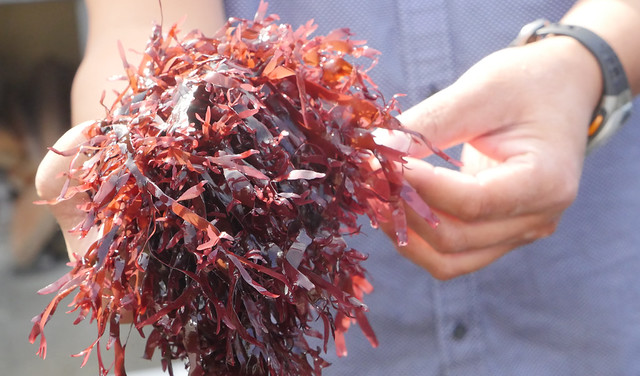
Dulse (Palmaria palmata) is a reddish-brown type of seaweed which is sometimes eaten in Ireland, Scotland, Wales and other places. The English word dulse was borrowed from Irish and/or Scottish Gaelic. It is also written dilisk, dillisk, dilsk or dulce.
Words marked with a * are reconstructions.
| Proto-Celtic | *doliskos = dulse, dilisk (edible seaweed of the species Palmaria palmata |
|---|---|
| Old Irish (Goídelc) | duilesc = dulse |
| Middle Irish (Gaoidhealg) | duilesc, duilleasg, duileasg [ˈd̪ulʲəsk] = dulse, seaweed with skinny horns, sea-grass |
| Irish (Gaeilge) | duileasc = dulse duileascar = rock moss |
| Scottish Gaelic (Gàidhlig) | duileasg [duləsg] = (red) dulse, sea lettuce flakes duileasg na h-aibhne = pondweed |
| Manx (Gaelg) | dullish = dulse dullish awin = pondweed |
| Proto-Brythonic | *dölɨsk = dulse |
| Middle Welsh (Kymraec) | dilysc, delysc, dylysc = dulse, edible seaweed |
| Welsh (Cymraeg) | delysg, dylysg, dylusg [ˈdɛlˠɨ̞sk / ˈdeːlɪsk] = dulse, edible seaweed, palmated seaweed; stuff which is cast up by the sea, offscouring, filth, sweepings delysg y môr = edible seaweed |
| Breton (Brezhoneg) | tellesk = dulse telleskek = where dulse is abundant |
Etymology: from Proto-Celtic *dol- (leaves), from Proto-Indo-European *dʰelh₁- (to well forth, to spring forth, to flourish, to green) [source]. Words from the same roots include dal (to exist, go out, leave) in Albanian, դեղ (deġ – drug, medicine, poison) in Armenian, მდელო (mdelo – meadow) in Georgian, foglio (sheet) in Italian, full (sheet of paper) in Catalan, dail (leaves, sheets [of paper]) in Welsh, and dulse, foil, folio, and possibly dill in English [source].
| Proto-Celtic | *wimmonā = seaweed |
|---|---|
| Old Irish (Goídelc) | femmuin = seaweed |
| Middle Irish (Gaoidhealg) | fem(m)ain, femman, femmuin = seaweed femnach = seaweed, edible water-weed femnachda = resembling seaweed |
| Irish (Gaeilge) | feamainn [ˈfʲamˠən̠ʲ] = seaweed, wrack, eelgrass, seawrack (Zostera marina) feamainneach = clustered (as seaweed), tressed, ringleted (of hair) feamnaigh = to cover with seaweed talamh a fheamnú = to spread seaweed onland, to fertilize land with seaweed |
| Scottish Gaelic (Gàidhlig) | feamainn [fɛmɪn̪ʲ] = seaweed, sea algae, seaweed used as fertiliser, marsh plant(s); fertilse with seaweed, harvest seaweed feamainneach [fɛmɪn̪ʲəx] = like or pertaining to seaweed, fucoid, alginic |
| Manx (Gaelg) | famlagh = seaweed, kelp, wrack fammyragh = seaweed, wrack |
| Proto-Brythonic | *gwɨmon = seaweed |
| Middle Welsh (Kymraec) | guimon, gwimon, gwymon, gwmon = seaweed, laver, dulse |
| Welsh (Cymraeg) | gwymon, gw(i)mon [ˈɡwɨ̞mɔn / ˈɡʊi̯mɔn] = seaweed, laver, dulse, freshwater alga, mean worthless thing gwymona = to gather seaweed (for use as manure) gw(y)monog, gwmanog = abounding in seaweed, covered with seaweed, seaweedy |
| Middle Cornish (Cernewec / Kernuak) | gumman = seaweed |
| Cornish (Kernewek) | gomonen = seaweed, kelp gomonna, gomodna = to gather seaweed |
| Old Breton (Brethonoc) | goumon, gueimmonou = seaweed |
| Middle Breton (Brezonec) | goaymon, goumon = seaweed |
| Breton (Brezhoneg) | gouemon, go(u)mon [ˈɡumːɔ̃n] = seaweed, kelp gouemona = to search for / gather seaweed gouemonaer = seaweed harvester |
Etymology: uncertain, possibly from PIE *weyb- (to wind around). The words gamó (asphodel, mullein) in Catalan, gamón (asphodel) in Galician gamão (backgammon) in Portuguese might also come from the same Proto-Celtic roots [source]. The French word goémon (wrack [seaweed], kelp) was borrowed from Middle Breton gwemon [source].
| Old Irish (Goídelc) | fithrech = dulse, edible seaweed |
|---|---|
| Middle Irish (Gaoidhealg) | fithrech, fithreoch = dulse, edible seaweed |
| Scottish Gaelic (Gàidhlig) | fithreach = dulse, edible seaweed |
Etymology: ?

Sources: Wiktionary, Am Faclair Beag, Online Manx Dictionary, Teanglann.ie, eDIL – Electronic Dictionary of the Irish Language, In Dúil Bélrai English – Old Irish glossary, Geiriadur Prifysgol Cymru, Gerlyver Kernehe, itk, Dictionaire Favereau, TermOfis, English – ProtoCeltic WordList (PDF), Etymological Dictionary Of Proto Celtic