Yoked Bonds

Words for yoke, bond and related things in Celtic languages.

Yoked

Words marked with a * are reconstructions.

Proto-Celtic *yugom = yoke
*komyungis = (?)
Gaulish *yugom = yoke (?)
*Weryugos = personal name
Old Irish (Goídelc) cuing = yoke
Middle Irish (Gaoidhealg) cuing, coing = yoke, burden, duty, sway, discipline, behaviour
Irish (Gaeilge) cuing [kiːɲɟ/kɪɲ] = yoke, bond, obligation, tie, beam, narrow neck of land (as between two lakes)
cuingealach = jugular
cuingigh = to yoke, enjoin
cuingir = yoke, pair, couple, group, herd
cuingleánach = yoked
cuingrigh = yoke, couple
Scottish Gaelic (Gàidhlig) cuing [kɯ̃ĩŋʲgʲ] = yoke, asthma, bond, obligation
cuinge [kɯ̃ĩŋʲgʲə] = narrow place, passage, pass, difficulty, limitation
cuingeach [kɯ̃ĩŋʲgʲəx] = asthmatic
cuingeachadh [kɯ̃ĩŋʲgʲəxəɣ] = (act of) yoking, abridgement, constraining, restricting, constraint
cuingeachail [kɯiŋʲgʲəxal] = limiting, restrictive
cuingealach [kɯ̃ĩŋʲgʲəl̪ˠəx] = restricted, shackled, constricted
Manx (Gaelg) quing = yoke, brace, team of oxen, (balance) beam
quingaghey = to subjugate, yoke
quingey = to yoke
quingit = yoked
Proto-Brythonic *jọw = yoke
Old Welsh (Kembraec) iou = yoke
Middle Welsh (Kymraec) iou, yeu, iau, jav = yoke
Welsh (Cymraeg) iau [jaɨ̯/jai̯] = yoke, pair of oxen, sway, dominion, authority, discipline, oppression
Old Cornish ieu = yoke
Middle Cornish (Cernewec) yeu = yoke
Cornish (Kernewek) yew = yoke
war yew = onward
Middle Breton (Brezonec) yeu, yau = yoke
Breton (Brezhoneg) yev [jew] = yoke, servitude
yevad = yoke, hitch, team, coupling
yevan, yevañ = to yoke, subjugate, enslave

Etymology: from the Proto-Indo-European *yugóm (yoke) or *yung, from *yewg- (to join, yoke, tie together) [source]. Words from the same roots include adjunct, conjugate, join, jugular, junction, yoga and yoke in English, joindre (to join up, reach, contact) in French, and junto (together, joined, next to) in Spanish [source].

Proto-Celtic *wedos = yoke, harness
Old Irish (Goídelc) fedan = band, carrying, company, drawing
feidid [ˈɸʲeðʲiðʲ] = to bring, lead
Middle Irish (Gaoidhealg) fedan, feadhan, fedhain = (act of) carrying, conveying, carriage, harness, band, company, part, some
feidid, fedid = to bring, lead, refer, apply
Irish (Gaeilge) feadhain = band, troop, company
Scottish Gaelic (Gàidhlig) feadhain = team of horses
Manx (Gaelg) fwirran = staff, team
Middle Welsh (Kymraec) gued, guet, gved, gwedd = yoke, harness
guedu, gwedha = to be coupled with a yoke, be yoked
gwedeu, guedeu = traces, draught-harness
gwedhau = to submit, pay homage
Welsh (Cymraeg) gwedd [ɡweːð] = yoke, harness, team (of horses, oxen, etc), bondage, captivity, submission, humility, homage, offspring, progeny, children
gweddaf, gweddu = to be coupled with a yoke, be yoked, submit, humble oneself
gweddau = traces, draught-harness

Etymology: from the Proto-Indo-European *wedʰ- (to bind, secure, pledge, guarantee, lead) [source]. Words from the same roots include gage, wage, wager and wed in English, Wette (bet) in German, and gage (pledge, guarantee, deposit) in French [source].

Old Irish (Goídelc) mám [maːm] = yoke
Middle Irish (Gaoidhealg) mám = yoke
Irish (Gaeilge) mám = yoke

Etymology: ? [source].

The Fastest Way to Learn Japanese Guaranteed with JapanesePod101.com

Sources: Wiktionary, Am Faclair Beag, Online Manx Dictionary, Teanglann.ie, eDIL – Electronic Dictionary of the Irish Language, In Dúil Bélrai English – Old Irish glossary, Geiriadur Prifysgol Cymru, Gerlyver Kernewek, Dictionaire Favereau, TermOfis, English – ProtoCeltic WordList (PDF), Etymological Dictionary Of Proto Celtic

Unlimited Web Hosting - Kualo

Grinding Mills

Words for grind, crush, mill and related things in Celtic languages.

Olive press grinding stones

Words marked with a * are reconstructions.

Proto-Celtic *malati = to grind, crush
Old Irish (Goídelc) meilid = to crush, grind, sharpen, eat
con·meil = to grind together
Middle Irish (Gaoidhealg) melaid, meilid = to grind, crush, sharpen, use, consume (esp. food)
con-meil, coimlid, cuimlid, comlaid = to rub, grind together, attach, consume, destroy
Irish (Gaeilge) meil [mʲɛlʲ] = to grind, crush
meilim = to grind
meilt = grinding, crushing, consuming, spending, wasting, incessant talk
meilteach = grinding, crushing, consuming
meilteoir = grinder, crusher
meilteoireacht = (act of) grinding, crushing
meiltire = incessant talker, chatterer
Scottish Gaelic (Gàidhlig) meil [mel̪] = (to) grind, mill, pulverize, masticate
meileach [meləx] = grinding, pertaining to or abounding in grinders/mills; finely ground flour
meileadh [mɛl̪ʲɛvadʲ] = grinding, milling, pulverizing, masticating
meilt [meldʲ] = grinding
meilte [meldʲə] = ground, milled, pulverized, masticated
meiltear, meileadair [meldʲər / melədɪrʲ] = grinder
Manx (Gaelg) beihll = to grind, pulverize; pulverization
beihlleyder = grinder, pulverizer
beihllinder = grinder
bleih = grind, grist; duffer, halfling, hobbledehoy, ninny, triffler
bleihit = ground
bleihder = grinder, molar
Proto-Brythonic *malɨd = to grind, crush
Middle Welsh (Kymraec) malu, mâlu = to grind, crush, pulverise, break, shatter, smash
Welsh (Cymraeg) malu [ˈma(ː)li] = to grind, crush, pulverise, break, shatter, smash, trample, chop, sharpen, destroy, utter, speak, recite (poetry)
malu awyr = to talk idly, talk nonsense, blather (“to grind air”)
malaid = finely ground, ground to a powder
malurio = to break into fragments, shatter, smash, grind, crumble, reduce to dust, pulverise
malwr [ˈmalʊr / ˈma(ː)lʊr] = grinder, mincer, molar, miller; speaker, utterer, babbler, chatterer
Middle Cornish (Cernewec) melias = to reduce, power, grind
Cornish (Kernewek) mala = to grind
maler = grinder
melyas = to grind
Old Breton (Brethonoc) malaff = to grind
Middle Breton (Brezonec) malaff = to grind
Breton (Brezhoneg) malañ [ˈmɑːlã] = to grind, cruse, seize
malad = ground things
maladeg, maladur = grinding
maler [ˈmɑːlɛr] = miller
malerez [ma.leː.res] = grinder, vegetable mill

Etymology: from the Proto-Indo-European *ml̥h₂-é-ti, from *melh₂- (to crush, grind). Words from the same roots include maelstrom (a large and violent whirlpool) and meal (the coarse-ground edible part of various grains often used to feed animals) in English, moudre (to grind), meule (grindstone, millstone) and moulin (mill, windmill) in French, and moler (to grind, mill), and words for mill in Celtic languages – see below [source].

Old Irish (Goídelc) muilend = mill
muileóir = miller
Middle Irish (Gaoidhealg) muilend, muilund = mill
muileóir, moilleóir = miller
Irish (Gaeilge) muileann [ˈmˠɪlʲən̪ˠ] = mill, grinding apparatus, manufactory
muileann uisce = watermill
muileann gaoithe = windmill, pinwheel
muileann iarainn = ironworks
muileann sábhadóireachta = sawmill
muileóir = miller, mill owner
muileóireacht = (act of) milling
Scottish Gaelic (Gàidhlig) muileann [mul̪ʲən̪ˠ] = mill
muileann-gaoithe = windmill
muileann-sàbhaidh = sawmill
muileann-uisge = watermill
muilear [mul̪ʲər] = miller
muilearachd [mul̪ʲərəxg] = milling, grinding
Manx (Gaelg) mwyllin = mill, factory
mwyllin geayee = windmill
mwyllin saaual = sawmill
mwyllin ushtey = watermill
mwyllar = miller, mill owner
mwyllaragh, mwyllarys = milling
Proto-Brythonic *melɨn = mill
Middle Welsh (Kymraec) melyn, melin = mill
melin wynt = windmill
melina = to grind, mill
melinyt, melinyd, melinid = miller, grinder
Welsh (Cymraeg) melin [ˈmɛlɪn] = mill, factory
melin wynt = windmill
melin lif(anu) = sawmill
melin ddŵr = watermill
melina(f), melino = to grind, mill
melinwr = miller, mill owner
melinydd = miller, grinder, molar
melinyddiaeth = the craft of milling
Old Cornish melin = mill
Middle Cornish (Cernewec) melin, belin = mill
Cornish (Kernewek) melin, belin = mill
melin dhowr = watermill
melin wyns = windmill
meliner / melinores, belender = miller
melinji = millhouse
Old Breton (Brethonoc) molin = mill
Middle Breton (Brezonec) melin = mill
Breton (Brezhoneg) milin, melin [ˈmiː.lĩn] = mill, factory
milin-avel [mi.lĩ.ˈnɑː.vɛl] = windmill
milin-dour, melin-dour [milĩnˈduːr] = watermill
milinan, milinañ = to mill, rotate
miliner, meilher = miller
milinerezh = milling

Etymology: from Late Latin molinum (a mill), from molīnus (mill), molō (to grin or mill), from Proto-Italic *melō (to grind), from Proto-Indo-European *mélh₂-ti, from *melh₂- (to grind, crush) [source].

The Fastest Way to Learn Japanese Guaranteed with JapanesePod101.com

Sources: Wiktionary, Am Faclair Beag, Online Manx Dictionary, Teanglann.ie, eDIL – Electronic Dictionary of the Irish Language, In Dúil Bélrai English – Old Irish glossary, Geiriadur Prifysgol Cymru, Gerlyver Kernewek, Dictionaire Favereau, TermOfis, English – ProtoCeltic WordList (PDF), Etymological Dictionary Of Proto Celtic

Unlimited Web Hosting - Kualo

A Meeting of Assemblies

Words for meeting, assembly and related gatherings in Celtic languages.

Dáil na nÓg - Ireland's Youth Parliament
Dáil na nÓg – Ireland’s Youth Parliament

Words marked with a * are reconstructions.

Proto-Celtic *datlā = assembly, meeting
Old Irish (Goídelc) dál = meeting, encounter, judgement, sentence, decree, dispensing, distribution, division, tribe
comdál = assembly, meeting
Middle Irish (Gaoidhealg) dál, dáil = meeting, encounter, conference, assembly, convention, court; case, dispute, controversy; judgement, decree, sentence, law; agreement, contract, covenant
dál-loc, dálluc = meeting place
dál-ṡuide, dálṡuidae = judgement-seat, forum
dál-tech = meeting house
comdál, comdhail, comdāl = meeting, tryst, assembly, conference
Irish (Gaeilge) dáil [d̪ˠɑːlʲ / d̪ˠaːlʲ] = meeting, tryst, encounter, assembly, convention, match-making gathering, betrothal, legislative assembly, parliament, distrubtion, decree, judgement, matter, condition, affair
Dáil Éireann = the lower house of the Parliament of Ireland
dáilcheantar = (parliamentary) constituency
dáileach = distributive
dáileacháin = distribution
dáileán = handout, leaflet
dáileog = little portion, dose
dáileoir = distributor, dispenser
dálach = found of meetings, of company; suitable for gatherings
comhdháil = meeting, tryst, convention, congress
Scottish Gaelic (Gàidhlig) dàil [daːl] = agreement, covenant, condition, circumstance, history
còmhdhàil [kɔ̃ː.al] = congress, convention, meeting, encounter, transport, group of people
mòr-dhàil [moːrɣal] = congress, assmebly
Manx (Gaelg) coardail = accord, agreement, covenant, convention, compromise
coardailys = agreement, compliance, compromise, concord, harmony
Proto-Brythonic *dadl [ˈdadl] = assembly, meeting
Old Welsh (Kembraec) dat = meeting, assembly, council, court
Middle Welsh (Kymraec) daddyl, dadyl, dadl, datlev = argument, dispute, controversy, plea, lawsuit, complaint; meeting, assembly, council, court; account, transaction; battle, fight
dadleu, dadlev, datleu = arguement, reasoning, controversy, contention, dispute; meeting, assembly, council, business, proceedings; court of lawm assizes, lawsuit, pleading, plea; battle, fight
dadlewad, dadleuad = pleading, debate, disputation, intercession
dadleu, dadlew = to argue, debate, dispute
dadleuty, dadlaudy = court of law, guildhall, forum, parliament (house); theatre
dadleuwr, dadylewr = advocate, counsel, solicitor, attorney; litigant
kinatlet, kynnadled = conference, assembly, congress
Welsh (Cymraeg) dadl [dadl] = argument, debate, wrangle, controversy, contention, plea, lawsuit, complaint
dadlau = arguement, reasoning, controversy, contention, dispute
dadl(eu)af, dadl(a)u = to argue, debate, dispute
dadleuol = controversial, debatable
dadleuwr, dadylewr = advocate, counsel, solicitor, attorney, debater, disputant
cynhadledd = conference, assembly, congress
Middle Cornish (Cernewec) dadyl, dadl, datl = assembly, forum (?)
dadloyer = speaker, orator
Cornish (Kernewek) dadhel = arguement, discussion, dispute
dadhelor(es) = debater, orator
dadhelva = debate
dadhla = to argue, debate, discuss
Old Breton (Brethonoc) dadl = quarrel, arguement
Middle Breton (Brezonec) dael = quarrel, arguement
Breton (Brezhoneg) dael = quarrel, arguement
daelañ = to discuss, dispute

Etymology: possibly from Proto-Indo-European *dʰh̥₁-tl-eh₂, from *dʰeh₁- (to do, put, place) [source]. Words from the same roots include odd, wood, word, deed, theme and many more in English, oord (place, region) in Dutch, and soler (to get used to, tend to) in Spanish [source].

Old Irish (Goídelc) cruinn = circular, globular, round
Middle Irish (Gaoidhealg) cruinn = round, globular, compact, precise, assembled,
cruinniugad, crunnaghadh = (act of) gathering, collecting, assembling
Irish (Gaeilge) cruinn [kɾˠiːnʲ] = round, gathered, exact, accurate, concentrated
cruinniú [ˈkɾˠɪn̠ʲuː] = gathering, meeting, assemblage
cruinniúchán = (act of) gathering
cruinnitheoir = gatherer, collector
cruinnigh = to gather, assemble, collect, draw together, summon up, recover, converge, focus
Scottish Gaelic (Gàidhlig) cruinneachadh [krɯ̪ʲəxəɣ] = (to) gather, assemble, collect, accumulate; gathering, assembly, collection, accumulation
cruinnich [krɯn̪ʲɪç] = related to a mòd, courtly, fond of meetings
cruinneachail [krɯn̪ʲəxal] = (ac)cumulative
cruinneachair [krɯn̪ʲəxɛrʲ] = gatherer
neach-cruinneachaidh = collector, gatherer
talla-cruinneachaidh = meeting hall
Manx (Gaelg) cruinnaght = assembly, function, gathering, event
cruinnaghey = assemblage, congregation; to gather, focus, huddle, sum up
cruinneyder = gatherer
Middle Welsh (Kymraec) krynoi, crynói = to gather, hoard, amass, make round, roll up
crynoat = a bending, stooping
Welsh (Cymraeg) cryn(h)oad = the act of gathering together, compendium, summary, digest, assembly
crynhoi = to muster, assemble, gather, hoard, amass, make round, roll up
crynhofa = assembly, collection, gathering, store, reservoir
crynhowr = one who collects or gathers together
crynoëdig = gathered together, abridged

Etymology: from Proto-Celtic krundis (round), which probably from a non-Indo-European substrate language. [source]. Words for round in Celtic languages come from the same roots.

Scottish Gaelic (Gàidhlig) mòd [mɔːd] = assembly, meeting, court of justice, mòd (cultural festival)
mòdach [mɔːdəx] = related to a mòd, courtly, fond of meetings
mòd-ceartais = tribunal
Manx (Gaelg) mod = assembly, gathering, meeting

Etymology: from Old Norse mót (meeting, joint), from Proto-Germanic *mōtą (meeting) Proto-Indo-European *meh₂d- (to meet, approach, encounter) [source]. Words from the same roots include meet and moot (subject of discussion, arguable, debatable) in English, møde (meeting, encounter, conference) in Danish, and mót (meeting, gathering, assembly) in Icelandic [source].

Middle Welsh (Kymraec) kynnull = collection, a gathering (of harvest, etc)
kynullaw, cynull = to collect, gather, bring together, muster, assemble
kinvllaud, cynullawd = a gathering, assembly
cynulledic = collected, gathered, assembled, collective
cynulleidua, cynulleitua, kynulleitua = congregation, audience, gathering, host
Welsh (Cymraeg) cynnull [ˈkənɪɬ] = collection, a gathering
cynullaf, cynullo = to collect, gather, bring together, muster, assemble
cynulliad = assembly, gathering
cynull(i)edig = collected, gathered, assembled, collective
cynulleidfa = congregation, audience, gathering, host
ymgynnull = to assemble
Middle Cornish (Cernewec) cuntell, contell = a gathering together, collection
cuntell, cuntullys, cuntyllys, contellyes = to gather together, collect
cuntellet = a congregation
cuntellyans = a gathering together
Cornish (Kernewek) kuntel = collection; to accumulate, collect, gather, pick; harvest
kunteller, kuntellores = collector, picker
kuntelles = assembly, congress, meeting
kuntellyans = aggregation, congregation
Breton (Brezhoneg) kuntuilh = to pick, picking
kuntuilher = picker
kuntuilherezh = picking

Etymology: from Proto-Brythonic *köβ̃- (with, together), from Proto-Celtic *kom- (with, together), from PIE*ḱóm (beside, near, by, with) + dull (method), from PIE *deyḱ (to show, point out) [source].

The Fastest Way to Learn Japanese Guaranteed with JapanesePod101.com

Sources: Wiktionary, Am Faclair Beag, Online Manx Dictionary, Teanglann.ie, eDIL – Electronic Dictionary of the Irish Language, In Dúil Bélrai English – Old Irish glossary, An Etymological Dictionary of the Gaelic Language, Geiriadur Prifysgol Cymru, Gerlyver Kernewek, Dictionaire Favereau, TermOfis, English – ProtoCeltic WordList (PDF), Etymological Dictionary Of Proto Celtic

Unlimited Web Hosting - Kualo

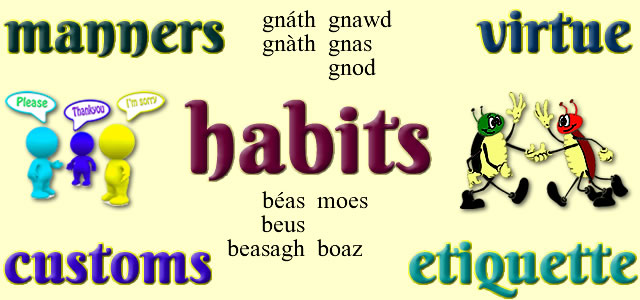
Habitual Customs

Words for habit, custom, virtue, moral(ity) and related things in Celtic languages.

Habitual Customs

Words marked with a * are reconstructions.

Proto-Celtic *banssus = custom, habit
Gaulish bessu = customs, habits
Old Irish (Goídelc) bés, béss, bǽs = custom, habit
bésad = custom, customary practice
bésgnae = custom, discipline, law
Middle Irish (Gaoidhealg) bés, bésse, bes = habit, custom, usual procedure, practice, manner, way, moral(s), good behaviour
bésach = mannerly, well-behaviour
bésaid = moralist (?)
bésgnae = custom, usage, discipline, protocol
béstae = moral
Irish (Gaeilge) béas [bʲiːa̯sˠ/bʲeːsˠ] = habit, moral habit
béasa = conduct, manners
béasach = well-mannered, mannerly, polite
béasaíocht = mannerliness, politness
béascna = mode of conduct, custom, usage, culture
béasmhúineadh = teaching of good manners
Scottish Gaelic (Gàidhlig) beus [beːs] = moral(s), virtue, conduct, demeanour
beus-eòlas = ethics, moral philosophy
beusach [beːsəx] = moral, virtuous, ethical, chaste, modest
beusachd [beːsəxg] = good behaviour, moral rectitude, etiquette
beusail [beːsal] = moral, virtuous, ethical, chaste, modest
beusalachd [beːsəl̪ˠəxg] = ethics, moral behaviour
beusanta [beːsən̪ˠdə] = ethical
Manx (Gaelg) beaoil = moral, living
beasagh = civil(ized), decorous, moral, obedient, pliable
Proto-Brythonic *boɨs = (?)
Middle Welsh (Kymraec) moes = habit, wont, custom, tradition
moeseidd, moesaidd = courteous, polite, well-bred
moesgar, moes gar = courteous, polite, refined
moessic = courteous, where courtesy is found
moessauc, moessawc, moessoc = polite, well-bred, seemly, deferential
moes(s)sawl = moral, ethical
Welsh (Cymraeg) moes [moːɨ̯s / mɔi̯s] = established or usual behaviour, habit, wont, custom, tradition, social convention, courtesy, civility, manners, etiquette
moesau, moesoedd = morals, moral principle(s)
moesgar = courteous, polite, refined, well-mannered, civil
moesog = polite, well-bred, seemly, deferential
moesol = moral, ethical, high-principled
anfoesol, di-foes = immoral
Middle Breton (Brezonec) boas = custom, habit
boaset = accustomed, trained, habitually
Breton (Brezhoneg) boaz [ˈbwɑːs] = custom, habit
boazamant = practice, tradition
boazañ [ˈbwɑːzã] = to get used to
boazet = accustomed, trained, habitually

Etymology: from the Proto-Indo-European *bʰendʰ- (to bind, bond), or from *bʰeydʰ- (to compel, force, trust) [source].

Words from the same PIE root include bide, confide, defy, faith, federal and infidelity in English, besë (pledge, oath, promise, vow) in Albanian, beiða (to ask, request) in Icelandic, and бедя (bedjá – to accuse, slander, persuade) in Bulgarian [source].

Proto-Celtic *gnātos = known, recognised
*angnātos = unknown, obscure
*gnināti = to recognise
Gaulish gniiou = I recognise (?)
Old Irish (Goídelc) gnáth [ɡnaːθ] = customary, usual
gnáthach [ˈɡnaːθax] = customary, usual, constant, familiar, well-known
gnáthaigid = to frequent, inhabit, practise
ingnad = strange, unusual, wonderful, marvel, miracle, wonder
Middle Irish (Gaoidhealg) gnáth = customary, usual, familiar, well-known, custom, wont, usage
gnáthaid = to practise, use, be accustomed to
gnáthaigid = to be accustomed to, practise, frequent, inhabit
gnátham = custom, wont, habit
gnáthe = usualness, frequency
gnáthmar = wonted, customary
ingnad, ingnáth, ingnuth = strange, wonderful, remarkable, unusual, unfamiliar
Irish (Gaeilge) gnáth [ɡn̪ˠɑː/ɡɾˠɑː/ɡɾˠæː] = custom, usage, customary thing, haunt, resort
gnách [ɡn̪ˠɑ̃ːx/ɡɾˠɑːx] = customary, usual, common, ordinary
gnáthaigh = to make a habit of, practise, frequent, haunt
gnáthaíocht = commonness, frequency, usage, wont
gnáthamh = usage, custom, procedure, routine
Scottish Gaelic (Gàidhlig) gnàth [grãː] = usual, common
gnàthach [grãː.əx] = conventional, routine, habitual, orthodox
gnàthachadh [grã.əxəɣ] = accustoming, practising, rehearsing, custom, practice, rehearsal
gnàthachail [grãː.əxal] = customary
gnàthachas [grãː.əxəs] = invariableness, constancy, convention, custom
gnàthachd [grãː.əxg] = customariness
Proto-Brythonic *gnọd = known, recognised
Middle Welsh (Kymraec) gnaud, gnawd, gnawt, gnot = usual, customary, wont
Welsh (Cymraeg) gnawd [ɡnau̯d] = usual, customary, wont, accustomed, natural, characteristic, known, frequent
Cornish (Kernewek) gnas = character, nature, temper, quality
gnasek = natural
gnasen = trait
Old Breton (Brethonoc) gnot = (?)

Etymology: from the Proto-Indo-European *ǵn̥h₃tós (known, recognisable), from *ǵneh₃- (to know, recognise) [source].

Words from the same PIE roots include agnostic, canny, cognition, cunning, ignore, incognito, know, recognise in English, and noto (well-known, famous, notorious) in Italian [source].

Proto-Celtic *kleto- = (?)
Old Irish (Goídelc) clecht = custom, habit
clechtaid = to practise, ply
Middle Irish (Gaoidhealg) clecht = custom, wont, habit
clechtach = practised, experienced, customary
clechtaid = to become accustomed to, frequent, consort with, practise, ply
Irish (Gaeilge) cleacht [clʲaxt̪ˠ] = to perform habitually, to be, to become accustomed to, to practise
cleachtach (ar, le) = accustomed (to)
cleachtadh [ˈclʲaxt̪ˠə/ˈclʲaxt̪ˠu] = habit, wont, practice, experience, exercise; to practise
cleachtas = practice
cleachtóir = practitioner
Scottish Gaelic (Gàidhlig) cleachd [klɛxg] = use, employ, accustom, get used to, habituate, practise
cleachdach [klɛxgəx] = customary, habitual, usual
cleachdadh [klɛxgəɣ] = using, use, convention, custom, habit
cleachdaiche [klɛxgɪçə] = consumer, user
cleachdail [klɛxgal] = customary, habitual, usual
cleachdta [klɛxdə] = used to, accustomed to
Manx (Gaelg) cliaghtey = habit, practice, rehearsal, usage, use; to rehearse, train, use, profess
cliaghtagh = habitual, customary, conventional
cliaghtaghey = to accustom, exercise, practise

Etymology: possibly from the Proto-Indo-European *kʷelh₁- (to turn, revolve around, dwell) [source].

Proto-Celtic *ɸarebereti = to use
Old Irish (Goídelc) arbeir [arˈbʲerʲ] = to live, use, employ, eat, reproach, subdue, express
do·airbir = to bend, subdue, bow down, yield, surrender
Middle Irish (Gaoidhealg) ar-beir, air-ber, arbeir = to live, eat, use, employ, plead, oppose, express, subdue, quell
Proto-Brythonic *ėrβėrɨd, = to make use of, employ, take
Old Welsh (Kembraec) arber = to use, make use (of), employ
Middle Welsh (Kymraec) aruer, arfer, arver = usage, practice, habit, custom, tradition
arber, arueru, arver, arfer = to use, make use (of), employ
arueredic, arferedig = usual, habitual, customary, familiar
arverog, arferoc = usual, habitual, customary, familiar, common, ordinary
arferol, arverol, aruerol = usual, habitual, customary, familiar, common, ordinary, normal, regular
Welsh (Cymraeg) arfer [ˈarvɛr/ˈarvar] = usage, practice, habit, custom, tradition
arferaf, arfer(u) = to use, make use (of), employ
arferedig = usual, habitual, customary, familiar
arferiad = habit, usage, practice, custom
arferol = usual, habitual, customary, familiar, common, ordinary, normal, regular

Etymology: from the Proto-Celtic *ɸare- (for(e)-) and *bereti (to carry, bear, flow), from Proto-Indo-European *bʰéreti (to be carrying), from *bʰer- (to bear, carry) [source].

Words for To Carry / Flow in Celtic languages come from the same roots.

The Fastest Way to Learn Japanese Guaranteed with JapanesePod101.com

Sources: Wiktionary, Am Faclair Beag, Online Manx Dictionary, Teanglann.ie, eDIL – Electronic Dictionary of the Irish Language, In Dúil Bélrai English – Old Irish glossary, An Etymological Dictionary of the Gaelic Language, Geiriadur Prifysgol Cymru, Gerlyver Kernewek, Dictionaire Favereau, TermOfis, English – ProtoCeltic WordList (PDF), Etymological Dictionary Of Proto Celtic

Unlimited Web Hosting - Kualo

Drills & Augers

Words for augur and related things in Celtic languages.

Auger

Words marked with a * are reconstructions.

Proto-Celtic *taratrom = auger
Gaulish taratron = auger
Old Irish (Goídelc) tarathar = auger
Middle Irish (Gaoidhealg) tarathar = auger
Irish (Gaeilge) tarathar = auger
tarathraigh = to bore with an auger
Scottish Gaelic (Gàidhlig) tora [tɔrə] = auger, gimble, gimlet
torach [tɔrəx] = pertaining to or abounding in augers / gimbles / gimlets
torachair [tɔrəxɪrʲ] = auger, gimble, gimlet
torachan [tɔrəxan] = small auger / gimble
tarachair† = gimlet, auger
Manx (Gaelg) tarrar = drill
tarrarey = to drill, drilling
Proto-Brythonic *taradr [taˈradr̩] = auger, borer, drill
Old Welsh (Kembraec) tarater = auger, drill, borer
Middle Welsh (Kymraec) tarader, taradyr, taradr = auger, drill, borer
Welsh (Cymraeg) taradr [ˈtaradr] = auger, drill, borer, awl, gimlet, trepan
taradru = to bore with an auger, drill, pierce
tarad(r) y coed = woodpecker
Middle Cornish (Cernewec) tardar, tarad = auger, borer, whimble
tardha, tardhe = to pervade, break out, emanate, penetrate, bore, pierce
Cornish (Kernewek) tarder = drill
tardra = to bore, drill, tap
Middle Breton (Brezonec) tarazr, talazr = auger
Breton (Brezhoneg) tarar [ˈtɑː.rar] = augur, chignole (a hand drill), shipworm (mollusk)
tararer [ta.ʁa.ʁe] = to pass a cereal through a sieve
tarzhañ = to burst, break, hatch, pierce, emerge, die (of thirst), warp

Etymology: from the Proto-Indo-European *térh₁trom (tool for drilling), from *terh₁- (to rub, turn, drill, pierce) [source].

Words from the same Celtic roots, via Gaulish taratron (auger) and Late Latin taratrum, possibly include taraire in Occitan, taradre (to bore) in Catalan, trade (auger) in Galician, taladro (drill) in Spanish, tarière (auger) in French, tarader (drill) in Romansch [source].

Words from the same PIE roots include thread, thresh, trout and throw in English, settentrione (north) in Italian, třít (to rub) in Czech, and drehen (to turn) in German [source].

Drill Set

Irish (Gaeilge) druil = drill
druilchéachta = drill-plough
druileáil = drilling, to drill
druileálaí = drill-maker, drill-master
druilire láimhe = hand-drill
Scottish Gaelic (Gàidhlig) dril(e) [dril(ə)] = drill
dril(g)eadh [driləɣ] = drilling, drill
plaosgach [pl̪ˠɯːsgəx] = shelled, husky, shelly
Manx (Gaelg) drillal = to drill
drilley = drill
drilleyder = drill
Welsh (Cymraeg) drill = drill
dril, drul, trul = drill, small furrow, machine for sowing seed in drills
drillio = to drill, bore, subject to discipline

Etymology: from English drill, from drillen (to bore, move in a circle in Middle Dutch, from Old Dutch *thrillen, from Proto-Germanic *þriljaną, from Proto-Indo-European *ter- (through, over) [source].

Words from the same PIE roots include thrill in English and drillen (to drill, domineer) in Dutch [source].

The Fastest Way to Learn Japanese Guaranteed with JapanesePod101.com

Sources: Wiktionary, Am Faclair Beag, Online Manx Dictionary, Teanglann.ie, eDIL – Electronic Dictionary of the Irish Language, In Dúil Bélrai English – Old Irish glossary, An Etymological Dictionary of the Gaelic Language, Geiriadur Prifysgol Cymru, Gerlyver Kernewek, Dictionaire Favereau, TermOfis, English – ProtoCeltic WordList (PDF), Etymological Dictionary Of Proto Celtic

Unlimited Web Hosting - Kualo

Razors

Today we’re looking at the words for razor and related things in Celtic languages.

Vintage razors

Words marked with a * are reconstructions.

Proto-Celtic *altēn = razor
Old Irish (Goídelc) altan = razor, blade
Middle Irish (Gaoidhealg) ailt = edge, blade, edged weapon
ailtech = well jointed, finely bladed
altan = sharp blade, razor
Irish (Gaeilge) altán [ˈɑhəɾʲ/ˈahæɾʲ] = sharp knife
Scottish Gaelic (Gàidhlig) ealtainn [jal̪ˠdɪn̪ʲ] = flock, sharp blade, razor
Old Welsh elinn = razor
Middle Welsh (Kymraec) ellyn = razor
eillyaỽ, eillaw, eillya = to shave, cut off, destroy completely, exterminate, erase, pillage
ellyaeth = tenancy, support or sustenance
eilliedydd = shaver, barber
Welsh (Cymraeg) ellyn [ˈɛɬɨ̞n/ˈɛɬɪn] = razor
eill(i)af, ell(i)o [ˈei̯ɬjɔ] = to shave, cut off, destroy completely, exterminate, erase, pillage
eilliad = a shaving, tonsure
eilliedig = shaved, shaven, tonsured
eilliwr, eillydd = barber, shaver
eillty = barber’s shop
Old Cornish elinn = razor
Cornish (Kernwek) alsen [alzɛn/ɒlzɐn] = razor
alten [altɛn/ɒltɐn] = razor
Old Breton (Brethonoc) altin = razor
Middle Breton autenn = razor
Breton (Brezhoneg) aotenn [ˈɔtːɛn] = razor
aotenn-dredan [ˈɔtɛnˈdʁeːdɑ̃n] = electric razor
aotenniñ [oˈtɛnːĩ] = to shave

Etymology: unknown. Most likely from a non-IE substrate language [source].

Irish (Gaeilge) rásúr [ɾˠɑːˈsˠuːɾˠ/ˈɾˠɑːsˠuːɾˠ] = razor
rásúr sábhailte = safety razor
lann rásúr = razor blade
Scottish Gaelic (Gàidhlig) ràsar [r̪ˠaːsər] = razor
Manx (Gaelg) rhesar, razor = razor
Welsh (Cymraeg) r(h)asel, rasal [ˈrasɛl / ˈrasal] = razor
r(h)asel ddiogel = safety razor
r(h)asel hogi = cut-throat razor
raselaidd, rasalaidd = razor-like, sharp
r(h)aser = razor
Middle Breton razaff = to shave
Breton (Brezhoneg) razher = razor
razhañ, razhiñ = to shave
razher = barber, gelder
razherezh = shave, cut, equality
razhouarn = razor, shaver

Etymology (Irish and Breton) from Old French rasour (razor), from raser (to shave), from Vulgar Latin *rāsāre (to shave), from Latin rāsus, from rādō (to scrape, shave, scratch, rub, smooth, graze), from Proto-Italic *razdō, from Proto-Indo-European *rh₁d-dʰ-, from *reh₁d- (to scrape, scratch, gnaw) [source].

Etymology (Scottish Gaelic, Manx and Welsh) from English razor, from Middle English rasour (razor), from Old French rasour (razor) – see above [source].

Words from the same roots include errode, rash, rat, raze, rodent, rostrum in English, rhathu (to scrape, chafe) in Welsh, roder (to polish, wear in, hone) in French, and roer (to gnaw, pick at, wear down) in Spanish [source].

The Fastest Way to Learn Japanese Guaranteed with JapanesePod101.com

Sources: Wiktionary, Am Faclair Beag, Online Manx Dictionary, Teanglann.ie, eDIL – Electronic Dictionary of the Irish Language, In Dúil Bélrai English – Old Irish glossary, An Etymological Dictionary of the Gaelic Language, Geiriadur Prifysgol Cymru, Gerlyver Kernewek, Dictionaire Favereau, TermOfis, English – ProtoCeltic WordList (PDF), Etymological Dictionary Of Proto Celtic

Unlimited Web Hosting - Kualo

Monday Moons

Today we’re looking at the words for moon, Monday and related things in Celtic languages.

Blue Moon

Words marked with a * are reconstructions.

Proto-Celtic *louxsnos = (?)
Old Irish (Goídelc) lúan = moon, Monday, radiance
Middle Irish (Gaoidhealg) lúan [ˈl͈uːə̯nʲ] = moon, Monday, doomsday, judgement day
día lúain [dʲiːə̯ ˈl͈uːə̯nʲ] = (on) Monday
Irish (Gaeilge) Luan [l̪ˠuən̪ˠ] = Monday, Aureole, nimbus, halo
Dé Luain [dʲeːˈl̪ˠuənʲ] = (on) Monday
Scottish Gaelic (Gàidhlig) Luan [l̪ˠuən] = Monday, the moon (poetic)
Diluain [dʲɪˈl̪ˠuən̪ʲ] = Monday
Manx (Gaelg) luan, lune = moon
Jelune, Jyluain, Lhein, Luain = Monday
Middle Welsh (Kymraec) llun = Monday, (the) moon
Welsh (Cymraeg) llun, Llun [ɬɨːn /ɬiːn] = Monday, (the) moon
dydd Llun [dɨːð ˈɬɨːn / diːð ˈɬiːn] = Monday
Middle Cornish lin = the moon
di-lin, De Lun = Monday
Cornish (Kernewek) Lun = Monday
dy’Lun, de Lun = Monday
Breton (Brezhoneg) Lun = the moon
dilun [di.ˈlỹːn] = Monday

Etymology from PIE *lówksneh₂ (moon, shining thing), from *lewk- (to shine, to see, bright) [source].

Words from the same PIE roots include illumiate, light, lucent, lucid, Lucifer, luminous, lunar, lustre, and lynx in English [source].

Etymology (Monday words) from Latin *diēs Lūnae (Monday), from diēs (day) and Lūna (the moon, Luna [a moon goddess]), or calques of this word [source].

Words from the same roots include dilluns (Monday) in Catalan, dilunes (Monday) in Occitan, and dilon (Monday) in Walloon [source].

Proto-Celtic *lugrā = moon
Proto-Brythonic *lloɨr = moon
*lloɨrkann = moonlight
Old Welsh (Kembraec) loyr = moon
loiraul = lunar
Middle Welsh (Kymraec) lloer = moon
lloerferch = one as fair as the moon, fair maiden, beautiful woman
lloergan = (bright) moonlight, moonlit
lloeric = lunatic, moonstruck, insane, mad, frantic, wild, lunar
lloerol = lunar
Welsh (Cymraeg) lloer [ˈɬoːɨ̯r /ˈɬɔi̯r] = (the) moon, satellite
lloeraidd = lunar, lunatic
lloeren = circle, round spot, satellite, little moon
lloerennol = satellite, pertaining to the moon
lloergan = (bright) moonlight, moonlit
lloergannu = to shine (of the moon)
lloeri = to crook like the new moon, make cresent-shaped
lloerig = lunatic, moonstruck, insane, mad, frantic, wild, lunar
Old Cornish luir = moon
Middle Cornish loer, lor, lôr, loor, lour, lûr = moon
Cornish (Kernewek) loor = moon
lorel = lunar
lorell = satellite
lorek, loroges = lunatic, maniac, psychotic
Old Breton (Brethonoc) loir, loer = moon
Middle Breton (Brezonec) loar = moon
loer cann = full moon
Breton (Brezhoneg) loar = moon
loargann = full moon
loarieg = lunatic

Etymology from PIE *lewk- (bright, light, to shine, to see), or from *lewg- (to bend, twist) [source].

Middle Welsh (Kymraec) lleuad, lleuat = moon
lleuadic = mad, lunatic
Welsh (Cymraeg) lleuad [ˈɬeɨ̯.ad /ˈɬei̯.ad] = the moon
lleuadu = to crook like the new moon, make cresent-shaped
lleuadaidd = lunar
lleuadig = mad, lunatic
lleuadog = lunar, moon-like, moonlit, lunatic, moonstruck, mad, insane

Etymology from PIE *lewk- (bright, light, to shine, to see). Related to lleu (light, brightness) and golau (light, bright, fair) in Welsh [source].

Proto-Celtic *ēskyom = moon
Old Irish (Goídelc) éscae, aesca, æscae, ésca, æscæ, éisce [ˈeːske] = moon, lunar month
éscaide = lunar
Middle Irish (Gaoidhealg) éscae = moon
éscaide = lunar
Irish (Gaeilge) éasca [ˈiːɑ̯skə / ˈeːsˠkə] = moon
éascaí = lunar
Scottish Gaelic (Gàidhlig) èsga [eːsgə] = moon (archaic)
Manx (Gaelg) eayst = moon, lunar
lane-eayst = full moon

Etymology from PIE *h₁eysk- (to shine, glitter) [source].

Middle Irish (Gaoidhealg) gelach = moon
Irish (Gaeilge) gealach [ɟəˈl̪ˠɑx / ˈɟalˠəx] = moon, brightness (as of moon), moonlight
Scottish Gaelic (Gàidhlig) gealach [gʲal̪ˠəx] = (the) moon
gealach làn = full moon
gealachail [gʲal̪ˠəxal] = lunar
gealachan [gʲa̪ˠəxan] = lunatic
Manx (Gaelg) giallagh = moon

Etymology from Old Irish gel (fair, white, bright), from Proto-Celtic *gelos (shining, white), from PIE *ǵʰelh₃os, from *ǵʰelh₃- (to shine) [source].

Words from the same roots include words for white, bay and brown in Celtic languages, and arsenic, gall, gild, gild, gold and yellow in English [source].

Old Irish (Goídelc) = moon
Middle Irish (Gaoidhealg) ré, re = the moon
Irish (Gaeilge) = moon, phase of the moon, month, period, portion of time, span of life, career, age, era, epoch
na ré = lunar
(oíche) rédhorcha = moonless
Scottish Gaelic (Gàidhlig) [r̪eː] = the moon (poetic)
Manx (Gaelg) re, ray = moon

Etymology possibly from Proto-Celtic *rowis [source].

Another word for moon in Welsh is cannwyll awyr (“sky candle”), and the word cannaid (white, bright, shining, pure, clean radiant) used to mean moon in Carmarthenshire (and sun in north Wales).

The Fastest Way to Learn Japanese Guaranteed with JapanesePod101.com

Sources: Wiktionary, Am Faclair Beag, Online Manx Dictionary, Teanglann.ie, eDIL – Electronic Dictionary of the Irish Language, In Dúil Bélrai English – Old Irish glossary, An Etymological Dictionary of the Gaelic Language, Geiriadur Prifysgol Cymru, Gerlyver Kernewek, Dictionaire Favereau, TermOfis, English – ProtoCeltic WordList (PDF), Etymological Dictionary Of Proto Celtic

Unlimited Web Hosting - Kualo

A Shovelful of Spades

In this post we’re looking at words for shovel, spade, oar, and related things in Celtic languages.

spades

Words marked with a * are reconstructions.

Proto-Celtic *rāmyos = oar, spade, shovel
Old Irish (Goídelc) ráma = oar
ráïd = to row (with oars), sail, voyage
imm·rá = to row (about), navigate
Middle Irish (Gaoidhealg) rám(a), rámha = oar, spade
imm-rá, immará = to row (around), navigate, go
Irish (Gaeilge) rámh = oar
rámhach = oared
rámhaíocht = rowing, oarsmanship
rámhainn = spade, spade-length
rámhaí = oarsman
rámhaigh = to row
iomair = to row
iomróir = oarsman, rower
Scottish Gaelic (Gàidhlig) ràmh [r̪ˠaːv] = oar, paddle
ràmhach [r̪ˠãːvəx] = row(ing) boat, set of oars
ràmhachd [rˠ̪ãːvəxg] = (act of) rowing, oar-making
ràmhadh [r̪ˠaːvəɣ] = (act of) rowing
ràmhaiche, ràmhair [r̪ˠaːvɪçə / r̪ˠaːvɛrʲ] = oarsman, rower
iomair [imɪrʲ] = to row (a boat)
iomramhaiche [imərəvɪçə] = oarsman, rower
Manx (Gaelg) raue = rowing
raueder = rowing man
ymmyrt = oar, rowing, to row, to launch
ymmyrtagh = oarsman, rower, waterman, ferryman, rowing
reuyrey = to delve, dig (up), root, spade
Proto-Brythonic *rrọβ = shovel, spade
*rruɨβ̃ = oar
Middle Welsh (Kymraec) rau, raỽ, raw, rhaw = shovel, spade
rawyet, rhawieit = shoveful, spadeful
rwyf, rỽyf, rwyff = oar, paddle
rỽyuaỽ, rhwyfo = to row, travel (by sea), voyage, journey
rhwyfwr = oarsman, rower
Welsh (Cymraeg) rhaw [r̥aːu̯ / r̥au̯] = shovel, spade
rhaw(i)aid = shoveful, spadeful
rhawffon = spade, shovel, paddle
rhawiaf, rhawio, rhoddio, rhofio = to shovel, dig
rhawiwr = shoveller
rhwyf = oar, paddle
rhwyfadain, rhwyfaden = fin (of a fish), propeller
rhwyf(i)af, rhwyf(i)o = to row, travel (by sea), voyage, journey, agitate, shake, swing, wave
rhwyfwr = oarsman, rower, sailor, seaman, boatman, mariner
Old Cornish ruif = oar
Middle Cornish (Cernewec) ruif, rev = oar, ruler, king
ruifadur, revadar, ruivadur = rower, oarsman
Cornish (Kernewek) reuv = shovel
reuv arader = ploughshare
rev = oar
revya = to row, paddle
Middle Breton (Brezonec) reuf = spade
reuff, roeuff = oar
Breton (Brezhoneg) roev = spade
roeñv [rwẽʷ] = rowing, oar
roenvier, roevier = rower, oarsman

Etymology: from the Proto-Indo-European *h₁reh₁- (to row). Words from the same PIE root include row, rudder and Russia in English, roeien (to row [with oars]) and riem (oar, paddle) in Dutch, (to row, sail out to fish, rock backwards and forwards) in Icelandic, ro (to row, quickly hand over, pass) in Swedish, rame (oar, paddle) in French [source].

Etymology: the Brythonic words for oar come from Latin rēmus (oar), from Proto-Italic *rē(z)mos, from a PIE *h₁reh₁- (to row) [source].

Old Irish (Goídelc) slúasat = shovel
Middle Irish (Gaoidhealg) slúasat, slúasad = shovel, paddle, tooth
slúaistech = shovel-like
Irish (Gaeilge) sluasaid = shovel, shovelful
sluaisteáil = to shovel, gather in large quantities, scoop
sluaisteog = (small) shovelful
sluaisteoir = shoveller
Scottish Gaelic (Gàidhlig) sluasaid [sl̪uəsadʲ] = shovel, spade
sluaist [sl̪uəʃdʲ] = shovel, spade
sluaisreadh [sl̪uəʃrʲəɣ] = shovelling, water washing up and down a beach
Manx (Gaelg) sleayst = shovel
sleaystey = to shovel, scoop, mix; shovelling, mixing
sleaysteyder = shoveller, scooper

Etymology: unknown [source].

Scottish Gaelic (Gàidhlig) fàl [faːl̪ˠ] = scythe
fàladair [faːl̪ˠədɪrʲ] = scyther, reaper, mower
fàlaireachd [faːl̪ˠədɪrʲəxg] = scything, mowing
fàlaid [faːl̪ˠadʲ] = scythe
Manx (Gaelg) faayl = turfcutter, turfspade
foll = scythe
folderagh = to cut with a scythe, mowing
Old Welsh (Kembraec) pelechi = cudgel, club, staff
Middle Welsh (Kymraec) pal, pál = spade, shovel
palach = cudgel, club, staff
Welsh (Cymraeg) pâl [paːl] = spade, shovel, dug soil, tilth, a digging,
palach = cudgel, club, staff
Middle Cornish (Cernewec) pal = spade, shove, mattock
Cornish (Kernewek) pal = spade
palas = to dig, excavate
Middle Breton (Brezonec) pal = shovel, spade
Breton (Brezhoneg) pal [pɑːl] = shovel, spade
palad [ˈpɑːlat] = shoveled
palat [ˈpɑːlat] = to dig
palerez [pa.ˈleː.res] = excavator

Etymology: possibly from the Proto-Indo-European *kʷel- (to turn). Words from the same PIE root include collar, cult and wheel in English, and Hals (neck, throat) in German [source].

The Fastest Way to Learn Japanese Guaranteed with JapanesePod101.com

Sources: Wiktionary, Am Faclair Beag, Online Manx Dictionary, Teanglann.ie, eDIL – Electronic Dictionary of the Irish Language, In Dúil Bélrai English – Old Irish glossary, Geiriadur Prifysgol Cymru, Gerlyver Kernewek, Dictionaire Favereau, TermOfis, English – ProtoCeltic WordList (PDF), Etymological Dictionary Of Proto Celtic

Unlimited Web Hosting - Kualo

Light Lungs

Words for light, lungs and related things in Celtic languages.

Feather

Words marked with a * are reconstructions.

Proto-Celtic *skamos = light (weight)
Old Irish (Goídelc) scam = lungs
Middle Irish (Gaoidhealg) scamán, scaman = lung
scoim, scaim = lungs
Irish (Gaeilge) scamhóg [sˠkəˈvˠoːɡ / ˈsˠkawoːɡ] = lung
scamhógach = pulmonary
Scottish Gaelic (Gàidhlig) sgamhan [sgavan] = lung
sgamhanach [sgavanəx] = pulmonary
Manx (Gaelg) scowan = lung
scowanagh = pulmonary, chesty, bronchial
Old Welsh (Kembraec) scamnhegint = to lighten
Middle Welsh (Kymraec) ysgaỽn, yscafyn, ysgavyn, ysgafyn, yscawin, ysgawn = light, quick, swift, nimble
yscafny = to lighten
escavynder, yscavnder = lightness, frivolity, levity
yscaunhav, ysgauynhav, ysgauynhau = to lighten
eskeueynt, (y)scheueyn, yscefeint, ysgyueint = lungs, lights (food)
Welsh (Cymraeg) ysgafn [ˈəsɡavn] = light, quick, swift, speedy, brisk, fleet, nimble, light-footed, mild, slight, cheap, easy, unimportant, trifling, soft (drink)
(y)sgafnaf, (y)sgafnu = to lighten, become giddy, brighten
ysgafnder = lightness, frivolity, levity
ysgafnhad = lightening, alleviation
ysgafnhau = to lighten
(y)sgyfaint, (y)sgyfain = lungs, lights (food), pulmonary disease, pneumonia
ysgyfeinaidd, ysgyfeiniol = pulmonary
Old Cornish sceuens = lungs
Middle Cornish (Cernewec) scaf, scâv, scâff, sc(h)aff, sgav = light in weight, nimble
scevens, sceuens, skephans = lungs, lights
Cornish (Kernewek) skav = agile, flimsy, light, nimble, quick, slight, swift
skavder = agility, quickness, speed
skafhe = to lighten
skevens = lungs
scowanagh = pulmonary
Old Breton (Brethonoc) scam = light, frivolous, alert
Middle Breton (Brezonec) scanff = light, frivolous, alert
scaffhat = to lighten, mitigate, attenuate
squeuent, squèuent = lungs
Breton (Brezhoneg) skañv [ˈskã(w)] = light, frivolous, alert
skañvaad [skã.ˈfɑːt / skã.ˈvɑːt] = to lighten, mitigate, attenuate
skañvbennadurezh = frivolity
skañvded [ˈskãː.det] = lightness
skevent [ˈskeː.vɛnt] = lungs, pulmonary

Etymology: possibly from Proto-Indo-European *(s)ḱem- [source].

Old Irish (Goídelc) étromm [ˈeːdrum] = light
étrommaigid = to lighten, alleviate
Middle Irish (Gaoidhealg) étromm, etrom, étrom = light, airy, buoyant, slight, trifling, unimportant
Irish (Gaeilge) éadrom [ˈiːa̯d̪ˠəɾˠəmˠ / ˈeːd̪ˠɾˠəmˠ] = light, not deep, weak, thin, sparse, frivolous, trivial, light-headed, free from care
éadromaigeanta = light of spirit, light-hearted
éadromaigh = to lighten
éadromán = lightened, air-filled, object, balloon, float, light-headed person
éadromántacht = light-headedness, frivolity
Scottish Gaelic (Gàidhlig) aotrom [ɯːdrəm] = light, light-hearted, trivial, frivolous
aotromachd [ɯːdrəməxg] = lightness, levity, buoyancy
aotromaich [ɯːdrəmɪç] = lighten, make ligter, alleviate
aotromas [ɯːdrəməs] = lightness
Manx (Gaelg) eddrym = light(weight), unsubstantial, slight, mild, feint, benign, weak, empty (headed), flighty, shallow, silly, vain, frivolous
eddrymaghey = to lighten, unburden, alleviate, ease
eddrymid = lightness, levity, giddiness, mildness, shallowness
eddrymys = lightness, levity

Etymology: from Old Irish é- (un-) and trom (heavy) [source]. More on words for heavy in Celtic languages.

The Fastest Way to Learn Japanese Guaranteed with JapanesePod101.com

Sources: Wiktionary, Am Faclair Beag, Online Manx Dictionary, Teanglann.ie, eDIL – Electronic Dictionary of the Irish Language, In Dúil Bélrai English – Old Irish glossary, Geiriadur Prifysgol Cymru, Gerlyver Kernewek, Dictionaire Favereau, TermOfis, English – ProtoCeltic WordList (PDF), Etymological Dictionary Of Proto Celtic

Unlimited Web Hosting - Kualo

Honey Wine

Words for mead, wine and related things in Celtic languages.

mead!

Words marked with a * are reconstructions.

Proto-Celtic *medu = mead, wine, alcoholic drink
*medwos = drunk
Celtiberian Mezu-kenos = personal name “mead-born”
Gaulish medu = mead
Medu-genos = personal name “mead-born”
Primitive Irish medu = mead
Primitive Irish *ᚋᚓᚇᚒ (*medu) = mead
ᚋᚓᚇᚇᚑᚌᚓᚅᚔ (meddogeni) = personal name “mead-born”
ᚋᚓᚇᚃᚃᚔ (medvvi) = personal name “meady”
Old Irish (Goídelc) mid [mʲið] = mead
medb = strong, intoxicating (liquor)
Medb = Maeve (personal name)
Midgen = personal name “mead-born”
Middle Irish (Gaoidhealg) mid, midh = mead
medb = strong, intoxicating (liquor)
Medb [mʲeðβ / mʲɛɣβ] = Maeve (personal name)
Irish (Gaeilge) meá [mʲæh / mʲa(h)] = mead
Méabh [mʲeːvˠ / mʲeːw / mʲeːwə] = Maeve (personal name)
Scottish Gaelic (Gàidhlig) meadh [mjɤɣ] = mead
meadhach = fuddled with mead, like mead, abounding in mead
Meadhbh [mjɤːv] = Maeve (personal name)
Manx (Gaelg) meddagh = mead-maker
Proto-Brythonic *með [mɛːð] = mead
Old Welsh (Kembraec) med = mead
Middle Welsh (Kymraec) met, med = mead
meddawt, meddavt, meddwdod = drunkenness, inebriation, intoxication
meddfaeth, metveith, meduaeth, medweith = nourished on mead, having feastedon mead, mead-feast
medgell, meddgell = mead-cellar, drink-cellar
met kirn, medgyrn, metgyrn, meddgyrn = mead-horn, drinking-horn
metv, medw, meddw = drunk
medwyt, medwi, meddwi [ˈmɛðwi] = to get drunk
Welsh (Cymraeg) medd [meːð] = mead
meddaidd = like mead, sweet
medd-dod, meddwdod = drunkenness, inebriation, intoxication
meddfaeth = luxurious, soft, gentle, delicate, pampered, effeminate
meddw [ˈmɛðu] = drunk, intoxicated, fuddled, tipsy
meddwi [ˈmɛðwi] = to be(come) drunk or tipsy, to be intoxicated or inebriated, to make drunky
Middle Cornish (Cernewec) medh, medu, meddou = mead
medhas = drunkenness, intoxication
medho = drunken, intoxicated
Cornish (Kernewek) medh = mead, hydromel
medhow = drunk, intoxicated
medhwenep = drunkenness, intoxication
medhwi = to intoxicate, make drunk
medhwynsi = drunkenness
Old Breton (Brethonoc) medot = mead
Middle Breton (Brezonec) mez = mead
Breton (Brezhoneg) mez [meː(s)] = mead
mezv [mɛ(z)w] = drunk, wobbly (furniture)
mezventi = alcoholism
mezvier = drunkard
mezvierezh = drunkenness
mezviñ [ˈmɛ(z)vĩ] = to get drunk
mezvus [ˈmɛ(z)vys] = intoxicating, heady

Etymology: from PIE *médʰu (honey, honey wine, mead), possibly related to Proto-Semitic *mataḳ- (sweet) [source].

Words from the same roots include mead in English, mead in English, mjöður (mead) in Icelandic, медведь [mʲɪdˈvʲetʲ] (bear, large clumsy person, lit. “honey eater”) in Russian, mesi (nectar) in Finnish, and possibly (mì / mitsu – honey) in Chinese and Japanese and (mil – beeswax, honey) in Korean [source].

Proto-Celtic *wīnom = wine
Leptonic 𐌖𐌉𐌍𐌏𐌌 (uinom) = wine
Old Irish (Goídelc) fín = wine
fín acat = vinegar
Middle Irish (Gaoidhealg) fín = wine
fínán = cheap wine
fínda = pertaining to wine
fínmar = having abundance of wine
fíntan = vineyard
Irish (Gaeilge) fíon [fʲiːn̪ˠ] = wine
fíonchaor = grape
fíoncheannaí = wine merchant, vintner
fíonda = vinous, pertaining to wine
fíondaite = wine-coloured
fíonghort [ˈfʲiːnˠˌɣɔɾˠtˠ] = vineyard
fíonmhar = rich in wine, vinous
fíonsaothrú = viticulture
Scottish Gaelic (Gàidhlig) fìon [fiən] = wine
fìon-chaor [fiən xɯːr] = grape
fìon-chrann = grapevine
fìon-fhoghar = wine harvest, vintage
fìon-geur = vinegar
fìon-lios = vineyard
fìonadair = wine-maker
Manx (Gaelg) feeyn = wine
feeyney = of wine, vinous
feeyneyder = wine-maker, vintner
feeyneydys = viticulture
berrish-feeyney = grape
feeyn geayr = vinegar
fouyr feeyney = vintage
garey feeyney = vineyard
Proto-Brythonic *gwin = wine
Old Welsh (Kembraec) guin = wine
Middle Welsh (Kymraec) gvin, guin, gwin = wine
gwinblas = mansion where wine is dispensed in abundance
gwindeveirn = wine-tavern
gwindy, gwin-dŷ = wine-house, wine-tavern, wine-cellar, banqueting house
guinegyr, gwinegyr = vinegar
guinlann, gwinllan(n) = vineyard, vine
Welsh (Cymraeg) gwin [ɡwiːn] = wine, fermented liquor made from the juice of fruits (apples, elderberries, rhubarb, gooseberries, etc), like wine, pleasant, sweet, fine, excellent
gwinbren = vine
gwindy = wine-house, wine-tavern, wine-cellar, banqueting house
gwinegr = vinegar
gwinllan = vineyard, vine, copse, grove, wood, plantation
gwinwr, gwinydd = vintner, vine-grower, vine-dresser, vineyard owner
Middle Cornish (Cernewec) gwin, guin = wine
gwinbren, guinbren = vine
Cornish (Kernewek) gwin [ɡwiːn] = wine
gwinbren = vine
gwinlan = vineyard
gwinyer = winemaker
Old Breton (Brethonoc) guin = wine
guiniin = vines
Middle Breton (Brezonec) guin, guyn = wine
guiny, guyni = vines
guynieyer = vineyard
Breton (Brezhoneg) gwin [ɡwĩːn / ɡɥĩːn] = wine
gwinegr [ɡwĩnˈɛk(r)] = vinegar
gwini [ˈɡɥĩːni] = vines
gwinieg [ɡɥĩ.ˈniː.ɛk] = vineyard
gwinier [ɡwĩ.ˈniː.ɛr / ɡɥĩ.ˈniː.ɛr] = winemaker
gwinioniezh [ɡɥĩ.nɔ̃ˈniː.ɛs] = oenology

Etymology: from Latin vīnum (wine, grapes, grapevine), from Proto-Italic *wīnom (wine), from Proto-Indo-European *wóyh₁nom (wine, vine). The Welsh and Cornish words come from Latin via Proto-Celtic, the Breton and Goidelic words were borrowed direct from Latin, and the Leptonic word comes direct from Proto-Italic [source].

Words from the same roots include wine, vine, vinegar and oenology (the scientific study of wines and winemaking) in English, wijn (wine) in Dutch, vino (wine) in Italian, wino (wine) in Polish, and possibly ወይን (wäyn – grape) in Amharic [source].

The Fastest Way to Learn Japanese Guaranteed with JapanesePod101.com

Sources: Wiktionary, Am Faclair Beag, Online Manx Dictionary, Teanglann.ie, eDIL – Electronic Dictionary of the Irish Language, In Dúil Bélrai English – Old Irish glossary, Geiriadur Prifysgol Cymru, Gerlyver Kernewek, Dictionaire Favereau, TermOfis, English – ProtoCeltic WordList (PDF), Etymological Dictionary Of Proto Celtic

Unlimited Web Hosting - Kualo