Abounding in fish

The Mill Pond and River Dart

I spent the weekend in Devon with my brother and his family. It was my nephew’s first birthday yesterday and I was there mainly to celebrate that. My journey, a long and meadering one, took me through some places with interesting names, such as Exeter, Teignmouth, Dawlish and Paignton.

As well as admiring the scenery, I started wondering about the origins of these names, and in the case of Teignmouth, how to pronounce it.

Exeter comes from the Old English Escanceaster, and is named after the River Exe, with the Old English suffix -ceaster (fortres, fortified town). So the name means “fortress on the Exe”. The Welsh name for the city, Caerwysg, means the same thing.

The River Exe gets it’s name from the Latin isca, which is what the Romans called the fort they built where Exeter is now, in 55AD. They later called it Isca Dumnoniorum (Watertown of the Dumnonii), to distinguish it from Isca (Augusta) or Caerleon in South Wales.

The Latin name isca is a modified form of a Brittonic root meaning “water” or “abounding in fish”. Other river names from the same root include Esk, Axe and Usk. I think the root referred to is the Proto-Celtic *udenskyos (water), from the Proto-Indo-European *wódr̥ (water) [source].

The Proto-Indo-European *wódr̥ is also the root of words for water in Germanic, Slavic, Baltic, and Goidelic Celitic languages. It is the root of words for wave in the Romance languages (onda, unda, onde, etc), and of an obsolete English word for wave, und, from the Middle English unde (a wave), via the Old French unde (wave).

Teignmouth is pronounced [tɪnməθ] and comes from the Old English Tengemuða (mouth of the stream) [source].

Dawlish, according to Wikipedia, comes from a Welsh river name meaning ‘black stream’. In Roman times it was known as Dolfisc (dark river or the devil’s water). According to dawlish.com, Dawlish was originally spelt Deawlisc, a Celtic (Brythonic) word meaning ‘Devil Water’, or from a word meaning “black stream”, which is cognate with Welsh du (g)lais (black stream).

Paignton [ˈpeɪntən] comes from an Anglo-Saxon name meaning Paega’s town.

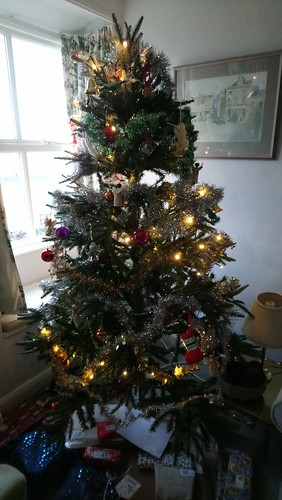
In case you’re wondering, the photo is of the mill pond and River Dart in Stoke Gabriel, where my brother lives. Stoke comes from the Old English word stoc (place), which also has two two specialised meanings: (1) a religious place and (2) a secondary settlement [source], and Gabriel is a saint/angel associated with the area. The Dart apparently gets its name from a Brythonic Celtic word meaning ‘river where oak trees grow’ [source]. If you click on the photo you can see a larger version, and some of my other photos from Stoke Gabriel.

Rollipokes, ronners and roudges

If I offered you a rollipoke, would you have any idea what it was or what to do with it?

This is a word I came across while looking for something else in the Dictionary of The Scots Language / Dictionar o the Scots Leid today. It is defined as, “A sacking of loosely woven hemp in which cheese was wrapped before being buried to ripen.”

Rollipoke comes from roll / row, one of the meanings of which is ‘to wrap up, around, in’; and poke is a variant of pock (a simple type of bag or pouch, a small sack or sack-like receptacle).

Ronner and roudge are other words for the rollipoke.

In East Anglian varieties of English, a rollipoke is “hempen cloth of very coarse texture. Perhaps so named, because only fit to be used as bags or wrappers for rolls or bales of finer goods.” [from The Vocbulary of East-Anglia Etc. Volume 2]

Some examples of use of poke / pock (also written powk, poak, etc):

– An ill-bred loon or twa crackit a paper pyoke at the verra time he was speakin’.

– Every young sheeld hed his muckle pokky o’ sweeties, ‘at he haandit aboot in nev-fues.

– He wambles like a poke o’ bran.

Glossary
– loon = a rogue, rascal, scoundrel, a worthless person
– sheeld (a variant of chield) = child
– muckle = large, big
– nev-fues = ?
– to wamble = to stagger, totter, wobble

Pock can also mean:

– the bag used by a beggar for collecting meal or the like given in charity, a beggar’s scrip or wallet.

– a sack or bag holding a certain quantity of wool, a measure of wool

– A net in the form of a bag or pouch used for catching salmon, a purse-net; a bag-shaped net for catching small coal-fish

Related words include:

butter-poki = a small thin bag through which the water is strained from freshly-churned butter

pock-end = the bottom or corner of a bag or receptacle, esp. one used to hold money.

pock-pud(ding) = (1) a dumpling or steamed pudding cooked in a bag of muslin or similar thin material; (2) a jocular or pejorative nickname for an Englishman from the supposed fondness of the English for steamed puddings, with an additional implication of omnivorousness and stolidity.

National Motto(e)s

Navis volitans mihi anguillis plena est
Created with The Keep Calm-O-Matic

Do you know your country’s national motto?

Not all countries have them. Many are in Latin and other ancient languages, and most are a bit bland and include things like freedom, liberty, unity, strength, work, progress, God, etc.

Here are some more interesting ones:

Isle of Man (Latin): Quocunque Ieceris Stabit (Whithersoever you throw it, it will stand) – refers to the triskelion on the flag.

– Luxembourg (Luxembourgish): Mir wëlle bleiwe wat mir sinn (We wish to remain what we are)

– Moldova (Romanian): Limba noastră-i o comoară (Our Language is a Treasure)

– Somalia: Go forward, and never backward

– South Georgia and the South Sandwich Islands (Latin): Leo terram propriam protegat (Let the lion protect his own land)

– Switzerland (Latin): Unus pro omnibus, omnes pro uno (One for all, all for on)

– Turks and Caicos Islands: Beautiful By Nature, Clean By Choice

You can see a list of them on Wikipedia, and here’s an infographic with a selection of them:

”The
From The Translation Company blog

If you were asked to think of a new motto for your country, perhaps one that reflects how you feel about the country, what would you suggest?

Here’s a few I came up with:

Wales:
Nid yn bwrw glaw trwy’r amser (Not Always Raining – the English version comes from Jasper Fforde’s Thursday Next novels)
Mae dreigiau yma (Here Be Dragons)
Gwlad Gydgordiol (Harmonious Country)

England:
Perfer et Obdura (Keep Calm and Carry On) [source]
Let’s Not Make a Fuss
Ignosce mihi! (Sorry!)
Terra antiqua (The Antique Terror, or possibly the Old Land)
Navis volitans mihi anguillis plena est (My hovercraft is full of eels)

Ave a butchers at er barnet

The title of this post is an example of Cockney, a form of speech you might hear in London, specifically in the Cheapside district of the City of London. It includes to bits of rhyming slang – butchers and barnet. Do you know, or can you guess what they mean?

To (h)ave a butchers (the initial h is not used in Cockney) means to have a look or just to look. It is used in informal English in much of the UK, and I didn’t realise it was rhyming slang until I discovered that it actually stands for butcher’s hook = look.

Barnet means hair, and until I read Vulgar Tongues: An Alternative History of English Slang by Max Décharné, which I just finished, I didn’t know that barnet is also rhyming slang: Barnet Fair = hair.

Barnet Fair is a fair that has been taking place since 1588 in Barnet, a part of north London also known as High Barnet or Chipping Barnet. The main focus of the fair was originally horses and other livestock, but these days it is a funfair, and takes place from 4-7 September each year.

So the title means ‘Have a look at her hair’.

Incidentally, in Swedish barnet means ‘the child’ from barn [bɑːrn] (child, infant, baby, offspring, family) [source].

Barn comes from the Old Norse barn (child), from the Proto-Germanic *barną (child), from the Proto-Indo-European *bʰer- (to bear, to carry), which is also the root of the Scots bairn (child), the Icelandic / Faroese / Norwegian / Danish barn (child), and related words in other Indo-European languages [source].

According to Wikipedia, rhyming slang was first recording in the East End of London in about 1840, and the earliest glossaries of this slang appeared in 1859 in the Dictionary of Modern Slang, Cant, and Vulgar Words by John Camden Hotten. He included examples such as frog and toad (road), apples and pears (stairs), Battle of the Nile (a tile, a vulgar term for a hat), and Duke of York (take a walk).

It is unknown why this type of slang originally emerged. It was possibly a game, or a way to confuse outsiders, a way for criminals to confuse the police, and/or a way to maintain a sense of belonging.

More up-to-date examples of rhyming slang, from cockneyrhymingslang.co.uk include:

– Andy McNab = kebab / cab
– Angela Merkel = circle
– Barack Obama = pyjamas
– Calvin Klein = wine / fine (body)
– Captain Kirk = work / Turk
– Dudley Moore = score (£20)
– Mariah Carey = scary

Is there rhyming slang in other languages?

Chut-chut

Yesterday I discovered an interesting resource for learning Russian – Russian Podcast, which includes a series of conversations in Russian with transcripts.

There are also videos featuring conversations with various people, with subtitles in Russian and English. These are called vodcasts, which is a new word to me. Most of the material is free, but you can get more if you subscribe.

In a video I watched yesterday the host chats about language learning with another Russian woman who lives in Paris and speaks quite a few languages. One expression I picked up from their conversation was по-чуть-чуть (pa-chut’-chut’), which means little by little, and that is one of the suggestions about how to learn languages that is discussed.

Here are some examples of usage:

– Я собирал каждый день по чуть-чуть. = I’ve been putting a bit aside every day.
– Я изучаю по чуть-чуть русский язык каждый день. = I study a little Russian every day.
– Я по чуть-чуть изучаю, и дальше у меня уже прогресс. = I study little by little, and that’s how I progress.

On it’s own, чуть means hardly, a little or as soon as. Here some examples of expressions and sentences featuring this word:

– чуть (было) не = almost, nearly
– чуть ли не = almost certainly
– чуть что = at the slightest thing
– Мне нужно подержам невесту чуть подольше = I need to hold on to the bride a little longer.
– Думаю, стоит покопать чуть глубже = I just have to dig a little deeper, I guess.

When reduplicated чуть-чуть means a little bit. Here are some examples of usage:

– Ну, хорошо, только чуть-чуть. = Erm, all right, then just a little bit.
– Мне просто нужно чуть-чуть больше времени. = I just need a little bit more time.

Source: Reverso Dictionary and Reverso Context

Special offer from Rocket Languages

Rocket languages

This week Rocket Languges are celebrating their 13th Anniversary with a 4-day sale starting today and continuing until Friday 17th March, or until they’ve sold 1,000 courses.

During this time you can get 60% off any of their online language courses, which include: French, Spanish, Italian, Chinese (Mandarin), German, Japanese, Russian, Arabic, Hindi, ASL, Korean, Portuguese and English (for Spanish or Japanese speakers).

The coupon code to receive the discount is ANNIVERSARY

They also offer online piano courses, in case you fancy a break from your language studies.

I have tried and reviewed their Hindi and Japanese courses, and think they are definitely worth a look. Since then they have added some new languages – Russian and Portuguese – and I’m tempted to try their Russian course, even though I already have plenty of other Russian courses and learning materials. Can you ever have too many language learning materials?

Note: I am a Rocket Languages affiliate, and will receive commission if you buy any of the courses via the links above.

Les mots de la semaine

français English Cymraeg
le boulon (nut and) bolt bollt
le boulon à oreilles wing bolt bollt adeiniogf/asgellog
le verrou bolt (on door) bollt(en)
verrouiller to bolt (a door) bolltio (drws)
boulonner to bolt (on) bolltio
engloutir to bolt (food) llowcio/claddu/bolgian bwyd
boulotter to tuck (into smth); to eat claddu bwyd
accordeur de piano piano tuner tiwniwr pianos
dyn tiwnio pianos
accorder to tune (an instrument) tiwnio
battre un record to break a record torri/curo record
collant sticky gludiog/td>

How to become a language expert in no time

Today we have a guest post from Sebastien Marion

Léa Knows

As most expats would agree, the best way to learn a language is to go abroad. When abroad, you are immersed in the culture and are forced to speak the language. But whether you are abroad already or trying to improve your language skills from home, vocabulary will be key to quick progress. Learning grammar and tenses is very important indeed, but without vocabulary, you will soon find yourself very limited.

When I arrived in Spain two years ago, I had some leftover fragments of my years in school studying the language. This was invaluable to me as it allowed to have some kind of conversation. When I did not know a word, I quickly typed it in a translation app and it gave me its translation on the fly.

As useful as these translation apps are however, to me they had a major flaw. As the conversation went on, I systematically forgot the words that I had searched for and their translations, making progress somewhat slow. And what’s worse, when I got home my history was gone. And while some apps do keep a record, to be able to practice the words using flashcards I would then have to copy them to a flashcard application, which slowed me down considerably.

To solve this problem, I have been working on a small application acting as a translator (using Google Translate and soon also WordReference) but with the twist that each translation gets automatically recorded and turned into flashcards for you to practice at a later time. Using flashcards you can learn vocabulary faster and improve you level quickly. You can even create lists and we will in the future add a bit to help you train better.

The app is nearly ready and will hopefully go live by the end of March. The website is available at http://www.leaknows.com and as a special offer to readers of Omniglot, you can claim a free lifetime membership by sending me a message before the 1st of April and quoting “OMNIGLOT_FREE_ACCOUNT” in the message field.

Protagonists and sidekicks

When listening to The Allusionist podcast today I learnt an interesting word – tritagonist, who was the actor who played the third role in ancient Greek drama.

Tritagonist comes from the Ancient Greek word τρίτἀγωνιστής (triagōnistḗs), from τρίτ ‎(third) and ἀγωνιστής ‎(combatant, participant).

The actors who played the first and second roles in ancient Greek drama were known as the protagonist and deuteragonist, or sidekick. Proto- comes from πρῶτος ‎(first), a superlative of πρό ‎(before), and deuter- from δευτερ (second).

Proto goes back to the Proto-Indo-European *pro/*per- (to go over), which is also the root of:

– Proto-Celtic *ɸro = before, in front of, in addition
– Welsh rhy = too
– Irish ro = too
– Proto-Germanic *fram = from, by, due to
– English from
– Scots frae = from
– Swedish från = from; and fram = forward
– Icelandic frá = from, away from, about
– Latin per = through, by means of, during, and related words in Romance languages.

The antonym of protagonist is antagonist, from ἀντί ‎(against) and ἀγωνιστής (combatant, participant).

Source: Wiktionary

Pull up a pew

Take a pew

One thing that came up in the French Conversation Group last night was church pews, and particularly how uncomfortable they are. We discovered that in French a pew is un banc (d’église).

Banc also means seat or bench, and can mean other things in combination with other words:

– banc de sable = sandbank
– banc des accusés = dock (in court)
– banc des témoins = witness box
– banc de touche = dugout
– banc des avocats = (legal) bar
– banc de brouillard = patch of fog
– banc de sable = sand bar

Banc comes ultimately from the Proto-Indo-European *bʰeg- ‎(to bend, curve, arch), which is also the root of banque (bank) and banquet (dinner, reception, banquet), as well as bank, banquet and bench in English, and related words in other languages.

The French equivalent of pull up a pew or take a pew (take a seat, sit down), is prends-toi une chaise or tire-toi une bûche (pull up a log). Are there other ways to say this?

Sources: Reverso, Wiktionary, WordReference.com