

Telugu is a Dravidian language spoken mainly in the southern Indian states of Andhra Pradesh and Telangana, where there are about 70.6 million speakers. Other India states with large numbers of Telugu speakers include: Karnataka (3.7 million), Tamil Nadu (3.5 million), Maharashtra (1.3 million), Chhattisgarh (1.1 million) and Odisha (214,010) [source]. According to the 2011 census there are about 93.9 million native speakers of Telugu in India, including 13 million people who speak it as a second language. The total number of Telugu speakers is about 95 million [source].
Other countries with significant numbers of Telugu speakers include the UAE (455,000), Saudi Arabic (349,000), the USA (248,000), Sri Lanka (230,000) and Malaysia (119,000).
Telugu is one of the 22 official languages of India, and a statutory provincial language in the states of Andhra Pradesh and Telangana, in the Yanam district of The Puducherry Union Territory, and in the Andaman and Nicobar islands. It is also a recognised minority language in South Africa.
There are three major dialects of Telugu: the Coastal dialect, which is spoken on the coast of Andhra Pradesh, the Rayalaseema dialect, which is spoken in the Rayalaseema districts of Andhra Pradesh, and the Telangana dialect, which spoken mainly in Telangana.
The origins of the Telugu alphabet can be traced by to the Brahmi alphabet of ancient India, which developed into an alphabet used for both Telugu and Kannada, which in turn split into two separate alphabets between the 12th and 15th centuries AD.
The earliest known inscriptions containing Telugu words appear on coins that date back to 400 BC. The first inscription entirely in Telugu was made in 575 AD and was probably made by Renati Cholas, who started writing royal proclamations in Telugu instead of Sanskrit. Telugu developed as a poetical and literary language during the 11th century.
Until the 20th century Telugu was written in an archaic style very different from the everyday spoken language. During the second half of the 20th century, a new written standard emerged based on the modern spoken language. In 2008 Telugu was designated as a classical language by the Indian government.
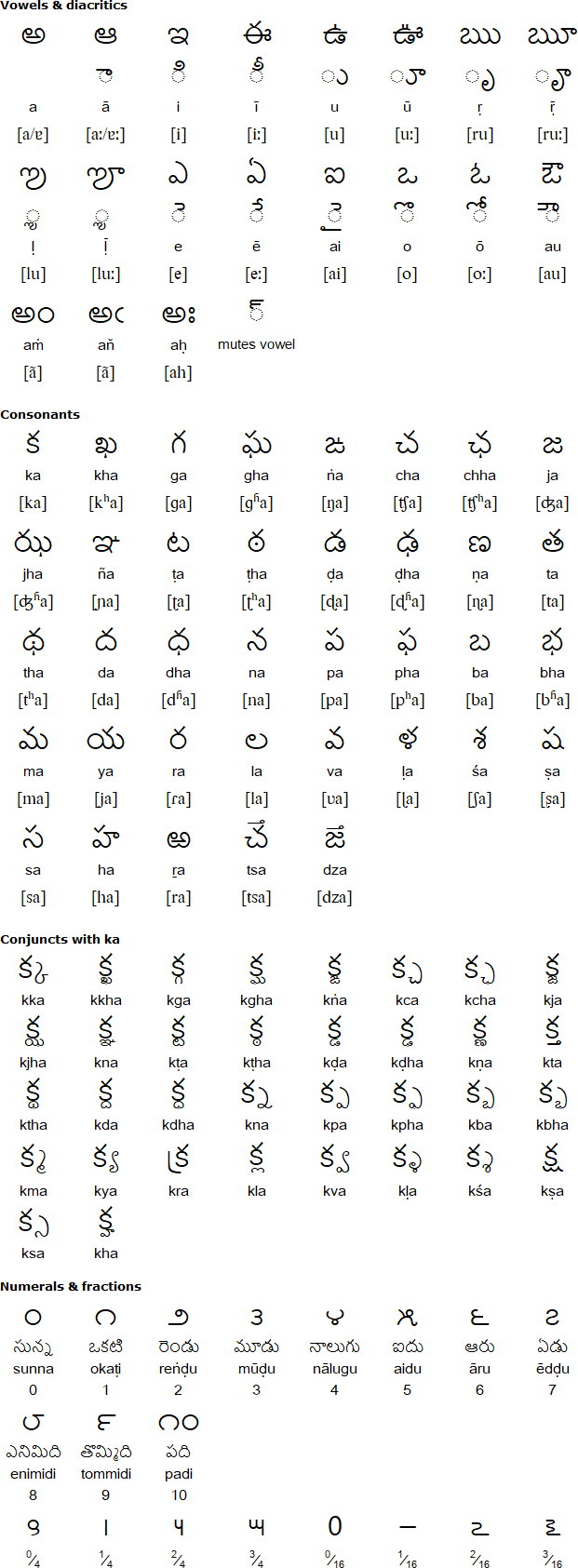
Download an alphabet chart for Telugu (Excel)
The letters ఌ (l̥a) and ౡ (l̥̄a) are not used in modern Telugu.
How to write and pronounce the Telugu letters:
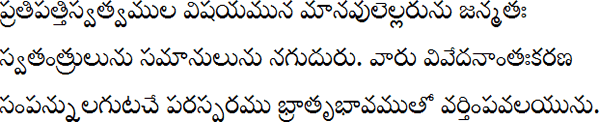
Pratipattisvatvamula visyamuna mānavulellarunu janmataḥ svataṁtrulunu samānulunu naguduru. Vāru vivēdanāṁtaḥkaraṇa saṁpannulaguṭacaē parasparamu bhrātṛbhāvamutō vartiṁpavalayunu.
Hear a recording of this text (made with Text To Speech Free)
All human beings are born free and equal in dignity and rights. They are endowed with reason and conscience and should act towards one another in a spirit of brotherhood.
(Article 1 of the Universal Declaration of Human Rights)
Information about Telugu | Phrases | Numbers | Colours | Family Words | Tower of Babel
Information about the Telugu language and script
http://en.wikipedia.org/wiki/Telugu_language
https://www.ethnologue.com/language/tel
http://www.teluguworld.org/Telugu/telugu_history.html
http://www.engr.mun.ca/~adluri/telugu/
http://www.teluguworld.org/Telugu/telugu_history.html
http://www.teluguwebsite.com
http://www.engr.mun.ca/~adluri/telugu/language/script/script1d.html
https://sites.google.com/site/sarvabhashin/en/te
Online Telugu lessons
http://www.wazu.jp/gallery/Fonts_Telugu.html
http://scriptsource.org/scr/Telu
Online Telugu phrases
http://wikitravel.org/en/Telugu_phrasebook
http://www.travelmasti.com/domestic/andhrapradesh/languagetips.htm
Online Telugu dictionary
http://www.shabdkosh.com/te/
http://www.andhrabharati.com/dictionary/
http://dsal.uchicago.edu/dictionaries/gwynn/
http://dictionary.tamilcube.com/telugu-dictionary.aspx
http://telugudictionary.telugupedia.com/
Telugu fonts
http://www.wazu.jp/gallery/Fonts_Telugu.html
http://scriptsource.org/scr/Telu
Online Telugu input / transliteration
http://specials.msn.co.in/ilit/Telugu.aspx
http://www.tamilcube.com/translate/telugu.aspx
Online Telugu news
http://www.eenadu.net
http://www.andhraprabha.com
http://www.omnamovenkatesaya.com
Online Telugu TV
http://www.youtube.com/user/tv9telugu
Badaga, Brahui, Dhundari, Gondi, Irula, Jatapu, Kannada, Kodava, Kolam, Konda, Koya, Kurukh, Malayalam, Malto, Mukha Dora, Ravula, Sankethi, Savara, Sunuwar, Suriyani Malayalam, Tamil, Telugu, Toda, Tulu, Yerukula
Ahom, Aima, Arleng, Badagu, Badlit, Basahan, Balinese, Balti-A, Balti-B, Batak, Baybayin, Bengali, Bhaiksuki, Bhujimol, Bilang-bilang, Bima, Blackfoot, Brahmi, Buhid, Burmese, Carrier, Chakma, Cham, Cree, Dehong Dai, Devanagari, Dham Lipi, Dhankari / Sirmauri, Ditema, Dives Akuru, Dogra, Ethiopic, Evēla Akuru, Fox, Fraser, Gond, Goykanadi, Grantha, Gujarati, Gunjala Gondi, Gupta, Gurmukhi, Halbi Lipi, Hanifi, Hanuno'o, Hočąk, Ibalnan, Incung, Inuktitut, Jaunsari Takri, Javanese, Kaithi, Kadamba, Kamarupi, Kannada, Kawi, Kharosthi, Khema, Khe Prih, Khmer, Khojki, Khom Thai, Khudabadi, Kirat Rai, Kōchi, Kodava Lipi, Komering, Kulitan, Kurukh Banna, Lai Tay (Tai Yo), Lampung, Lanna, Lao, Leke, Lepcha, Limbu, Lontara/Makasar, Lota Ende, Magar Akkha, Mahajani, Malayalam, Meitei (Modern), Manpuri (Old), Marchen, Meetei Yelhou Mayek, Meroïtic, Masarm Gondi, Modi, Mon, Mongolian Horizontal Square Script, Multani, Nandinagari, Newa, New Tai Lue, Ojibwe, Odia, Ogan, Pahawh Hmong, Pallava, Phags-pa, Purva Licchavi, Qiang / Rma, Ranjana, Rejang (Kaganga), Sasak, Savara, Satera Jontal, Shan, Sharda, Sheek Bakrii Saphaloo, Siddham, Sinhala, Sorang Sompeng, Sourashtra, Soyombo, Sukhothai, Sundanese, Syloti Nagri, Tagbanwa, Tai Noi, Takri, Tamil, Tanchangya (Ka-Pat), Tani, Thaana, Telugu, Thai, Thirke, Tibetan, Tigalari, Tikamuli, Tocharian, Tolong Siki, Vatteluttu, Warang Citi
Page last modified: 21.08.25
[top]

You can support this site by Buying Me A Coffee, via PayPal or Patreon, or by contributing in other ways.
If you find all the adverts annoying, there is now an Ad-free version of Omniglot which you can access for a small monthly or annual donation.

Note: all links on this site to Amazon.com


This website and its content is copyright of Simon Ager - © Simon Ager 1998-2026. All rights reserved. All images were created by me, unless otherwise indicated. Feel free to use them for personal, educational or non-commercial purposes, and don't forget to mention where they came from. More details about copyright

[top]


