

Balinese is a Malayo-Polynesian language spoken by about 3.3 million people mainly in Bali in Indonesian, and also in nothern Nusa Penida, western Lombok and eastern Java. According to the Bali Cultural Agency, a million or so people use Balinese in their every day lives. However, in urban areas Balinese-speaking parents speak Indonesian to their children.

The Balinese alphabet or Aksara Bali descended ultimately from the from Brahmi script of ancient India by way of the Pallava and Old Kawi scripts. The oldest known inscriptions in the Balinese alphabet date from the 11th century AD, but they are thought to be reproductions of texts originally written on palm leaves at an earlier date.
The Balinese alphabet is still used to this day, although very few people are familiar with it and it is mainly used for religious works. Generally a version of the Latin alphabet is used instead, although what little Balinese printed material exists in the Latin alphabet consists mainly of school books, religious works and a few books of stories. Balinese children are taught to read and write Balinese in the Latin alphabet at primary school, though few read or write it in later life.
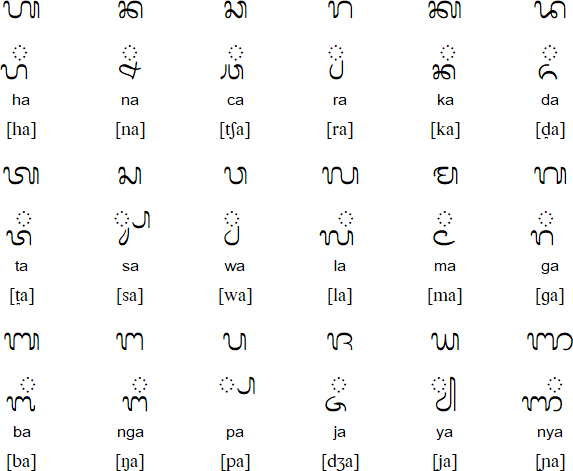
The appended forms (pangangge akśara) are shown below the consonants.
A recording of the Balinese consonants by Ali Aulia Ghozali
There consonants are used for writing words from the Kawi (Old Javanese) language.
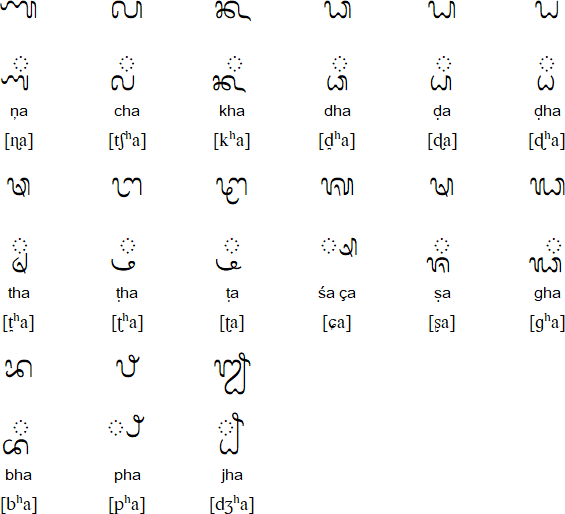
The appended forms (pangangge akśara) are shown below the consonants.
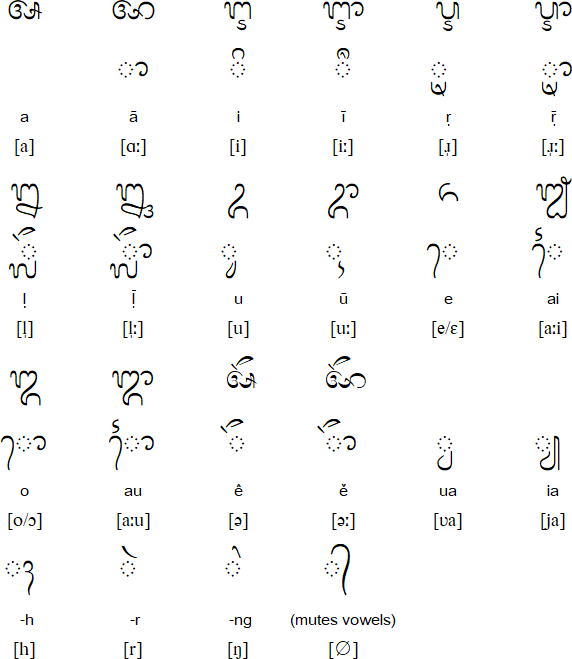
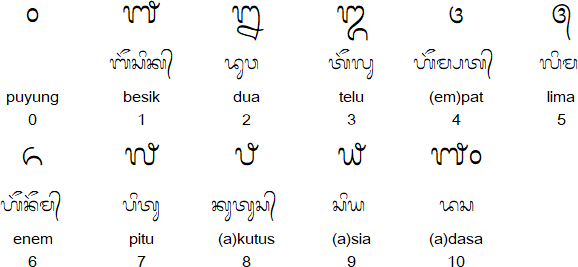
A recording of these numbers by Ali Aulia Ghozali
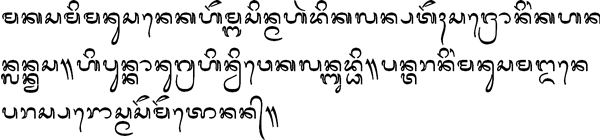
Makasami manusane kaembasin mahardika lan pateh. sajeroning kahanan lan kuasa. Ipun kanugrahin wiweka lan budi. pantaraning manusa mangdane paras-paros masemetonan.
(Article 1 of the Universal Declaration of Human Rights)
Translation by Tri Ediwan
A recording of this text by Ali Aulia Ghozali
Sami manusane sane nyruwadi wantah merdeka tur maduwe kautamaan lan hak-hak sane pateh. Sami kalugrain papineh lan idep tur mangdane pada masawitra melarapan semangat pakulawargaan.
A recording of this text by Ali Aulia Ghozali
All human beings are born free and equal in dignity and rights. They are endowed with reason and conscience and should act towards one another in a spirit of brotherhood.
(Article 1 of the Universal Declaration of Human Rights)
Information about Balinese | Phrases | Numbers | Tower of Babel | Books
Information about the Balinese language and alphabet
http://en.wikipedia.org/wiki/Balinese_language
http://www.balitouring.com/bali_articles/balinesean.htm
http://www.coralreeffish.com/balinese.htm
http://www.babadbali.com/aksarabali/alphabet-c.htm
http://www.babadbali.com/aksarabali/utama.htm
http://basabali.org/balinese-script/
Balinese lessons
http://basabali.org/flashcards/
http://web.archive.org/web/20080404024205/http://www.aa.tufs.ac.jp/~asako/textbook/index2.htm
http://www.asahi-net.or.jp/~bw5y-nsmr/basabali/preview.html
Balinese phrases
http://wikitravel.org/en/Balinese_phrasebook
http://30daysofadventure.com/balinese-words-tourist-travelers-learn/
https://quizlet.com/89011082/balinese-phrases-flash-cards/
https://youtu.be/IxQCxZvdOyo
Balinese word of the day
http://www.transparent.com/word-of-the-day/today/balinese.html
Balinese dictionaries
http://dictionary.basabali.org/
Balinese fonts
http://www.babadbali.com/aksarabali/balisimbar.htm
Alorese, Ambai, Ambel, Anuki, Baduy, Balinese, Batuley, Bawean, Bawm, Biak, Bima, Chamorro, Enggano, Fijian, Fordata, Gayo, Iban, Javanese, Kedang, Kei, Kenyah, Komering, Lamaholot, Lampung, Madurese, Mbula, Mentawai, Mualang, Musi, Ngaju, Nias, Nuaulu, Ogan, Palauan, Sasak, Sawai, Selaru, Sumbawa, Sundanese, Toqabaqita, Wakasihu, Wamesa, Wooi, Yamdena
Languages written with the Latin alphabet
Ahom, Aima, Arleng, Badagu, Badlit, Basahan, Balinese, Balti-A, Balti-B, Batak, Baybayin, Bengali, Bhaiksuki, Bhujimol, Bilang-bilang, Bima, Blackfoot, Brahmi, Buhid, Burmese, Carrier, Chakma, Cham, Cree, Dehong Dai, Devanagari, Dham Lipi, Dhankari / Sirmauri, Ditema, Dives Akuru, Dogra, Ethiopic, Evēla Akuru, Fox, Fraser, Gond, Goykanadi, Grantha, Gujarati, Gunjala Gondi, Gupta, Gurmukhi, Halbi Lipi, Hanifi, Hanuno'o, Hočąk, Ibalnan, Incung, Inuktitut, Jaunsari Takri, Javanese, Kaithi, Kadamba, Kamarupi, Kannada, Kawi, Kharosthi, Khema, Khe Prih, Khmer, Khojki, Khom Thai, Khudabadi, Kirat Rai, Kōchi, Kodava Lipi, Komering, Kulitan, Kurukh Banna, Lai Tay (Tai Yo), Lampung, Lanna, Lao, Leke, Lepcha, Limbu, Lontara/Makasar, Lota Ende, Magar Akkha, Mahajani, Malayalam, Meitei (Modern), Manpuri (Old), Marchen, Meetei Yelhou Mayek, Meroïtic, Masarm Gondi, Modi, Mon, Mongolian Horizontal Square Script, Multani, Nandinagari, Newa, New Tai Lue, Ojibwe, Odia, Ogan, Pahawh Hmong, Pallava, Phags-pa, Purva Licchavi, Qiang / Rma, Ranjana, Rejang (Kaganga), Sasak, Savara, Satera Jontal, Shan, Sharda, Sheek Bakrii Saphaloo, Siddham, Sinhala, Sorang Sompeng, Sourashtra, Soyombo, Sukhothai, Sundanese, Syloti Nagri, Tagbanwa, Tai Noi, Takri, Tamil, Tanchangya (Ka-Pat), Tani, Thaana, Telugu, Thai, Thirke, Tibetan, Tigalari, Tikamuli, Tocharian, Tolong Siki, Vatteluttu, Warang Citi
Page last modified: 06.01.25
[top]

You can support this site by Buying Me A Coffee, via PayPal or Patreon, or by contributing in other ways.
If you find all the adverts annoying, there is now an Ad-free version of Omniglot which you can access for a small monthly or annual donation.

Note: all links on this site to Amazon.com



[top]


