
Carrier is a Northern Athabascan language spoken in central British Columbia in Canada. It is spoken between Stewart Lake and Quesnel. The people who speak it call themselves and their language Dakelh (ᑕᗸᒡ). The name Carrier is a translation of Aghele, the Sekani name for the Dakelh. The language is also known as Dakelhne, Porteur, Takelne or Takulie.
In 2014 there were about 680 fluent speakers of Carrier, and another 1,380 people with some knowledge of the language. The majority of speakers are adults.
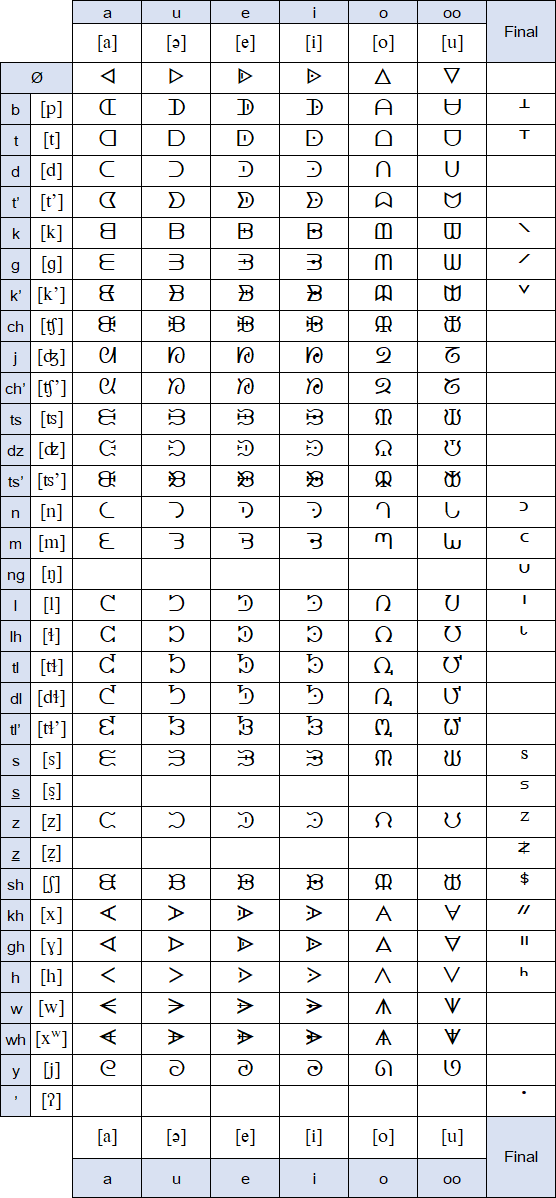
The Carrier syllabary, or Déné Syllabics, was devised by Father Adrien-Gabriel Morice in 1885. He adapted it from the syllabic writing systems developed for the Athabaskan languages of the Northwest Territories of Canada by Father Emile Petitot.
The Carrier syllabary was fairly widely used for several decades for such purposes as writing diaries and letters and leaving messages on trees. Though the syllabary is no longer used or understood by many people, there has been a recent revival of interest in it and it occasionally appears on plaques and memorials.
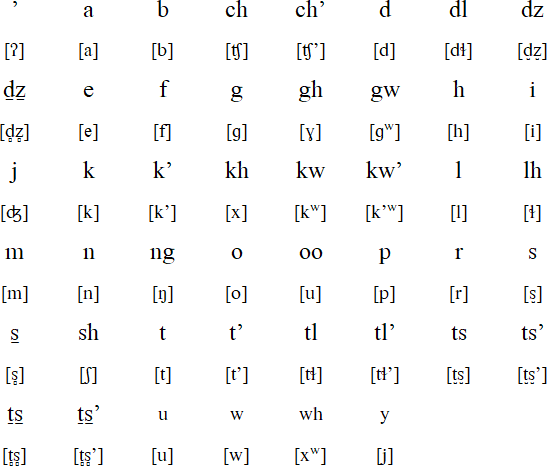
In the 1960s, the Carrier Linguistic Committee in Fort St James developed an alternative writing system based on the Latin alphabet. This system is now the most popular writing system for Dakelh.
Download a script charts for Carrier (Excel)
Ba cha ye cha ndoni cha boozi be ndohone. Hoonzoo ts'i neondleh. Nemoodihti inzoo hoowa ndi netl'adantsut. 'I cha hoonzoo ts'i neba ondleh. Sizi Gri nemoodihti nyoozi 'i be ndohone.
Source: https://www.ydli.org/dakinfo/gracemai.htm
Information about Carrier | Numbers | Tower of Babel
Information about Carrier
https://en.wikipedia.org/wiki/Carrier_language
http://www.native-languages.org/carrier.htm
http://www.languagegeek.com/dene/dakelh/dakelh.html
https://www.ydli.org/linginfo.htm
https://www.ethnologue.com/language/crx
Ahtna, Apache (Western), Babine-Witsuwit'en, Chilcotin, Chipewyan, Deg Xinag, Denaʼina, Dane-zaa (Beaver), Eyak, Gwich'in, Hän, Hupa, Jicarilla, Kaska, Koyukon, Lipan Apache, Lower Tanana, Mescalero-Chiricahua, Navajo, North Slavey, Sekani, South Slavey, Tahltan, Tanacross, Tłı̨chǫ (Dogrib), Tolowa, Tsuut'ina (Sarcee), Tutchone, Upper Kuskokwim, Upper Tanana
Blackfoot, Carrier, Chipewyan, Cree (East), Cree (Moose), Cree (Plains), Cree (Swampy), Cree (Woods), Inuinnaqtun, Inuktitut, Naskapi, Ojibwe, Oji-Cree
Ahom, Aima, Arleng, Badagu, Badlit, Basahan, Balinese, Balti-A, Balti-B, Batak, Baybayin, Bengali, Bhaiksuki, Bhujimol, Bilang-bilang, Bima, Blackfoot, Brahmi, Buhid, Burmese, Carrier, Chakma, Cham, Cree, Dehong Dai, Devanagari, Dham Lipi, Dhankari / Sirmauri, Ditema, Dives Akuru, Dogra, Ethiopic, Evēla Akuru, Fox, Fraser, Gond, Goykanadi, Grantha, Gujarati, Gunjala Gondi, Gupta, Gurmukhi, Halbi Lipi, Hanifi, Hanuno'o, Hočąk, Ibalnan, Incung, Inuktitut, Jaunsari Takri, Javanese, Kaithi, Kadamba, Kamarupi, Kannada, Kawi, Kharosthi, Khema, Khe Prih, Khmer, Khojki, Khom Thai, Khudabadi, Kirat Rai, Kōchi, Kodava Lipi, Komering, Kulitan, Kurukh Banna, Lai Tay (Tai Yo), Lampung, Lanna, Lao, Leke, Lepcha, Limbu, Lontara/Makasar, Lota Ende, Magar Akkha, Mahajani, Malayalam, Meitei (Modern), Manpuri (Old), Marchen, Meetei Yelhou Mayek, Meroïtic, Masarm Gondi, Modi, Mon, Mongolian Horizontal Square Script, Multani, Nandinagari, Newa, New Tai Lue, Ojibwe, Odia, Ogan, Pahawh Hmong, Pallava, Phags-pa, Purva Licchavi, Qiang / Rma, Ranjana, Rejang (Kaganga), Sasak, Savara, Satera Jontal, Shan, Sharda, Sheek Bakrii Saphaloo, Siddham, Sinhala, Sorang Sompeng, Sourashtra, Soyombo, Sukhothai, Sundanese, Syloti Nagri, Tagbanwa, Tai Noi, Takri, Tamil, Tanchangya (Ka-Pat), Tani, Thaana, Telugu, Thai, Thirke, Tibetan, Tigalari, Tikamuli, Tocharian, Tolong Siki, Vatteluttu, Warang Citi
Page last modified: 16.03.23
[top]

You can support this site by Buying Me A Coffee, and if you like what you see on this page, you can use the buttons below to share it with people you know.

If you like this site and find it useful, you can support it by making a donation via PayPal or Patreon, or by contributing in other ways. Omniglot is how I make my living.

Note: all links on this site to Amazon.com


[top]


