
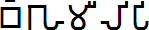
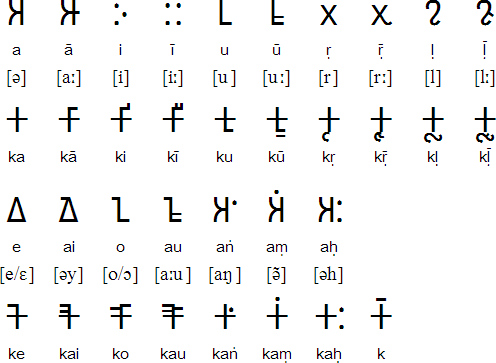
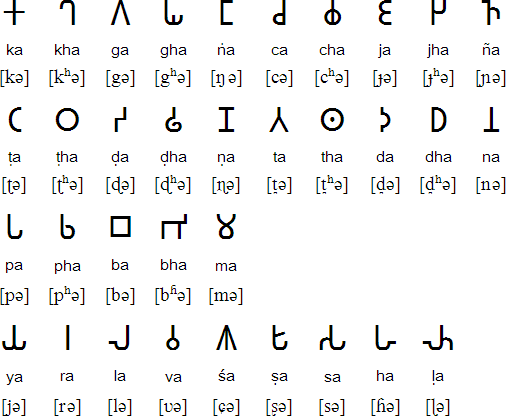
The Brāhmī alphabet is the ancestor of most of the 40 or so modern Indian alphabets, and of a number of other alphabets, such as Khmer and Tibetan. It is thought to have been modelled on the Aramaic or Phoenician alphabets, and appeared in India sometime before 500 BC. Another theory is that Brāhmī developed from the Indus or Harappa script, which was used in the Indus valley until about 2,000 BC.
The earliest known inscriptions in the Brāhmī alphabet are those of King Asoka (c.270-232 BC), third monarch of the Mauryan dynasty.
Brāhmī was used to write a variety of languages, including Sanskrit and Prakrit.

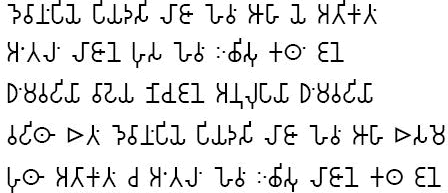
Asokan Edict - Delhi Inscription
devānaṁpiye piyadasi lājā hevaṁ āhā ye atikaṁtaṁ
aṁtalaṁ lājāne husa hevaṁ ichisu kathaṁ jane
dhaṁmavaḍhiyā vāḍheya nocujane anulupāyā dhaṁmavaḍhiyā
vaḍhithā etaṁ devānaṁpiye piyadasi lājā hevaṁ āhā esame
huthā atākaṁtaṁ ca aṁtalaṁ hevaṁ ichisu lājāne katha jane
Thus spoke king Devanampiya Piyadasi: "Kings of the olden time have gone to heaven under these very desires. How then among mankind may religion (or growth in grace) be increased? Yea, through the conversion of the humbly-born shall religion increase"
Source: http://www.virtualvinodh.com/brahmi-lipitva/144-asokan-edict-delhi
Bengali, Devanāgarī, Gujarāti, Gurmukhi, Kannada, Khmer, Malayalam, Odia, Sinhala, Tamil, Telugu, Tibetan
Information about Brāhmī
http://en.wikipedia.org/wiki/Br%C4%81hm%C4%AB_script
http://www.virtualvinodh.com/brahmi-lipitva
http://www.nibbanam.com/Brahmi/brahmi.htm
Brāhmī fonts
https://sites.google.com/site/brahmiscript/
The Edicts of King Asoka
http://www.cs.colostate.edu/~malaiya/ashoka.html
ALPHABETUM - a Unicode font
for ancient scripts, including Classical & Medieval Latin, Ancient Greek, Etruscan, Oscan, Umbrian, Faliscan, Messapic, Picene, Iberian, Celtiberian, Gothic, Runic, Old & Middle English, Hebrew, Sanskrit, Old Nordic, Ogham, Kharosthi, Glagolitic, Anatolian scripts, Phoenician, Brahmi, Imperial Aramaic, Old Turkic, Old Permic, Ugaritic, Linear B, Phaistos Disc, Meroitic, Coptic, Cypriot and Avestan.
https://www.typofonts.com/alphabetum.html
Bhaiksuki, Brāhmi, Devanāgari, Galik, Grantha, Gupta, Kadamba, Kharosthi, Nandinagari, Sharda, Siddham, Thai, Tibetan
Ahom, Aima, Arleng, Badagu, Badlit, Basahan, Balinese, Balti-A, Balti-B, Batak, Baybayin, Bengali, Bhaiksuki, Bhujimol, Bilang-bilang, Bima, Blackfoot, Brahmi, Buhid, Burmese, Carrier, Chakma, Cham, Cree, Dehong Dai, Devanagari, Dham Lipi, Dhankari / Sirmauri, Ditema, Dives Akuru, Dogra, Ethiopic, Evēla Akuru, Fox, Fraser, Gond, Goykanadi, Grantha, Gujarati, Gunjala Gondi, Gupta, Gurmukhi, Halbi Lipi, Hanifi, Hanuno'o, Hočąk, Ibalnan, Incung, Inuktitut, Jaunsari Takri, Javanese, Kaithi, Kadamba, Kamarupi, Kannada, Kawi, Kharosthi, Khema, Khe Prih, Khmer, Khojki, Khudabadi, Kirat Rai, Kōchi, Kodava Lipi, Komering, Kulitan, Kurukh Banna, Lai Tay (Tai Yo), Lampung, Lanna, Lao, Leke, Lepcha, Limbu, Lontara/Makasar, Lota Ende, Magar Akkha, Mahajani, Malayalam, Meitei (Modern), Manpuri (Old), Marchen, Meetei Yelhou Mayek, Meroïtic, Masarm Gondi, Modi, Mon, Mongolian Horizontal Square Script, Multani, Nandinagari, Newa, New Tai Lue, Ojibwe, Odia, Ogan, Pahawh Hmong, Pallava, Phags-pa, Purva Licchavi, Qiang / Rma, Ranjana, Rejang (Kaganga), Sasak, Savara, Satera Jontal, Shan, Sharda, Sheek Bakrii Saphaloo, Siddham, Sinhala, Sorang Sompeng, Sourashtra, Soyombo, Sukhothai, Sundanese, Syloti Nagri, Tagbanwa, Tai Noi, Takri, Tamil, Tanchangya (Ka-Pat), Tani, Thaana, Telugu, Thai, Thirke, Tibetan, Tigalari, Tikamuli, Tocharian, Tolong Siki, Vatteluttu, Warang Citi
Page last modified: 13.04.23
[top]

You can support this site by Buying Me A Coffee, and if you like what you see on this page, you can use the buttons below to share it with people you know.

If you like this site and find it useful, you can support it by making a donation via PayPal or Patreon, or by contributing in other ways. Omniglot is how I make my living.
Note: all links on this site to Amazon.com


[top]


