

The Tagbanwa alphabet was used until the 17th century, and is closely related to Baybayin. It is thought to have descended from the Kawi script of Java, Bali and Sumatra, which in turn descended from the Pallava script, one of the southern Indian scripts derived from Brahmi.
Aborlan Tagbanwa, Calamian Tagbanwa and Central Tagbanwa are spoken in the north of Palawan province in the Philippines. They belong to the Philippine branch of the Malayo-Polynesian language family.
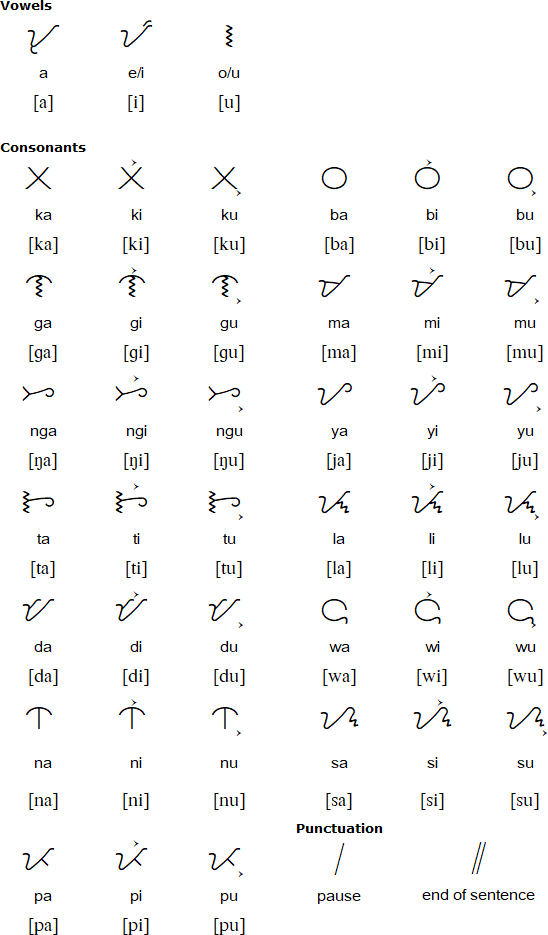
Download an alphabet chart for Tagbanwa (Excel)
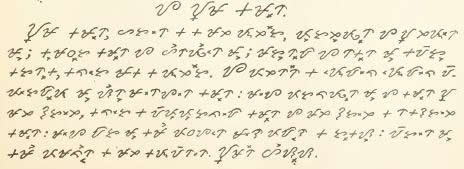
Source: http://archive.org/details/tagbanwaalphabet00romurich
Sample text supplied by Wolfgang Kuhl
Information about the Tagbanwa Script | Aborlan Tagbanwa | Calmian Tagbanwa | Central Tagbanwa | Numbers | Tower of Babel
Information about the Tagbanwa script
https://en.wikipedia.org/wiki/Tagbanwa_script
https://baybayink.files.wordpress.com/2007/09/tagbanwa-alphabet-bw.pdf
Tagbanwa fonts
https://www.google.com/get/noto/#sans-tagb
https://nordenx.blogspot.com/p/downloads.html
Ahom, Aima, Arleng, Badagu, Badlit, Basahan, Balinese, Balti-A, Balti-B, Batak, Baybayin, Bengali, Bhaiksuki, Bhujimol, Bilang-bilang, Bima, Blackfoot, Brahmi, Buhid, Burmese, Carrier, Chakma, Cham, Cree, Dehong Dai, Devanagari, Dham Lipi, Dhankari / Sirmauri, Ditema, Dives Akuru, Dogra, Ethiopic, Evēla Akuru, Fox, Fraser, Gond, Goykanadi, Grantha, Gujarati, Gunjala Gondi, Gupta, Gurmukhi, Halbi Lipi, Hanifi, Hanuno'o, Hočąk, Ibalnan, Incung, Inuktitut, Jaunsari Takri, Javanese, Kaithi, Kadamba, Kamarupi, Kannada, Kawi, Kharosthi, Khema, Khe Prih, Khmer, Khojki, Khom Thai, Khudabadi, Kirat Rai, Kōchi, Kodava Lipi, Komering, Kulitan, Kurukh Banna, Lai Tay (Tai Yo), Lampung, Lanna, Lao, Leke, Lepcha, Limbu, Lontara/Makasar, Lota Ende, Magar Akkha, Mahajani, Malayalam, Meitei (Modern), Manpuri (Old), Marchen, Meetei Yelhou Mayek, Meroïtic, Masarm Gondi, Modi, Mon, Mongolian Horizontal Square Script, Multani, Nandinagari, Newa, New Tai Lue, Ojibwe, Odia, Ogan, Pahawh Hmong, Pallava, Phags-pa, Purva Licchavi, Qiang / Rma, Ranjana, Rejang (Kaganga), Sasak, Savara, Satera Jontal, Shan, Sharda, Sheek Bakrii Saphaloo, Siddham, Sinhala, Sorang Sompeng, Sourashtra, Soyombo, Sukhothai, Sundanese, Syloti Nagri, Tagbanwa, Tai Noi, Takri, Tamil, Tanchangya (Ka-Pat), Tani, Thaana, Telugu, Thai, Thirke, Tibetan, Tigalari, Tikamuli, Tocharian, Tolong Siki, Vatteluttu, Warang Citi
Page last modified: 04.07.25
[top]

You can support this site by Buying Me A Coffee, via PayPal or Patreon, or by contributing in other ways.
If you find all the adverts annoying, there is now an Ad-free version of Omniglot which you can access for a small monthly or annual donation.

Note: all links on this site to Amazon.com



[top]


