

Sorang Sompeng was devised by Mangei Gomango in 1936 as a way to write the Sora, an Munda language spoken mainly in Andhra Pradesh in the northeast of India. Mangei Gomango was the son-in-law, Malia Gomango, an influential Sora leader, and claimed that the idea for Sorang Sompeng came to him in a vision on 18th June 1936. He also founded a religious order dedicated to Akshara Brahma.
The alphabet is used in primary and adult education and in various publications. It is also known as the Saura alphabet. Sora is written with the Odia (Oriya) alphabet in Odisha (Orissa), and with the Telugu alphabet in Andhra Pradesh and Telangana.
Before the invention of the Sorang Sompeng script, the Sora language was written with the Telugu, Odia or Latin scripts. Speakers of Telugu and Odia were keen to promote their scripts to the Sora people, who, instead of choosing one or the other, decided to try to come up with their own script.
This chart shows the Sorang Sompeng alphabet with Odia and Latin equivalents.
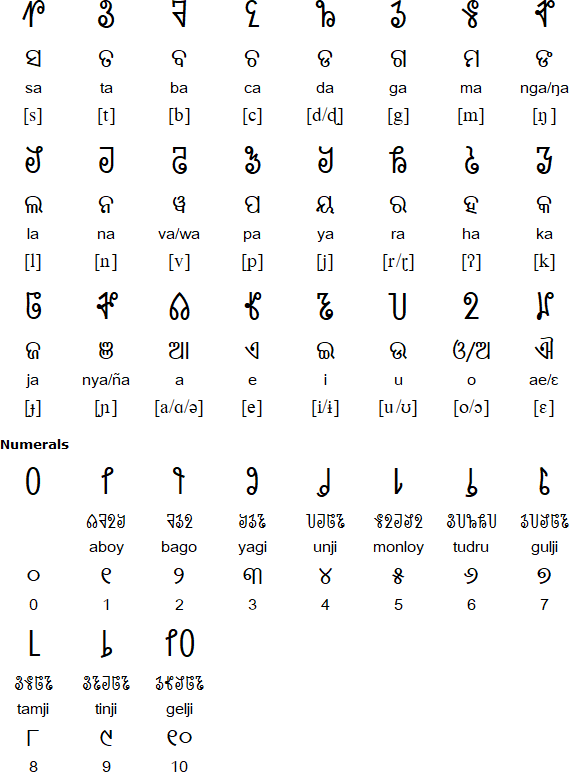
Download an alphabet chart for Sorang Sompeng (Excel)
Information about Sorang Sompeng
https://en.wikipedia.org/wiki/Sorang_Sompeng_alphabet
http://scriptsource.org/cms/scripts/page.php?item_id=script_detail&key=Sora
http://std.dkuug.dk/jtc1/sc2/wg2/docs/n1957_sorang_sompeng.pdf
http://sealang.net/sala/archives/pdf8/zide1999three.pdf
Information about the Sora language
http://en.wikipedia.org/wiki/Sora_language
https://www.ethnologue.com/18/language/srb/
http://www.swarthmore.edu/SocSci/langhotspots/Sora/
http://www.indianetzone.com/44/sora_language.htm
http://www.endangeredlanguages.com/lang/5619
https://livingtongues.org/projects/asia/india/munda-languages/sora/
Ahom, Aima, Arleng, Badagu, Badlit, Basahan, Balinese, Balti-A, Balti-B, Batak, Baybayin, Bengali, Bhaiksuki, Bhujimol, Bilang-bilang, Bima, Blackfoot, Brahmi, Buhid, Burmese, Carrier, Chakma, Cham, Cree, Dehong Dai, Devanagari, Dham Lipi, Dhankari / Sirmauri, Ditema, Dives Akuru, Dogra, Ethiopic, Evēla Akuru, Fox, Fraser, Gond, Goykanadi, Grantha, Gujarati, Gunjala Gondi, Gupta, Gurmukhi, Halbi Lipi, Hanifi, Hanuno'o, Hočąk, Ibalnan, Incung, Inuktitut, Jaunsari Takri, Javanese, Kaithi, Kadamba, Kamarupi, Kannada, Kawi, Kharosthi, Khema, Khe Prih, Khmer, Khojki, Khom Thai, Khudabadi, Kirat Rai, Kōchi, Kodava Lipi, Komering, Kulitan, Kurukh Banna, Lai Tay (Tai Yo), Lampung, Lanna, Lao, Leke, Lepcha, Limbu, Lontara/Makasar, Lota Ende, Magar Akkha, Mahajani, Malayalam, Meitei (Modern), Manpuri (Old), Marchen, Meetei Yelhou Mayek, Meroïtic, Masarm Gondi, Modi, Mon, Mongolian Horizontal Square Script, Multani, Nandinagari, Newa, New Tai Lue, Ojibwe, Odia, Ogan, Pahawh Hmong, Pallava, Phags-pa, Purva Licchavi, Qiang / Rma, Ranjana, Rejang (Kaganga), Sasak, Savara, Satera Jontal, Shan, Sharda, Sheek Bakrii Saphaloo, Siddham, Sinhala, Sorang Sompeng, Sourashtra, Soyombo, Sukhothai, Sundanese, Syloti Nagri, Tagbanwa, Tai Noi, Takri, Tamil, Tanchangya (Ka-Pat), Tani, Thaana, Telugu, Thai, Thirke, Tibetan, Tigalari, Tikamuli, Tocharian, Tolong Siki, Vatteluttu, Warang Citi
Page last modified: 14.04.24
[top]

Note: all links on this site to Amazon.com


You can support this site by Buying Me A Coffee, via PayPal or Patreon, or by contributing in other ways.
If you find all the adverts annoying, there is now an Ad-free version of Omniglot which you can access for a small monthly or annual donation.

This website and its content is copyright of Simon Ager - © Simon Ager 1998-2026. All rights reserved. All images were created by me, unless otherwise indicated. More details

[top]


