
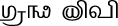
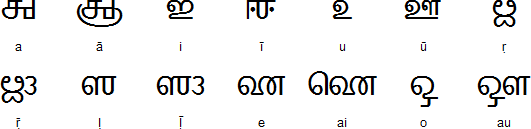
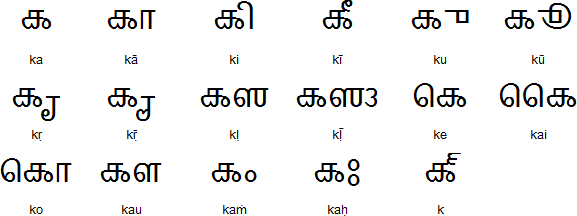
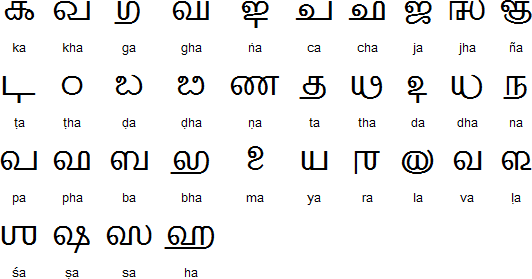
The Grantha alphabet is a descendent of the Brahmi alphabet and started to emerge during the 5th century AD. Most of the alphabets of southern India evolved from Grantha, and it also influenced the Sinhala and Thai alphabets.
The Grantha alphabet has traditional been used by Tamil speakers to write Sanskrit and is still used in traditional vedic schools (patasalas).

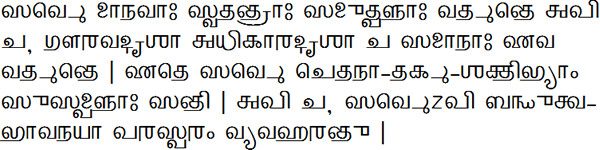
Sarvē mānavāḥ svatantrāḥ samutpannāḥ vartantē api ca, gauravadr̥śā adhikāradr̥śā ca samānāḥ ēva vartantē. Ētē sarvē cētanā-tarka-śaktibhyāṁ susampannāḥ santi. Api ca, sarvē´pi bandhutva-bhāvanayā parasparaṁ vyavaharantu.
All human beings are born free and equal in dignity and rights. They
are endowed with reason and conscience and should act towards one another in a spirit of brotherhood.
(Article 1 of the Universal Declaration of Human Rights)
Information about the Grantha Script
http://www.mudgala.com/articles/grantha.html
http://en.wikipedia.org/wiki/Grantha_script
http://noolaham.net/wiki/index.php/வலைவாசல்:கிரந்தம்
Grantha Script Tutorials
http://www.ibiblio.org/sadagopan/gsindex.html
Grantha fonts
http://www.virtualvinodh.com/wp/grantha-17-fonts-softwares/
Bhaiksuki, Brāhmi, Devanāgari, Galik, Grantha, Gupta, Kadamba, Kharosthi, Nandinagari, Sharda, Siddham, Thai, Tibetan
Ahom, Aima, Arleng, Badagu, Badlit, Basahan, Balinese, Balti-A, Balti-B, Batak, Baybayin, Bengali, Bhaiksuki, Bhujimol, Bilang-bilang, Bima, Blackfoot, Brahmi, Buhid, Burmese, Carrier, Chakma, Cham, Cree, Dehong Dai, Devanagari, Dham Lipi, Dhankari / Sirmauri, Ditema, Dives Akuru, Dogra, Ethiopic, Evēla Akuru, Fox, Fraser, Gond, Goykanadi, Grantha, Gujarati, Gunjala Gondi, Gupta, Gurmukhi, Halbi Lipi, Hanifi, Hanuno'o, Hočąk, Ibalnan, Incung, Inuktitut, Jaunsari Takri, Javanese, Kaithi, Kadamba, Kamarupi, Kannada, Kawi, Kharosthi, Khema, Khe Prih, Khmer, Khojki, Khom Thai, Khudabadi, Kirat Rai, Kōchi, Kodava Lipi, Komering, Kulitan, Kurukh Banna, Lai Tay (Tai Yo), Lampung, Lanna, Lao, Leke, Lepcha, Limbu, Lontara/Makasar, Lota Ende, Magar Akkha, Mahajani, Malayalam, Meitei (Modern), Manpuri (Old), Marchen, Meetei Yelhou Mayek, Meroïtic, Masarm Gondi, Modi, Mon, Mongolian Horizontal Square Script, Multani, Nandinagari, Newa, New Tai Lue, Ojibwe, Odia, Ogan, Pahawh Hmong, Pallava, Phags-pa, Purva Licchavi, Qiang / Rma, Ranjana, Rejang (Kaganga), Sasak, Savara, Satera Jontal, Shan, Sharda, Sheek Bakrii Saphaloo, Siddham, Sinhala, Sorang Sompeng, Sourashtra, Soyombo, Sukhothai, Sundanese, Syloti Nagri, Tagbanwa, Tai Noi, Takri, Tamil, Tanchangya (Ka-Pat), Tani, Thaana, Telugu, Thai, Thirke, Tibetan, Tigalari, Tikamuli, Tocharian, Tolong Siki, Vatteluttu, Warang Citi
Page last modified: 16.03.23
[top]

You can support this site by Buying Me A Coffee, and if you like what you see on this page, you can use the buttons below to share it with people you know.

If you like this site and find it useful, you can support it by making a donation via PayPal or Patreon, or by contributing in other ways. Omniglot is how I make my living.

Note: all links on this site to Amazon.com


[top]


