
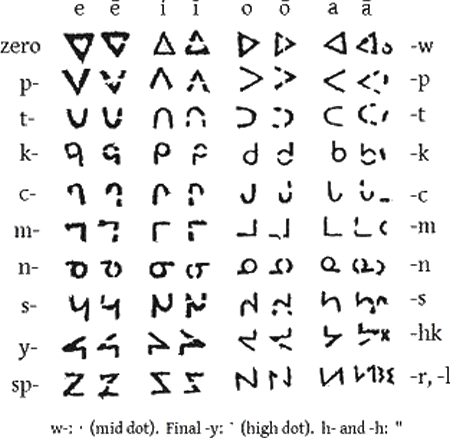
James Evans, a Wesleyan missionary and amateur linguist, invented a syllabary for language based partly on Devanagari and Pitman shorthand, while working at Norway House in Hudson's Bay. It was published in 1837. Evans' syllabary for Ojibwe consisted of just nine symbols, each of which could be written in four different orientations to indicate different vowels. This was sufficient to write Ojibwe.
In about 1841 Evans adapted his script to write Swampy Cree, and translated parts of the Bible and other religious works into Ojibwe and Cree. He printed them using type carved from wood, or made from melted-down linings of tea chests.
The script proved popular with Ojibwe and Cree speakers, and within about 10 years, many of them had learnt to read and write it, learning it mainly from family or friends. As paper was scarce at the time, they wrote on birch bark with soot from burnt sticks, or carved messages in wood, and nicknamed James Evans 'The man who made birch bark talk'.
The Cree script continued to be widely used until the 1950s and 1960s, when the integration policies of Department of Indian and Northern Affairs led to a decline in use to the script among Cree children taught to write in the Roman alphabet.
Today the Cree syllabics are used in schools in northern Quebec and Ontario. There is on-going debate about the use of Cree syllabics in Manitoba, Saskatchewan and Alberta. On the whole, however, Cree communities strongly identify with the syllabic script.
Main source: Murdoch, John Stewart, Syllabics: A Successful Educational Innovation (University of Manitoba, 1981).
According to Cree and Hopi legends, Cree syllabics were first given to Badger-Call or Calling Badger, a teacher-healer of the Wood Cree, long before James Evans came along. Apparently Calling Badger died and went to the spirt world, where he learnt the syllabics, then came back to life and taught them to his people. When missionaries came along they learnt the syllabics from the Cree, and James Evans helped to popularise them.
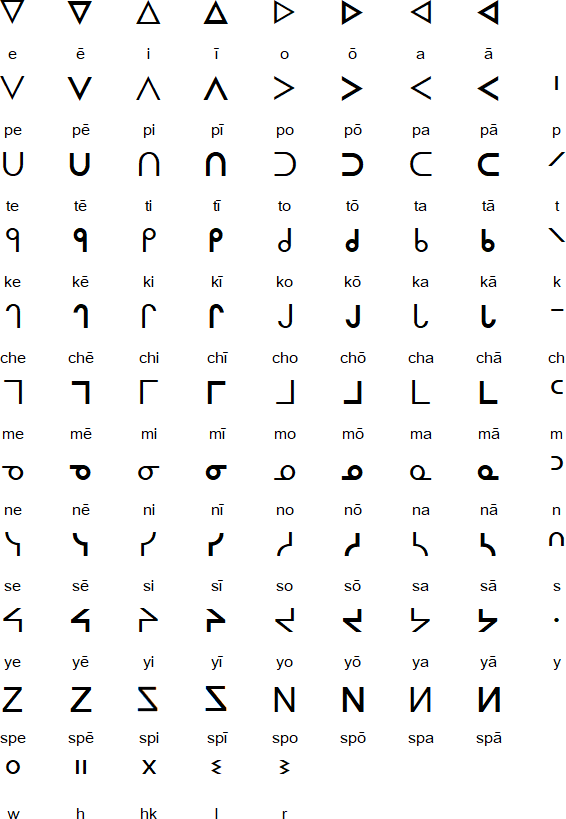
Download a script chart for Cree (Excel)
ᒥᓯᐌ ᐃᓂᓂᐤ ᑎᐯᓂᒥᑎᓱᐎᓂᐠ ᐁᔑ ᓂᑕᐎᑭᐟ ᓀᐢᑕ ᐯᔭᑾᐣ ᑭᒋ ᐃᔑ ᑲᓇᐗᐸᒥᑯᐎᓯᐟ ᑭᐢᑌᓂᒥᑎᓱᐎᓂᐠ ᓀᐢᑕ ᒥᓂᑯᐎᓯᐎᓇ᙮ ᐁ ᐸᑭᑎᓇᒪᒋᐠ ᑲᑫᑕᐌᓂᑕᒧᐎᓂᓂᐤ ᓀᐢᑕ ᒥᑐᓀᓂᒋᑲᓂᓂᐤ ᓀᐢᑕ ᐎᒋᑴᓯᑐᐎᓂᐠ ᑭᒋ ᐃᔑ ᑲᓇᐗᐸᒥᑐᒋᐠ᙮
Misiwe ininiw tipênimitisowinik êshi nitawikit nêsta pêyakwan kici ishi kanawapamikowisit kistênimitisowinik nêsta minikowisiwina. Ê pakitinamacik kakêtawenitamowininiw nêsta mitonênicikaniniw nêsta.
All human beings are born free and equal in dignity and rights. They are endowed with reason and conscience and should act towards one another in a spirit of brotherhood.
(Article 1 of the Universal Declaration of Human Rights)
Information about : Cree Syllabics | East Cree | Moose Cree | Plains Cree | Swampy Cree | Woods Cree | Cree courses on: Amazon.com and Amazon.co.uk [affilate links]
Information on Cree syllabics
https://en.wikipedia.org/wiki/Canadian_Aboriginal_syllabics
https://medium.com/naheyawin/sakikin-sharing-knowledge-did-james-evans-invent-cree-syllabics-53253e00e95a
https://creeliteracy.org/beginning-to-read-plains-cree-in-standard-roman-orthography/another-version-of-cree-literacy-the-cree-story-of-syllabics/
http://www.languagegeek.com/typography/syllabics/syl1.html
Syllabic Transliterators
http://www.syllabics.net/
Cree fonts
http://www.wazu.jp/gallery/Fonts_Cree.html
https://www.eastcree.org/cree/en/resources/how-to/cree-fonts/
Information about James Evans
http://www.biographi.ca/en/bio.php?id_nbr=3376
https://library.vicu.utoronto.ca/collections/special_collections/f10_james_evans
https://en.wikipedia.org/wiki/James_Evans_(linguist)
https://archive.org/details/jamesevansinven00maclgoog/page/n7
Abenaki, Algonquin, Arapaho, Atikamekw, Blackfoot, Cheyenne, Chippewa, Cree (East), Cree (Moose), Cree (Plains), Cree (Swampy), Cree (Woods), Fox, Innu (Montagnais), Kickapoo, Malecite-Passamaquoddy, Loup, Massachusett (Wampanoag), Menominee, Miami, Míkmaq, Mohegan, Mohican, Munsee, Narragansett, Naskapi, Ojibwe, Oji-Cree, Ottawa, Penobscot, Powhatan, Potawatomi, Quiripi, Sauk, Shawnee, Unami (Lenape)
Blackfoot, Carrier, Chipewyan, Cree (East), Cree (Moose), Cree (Plains), Cree (Swampy), Cree (Woods), Inuinnaqtun, Inuktitut, Naskapi, Ojibwe, Oji-Cree
Ahom, Aima, Arleng, Badagu, Badlit, Basahan, Balinese, Balti-A, Balti-B, Batak, Baybayin, Bengali, Bhaiksuki, Bhujimol, Bilang-bilang, Bima, Blackfoot, Brahmi, Buhid, Burmese, Carrier, Chakma, Cham, Cree, Dehong Dai, Devanagari, Dham Lipi, Dhankari / Sirmauri, Ditema, Dives Akuru, Dogra, Ethiopic, Evēla Akuru, Fox, Fraser, Gond, Goykanadi, Grantha, Gujarati, Gunjala Gondi, Gupta, Gurmukhi, Halbi Lipi, Hanifi, Hanuno'o, Hočąk, Ibalnan, Incung, Inuktitut, Jaunsari Takri, Javanese, Kaithi, Kadamba, Kamarupi, Kannada, Kawi, Kharosthi, Khema, Khe Prih, Khmer, Khojki, Khom Thai, Khudabadi, Kirat Rai, Kōchi, Kodava Lipi, Komering, Kulitan, Kurukh Banna, Lai Tay (Tai Yo), Lampung, Lanna, Lao, Leke, Lepcha, Limbu, Lontara/Makasar, Lota Ende, Magar Akkha, Mahajani, Malayalam, Meitei (Modern), Manpuri (Old), Marchen, Meetei Yelhou Mayek, Meroïtic, Masarm Gondi, Modi, Mon, Mongolian Horizontal Square Script, Multani, Nandinagari, Newa, New Tai Lue, Ojibwe, Odia, Ogan, Pahawh Hmong, Pallava, Phags-pa, Purva Licchavi, Qiang / Rma, Ranjana, Rejang (Kaganga), Sasak, Savara, Satera Jontal, Shan, Sharda, Sheek Bakrii Saphaloo, Siddham, Sinhala, Sorang Sompeng, Sourashtra, Soyombo, Sukhothai, Sundanese, Syloti Nagri, Tagbanwa, Tai Noi, Takri, Tamil, Tanchangya (Ka-Pat), Tani, Thaana, Telugu, Thai, Thirke, Tibetan, Tigalari, Tikamuli, Tocharian, Tolong Siki, Vatteluttu, Warang Citi
Page last modified: 14.04.25
[top]

Note: all links on this site to Amazon.com


You can support this site by Buying Me A Coffee, via PayPal or Patreon, or by contributing in other ways.
If you find all the adverts annoying, there is now an Ad-free version of Omniglot which you can access for a small monthly or annual donation.

This website and its content is copyright of Simon Ager - © Simon Ager 1998-2026. All rights reserved. All images were created by me, unless otherwise indicated. More details

[top]


