

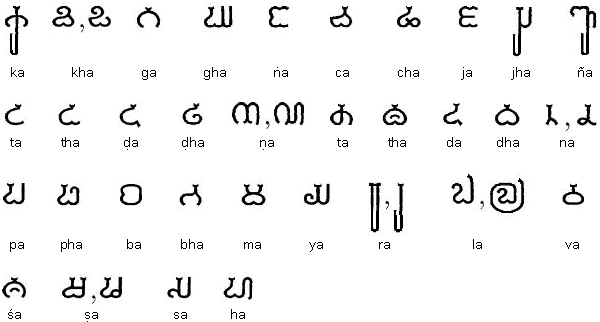
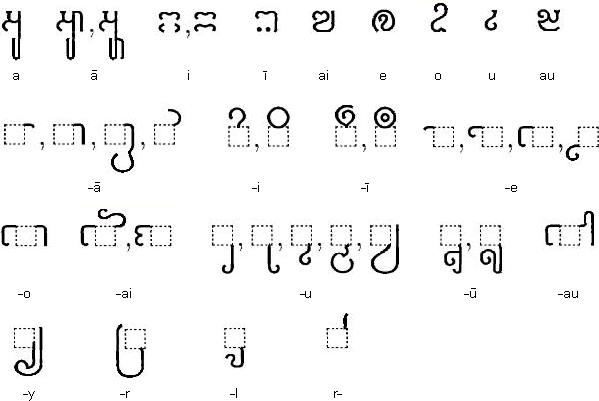
The Pallava script was developed in southern India during the Pallava dynasty, (ca. 3rd-5th century AD) The Pallava script was based on the Brahmi script and consists of a matched set of symbols for consonants, as well as ways to write consonant clusters.
At first the script was used to write Sanskrit, varieties of Prakrit, including Pali, and a number of other languages. Later it became popular for religious and politcal inscriptions on stone monuments and for 500 years it was used in this way, with alterations and adaptations, to write most of the languages of Southeast Asia.
Many other scripts developed from, or were influenced by Pallava, including Telugu, Kannada, Tamil, Malayalam, Sinhala, Burmese, Khmer, Lanna, Thai, Lao, Cham, Javanese, Balinese, Buginese and Sundanese.
The script is also known as Southern Gupta Brahmi, proto-Kannada, Tamil Grantham, and by a number of other names.
The letter forms shown are based on inscriptions from the 7th century AD.

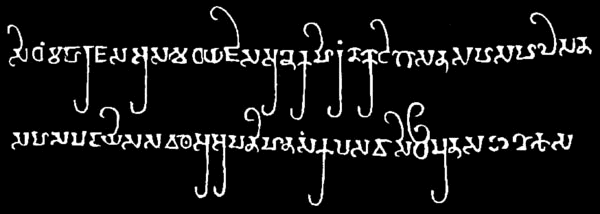
This text comes from India and dates from the 3rd century AD.

Information and images compiled by Ian James:
http://www.skyknowledge.com/pallava.htm
Information about Pallava alphabet, language and people
http://www.skyknowledge.com/pallava.htm
http://www.tamilnation.org/heritage/pallava/
http://en.wikipedia.org/wiki/Pallava
http://www.kamat.com/kalranga/deccan/pallavas.htm
http://www.iranchamber.com/history/articles/india_parthian_colony1.php
http://www.indianetzone.com/23/civilization_culture_pallavas.htm
Ahom, Aima, Arleng, Badagu, Badlit, Basahan, Balinese, Balti-A, Balti-B, Batak, Baybayin, Bengali, Bhaiksuki, Bhujimol, Bilang-bilang, Bima, Blackfoot, Brahmi, Buhid, Burmese, Carrier, Chakma, Cham, Cree, Dehong Dai, Devanagari, Dham Lipi, Dhankari / Sirmauri, Ditema, Dives Akuru, Dogra, Ethiopic, Evēla Akuru, Fox, Fraser, Gond, Goykanadi, Grantha, Gujarati, Gunjala Gondi, Gupta, Gurmukhi, Halbi Lipi, Hanifi, Hanuno'o, Hočąk, Ibalnan, Incung, Inuktitut, Jaunsari Takri, Javanese, Kaithi, Kadamba, Kamarupi, Kannada, Kawi, Kharosthi, Khema, Khe Prih, Khmer, Khojki, Khom Thai, Khudabadi, Kirat Rai, Kōchi, Kodava Lipi, Komering, Kulitan, Kurukh Banna, Lai Tay (Tai Yo), Lampung, Lanna, Lao, Leke, Lepcha, Limbu, Lontara/Makasar, Lota Ende, Magar Akkha, Mahajani, Malayalam, Meitei (Modern), Manpuri (Old), Marchen, Meetei Yelhou Mayek, Meroïtic, Masarm Gondi, Modi, Mon, Mongolian Horizontal Square Script, Multani, Nandinagari, Newa, New Tai Lue, Ojibwe, Odia, Ogan, Pahawh Hmong, Pallava, Phags-pa, Purva Licchavi, Qiang / Rma, Ranjana, Rejang (Kaganga), Sasak, Savara, Satera Jontal, Shan, Sharda, Sheek Bakrii Saphaloo, Siddham, Sinhala, Sorang Sompeng, Sourashtra, Soyombo, Sukhothai, Sundanese, Syloti Nagri, Tagbanwa, Tai Noi, Takri, Tamil, Tanchangya (Ka-Pat), Tani, Thaana, Telugu, Thai, Thirke, Tibetan, Tigalari, Tikamuli, Tocharian, Tolong Siki, Vatteluttu, Warang Citi
Page last modified: 13.04.23
[top]

You can support this site by Buying Me A Coffee, via PayPal or Patreon, or by contributing in other ways.
If you find all the adverts annoying, there is now an Ad-free version of Omniglot which you can access for a small monthly or annual donation.

Note: all links on this site to Amazon.com



[top]


