Here are some words for valley, glen and related things that are found in some or all of the Celtic languages, and related words in other languages.
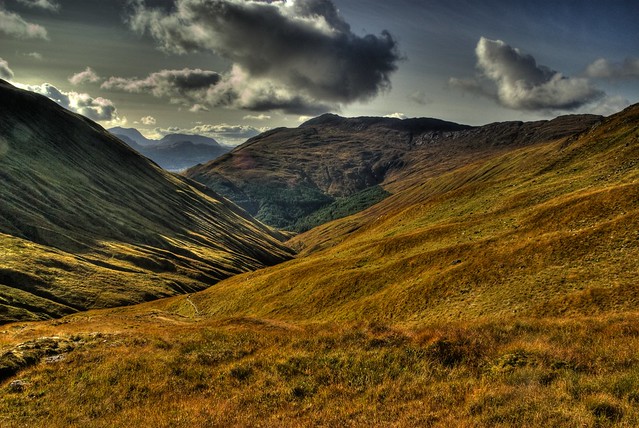
Strath Croe
Words marked with a * are reconstructions.
| Proto-Celtic | *stratos = valley |
|---|---|
| Old Irish (Goídelc) | srath = grassland, swarth |
| Middle Irish (Gaoidhealg) | srath, sreth, sraith = grass, sward, valley, bottom, meadow or grassy place near a river, fine, tax |
| Irish (Gaeilge) | srath [sˠɾˠa(h)] = river valley, low-lying land along a river srathach = bottom, low-lying, marshy |
| Scottish Gaelic (Gàidhlig) | srath [sdrah] = strath, wide valley, vale srathach = pertaining to or abounding in straths / wide valleys |
| Manx (Gaelg) | strah = level valley, plain, strath, flatness |
| Proto-Brythonic | *strad = valley |
| Middle Welsh (Kymraec) | ystrad, istrad, ystrat = (floor of a) valley, vale, plain |
| Welsh (Cymraeg) | ystrad [ˈəsdrad] = (floor of a) valley, vale, plain |
| Old Cornish | stræt = flat valley, low lying land, lowland |
| Middle Cornish (Cernewec | strat = flat valley, low lying land, lowland |
| Cornish (Kernewek) | stras = flat valley, low lying land, lowland |
| Old Breton (Brethonoc) | strat = bottom, low ground |
| Middle Breton (Brezonec) | strat = bottom, low ground |
| Breton (Brezhoneg) | stad [strɑːt] = bottom, low ground |
Etymology: the Proto-Indo-European *str̥h₃tós (stretched, spread), from *sterh₃- (to spread, extend, stretch out [Source]. Words from the same roots include sternum, strategy, stratus, stray, street (a type of cloud) and stratosphere in English, estrato (layer, stratum, stratus [cloud]) in Spanish, and sarnu (to trample, tread, ruin) in Welsh [Source].
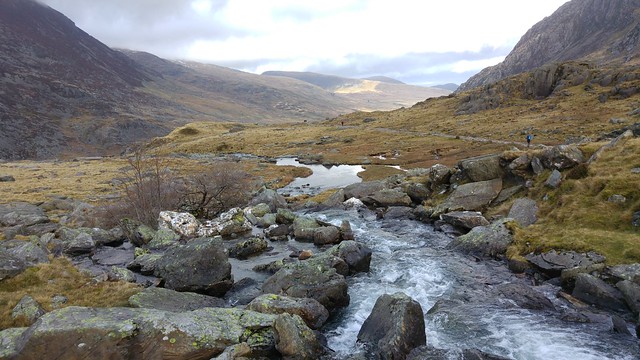
Cwm Idwal
| Proto-Celtic | *kumbā = valley |
|---|---|
| Transalpine Gaulish | *cumba = valley |
| Gaulish | *kumba = valley |
| Irish (Gaeilge) | com [kʌmˠ] = coomb, cirque, mountain recess |
| Proto-Brythonic | *komm = valley |
| Middle Welsh (Kymraec) | cum, cwm(m), kwm = a deep narrow valley, dale, dingle kwm(m)an = hump, stoop, hunchback, rump kwmarch, cwmaearch = ravine, dingle, little valley |
| Welsh (Cymraeg) | cwm [ˈəsdrad] = a deep narrow valley, coom, glen, dale; hollow, bowl-shaped depression cwmach = a stoop cwman = hump, stoop, hunchback, rump cwmanu = to stoop, hunch cwmanllyd, cwmanog = hunchbacked, crooked, bent cwmarch = ravine, dingle |
| Middle Cornish (Cernewec | cum = a valley opening downwards, from a narrow point, a dingle |
| Cornish (Kernewek) | komm = cirque, corrie, cwm |
| Middle Breton (Brezonec) | comm = combe, small valley, (water) trough, river-bed |
| Breton (Brezhoneg) | komm [ˈkɔ̃mː] = combe, small valley, (water) trough, river-bed komman, kommañ = to form hollows kommek = forming hollows |
Etymology: from the Proto-Indo-European *kumbʰos / *kumbʰéh₂, either from PIE *kew- (bend) or a from non-Indo-European substrate [Source].
Words from the same roots include cwm, combe (a valley or hollow, often wooded and with no river; a cirque) in English, combe (combe) in French, and coma (combe, cwm, cirque; an alpine meadow situated between two peaks) in Catalan [Source].
A dingle is a small, narrow or enclosed, usually wooded valley [Source].

Glenfinnan / Gleann Fhionnain
| Proto-Celtic | *glendos = valley |
|---|---|
| Old Irish (Goídelc) | glenn [ɡʲlʲen͈] = valley |
| Middle Irish (Gaoidhealg) | glenn = valley, hollow, depression glennach = having vales or hollows, curly (hair) |
| Irish (Gaeilge) | gleann [ɟlʲɑun̪ˠ(h) / ɟlʲɑːn̪ˠ / ɟlʲan̪ˠ] = glen, hollow gleann = abounding in glens, hollow-backed, wavy (hair) gleanntán = small glen, dell, dale gleanntóir = glensman, dalesman |
| Scottish Gaelic (Gàidhlig) | gleann [glaun̪ˠ] = glen, valley gleannach [glan̪ˠəx] = having or related to glens, steep sided gleannan [glan̪ˠan] = small glen / valley gleann crochte = hanging valley gleann sgoraidh = rift valley |
| Manx (Gaelg) | glion(e) [ɡlʲɔᵈn] = valley, glen, vale, creek |
| Proto-Brythonic | *glɨnn [ɡlɨnː] = glen, dale, valley |
| Middle Welsh (Kymraec) | glynn, glyn = glen, dingle, dale, dell (wooded) valley |
| Welsh (Cymraeg) | glyn [ɡlɨ̞n / ɡlɪn] = glen, dingle, dale, dell (wooded) valley, gloom, distressing experience |
| Middle Cornish (Cernewec | glen, glyn = valley (through which a river flows), a woody valley, dale |
| Cornish (Kernewek) | glynn, glydn = deep wooded valley, glen |
| Middle Breton (Brezonec) | glenn, glen = earth, country |
| Breton (Brezhoneg) | glen = bottom, low ground |
Etymology: the Proto-Indo-European *glendos (shore). Words from the same root include klit (dune) in Danish, klettur (rock, crag, cliff) in Icelandic, and cleit (rocky outcrop, cliff, reef) in Scottish Gaelic [Source].
The Irish word ailt refers to a steep-sided glen, ravine, height or cliff. There are cognate words in other Celtic languages, such as allt (hill, slope, cliff) in Welsh [More details].

Nant Gwrtheyrn
| Proto-Celtic | *nantos / nantus = stream, valley |
|---|---|
| Gaulish | nanto, nantu = valley |
| Proto-Brythonic | *nant [nant] = stream, river, valley |
| Middle Welsh (Kymraec) | nant = river, stream, brook |
| Welsh (Cymraeg) | nant [nant] = river, stream, brook, rivulet; torrent, ditch, valley, glen, dale; ravine, gorge nentig, nennig = small stream |
| Middle Cornish (Cernewec | nans = valley, dale, ravine |
| Cornish (Kernewek) | nans [nans / nænz] = dale, vale, valley krognans = hanging valley |
| Old Breton (Brethonoc) | nant = valley with watercourses |
| Middle Breton (Brezonec) | nant, ant = valley with watercourses |
| Breton (Brezhoneg) | nant [nãnt] = valley with watercourses (found in place names – archaic) |
Etymology: possibly from Proto-Celtic *nemetom (sacred place, sanctuary), from the Proto-Indo-European *nem- (to give, take, distribute) [source].
The Francoprovençal word nant (stream) comes from the same Proto-Celtic roots [source], as does the French place name Nanterre [source], the Irish word neimheadh (sanctuary, privilege of rank, holy thing), and the Breton word neved / neñved (sanctuary) [source].
More details of words for Streams and Currents in Celtic languages.
| Old Welsh (Kembraec) | t(o)nou = valley, vale, hollow, dale |
|---|---|
| Middle Welsh (Kymraec) | tnou, tonou, tyno, tino = valley, vale, hollow, dale |
| Welsh (Cymraeg) | tyno = valley, vale, hollow, dale, plain, green |
| Cornish (Kernewek) | tnow = dale, valley-bottom |
| Old Breton (Brethonoc) | tenou, tnou = bottom, lower part, valley |
| Middle Breton (Brezonec) | tnou [trãw] = bottom, lower part, valley trauyen = valley |
| Breton (Brezhoneg) | traoñ, traou [trãw] = bottom, lower part, valley (found in place names) traoñienn [ˈtrãw.jɛn] = valley |
Etymology: unknown [Source].
Another Welsh word for valley is dyffryn [ˈdəfrɨ̞n / ˈdəfrɪn], which comes from dwfr (water) and hynt (course, way). There are no cognates in other Celtic languages, as far as I can discover [Source].

Sources: Wiktionary, Am Faclair Beag, Online Manx Dictionary, Teanglann.ie, eDIL – Electronic Dictionary of the Irish Language, In Dúil Bélrai English – Old Irish glossary, Geiriadur Prifysgol Cymru, Gerlyver Kernewek, Dictionaire Favereau, TermOfis, English – ProtoCeltic WordList (PDF), Etymological Dictionary Of Proto Celtic