
Oroqen is a Northern Tungusic language spoken in Inner Mongolia and Heilongjiang in northern China. In Inner Mongolia it is spoken in Hulun Buir league, and Oroqen and Butha banners. In Heilongjiang it is spoken in Da Hinggan Ling, Heihe and Yichun prefectures. In 2009 there were about 1,200 fluent speakers of Oroqen, including 800 monolinguals. Oroqen is also used as a second language by the Daur and Evenki people. The language is also known as Orochon, Oronchon, Olunchun, Elunchun or Ulunchun. In Chinese it is known as 鄂伦春 (èlúnchūn).
Oroqen is also known as Orochon, Oronchon, Olunchun, Elunchun or Ulunchun. Speakers of Oroqen call their language Aruqen urgun / Аруӄен ургун [arʊtɕʰen urkun]. Dialects include Birarchen, Kumarchen, Orochen, Selpechen in Heilongjiang, and Gankui in Inner Mongolia. Gankui is considered the standard dialect. There are some younger speakers of the Kumarchen dialect, however other dialects have mainly elderly speakers.
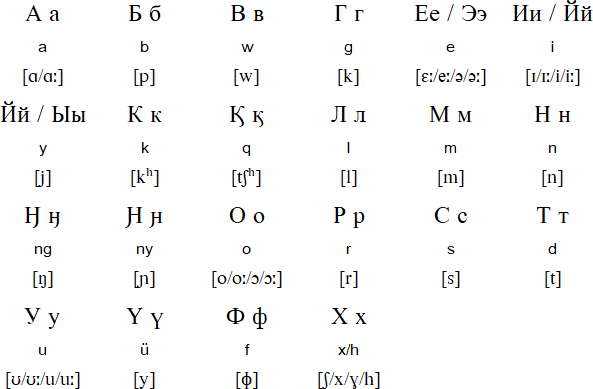
During the 1980s Oroqen learning materials were produced by teachers in Oroqen-speaking areas. They based the written form of the language based on the IPA (International Phonetic Alphabet) or Pinyin. Before then the language was not written. Further materials were produced in Heilongjiang in 2003. Web-based resources started to appear in 2013. There are also ways to write the language with the Latin and Cyrillic alphabets.
The language is used sometimes in radio programmes.
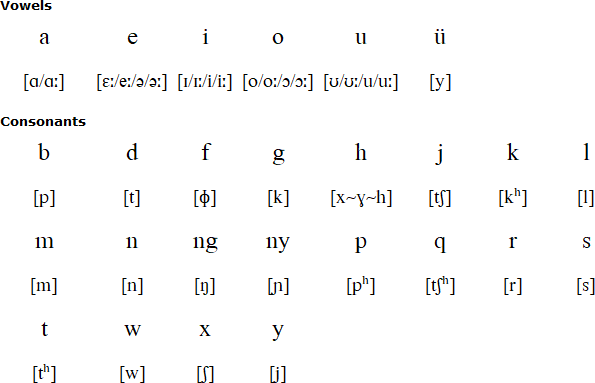
Long vowels may also be written doubled (aa, ee, etc).
Download alphabet charts for Oroqen (Excel)
Details of the Oroqen Latin alphabet provided by Michael Peter Füstumum
Beyel bambur zhiyu bishi, zhunyan-du bineken chuanli-du bambur pingdeng bishi. Nugartin lishing bineken liangshin bishi, akin nekun guanshi-ngi chingshen-du-in duidai-meet-ki-tin.
All human beings are born free and equal in dignity and rights. They are endowed with reason and conscience and should act towards one another in a spirit of brotherhood.
(Article 1 of the Universal Declaration of Human Rights)
Source: https://pt.wikipedia.org/wiki/Língua_orochom#Texto_de_Amostra
Information about Oroqen | Numbers
Information about Oroqen
https://en.wikipedia.org/wiki/Oroqen_language
https://zh.wikipedia.org/wiki/鄂伦春语
http://www.bfssmzyy.com/index.html
https://pt.wikipedia.org/wiki/L%C3%ADngua_orochom
https://tinyurl.com/y9b35pb3
https://www.culturalsurvival.org/publications/cultural-survival-quarterly/growing-shadow-oroqen-language-and-culture
http://www.theworldofchinese.com/2017/11/digitizing-the-oroqen/
https://baike.baidu.com/item/鄂伦春语
Even, Evenki, Jurchen, Kili, Manchu, Nanai, Negidal, Oroch, Orok / Uilta, Oroqen, Udege Ulch, Xibe
Abaza, Abkhaz, Adyghe, Aghul, Akhvakh, Akkala Sámi, Aleut, Altay, Alyutor, Andi, Archi, Assyrian / Neo-Assyrian, Avar, Azeri, Bagvalal, Balkar, Baraba Tatar, Bashkir, Belarusian, Besermyan, Bezhta, Bosnian, Botlikh, Budukh, Bulgarian, Buryat, Chamalal, Chechen, Chelkan, Chukchi, Chulym, Chuvash, Crimean Tatar, Dargwa, Daur, Dolgan, Dungan, Enets, Erzya, Even, Evenki, Gagauz, Godoberi, Hinukh, Hunzib, Ingush, Interslavic, Itelmen, Juhuri, Kabardian, Kaitag, Kalderash Romani, Kalmyk, Karaim, Karakalpak, Karata, Karelian, Kazakh, Ket, Khakas, Khanty, Khinalug, Khorasani Turkic, Khwarshi, Kildin Sámi, Kili, Komi, Komi-Permyak, Komi-Yazva, Komi-Zyrian, Koryak, Krymchak, Kryts, Kubachi, Kumandy, Kumyk, Kurdish, Kyrgyz, Lak, Lezgi, Lingua Franca Nova, Lithuanian, Ludic, Macedonian, Mansi, Mari, Moksha, Moldovan, Mongolian, Montenegrin, Nanai, Negidal, Nenets, Nganasan, Nivkh, Nogai, Old Church Slavonic, Oroch, Orok, Oroqen, Ossetian, Pontic Greek, Romanian, Rushani, Russian, Rusyn, Rutul, Selkup, Serbian, Shor, Shughni, Siberian Tatar, Sirenik, Slovio, Soyot, Tabassaran, Tajik, Talysh, Tat, Tatar, Teleut, Ter Sámi, Tindi, Tofa, Tsakhur, Tsez, Tsudaqar, Turkmen, Tuvan, Ubykh, Udege, Udi, Udmurt, Ukrainian, Ulch, Urum, Uyghur, Uzbek, Veps, Votic, Wakhi, West Polesian, Xibe, Yaghnobi, Yakut, Yazghulami, Yukaghir (Northern / Tundra), Yukaghir (Southern / Kolyma), Yupik (Central Siberian)
Languages written with the Latin alphabet
Page last modified: 18.04.26
[top]

You can support this site by Buying Me A Coffee, via PayPal or Patreon, or by contributing in other ways.
If you find all the adverts annoying, there is now an Ad-free version of Omniglot which you can access for a small monthly or annual donation.

Note: all links on this site to Amazon.com



[top]


