
Kili is a member of the Northern Ewenic group of Tungusic languages. It is spoken by about 100 people in southeast of the Russian Federation, and by about 20 in northeastern China. In particular, it is spoken in the basin of the Amur River in the Khabarovsk Krai in the Russian Far East region.
Kili is also known as Kilen, Kirin, Kila, Kur-Urmi Nanay, Kur-Urmi Nanai or Hezhe. In Russia the name Kili is used, while the name Kilen is used in China. It was traditionally considered a dialect of Nanai, which is a Southern Tungusic language, although it is now thought to belong to the Northern group of Tungusic languages.
A way to write Kili with the Cyrillic alphabet was devised in 1958 by Orest Petrovich Sunik (Орест Петрович Суник), a Soviet linguist and Tungus-Mancu scholar.
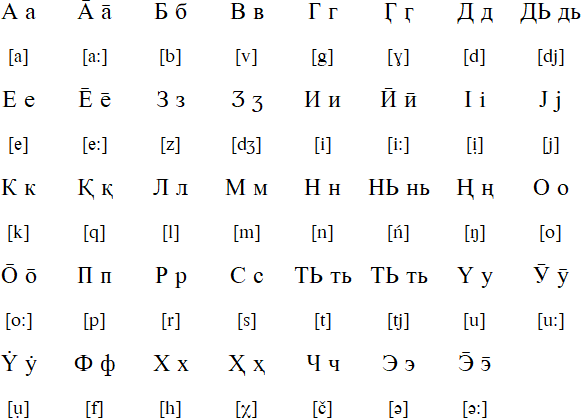
Download alphabet charts for Kili (Excel)
Information about the Kili language
https://en.wikipedia.org/wiki/Kili_language
https://fr.wikipedia.org/wiki/Kili_(langue)
https://www.endangeredlanguages.com/lang/10472
https://www.elararchive.org/dk0222/
Even, Evenki, Jurchen, Kili, Manchu, Nanai, Negidal, Oroch, Orok / Uilta, Oroqen, Udege Ulch, Xibe
Abaza, Abkhaz, Adyghe, Aghul, Akhvakh, Akkala Sámi, Aleut, Altay, Alyutor, Andi, Archi, Assyrian / Neo-Assyrian, Avar, Azeri, Bagvalal, Balkar, Baraba Tatar, Bashkir, Belarusian, Besermyan, Bezhta, Bosnian, Botlikh, Budukh, Bulgarian, Buryat, Chamalal, Chechen, Chelkan, Chukchi, Chulym, Chuvash, Crimean Tatar, Dargwa, Daur, Dolgan, Dungan, Enets, Erzya, Even, Evenki, Gagauz, Godoberi, Hinukh, Hunzib, Ingush, Interslavic, Itelmen, Juhuri, Kabardian, Kaitag, Kalderash Romani, Kalmyk, Karaim, Karakalpak, Karata, Karelian, Kazakh, Ket, Khakas, Khanty, Khinalug, Khorasani Turkic, Khwarshi, Kildin Sámi, Kili, Komi, Komi-Permyak, Komi-Yazva, Komi-Zyrian, Koryak, Krymchak, Kryts, Kubachi, Kumandy, Kumyk, Kurdish, Kyrgyz, Lak, Lezgi, Lingua Franca Nova, Lithuanian, Ludic, Macedonian, Mansi, Mari, Moksha, Moldovan, Mongolian, Montenegrin, Nanai, Negidal, Nenets, Nganasan, Nivkh, Nogai, Old Church Slavonic, Oroch, Orok, Oroqen, Ossetian, Pontic Greek, Romanian, Rushani, Russian, Rusyn, Rutul, Selkup, Serbian, Shor, Shughni, Siberian Tatar, Sirenik, Slovio, Soyot, Tabassaran, Tajik, Talysh, Tat, Tatar, Teleut, Ter Sámi, Tindi, Tofa, Tsakhur, Tsez, Tsudaqar, Turkmen, Tuvan, Ubykh, Udege, Udi, Udmurt, Ukrainian, Ulch, Urum, Uyghur, Uzbek, Veps, Votic, Wakhi, West Polesian, Xibe, Yaghnobi, Yakut, Yazghulami, Yukaghir (Northern / Tundra), Yukaghir (Southern / Kolyma), Yupik (Central Siberian)
Page created: 28.11.23. Last modified: 28.11.23
[top]

Note: all links on this site to Amazon.com


You can support this site by Buying Me A Coffee, via PayPal or Patreon, or by contributing in other ways.
If you find all the adverts annoying, there is now an Ad-free version of Omniglot which you can access for a small monthly or annual donation.

This website and its content is copyright of Simon Ager - © Simon Ager 1998-2026. All rights reserved. All images were created by me, unless otherwise indicated. More details

[top]


