Bees

Words for bee, sting and related things in Celtic languages.

Bee

Words marked with a * are reconstructions.

Proto-Celtic *bekos/*bikos = bee
Old Irish (Goídelc) bech [bʲex] = bee
Middle Irish bech [bʲex] = bee
bechlann [bʲex] = beehive
bechatoir, beachadoir = (hereditary) beekeeper
bechda = full of bees
Irish (Gaeilge) beach [bʲax] = bee
beachaire = beekeeper, beehive
beachaireacht = beekeeping
beachlann = apiary
Scottish Gaelic (Gàidhlig) beach [bɛx] = bee, wasp
beachach [bɛxəx] = pertaining to or abounding in bees or wasps
beachair [bɛxɪrʲ] = beehive
beachan [bjaxər̪ˠn̪ˠ] = small bees or wasps
Proto-Brythonic *bɨg = bee
Middle Welsh (Cymraeg) byg = bee
bedaf, bydaf = bees’ nest, beehive
bygegyr = drone
Welsh (Cymraeg) bygegyr, begegyr = drone
bydaf = swarm or nest of (wild) bees, bees’ nest and honey therein, beehive

Etymology: possibly from Proto-Indo-European *bʰik-/bʰoyk- (bee), from*bʰey- (bee) [source]. Words from the same roots include bee in English, and fuco (drone – male bee) in Italian [source].

Middle Irish teillenn = swarm of bees
Irish (Gaeilge) seileán = (wild) honey bee
Scottish Gaelic (Gàidhlig) seillean [ʃel̪ʲan] = bee
Manx (Gaelg) shellan [ˈʃɛlʲan] = bee
shelleig, shellaig = beehive, hive

Etymology: unknown [source].

Proto-Celtic *wan-inyo- = bee (?)
Middle Welsh (Cymraeg) gwanan, gwenyn = bees
gwenynen, guenenen = bee
gwenynllestyr = beehive
Welsh (Cymraeg) gwenyn = bees
gwenynen = bee
gwenynaf, gwenynu = to keep bees
gwenynllais = a humming (of bees)
gwenynlle = beehive
gwenynog = apiary, bee-garden, pertaining to bees, abounding in bees
gwenynydd = beekeeper, apiarist
gwenynyddiaeth = beekeeping
Middle Cornish (Cernewec) gwanan, gwenyn = bees
gwenynen, guenenen = bee
Cornish (Kernewek) gwenen = bees
gwenenen = bee
gwenen sia = bumble bee
Middle Breton (Brezonec) guenan, guënan = bees
guenanenn, guennanen = bee
Breton (Brezhoneg) gwenan, gwenen, gweren = bees
gwenanenn = bee
gwenaneg = apiary
gwenaner = beekeeper
gwenanerezh = beekeeping, apiculture

Etymology: from Proto-Celtic *wano- (tip, sting) [source], from PIE *gʷʰen- (to strike, slay, kill). Words from the same root include bane, defend, fence and gun , and words for to stab, sting, wound, etc. in Celtic languages (see below) [source].

Proto-Celtic *gʷaneti = to strike, wound, kill, slay
Old Irish (Goídelc) gonaid [ˈɡonɨðʲ] = to pierce, wound
con·goin = to pierce, wound
Middle Irish gonaid = to pierce, wound
Irish (Gaeilge) goin = to wound, stab, sting, hurt
goinbhlasta = piquant
goineach = wounding, piercing, hurtful
goineadóir = wounder, sharp-tongued person
goineog = stab, sting, prick, cutting remark, thrust, gibe
goineogacht = cutting remarks, gibing
Scottish Gaelic (Gàidhlig) goin [gɔn̪ʲ] = wound, stab, sting, stabbing, stinging
goineag [gɔnag] = nip, pinch, twitch, canine (tooth)
goineanta [gɔn̪ʲən̪ˠdə] = keen, piercing
gointe [gɔn̪ʲdʲə] = sorely wounded, bewitched
gointeach [gɔn̪ʲdʲəx] = wounding, stabbing, stinging, agonizing
Manx (Gaelg) guin = pain, stitch, pang
guinn = insect bite, pain, smart
guinney = needle, pain, sting, wound, wounding
gonnid = pain, peevishness, smarting, soreness
Proto-Brythonic *gwėnɨd [ɡwe̝ˈnɨːð] = to strike, kill
*ėdwėnɨd = to strike again
Middle Welsh (Cymraeg) gvant, guant, gwanu = to stab, prick, deeply, pierce
Welsh (Cymraeg) gwanu [ˈɡwanɨ̞ / ˈɡwa(ː)ni] = to stab, prick, deeply, pierce, perforate, penetrate, kill, strike, thrust (also written gwanaf or gwân)
Middle Cornish (Cernewec) gwane = to thrust, penetrate, pierce, stab, stick
gwenys, gwynys = pierced, stabbed, stung
Cornish (Kernewek) gwana = to pierce, stab, sting
gwan = jab, prick, sting
omwana = to stab oneself
Middle Breton (Brezonec) goano, goanaff, goan = to prick, grip, squeeze, annoy
Breton (Brezhoneg) gwanañ = to sting, punish, macerate
gwanerezh = maceration
gwanikennan = to prick

Etymology: from Proto-Indo-European *gʷʰénti (to be striking down, killing, slaying), from*gʷʰen- (to strike, slay, kill) [source].

The Fastest Way to Learn Japanese Guaranteed with JapanesePod101.com

Sources: Wiktionary, Am Faclair Beag, Online Manx Dictionary, Teanglann.ie, eDIL – Electronic Dictionary of the Irish Language, In Dúil Bélrai English – Old Irish glossary, Geiriadur Prifysgol Cymru, Gerlyver Kernewek, Lexicon Cornu-britannicum: A Dictionary of the Ancient Celtic Language of Cornwall, Dictionaire Favereau, TermOfis, Le dictionnaire diachronique du breton, Etymological Dictionary Of Proto Celtic

Dinner

Words for dinner and related things in Celtic languages.

Speakers' Dinner at the Polyglot Gathering

Words marked with a * are reconstructions.

Middle Irish (Gaoidhleag) din(n)ér = repast, meal
Irish (Gaeilge) dinnéar [dʲɪˈnʲeːɾˠ] = dinner
am dinnéir = dinner-time
foreann dinnéir = dinner-service
Scottish Gaelic (Gàidhlig) dinnear [dʲiːn̪ʲər] = dinner
àm dìnnearach = dinner-time
bòrd-dìnnearach = dinner table
seacaid-dìnnearach = dinner-jacket/suit, tuxedo
seòmar-dìnnearach = dining room
Manx (Gaelg) jinnair = dinner
co’heshaght yinnairagh = dinner party
forran buird = dinner service
jaggad yinnairagh = dinner jacket

Etymology: from Old French disner (to dine, eat the main meal of the day), from Vulgar Latin *disiūnāre, from Late Latin disieiūnō (to break the fast), from dis- (apart, reversal, utterly) and ieiūnō (to fast) [source].

Words from the same roots include dine and diner and dinner in English, and dîner (to dine, dinner) in French [source].

Proto-Brythonic *kinjọ = dinner (?)
Middle Welsh (Kymreac) kinyaỽ, kinyaw, kinio, kinnaw = dinner
kino echwydd, ciniaw echwydd, kinnechwydd = midday-dinner
kinnawha, kinawu, kinyawa = to dine, eat a meal
Welsh (Cymraeg) cinio [ˈkɪnjɔ] = dinner, breakfast
cinio echwydd, cinechwydd = midday-dinner
cin(i)awaf, cin(i)awu = to dine, eat a meal
ciniawdy = restaurant, café
ciniawfwyd = dinner, meal
Middle Cornish (Cernwec) cynyow, cidnio = dinner
Cornish (Kernwek) kinnyow, kidnyow = dinner
kinyewel = to dine

Etymology: cognate with or from Latin cēna (dinner), from Old Latin cesna, from Proto-Italic *kertsnā, from Proto-Indo-European *kért-sneh₂ (portion), from *(s)kert- (to cut), from *(s)ker- (to cut off, separate) [source].

Middle Welsh (Kymreac) cvin, kwyn = dinner, supper, feast, banquet
kvynnos, cwynos = supper, evening, meal, feast
kuynossa, cwynosa = to sup, take supper
cwynossauc, cwynossawc = giving (or one who gives) supper or a meal to a king or lord and his retinue on circuit
Welsh (Cymraeg) cwyn = dinner, supper, feast, banquet
cwynos = supper, evening, meal, feast
cwynosa(f) = to sup, take supper
cwynosfwyd = supper, tea, a light meal or lunch taken in the afternoon in the fields.
cwynosog = giving (or one who gives) supper or a meal to a king or lord and his retinue on circuit
Middle Cornish (Cernwec) coyn, cón = supper
Cornish (Kernwek) kon = dinner, supper
Middle Breton (Brezonec) coan = dinner, supper, to have supper
coan(i)aff, coanyaff, coania = to dine, to have supper
coanlech = place where one has supper
Breton (Brezhoneg) koan [ˈkwãːn] = supper, dinner, to have supper
koanan, koaniañ = to have dinner, to dine
koanier = dinner

Etymology: from Latin cēna (dinner), from Old Latin cesna, from Proto-Italic *kertsnā, from Proto-Indo-European *kért-sneh₂ (portion), from *(s)kert- (to cut), from *(s)ker- (to cut off, separate) [source].

Middle Irish (Gaoidhleag) béile = meal
Irish (Gaeilge) béile [ˈbʲeːlʲə] = meal
béile maidine = breakfast
béile meán lae = lunch
béile oíche = supper, dinner
ní fiú a bhéilí é = he is not worth his keep
Scottish Gaelic (Gàidhlig) beil = diet, meal of meat (archaic)

Etymology: from Middle English mel (a time, occasion, meal, feast), from Old English mǣl (measure, mark, sign, time, occasion), from Proto-Germanic *mēlą (measure, time, occasion, meal), from PIE *meh₁- (to measure) [source].

Words from the same roots include meal in English, maal (meal, time) in Dutch, Mahl (meal) in German, and mål (target, goal, meal) in Swedish [source].

Sources: Wiktionary, Am Faclair Beag, Online Manx Dictionary, Teanglann.ie, eDIL – Electronic Dictionary of the Irish Language, In Dúil Bélrai English – Old Irish glossary, Geiriadur Prifysgol Cymru, Gerlyver Kernewek, Lexicon Cornu-britannicum: A Dictionary of the Ancient Celtic Language of Cornwall, Dictionaire Favereau, TermOfis, Le dictionnaire diachronique du breton, Etymological Dictionary Of Proto Celtic

The Fastest Way to Learn Japanese Guaranteed with JapanesePod101.com

Justly Right

Words meaning just, right and related things in Celtic languages.

Justice

Words marked with a * are reconstructions.

Proto-Celtic *kowwaris, *komwīros = just, rightful, proper, fitting
Old Irish (Goídelc) cóir = even, fitting, just, proper
córae = justice
córus = justice
Middle Irish (Gaoidhealg) cóir, coair, coir = even, well-proportioned, straight, proper, correct, right, suitable, fitting, just
córae, corae = correctness, propriety, justice, lawsuit, claim, right, proper, peace, amity, concord
córus, corus = justness, rightness, proper arrangement, propriety, peace, agreement
Irish (Gaeilge) cóir [koːɾʲ/kɔːɾʲ] = justice, equity, proper share, due, proper provision, accommodation, proper condition, proper equipment
cóireáil = treatment, treat
cóireanta = neat, tidy
cóirigh = to arrange, dress, mend, repair
cóiríocht = fitness, suitability, accommodation, equipment, fittings, furniture
cóiriú = arrangement, dressing, repair
cóiriúchán = arrangement, dressing
éagóir = injustice, wrong, unfairness, inequity
Scottish Gaelic (Gàidhlig) còir [kɔːrʲ] = right, justice, duty, obligation
còireachadh [kɔːrʲəxəɣ] = (act of) arranging, arrangement
còiread [kɔːrʲəd] = probity, goodness, kindness
còrachadh [kɔːrəxəɣ] = arranging, arrangement
Manx (Gaelg) cair = privilege, property, rights, duty, righteousness, due, right, just, good
cair aascreeuee = copyright
cair vie = bon voyage, favourable wind, god speed, pleasant journey
cairagh = fair, impartial, just, proper, justifiable, justly
cairal = right, righteous, upright, upstanding
cairys = applicability, fairness, justice, right, uprightness
cairysagh = right
Proto-Brythonic *küwėr = complete
Old Welsh (Kembraec) couer = fully-equipped, arrayed, furnished, complete, orderly, prepared, ready, correct
Middle Welsh (Kymraec) kyveir, kyweir, cyweir = proper order, fit state, repair, provision
kyweyryau, kyỽeirir, kyweirio = to put in order, arrange, prepare, set to rights, repair, restore, equip
kyweiriawdr = one who sets in order, one who promotes unity or harmony; repairer
kyweirwr = repairer, restorer, amender
Welsh (Cymraeg cywair [ˈkəwai̯r] = proper order, fit state, repair, provision, seasoning, state of mind, mood, humour, temper, condition, state, plight, key (in music), song, harmony, fully-equipped, arrayed, furnished, complete, orderly, prepared, ready, correct
cyweiriaf, cyweirio = to put in order, arrange, prepare, set to rights, repair, restore, equip
cyweiriawdr = one who sets in order, one who promotes unity or harmony; repairer
cyweiriedig = arranged, set in order, preserved
cyweir(i)wr = repairer, restorer, amender

Etymology: possibly from Proto-Celtic *kom- (with, together), from PIE *ḱóm (beside, near, by with), and PIE *wīros (true) [source]. Words from the same roots include word for true and related things in Celtic languages, and beware, guard, reward, ward and weir in English [source].

Old Irish (Goídelc) cert [kʲer͈t] = fitting, proper, right
Middle Irish (Gaoidhealg) cert = correct, right, proper, fitting, fair, just, straight, even, exact, precise
Irish (Gaeilge) ceart [caɾˠt̪ˠ/cæɾˠt̪ˠ] = right, just, proper, true, correct, true, real, good, excellent
ceartaigh = to correct, rectify, amend, expound, mend
ceartaiseach = insistent on one’s rights, self-righteous, dogmatic, conceited, priggish
ceartaiseacht = self-righteousness, conceit, priggishness
ceartaitheach = corrective, amending
ceartaitheoir = corrector, rectifier, reformer, chastiser
ceartas = justice, rights
Scottish Gaelic (Gàidhlig) ceart [kʲar̪ˠʃd = right, justice, propriety, righteousness, accurate, correct, proper, right
ceartachadh [kʲar̪ˠʃdəxəɣ] = correcting, putting right, rectifying, correction
ceartachair = corrector, rectifier, regulator
ceartachd [kʲar̪ˠʃdəxg] = correctness
ceartas = [kʲar̪ˠʃdəs] = justice, right, equity
Manx (Gaelg) kiart = accurate, concession, correct, due, equity, even, exact, just, orthodox, precise, right
kiartaghey = to accommodate, adjust, amend
kiartys = accuracy, correctness, exactness
kiartyn = rights
Proto-Brythonic *kerθ = right, true, certain, vehement, terrible, awful, fine, wonderful
Middle Welsh (Kymraec) kerth = right(s), true, certain, vehement, terrible, awful, fine, wonderful
kerthrwydd = integrity, justice, awfulness
Welsh (Cymraeg certh [kɛrθ] = right(s), true, certain, vehement, terrible, awful, fine, wonderful, truth
certhrwydd = integrity, justice, awfulness

Etymology: from Latin certus (certain, fixed), from Proto-Italic *kritos, from *krinō (to sift, separate, distinguish, discern), from PIE *krey- (to sift, separate, divide) [source]. Words from the same roots include certo (certain, sure, reliable) in Italian, cierto (true, certain, specific) in Spanish, and certain, crime, crisis, discreet and secret in English [source].

Words marked with a * are reconstructions.

Sources: Wiktionary, Am Faclair Beag, Online Manx Dictionary, Teanglann.ie, eDIL – Electronic Dictionary of the Irish Language, In Dúil Bélrai English – Old Irish glossary, Geiriadur Prifysgol Cymru, Gerlyver Kernewek, Lexicon Cornu-britannicum: A Dictionary of the Ancient Celtic Language of Cornwall, Dictionaire Favereau, TermOfis, Le dictionnaire diachronique du breton, Etymological Dictionary Of Proto Celtic

The Fastest Way to Learn Japanese Guaranteed with JapanesePod101.com

Worms & Maggots

Today we’re looking at the words for worm, maggot and related things in Celtic languages.

Earth Worm

Words marked with a * are reconstructions.

Proto-Celtic *kʷrimis = worm
Old Irish (Goídelc) cruim [kruṽʲ] = maggot, worm
crumdoma = maggot heap
Middle Irish (Gaoidhleag) cruim, crúim = worm, maggot
crumach = full of reptiles
crumdoma = dunghill
cromóc = maggot
Irish (Gaeilge) cruimh = maggot, larva, grub, tiny insect, worm
crumhóg = maggot
cruimheach = maggoty
cruimheachán = venemous person
Scottish Gaelic (Gàidhlig) cnuimh [krɯ̃ĩv] = maggot, grub, worm
cnuimheach [krɯ̃ĩvəx] = maggoty
cnuimheag [krɯ̃ĩvag] = maggot, grub, worm
cnuimhneag [krɯ̃ĩvn̪ˠʲag] = maggot, worm
Manx (Gaelg) crooag = (flesh) worm, grub, maggot, worm
crooagagh = maggoty, wormy
Proto-Brythonic *prɨβ̃ [ˈprɨβ̃] = worm
Old Welsh prem = insect, fly, larva, maggot, grub, worm
Middle Welsh (Kymraec) pryuet, pryf = insect, fly, larva, maggot, grub, worm
pryuyedic = abounding in / infested with worms or maggots
Welsh (Cymraeg) pryf [prɨːv/priːv] = insect, fly, larva, maggot, grub, worm
pryfedaf, pryfedu, pryfedo = to breed worms of maggots, to become infested with worms or maggots
pryfediad = worm or maggot infestation
pryfedig = wormeaten, maggoty
pryfeteg = entomology
pryfiedig = abounding in / infested with worms or maggots
Middle Cornish (Cernewec) pref, prêv, pryf = any small animal, a vermin, an insect, a worm, a reptile
Cornish (Kernewek) pryv, prev = crawling animal, grub, insect, worm, weevil
pryv del = caterpillar
pryv prenn woodworm
pryvladher = insecticide
Middle Breton (Brezonec) preff, preuet, prenvv = worm
Breton (Brezhoneg) preñv = worm
preñvedik = vermiculated
preñvek = vermicular, wormlike, wormy
eneppreñveg, eneppreñvek = wormable

Etymology: from PIE *kʷŕ̥mis (worm) [source]. Words from the same root include cirmenis (maggot, grub) in Latvian, kirmis (worm) in Lithuanian, käärme (snake) in Finnish, کرم (kerm – worm) in Persian, and červ (worm, maggot) in Czech and Slovak [source].

Old Irish (Goídelc) dorb = worm, larva
Middle Irish (Gaoidhleag) dorb = small insect or worm
Irish (Gaeilge) doirb [kɑbʲ/kabʲ] = water beelte
doirbeach = infested with water beetles
Scottish Gaelic (Gàidhlig) doirb [dɤrʲɤb] = unspecific term for a small/tiny/insignificant creature (e.g. minnow, worm, leech, small person)
Manx (Gaelg) durrag = cabbage worm, larva of cabbage moth

Etymology: unknown

Sources: Wiktionary, Am Faclair Beag, Online Manx Dictionary, Teanglann.ie, eDIL – Electronic Dictionary of the Irish Language, In Dúil Bélrai English – Old Irish glossary, Geiriadur Prifysgol Cymru, Gerlyver Kernewek, Lexicon Cornu-britannicum: A Dictionary of the Ancient Celtic Language of Cornwall, Dictionaire Favereau, TermOfis, Le dictionnaire diachronique du breton, Etymological Dictionary Of Proto Celtic

italki - Win cash rewards for learning any language

Flowing Slowly

Words for slow and related things in Celtic languages.

sloth

Words marked with a * are reconstructions.

Proto-Celtic *malnos/*mallo- = slow, lazy
Old Irish (Goídelc) mall [mal͈] = slow, tardy, late
utmall = unsteady, restless
Middle Irish (Gaoidhealg) mall = slow, sluggish
mallaigid = to make slow, retard
maill, moill = tardiness, delay
maillech = slowly-moving, leisurely, gentle
admall = very slow, dilatory
immall = very slow, wearisome, sad, sluggish
utmall = unstable, fickle, restless
Irish (Gaeilge) mall [mˠɑul̪ˠ/mˠɑːl̪ˠ/mˠal̪ˠ] = slow, late
mallachar = slowness, dullness, dimness
mallacharach = slow, dim
mallaibh = of late, lately
udhmhall = unstable, restless, unceratin, nimble, quick
Scottish Gaelic (Gàidhlig) mall [maul̪ˠ] = slow, deliberate, placid
mallan [mal̪ˠan] = sluggard, slowcoach
mallanach [mal̪ˠanəx] = slow, dilatory
Manx (Gaelg) moal = slow, sorry, tardy, unimpressive, backward, deliberate, dull, feeble, gradual, meagre

Etymology: possibly from PIE *mel- (to be late, hesitate) and *-nós (creates verbal adjectives) [source].

Old Irish (Goídelc) slaet = heap, layer, pile
Middle Irish (Gaoidhealg) slaet = a swathe, layer, pile, illness, disease
slaetach, slaebach = in layers, sweeping (hair)
Irish (Gaeilge) slaod = swath, layer, flowing mass, prostration, stupefication, float, raft; to mow down, lay low, flow, drag, trail, trudge
slaodach = in swaths, in layers, flowing, prostrating, heavy, oppressive, viscous
slaodacht = viscosity
slaodaí = trudger, slowcoach, lazy-bones
slaodaíocht = trudging, slowness, laziness
slaodchiallach = slow-witted
Scottish Gaelic (Gàidhlig) slaod [sl̪ˠɯːd] = raft, float, sledge, tow, drag, sluggard, slowcoach
slaodach [sl̪ˠɯːdəx] = slow, sluggish, dilatory, dragging, pulling, awkward, clumsy
slaodachadh [sl̪ˠɯːdəxəɣ] = dragging, hauling, slowing down
slaodachd [sl̪ˠɯːdəxg] = slowness, drowsiness, awkwardness
Manx (Gaelg) sleayd = dredge, trail, sledge, trailer
sleaydagh = trailing
sleayder = lug, trailing

Etymology: unknown [source].

Proto-Celtic *aramo- = quiet
Middle Welsh (Kymraec) araf, arav [ˈarav] = slow, leisurely, calm, quiet
arafu = to be(come) or make slow, slow down
arafaidd, arauaidd = slow, gradual, mild, gentle
arafhau = to make or become quiet or calm,
Welsh (Cymraeg) araf [ˈarav] = slow, gradual, tedious, tiresome, mild, meek, gentle, tender
arafu = to be(come) or make slow, slow down, retard
arafaidd = slow, gradual, mild, gentle, lovely, pleasant
arafedd = slowness, gentleness, tenderness
arafhau = to make or become quiet or calm, ease, abate, moderate
arafol = slow, gradual, slowing, delaying

Etymology: from PIE *h₁r̥h₃-mo-, from *h₁reh₃- (rest). Words from the same roots include Ruhe (calm, quietness, rest) in German, ro (calmness) in Danish, ro (peace, quiet, tranquility) in Swedish, and unruly in English [source].

Proto-Brythonic *segʉr = idle
Middle Welsh (Kymraec) segur = idle
segyra, segura, seguru, segvro = to (be) idle
segyrllyt, segurllyd = idle, lazy, sluggish, slothful
Welsh (Cymraeg) segur [ˈsɛɡɨ̞r / ˈseːɡɪr] = idle, unoccupied, inactive, lazy, slothful, disused, idle
seguro = to (be) idle, laze, linger, lounge around, rest
segurdod = idleness, laziness
segurllyd = idle, lazy, sluggish, slothful
segurwr = idler, lazy person
Middle Cornish (Cernewec) sigyr, zigyr = sluggish, lazy
Cornish (Kernewek) syger = idle, lazy, lethargic, slow
sygera = to seep, trickle
sygerans = seep(age)
sygerneth = idleness, laziness, lethargy
sygerus = at leisure, leisurely

Etymology: from Latin sēcūrus (careless, carefree, negligent, safe, secure), from sē- (without) and‎ cūra (care). Words from the same root include secure and sure in English, sicuru (safe, secure, sure) in Italian, seguro (secure, safe, sure) in Spanish and säker (safe, secure, sure, certain) in Swedish [source].

Proto-Celtic *uɸostatos = stable
Old Irish (Goídelc) fossad = firm, steady
Middle Irish (Gaoidhealg) fossad, fossud = stationary, fixed, firm, steady, steadfast, consistent, flat surface, level place, stopping-place, abode
Irish (Gaeilge) fosadh = stop, stay, rest, stable position, steadiness, stability
Scottish Gaelic (Gàidhlig) fosadh [fɔsəɣ] = cessation, desisting, recess, respite, (act of) abiding
Proto-Brythonic *gwostad = (?)
Middle Welsh (Kymraec) gwastat, guastat = flat, level, smooth
Welsh (Cymraeg) gwastad [ˈɡwastad] = flat, level, smooth, even, horizontal, continual, constant, quiet, peaceful, gentle, plain, level
Cornish (Kernewek) gwastas = flat, open, plain, smooth
Middle Breton (Brezonec) goustat, goustadic, goustadec, goustadic = gently, slowly
Breton (Brezhoneg) gou(e)stad = slow, slowly
doustadik = slow, slowly

Etymology: unknown [source].

Another word for slow in Cornish is lent, and lenthe means to slow down. This is possibly from (Old) French lent (slow), or from Latin lentus (sticky, slow, flexible).

In Middle Cornish the word hel means slow or tardy, and cosel/kozal means soft, quiet, slow or sluggish, which became kosel (calm, quiet, restful, still, tranquil) in revived Cornish.

Another Proto-Celtic word for slow is *dwāyo-. This became doé / doe (slow, sluggish) in Old Irish and Middle Irish, but has no descendents I can find in the modern Celtic languages.

The Fastest Way to Learn Japanese Guaranteed with JapanesePod101.com

Sources: Wiktionary, Am Faclair Beag, Online Manx Dictionary, Teanglann.ie, eDIL – Electronic Dictionary of the Irish Language, In Dúil Bélrai English – Old Irish glossary, Geiriadur Prifysgol Cymru, Gerlyver Kernewek, Lexicon Cornu-britannicum: A Dictionary of the Ancient Celtic Language of Cornwall, Dictionaire Favereau, TermOfis, Le dictionnaire diachronique du breton, Etymological Dictionary Of Proto Celtic
Facing Opposition

Words for face, honour and related things in Celtic languages.

Mr. Funny Face

Words marked with a * are reconstructions.

Proto-Celtic *gnūstis = face
Old Irish (Goídelc) gnúis [ɡnuːsʲ] = face
Middle Irish (Gaoidhealg) gnúis = face, countenance, disc (of sun or moon), aspect, kind, form, species
dognúisach = ill-featured, ill-favoured
Irish (Gaeilge) gnúis [ɡn̪ˠuːʃ/ɡɾˠuːʃ] = face, mien, countenance, sour expression, frown, aspect, kind, form
gnúiseach = well-favoured, good-looking.
gnúiseachán = sour-faced person.
gnúisgheal = bright-faced
gnúis-searbh = sour-faced
Scottish Gaelic (Gàidhlig) gnùis [gruːʃ] = face, countenance, visage
gnùis-dhreach = aspect
gnùis-bhrat = veil
samhla-gnùis = smiley ☺️, emoticon
maise-gnùis = cosmetics
ruadhadh-gnùis = blush
Manx (Gaelg) grooish = countenance, visage, aspect
grooish-volley = deceit, deceive
geyre-ghrooishagh = sharp-faced
sharroo-ghrooishagh = vinegar-faced
Middle Welsh (Kymraec) gnis = jaw, chin, countenance, face
Welsh (Cymraeg) gnis [miːl] = jaw, chin, countenance, face
gnisiaf, gnisio = to low, neigh, sigh, pant, groan, grumble
Cornish (Kernewek) greuv = face, front

Etymology: from the Proto-Indo-European *ǵneh₃- (to recognise, know) [source]. Words from the same roots include cognition, cunning, gnome, ignorant, know, noble and uncouth in English [source].

Proto-Celtic *enekʷos = face
Old Irish (Goídelc) enech = face, honour, reputation
Middle Irish (Gaoidhealg) enech, ainech = face, front, opposite, against, in opposition to
enechgris = face-flushing
enechlóg = honour-price
Irish (Gaeilge) oineach = honour, good name, reputation, generosity, hospitality, bounty, favour
oineachúil = generous, good-natured
eineach = face (literary)
eineachlann = ‘honour-price’, proportionate compensation, satisfaction for injury, etc
eineachras = safeguard, protection
Scottish Gaelic (Gàidhlig) eanach [ɛnəx] = honour, praise
Proto-Brythonic *ėnib = face
Old Welsh enep = face
Middle Welsh (Kymraec) wynep, wyneb, vynep = face
wynebiat, wnepiat, wynepiat = surface, facing, behaviour, aspect
wynebion, wynebyon = surface, scum, froth,
Welsh (Cymraeg) wyneb [ˈwɨnɛb / ˈwɨnab] = face, countenance, expression, grimace, surface, area, front, side, honour, respect, status, effrontery, impudence, audacity, cheek
wynebaf, wynebu = to face, look towards, confront, oppose, encourage, support
(g)wynebiad = surface, facing, behaviour, aspect
wynebion = surface, scum, froth, head (of beer), cream
(g)wynebol = honourable, worthy, facial, front, facing, promising, favourable, handsome, beautiful
Old Cornish eneb = face
Middle Cornish (Cernewec) enep, enap = face, countenance, page (of a book)
Cornish (Kernewek) enep = face, surface
enebi = to face, oppose
enebieth = opposition
Old Breton enep = face
Middle Breton (Brezonec) enep = face, resistance, opposition, opposite
Breton (Brezhoneg) eneb [ˈẽːnep] = face, opposite, honour
enebenn [e.ˈneː.bɛn] = upper, front, page
eneberezh = opposition
enebiñ = to oppose

Etymology: from the PIE *h₁enih₃kʷos (face), from animālis (animate, living), from *h₁én (in) and *h₃ókʷs (eye), and okno (window) in Czech [source].

Words from the same roots include eye in English, acs (eye, vision, attention) in Latvian, akis (eye, loop) in Lithuanian [source].

Proto-Celtic *antonos = forehead
Old Irish (Goídelc) étan = brow, forehead
Middle Irish (Gaoidhealg) étan, édan = front, brow, forehead
étanán = frontlet
Irish (Gaeilge) éadan [ˈeːd̪ˠən̪ˠ/ˈeːd̪ˠənˠ] = front, face, flat surface, facet, table, end
éadána = timid, diffident
éadánacht = timidity, diffidence
éadanchlár = fascia
Scottish Gaelic (Gàidhlig) aodann [ɯːdən̪ˠ] = face, front, dial, side
aodannach [ɯːdən̪ˠəx] = little face, mask, frontispiece
aodann-clò = typeface
aodann-coimheach = mask
aodann creige = rockface, cliff-face
Manx (Gaelg) eddin = face, facade, feature, front, apron, dial, impudence, cheek
eddinagh = facial

Etymology: from the Proto-Indo-European *h₂ent- (face, forehead, front). Words from the same roots include answer, end in English, and anë (side, edge, verge, brink) in Albanian [source].

Old Irish (Goídelc) agad [ˈaɣəð] = face, honour, surface
Middle Irish (Gaoidhealg) agad, aiged = face, countenance, surface, front
Irish (Gaeilge) aghaidh [əiɟ/ai/əi̯] = face, front, aspect, dial (of clock), obverse (of coin)
aghaidhbhéasach = civil-looking
aghaidh-dhána = bold-faced
Scottish Gaelic (Gàidhlig) aghaidh [ɤː.ɪ] = face, visage, facade, front, facing, cheek, impudence, nerve
aghaidheachd [ɤː.ɪjəxg] = resistance
aghaidhich = oppose, face, confront, affront
aghaidhichte = opposed, opposing, fronting, facing, confronted
Manx (Gaelg) oai = countenance
oaie = dial, exposure, facade, face, facial, front, frontage
oaieagh = blasphemous, sepulchral

Etymology: uncertain, possibly related to the Old Irish aigid (to drive), from Proto-Celtic *ageti (to drive), from Proto-Indo-European *h₂éǵeti (to be driving) [source].

Proto-Celtic *drikā = face, front
*ɸaredrikā = face, front
Old Irish (Goídelc) drech = face
Middle Irish (Gaoidhealg) drech, dreach = face, countenance, front, surface
drechach = fair, comely, graceful, shapely
Irish (Gaeilge) dreach [dʲɾʲax] = facial appearance, look, expression, aspect, face, surface
dreachadh =delineation, portrayal, make-up
dreachadóir = delineator
dreachúil = good-looking, comely
Scottish Gaelic (Gàidhlig) dreach [drɛx] = figure, form, shape, appearance, complexion
dreachmhor [drɛxvər] = comely, handsome, a healthy complexion
dreachadh [drɛxəɣ] = portraying, shaping, adorning
dreachail [drɛxal] = handsome, personable
dreachalachd [drɛxəl̪ˠəxg] = handsomeness
Manx (Gaelg) dreagh = expression
Middle Welsh (Kymraec) dyrch = face
drychiolaeth = apparition, ghost, spectre, phantom
edrich, edrych = to look, view, observe
Welsh (Cymraeg) drych [drɨːχ / driːχ] = mirror, looking-glass, reflection, example, magnifying-glass, glasses, countenance, appearance, aspect
drachaf, drychu = to mirror, see, make apparent
drychiolaeth = apparition, ghost, spectre, phantom
edrych = regard, appearance
edrych(af) = to look, view, observe, watch, search
Middle Breton (Brezonec) derch = shape, aspect, appearance

Etymology: from Proto-Indo-European *dr̥ḱ-eh₂ from *derḱ- (to see) [source]. Words from the same roots include dragon, drake and tarragon in English [source].

Old Irish (Goídelc) onóir = honour
Middle Irish (Gaoidhealg) onóir, anóir = honour, respect, dignity
Irish (Gaeilge) onóir = honour
onórach = honourable, upright, honoured, esteemed, honorary
onóraigh = to honour
onórú = honouring, reverence, worship
Scottish Gaelic (Gàidhlig) onair [ɔnɪrʲ] = honour, respect, honesty
onaireach [ɔnɪrʲəx] = honourable, honest
Manx (Gaelg) honor, onnor = honour
onnoragh, onneragh = honest, honorary, creditable, worshipful
onnoraghey = to honour
onnorey = to honour
onnoroil = honourable, upstanding
Middle Welsh (Kymraec) anaỽr, anhaur, anawr = honour, praise, might, force, vigour
Welsh (Cymraeg) anawr = honour, praise, might, force, vigour
Middle Breton (Brezonec) enor, onour = honour
enorif, enoraff = to honour
Breton (Brezhoneg) enor [ˈẽː.nɔr] = honour
enoriñ = to honour
enorus = honourable

Etymology: from Anglo-Norman honur (honour), from Old French honor (honour), from Latin honor (honour, esteem, dignity, reputation, office), from Old Latin honōs (honour, etc), of unknown origin [source].

Words from the same roots may include honour and honest in English, onore (honour, reputation, credit) in Italian, honneur (honour) in French, and honrar (to honour) in Spanish [source].

Sources: Wiktionary, Am Faclair Beag, Online Manx Dictionary, Teanglann.ie, eDIL – Electronic Dictionary of the Irish Language, In Dúil Bélrai English – Old Irish glossary, Geiriadur Prifysgol Cymru, Gerlyver Kernewek, Lexicon Cornu-britannicum: A Dictionary of the Ancient Celtic Language of Cornwall, Dictionaire Favereau, TermOfis, Le dictionnaire diachronique du breton, Etymological Dictionary Of Proto Celtic

Order

Words for order and related words in Celtic languages.

Cystadleuaeth Athletau TYG 2015

Words marked with a * are reconstructions.

Old Irish (Goídelc) ord = order, sequence
ordaigidir = to order, ordain
Middle Irish (Gaoidhealg) ord, ordd, ort, órd = order, sequence, arrangement, state, way, course, procedure, degree, rank, dignity, ritual, office
ord(d)ad = ordering, arranging
ord(d)aigecht = dignity, nobility
ord(d)aigid(ir) = to order, ordain, institue, appoint
ord(d)aigthe = ordered, ordained, arranged
ord(d)an = dignity, honour, pre-eminence
Irish (Gaeilge) ord [əuɾˠd̪ˠ / ɔːɾˠd̪ˠ] = order, sequence, arrangement
ordaigh = to order, command, prescribe, ordain, recommend
ordaiteach = imperative
ordaithe = ordered, stipulated
ordan = honour, dignity, rank, pre-eminence
ordanáilte = neat, ordered
ordú = to order, command
ordúil = orderly, neat, ordered
ordúilacht = orderliness, neatness, tidiness
Scottish Gaelic (Gàidhlig) òrd [or̪ˠd] = order
òrdach [or̪ˠdəx] = orderly, regular
òrdachadh [or̪ˠdəxəɣ] = commanding, ordering
òrdachail [or̪ˠdəxal] = prescriptive
òrdan [or̪ˠdan] = order, statute
òrdugh [or̪ˠdu] = order, prescription, command
Manx (Gaelg) oardyr, ordyr = order
oardagh = arrangement, array, commission, decree, directive, order, rite, ritual, sequence
oardee = to bid, command, order
oarderit = ordained, ordered, regulated
oardit = appointed, authorized, decreed, ordained, ordered
oardoil = orderly, oridinal
oardreilys = order, system
Proto-Brythonic *ʉrð = order
Middle Welsh (Kymraec) urd, urdd = holy orders, order
urdav, vrdav = to appoint to an honour, duty, or office
urdein, urtyein, urtdein, urtein, vrddain = dignified, honourable, praiseworthy
urtas, vrdas, urdas = dignity, honour, nobility
vrddassav, urddasu, vrddassv = to dignify, honour, venerate
vrdasseyd, urdasseid, vrdasseid = dignified, honourable
urtassaỼc, urddasog = dignified, honourable, of high rank, noble
Welsh (Cymraeg) urdd [ɨ̞rð / ɪrð] = holy orders, (religious, military, chivalric, taxonomic) order, dignity, honour, discipline, rule, control, manner
urddaf, urddo = to appoint to an honour, duty, or office, ordain, crown, dub (knight), honour, elevate, dignify, dedicate
urdd(i)ain = dignified, honourable, praiseworthy
urddas = dignity, honour, nobility, (high) rank, reputation, status
urddasaf, urddasu = to dignify, honour, venerate, revere, elevate, ennoble
urddasaidd = dignified, honourable, of high rank, noble, orderly
urddasog = dignified, honourable, of high rank, noble
Cornish (Kernewek) urdh = order
urdhas = hierarchy
urdhya = to initiate
urdhyans = initiation
Middle Breton (Brezonec) eurz, urz, vrz = order, arrangement, command
Breton (Brezhoneg) urzh [yrs] = order, right, authorisation
urzhad [ˈyrzat] = (biological) order
urzhaz = hierarchy
urzhiadur = prescription, order, arrangment, ordination
urzhiañ [ˈyrzjã] = to order, arrange, organise
urzhiataer [yr.zja.ˈtɛːr] = computer

Etymology: from Latin ōrdō (order, row, series, class, condition, group), from Proto-Italic *ordō (row, order), probably from Proto-Indo-European *h₂or-d-, from *h₂er- (to fit, fix, put together). Words from the same roots include arm, art, harmony, order, ordinary, ornate and reason in English, orden (order) in Spanish and Ordnung (arrangement, regulation) in German [source].

Sources: Wiktionary, Am Faclair Beag, Online Manx Dictionary, Teanglann.ie, eDIL – Electronic Dictionary of the Irish Language, In Dúil Bélrai English – Old Irish glossary, Geiriadur Prifysgol Cymru, Gerlyver Kernewek, Gerlyvyr Cernewec, Lexicon Cornu-britannicum: A Dictionary of the Ancient Celtic Language of Cornwall, Dictionaire Favereau, TermOfis, Le dictionnaire diachronique du breton, Geriafurch, English – ProtoCeltic WordList (PDF), Etymological Dictionary Of Proto Celtic

Hiding & Concealment

Words for hide, conceal and related words in Celtic languages.

hiding

Words marked * are reconstructions.

Proto-Celtic *kelo- = to hide
*keleti = to hide, conceal
Old Irish (Goídelc) ceilid = to hide, conceal
Middle Irish (Gaoidhealg) ceilid = to hide, conceal, admit, allow, concede, withhold, hoard, suppress, destroy
ceilt = act of hiding, concealing, suppressing
cel = concealment, dissolution, extinction, death
celt = covering, garment, clothing
celtair = concealment, covering, garment, cloak
Irish (Gaeilge) ceil [kɛlʲ] = to conceal, suppress, withhold
ceileantas = concealment, secrecy
ceileatram = disguise, veneer
ceilt = concealment, withholding, denial
ceilteanas = concealment
Scottish Gaelic (Gàidhlig) ceil [kʲel] = concealment, death (archaic)
ceileadh [kʲeləɣ] =(act of) concealing, hiding
ceilear [kʲelər] = concealer, someone who hides, screener
ceilt [kʲeldʲ] = concealment
ceilte [kʲeldʲə] = concealed, hidden
ceilteach [kʲeldʲəx] = concealing, reserved
Manx (Gaelg) keill = to hide
keiltyn = to coneal, cover (up), disguies, hide, shelter; concealment, dissimulation, suppression
keiltynys = camouflage, furtiveness, hiding
Proto-Brythonic *kelɨd =
Middle Welsh (Kymraec) cêl, cel = hiding, concealment, shelter
kelv, kelu, kely = to hide, conceal
celadwy, keladwy = hidden, concealed, private, secret
keledic = hidden, concealed, secret
Welsh (Cymraeg) cêl [kɛːl/keːl] = hiding, concealment, shelter, bower, hidden, secret
celaf, celu [ˈkɛlɨ̞/ˈkeːli/ˈkɛli] = to hide, conceal, keep secret
celadwy = hidden, concealed, private, secret
celdy = bower, arbour
celedig = hidden, concealed, secret, dissembled
celedigaeth = concealment, secrecy
celedd = secretiveness, caution
datgelaf, datgelu = to reveal, detect, blab, solve
Middle Cornish (Cernewec) celes, celys, kelys = to conceal, hide
Cornish (Kernewek) kel = hidden, secret
keles = to conceal, hide
keles ha kavos = hide-and-seek

Etymology: from the Proto-Indo-European *ḱéleti (to be covering, hiding), from *ḱel- (to cover) [source].

Words from the same roots include words for cell and church in Celtic languages, cell, cellar, clandestine, conceal, hall, hell, helmet and occult in English, and the name William [source].

Words such as Celt and Celtic, and their equivalents in other languages possibly come from the same Proto-Celtic roots, via the French celtique (Celtic), Latin Celtae (the Celts) and the Greek Κελτοί (Keltoí) / Κέλται (Kéltai), which is what Herodotus called the Gauls. They might have originally meant something like ‘descendents of the hidden one (the underworld deity)’, and according to Julius Caesar, the Gauls claimed descent from an underworld god [source].

In Breton, kuzh means secret and confidential, and kuzhat means to hide. They are cognate with the Welsh words cudd (concealment, secrecy) and cuddio (to hide, conceal), and the Cornish words kudh (concealed, hidden, secret) and kudha (to conceal, hide). See the Celtiadur post Mysterious Secrets for more details.

Blubrry podcast hosting

Sources: Wiktionary, Am Faclair Beag, Online Manx Dictionary, Teanglann.ie, eDIL – Electronic Dictionary of the Irish Language, In Dúil Bélrai English – Old Irish glossary, Geiriadur Prifysgol Cymru, Gerlyver Kernewek, Lexicon Cornu-britannicum: A Dictionary of the Ancient Celtic Language of Cornwall, Dictionaire Favereau, TermOfis, Le dictionnaire diachronique du breton, Etymological Dictionary Of Proto Celtic
Size & Quantity

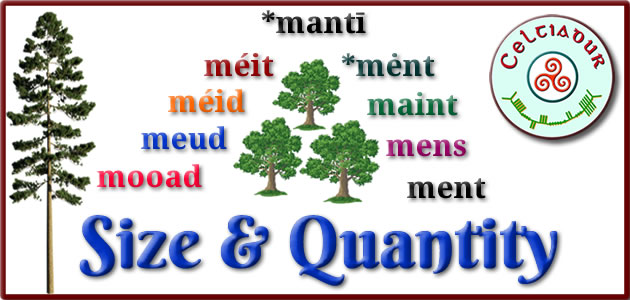
Words for size, amount, quantity and related things in Celtic languages.

Size & Quantity

Words marked with a * are reconstructions.

Proto-Celtic *mantī = size, quantity
Old Irish (Goídelc) méit [mʲeːdʲ] = amount, extent, greatness, quantity
Middle Irish (Gaoidhealg) méit, mét = greatness, magnitude
méite, méte, méide = size, amount, extent
Irish (Gaeilge) méid [mʲeːdʲ] = amount, quantity, extent, degree, number; size, magnitude
ainmhéid = hugeness, overgrowth
cóimhéid = equal size or amount
gearrmhéid = fair size
gháthmhéid = ordinary, average, size
lánmhéid = full size
meánmhéid = medium size
ollméid = great, size, hugeness, immensity
méadaigh = to increase, multiply, enlarge, augment
méadail = paunch, stomach
méadaíocht = grown state, increase, growth, self-importance, friendship
Scottish Gaelic (Gàidhlig) meud [miad] = size, largeness, amount, quantity, dimension
meudmhor = ample, sizeable
meudachd = dimension, bulk, greatness, magnitude, size, scale
meudachadh = increasing, expanding, augmenting
meudaichte = increased, expanded, augmented
làn-mheud = full size
mòr-mheud = great size
ro-mheud = excessive size / amount
Manx (Gaelg) mooad = amount, quantity
mooadys = amount, amplitude, augmentation, capacity, dimension
mooadagh = bulky, expansionist, large, sizeable
mooadaghey = aggravation, amplify, augment, develop, developing, enlarge
mooad-vaghteyr = quantity surveyor
Proto-Brythonic *mėnt = vain (?)
Middle Welsh (Kymraec) meint, meynt, mint = size, stature, amount
kymeint, kemeint, cymain = as great, as large, as big
meintholy, meynholy, meintoli = to specify an amount, measure
Welsh (Cymraeg) maint [mai̯nt] = size, dimension, magnitude, stature, amount, sum, number, quantity, the whole, all, as many, such
maintiol(i)aeth = size, dimension, measure, quantity
cymaint = as great, as large, as big, as many, as much
(pa) faint? = how many? how many?
meintiol = quantitative
mein(ti)olaf, meint(i)oli = to specify an amount, measure, quantify, value
meint(i)oliad = quantification
Middle Cornish (Cernewec) mens, mŷns = magnitude, greatness, quantity
Cornish (Kernewek) myns, mens = amount, quantity, as many as
mynsek, mensek = considerable, sizeable
mynsonieth, mensonieth = geometry
Old Breton ment, mint =
Middle Breton (Brezonec) ment, mænt, men = size, dimension
Breton (Brezhoneg) ment [ˈmɛnt/ˈmẽnt] = size, dimension, measure, format
mentad = measure
mentadañ = to measure, format
mentadur = quantification
mentel [ˈmẽntɛl] = dimensional, quantitative

Words marked with a * are reconstructions.

Etymology: from Proto-Indo-European *mh₁-nt-, from *meh₁- (to measure) [source].

Words from the same PIE roots include immense, meal, measure, meter / metre, metronome and probably moon and month in English, vermaren (to make famous) and maal (meal, time, turn) in Dutch, and mærð (flattery, praise) in Icelandic [source].

Blubrry podcast hosting

Sources: Wiktionary, Am Faclair Beag, Online Manx Dictionary, Teanglann.ie, eDIL – Electronic Dictionary of the Irish Language, In Dúil Bélrai English – Old Irish glossary, Geiriadur Prifysgol Cymru, Gerlyver Kernewek, Gerlyvyr Cernewec, Lexicon Cornu-britannicum: A Dictionary of the Ancient Celtic Language of Cornwall, Dictionaire Favereau, TermOfis, Le dictionnaire diachronique du breton, Geriafurch, English – ProtoCeltic WordList (PDF), Etymological Dictionary Of Proto Celtic

Haughty Pride

Words for pride, arrogance, vanity and related things in Celtic languages.

Gay Pride

Words marked with a * are reconstructions.

Proto-Celtic *auberos = vain
Old Irish (Goídelc) úabar = pride, arrogance
úabrige = pride, arrogance
Middle Irish (Gaoidhealg) úabar = pride, arrogance, vanity, confidence
úabrach = proud, haughty
úabrigidir = to treat insolently, profane, mock
óbar = vain-glory
anúabar, anuabhar = inordinate pride
comúabar = great pride
Irish (Gaeilge) uabhar = pride, arrogance, spiritedness, exuberance, frolicking, frolicsomeness, rankness, luxuriance, eeriness, feeling of loneliness
anuabhar = overweening pride, excess (of grief, weeping)
aingeal an uabhair = fallen angel
Scottish Gaelic (Gàidhlig) uabhar [uəvər̪] = pride, insolence
uabharra [uəvər̪ˠə] = proud, haughty
uaibhreach [uəivr̪ʲəx] = haughty, proud, arrogant
an-uaibhreach = humble
uaibhreas = arrogance, haughtiness
uaibhridh = haughty, proud, arrogant
ro sgrios thig uabhar = pride goes/comes before a fall
Proto-Brythonic *ọβer = vain (?)
Middle Welsh (Kymraec) ofer, ouer = worthless, vain, useless
ofêra, ouera, ofera = to behave frivolously
overaidd = vain, frivolous
oferbeth, obherbeth = worthless or pointless thing
ofered, oferedd = vanity, unsubstantiality, emptiness, vainglory
ofergoel, ofer-goel = superstition, vain belief
overwr, ouerwr, oferwr = good-for-nothing, waster, idler
Welsh (Cymraeg) ofer [ˈɔvɛr / ˈoːvɛr] = worthless, vain, useless, unnecessary, futile, wasteful, prodigal, unprofitable, frivolous
ofera(f) = to behave frivolously, live dissolutely, trifle, idle, laze, loiter, waste, squander
oferaidd = vain, frivolous, unprofitable, worthless
oferbeth = worthless or pointless thing, trifle, bauble
oferdod = vanity, dissipation, frivolousness
oferedd = vanity, unsubstantiality, emptiness, vainglory
ofergoel = superstition, vain belief, false religion
oferwr = good-for-nothing, waster, idler
Middle Cornish (Cernewec) evereth, ufereth = vanity, idleness, frivolity
Cornish (Kernewek) euver = valueless, worthless
euvergryjyk = superstitious
Middle Breton (Brezonec) euver = bland, insipid, flavourless
Breton (Brezhoneg) euver = bland, spineless(ness), damage

Etymology: from Proto-Celtic *aw- and *ber-o- (to carry), from Proto-Indo-European *bʰéreti (to carry, bear, flow), *bʰer- (to bear, carry) [source].

Words from the same PIE roots include beir (to bear, give birth to, lay, bring, take) in Irish, beir (to bear, give birth to) in Scottish Gaelic, behr (to bear, give birth to) in Manx, bairn (child) in Scots, and bear (to carry), bier, birth, burden, ferret, and fortune in English [source].

Proto-Celtic *balkos = strong
Gaulish balco- = strong (?)
Old Irish (Goídelc) balc = robust, strong, sturdy
Middle Irish (Gaoidhealg) balc, bailc = stout, strength, sturdy, firm, vigorous, powerful, strength, firmness, vigour
Irish (Gaeilge) bailc = strong, stout
bailcbhéim = strong, heavy, blow
Scottish Gaelic (Gàidhlig) bailc [balçgʲ] = strong, bold, daring
bailc uisge = sudden, heavy shower
bailceach [balçgʲəx] = stout/strong person
bailceata [balçgʲən̪ˠdə] = stout, strong, boastful
Middle Welsh (Kymraec) balch, bỽlch, beilch = proud, glad, pleased, dignified, splendid, imposing, fine, strong, brave
balchav = to grow proud or arrogant, pride oneself
bylchdaidd = proud, conceited, arrogant, haughty, vain
strong>ualchder, balchder = pride, pleasure, fineness, glory, dignity
ualchdet, balchet = pride, arrogance
Welsh (Cymraeg) balch [balχ] = proud, glad, pleased, dignified, splendid, imposing, fine, strong, brave, conceited, arrogant, haughty, vain, pompous
balchâf, balcháu = to grow proud or arrogant, pride oneself
balchdaidd = proud, conceited, arrogant, haughty, vain
balchder = pride, pleasure, fineness, glory, dignity
balchded = pride, arrogance
balchus = proud, vain
balchwedd = pride, conceit, lofty
belchyn = proud, pompous or self-important person, prig
Cornish (Kernewek) balgh = arrogant
Middle Breton (Brezonec) balc’h = haughty, proud, arrogant
Breton (Brezhoneg) balc’h [ˈbalx] = haughty, proud, arrogant
ambalc’h = reserved, timid
balc’haat = to make or become haughty
balc’hded = superb, arrogance
balc’hder = = pride, arrogance, audacity

Etymology: possibly from Proto-Indo-European *bʰel- (to blow, swell, inflate). A word from the same Proto-Celtic root is balca (bulrush, cattail) in Catalan and Occitan [source].

Words from the same PIE root include bold in English, boud (bold, brave) in Dutch, and bald (soon, almost) in German [source].

Welsh (Cymraeg) gwrth [ɡʊrθχ] = opposition, objection, resistance, contast, opposite
gwrthâd = taunt, light censure, upbraiding, remorse, conviction
Middle Cornish (Cernewec) goth = pride
gothus, gothys = proud
Cornish (Kernewek) gooth = pride
gothus = proud, arrogant
gorth = obstinate, perverse, stubborn, uppity
gorthus = proud

Etymology: unknown

Old Irish (Goídelc) blad = fame, renown
bladach = famous, renowned, splendid
Middle Irish (Gaoidhealg) blad, bladh, blath = fame, renown, glories, triumphs
bladach, bladaig = famous, renowned, splendid
bladaigid = praises, extols
Irish (Gaeilge) bláth = pride
Manx (Gaelg) blaa = heyday, pride

Etymology: unknown

Old Irish (Goídelc) borr = huge, large, proud, swollen, thick, vast
borrfadach = bold, high-spirited, proud
Middle Irish (Gaoidhealg) borr, bórr = big, large, great, vast, mighty, strong, puffed-up, proud
borrach = a proud, pretentious person
borra(i)d = swelling, maturing, blooming, springing, swells, becomes swollen, bloated
Irish (Gaeilge) borr = puffed (up with), proud, luxuriant; to swell, grow
borrach = proud, arrogant person; swollen, proud, arrogant
borrachas = pride, arrogance
borradh = swelling, growth, surge, expansion
Scottish Gaelic (Gàidhlig) bòrr [bɔːr̪ˠ] = puffed up, swollen, grand, splendid, haughty
borrail = swaggering, boastful
borranachadh = swelling up, puffing up, frothing at the mouth
borraganta = swelling, fierce

Etymology: unknown

Manx (Gaelg) sturd = pride, haughtiness; angry look, menacing look
styrdalys = stateliness
styrdalaght = pride, stateliness

Etymology: unknown

Manx (Gaelg) moyrn = pomp, pride, self-conceit
moyrnagh = haughty, proud, vain, pompous
moyrnee = proud

Etymology: unknown

Words marked with a * are reconstructions.

Blubrry podcast hosting

Sources: Wiktionary, Am Faclair Beag, Online Manx Dictionary, Teanglann.ie, eDIL – Electronic Dictionary of the Irish Language, In Dúil Bélrai English – Old Irish glossary, Geiriadur Prifysgol Cymru, Gerlyver Kernewek, Gerlyvyr Cernewec, Lexicon Cornu-britannicum: A Dictionary of the Ancient Celtic Language of Cornwall, Dictionaire Favereau, TermOfis, Le dictionnaire diachronique du breton, Geriafurch, English – ProtoCeltic WordList (PDF), Etymological Dictionary Of Proto Celtic