
The Moriscos (Spanish for "Moor-like") were Muslims in Spain and Portugal who were forced to convert to Christianity at the beginning of the 16th century. Many Moriscos continued to practice Islam, most in secret, but some did so openly. A decree issued by King Felipe II in 1566 obliged the Moriscos to adopt Spanish language, dress and customs. A number of unsuccessful rebellions of the Moriscos led to them being relocated from Granada to other parts of Spain, particularly Castile. At the beginning of the 17th century the Moriscos were expelled from Spain to Algeria, Tunisia, and Morocco.
The Moriscos produced books known as aljamiados, which written in Spanish using the Arabic alphabet and were used to instruct fellow Moriscos in Islam.
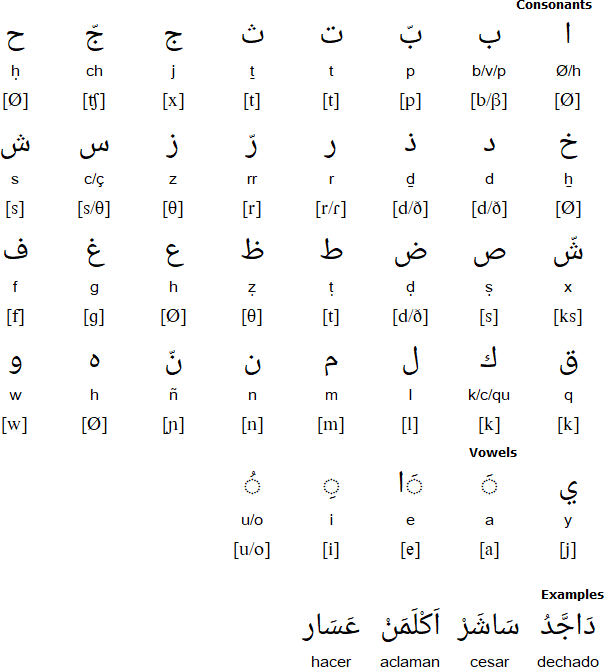
Download an alphabet chart for Morisco (Excel)
دَالْ وَلَرْدُنّ دَا لُشْ شَبِيُشْ
دِيشُ اُنْ رَّاكُنّتَدُرْ كِيَانْ
دَامَنْدَرَ بُّرْ كَمِنُ اِ كَرَّا رَ بَّرَ اَبَّارَانْدَارْ سَانْسِيَ اِ شَبِدُرِيَ اَدَارَاسُلُ دِيُشْ اَدَكَالْتَلْ اَ اُنْ كَمِنُ دَا لُشْ كَمِنُشْ دَالْ بَّرَاِشُ اِ لُشْ اَنْجَالاَش أَشْتِيَانْدَانْ شُشْ اَلَشْ اَ لُشْ
Del galardón de los sabios - diso un recontador - quien demandará por camino y carrera para aprender sensia y sabiduria, enderesólo Dios ad aquel tal á un camino de los caminos del paraiso y los ángeles estienden sus alas á los [...].
From the award of the wise men - said a teller - who will demand by road and race to learn science and wisdom, God straightened him into a way of the ways of the paradise and the angels spread their wings to [...].
Translation and transcription by by Michael Peter Füstumum
Information about the Moriscos the Aljamiado
https://en.wikipedia.org/wiki/Morisco
https://en.wikipedia.org/wiki/Aljamiado
https://es.wikipedia.org/wiki/Aljamía
https://core.ac.uk/reader/36033440
Adamaua Fulfulde, Aer, Afrikaans, Arabic (Algerian), Arabic (Bedawi), Arabic (Chadian), Arabic (Egyptian), Arabic (Gulf), Arabic (Hassaniya), Arabic (Hejazi), Arabic (Lebanese), Arabic (Libyan), Arabic (Modern Standard), Arabic (Moroccan), Arabic (Najdi), Arabic (Sudanese), Arabic (Syrian), Arabic (Tunisian), Arwi, Äynu, Azeri, Balanta-Ganja, Balti, Baluchi, Beja, Belarusian, Bosnian, Brahui, Chagatai, Chechen, Chittagonian, Comorian, Crimean Tatar, Dameli, Dargwa, Dari, Dhatki, Dogri, Domari, Gawar Bati, Gawri, Gilaki, Hausa, Hazaragi, Hindko, Humburi Senni, Indus Kohistani, Kabyle, Kalkoti, Karachay-Balkar, Karakalpak, Kashmiri, Katë, Kazakh, Khowar, Khorasani Turkic, Khwarezmian, Konkani, Korandje, Koyra Chiini, Koyraboro Senni, Kumzari, Kurdish, Kyrgyz, Lezgi, Lop, Luri, Maasina Fulfulde, Maba, Maguindanao, Malay, Malay (Terengganu), Mandinka, Marwari, Mazandarani, Mogholi, Morisco, Mozarabic, Munji, Noakhailla, Nubi, Ormuri, Palula, Parkari Koli, Pashto, Persian/Farsi, Punjabi, Qashqai, Rajasthani, Rohingya, Salar, Saraiki, Sawi, Serer, Shabaki, Shina, Shughni, Sindhi, Somali, Soninke, Tatar, Tausūg, Tawallammat Tamajaq, Tayart Tamajeq, Ternate, Torwali, Turkish, Urdu, Ushoji, Uyghur, Uzbek, Wakhi, Wanetsi, Wolof, Xiao'erjing, Yidgha
Page last modified: 23.04.21
[top]

Note: all links on this site to Amazon.com


You can support this site by Buying Me A Coffee, via PayPal or Patreon, or by contributing in other ways.
If you find all the adverts annoying, there is now an Ad-free version of Omniglot which you can access for a small monthly or annual donation.

This website and its content is copyright of Simon Ager - © Simon Ager 1998-2026. All rights reserved. All images were created by me, unless otherwise indicated. More details

[top]


