Rawness

Today we’re looking at the words for raw and related things in Celtic languages.

Raw

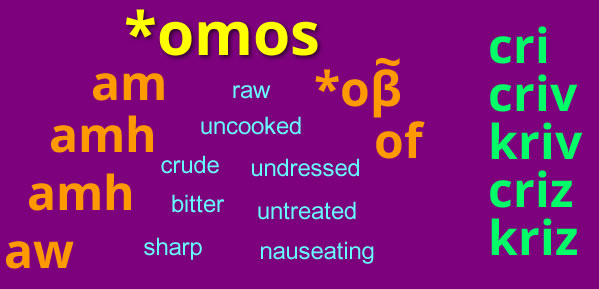
Proto-Celtic *omos = raw
Old Irish (Goídelc) om [oṽ] = raw, uncooked
Middle Irish (Gaoidhealg) om = raw, uncooked; crude, undigested, immature; rude, unrefined, barbarous
Irish (Gaeilge) amh [ˈavˠ / ˈaw] = raw, uncooked
amhábhar = raw material, staple
aimhe = rawness, crudeness
amhainse = sharpness, astuteness
amhainseach = sharp, astute
amhchaoin = rough, uncouth
amhola = crude oil
Scottish Gaelic (Gàidhlig) amh [af] = raw, uncooked; extra rare, blue (meat); uncouth, crude
amhachd [avəxg] = rawness
Manx (Gaelg) aw = crude, raw, uncooked, undressed
awid = crudeness, rawness, rareness
awaneagh = moron, oaf; oafish, raw, rude, uncivilsed, vain
feill aw = raw meat
ooill aw = crude oil
Proto-Brythonic *oβ̃ = raw
Middle Welsh (Kymraec) of = crude, uncooked, raw
Welsh (Cymraeg) of [braːɨ̯n / brai̯n] = crude, untreated, uncooked, raw, bitter, sharp, nauseating, sickly
ofaf, ofi = to decompose, crumble, analyse

Etymology: from the Proto-Indo-European *h₂eh₃mós (raw, uncooked, bitter, sour), probably from *h₂eh₃- (to be hot, burn) [source].

Words for copper and bronze in Celtic languages possibly come from the same Proto-Celtic root, via the word *omiyom [source].

The Greek word ὠμός [oˈmos] (raw, uncooked, crude, brutal) comes from the same PIE root [source].

Middle Welsh (Kymraec) cri = crude, uncooked, raw
Welsh (Cymraeg) cri [kriː] = raw, fresh, new, crude, coarse, unfulled (cloth), unleavened
bara cri = unleavened bread
defnyddiau cri = raw materials
teisen gri = griddle cake, Welsh cake
Middle Cornish (Cernewec) criv = rude, raw, green, newly made, unripe
Cornish (Kernewek) kriv = crude, fresh, raw, uncooked, unripe
krivder = rawness
gossen griv = raw umber
Middle Breton criz, cry = raw, crude, cruel, rough
Breton (Brezhoneg) kriz = raw, crude, cruel, rough
gopr kriz = gross salary
hollad kriz = gross total
obar kriz = act of barbarism

Etymology: possibly from the Latin crūdus (raw, bloody), from the Proto-Italic *krūros (bloody), from the Proto-Indo-European *kruh₂rós (bloody), from *krewh₂- (raw meat, fresh blood). The English words crude and cruel come from the same Latin root, and raw comes from the same PIE root [source].

Middle Welsh (Kymraec) amrwt = raw, uncooked
Welsh (Cymraeg) amrwd [ˈamrʊd] = raw, uncooked, unprocessed, undigested, crude, untreated, unrefined, rough, approximate

Etymology: from the Proto-Celtic *an (un-) and *brutus (boiling heat), from the Proto-Indo-European *bʰrewh₁- (to boil, brew) [source].

Other words from the Proto-Celtic root *brutus include brwd (eager, keen, passionate, zealous) and brwdfrydedd (enthusiasm) in Welsh, and bruth (heat, rash, eruption, nap, pile, surf) in Irish [source].

Words marked with a * are reconstructions.

Sources: Wiktionary, Am Faclair Beag, Online Manx Dictionary, Teanglann.ie, eDIL – Electronic Dictionary of the Irish Language, In Dúil Bélrai English – Old Irish glossary, Geiriadur Prifysgol Cymru, Gerlyver Kernewek, Gerlyvyr Cernewec, Dictionaire Favereau, TermOfis, Le dictionnaire diachronique du breton, Geriafurch, English – ProtoCeltic WordList (PDF), Etymological Dictionary Of Proto Celtic

The Fastest Way to Learn Japanese Guaranteed with JapanesePod101.com

Sieving Riddles

Today we’re looking at the words for sieve and related things in Celtic languages.

Sieving Flour

Words marked with a * are reconstructions.

Proto-Celtic *krētros = sieve
Old Irish (Gaoidhealg) críathar = sieve
Middle Irish (Gaoidhealg) críathar = sieve, riddle
críatharach = marsh, morass, boggy wasteland
críathrad = act of winnowing, sifting, riddling
críathraid = sifts, riddles, spreads
Irish (Gaeilge) criathar [ˈcɾʲiəhəɾˠ / ˈcɾʲiːhəɾˠ] = sieve, riddle
criathach = pitted, perforated, swampy
criathrú = winnowing, sifting, honeycombing
criathradóir = winnower, sifter, maker of sieves
criathraigh = to sieve, winnow, riddle, sift, honeycomb
criathróir = animal surefooted on boggy ground
criathar meala = honeycomb
criathar mín = fine sieve
Scottish Gaelic (Gàidhlig) criathar [krʲiə.ər] = riddle, sieve
criathar-tomhais = bushel (measure and implement)
criathar-garbh = riddle (implement)
criatharair [krʲiəhərɛrʲ] = sieve-maker
criathradh [krʲiarəɣ] = (act of) filtering
Manx (Gaelg) creear = sieve, riddle
creearey = sieve, pan, sift, riddle
creear meein = fine sieve
creear garroo = rough sieve
jannoo creear = to honeycomb
Proto-Brythonic *kruɨdr = wandering, sieve
Old Welsh cruitr = winnowing shovel
Middle Welsh (Kymraec) cruidir, crwydr = sieve
Welsh (Cymraeg) crwydr [ˈkrʰʊɨ̯dr̩ / ˈkrʰʊi̯dr̩] = a wandering, a roaming; misfortune, trouble, confusion, rout, dispersion; a straying, aberration, error; winnowing-fan, winnowing-shovel, sieve
crwydro = to wander, roam, stroll, gad about, stray, go astray, deviate, digress
crwydredig = wandering, vagrant, roving, stray
crwydro = barn, granary, farm building
crwydrwr = wanderer, vagrant, vagabond, rover, nomad
Old Cornish croider = sieve, riddle
Middle Cornish croider, crodar = sieve, riddle
Cornish (Kernewek) kroder = coarse sieve, strainer, riddle
kroder kroghen = bodhrán, hold-all
Old Breton croitir = sieve, riddle
Middle Breton croezr = sieve, riddle
Breton (Brezhoneg) krouer = sieve, riddle, screen
krouerañ = to sift, riddle, sieve
krouer liammoù = link generator
rakkroueriañ = pre-screening

Etymology: from the Proto-Indo-European *krey-trom (sieve) from *krey- (to sift, separate, divide) [source]. Words from the same PIE root include crime, crisis, riddle and secret in English, ceart (right, correct, true) in Irish, and crynu (to tremble, shake) and ergryn (horror, dread) in Welsh [source].

Proto-Celtic *sītlā = vase
Old Irish (Goídelc) síthal = bucket
síthlaid = to filter, sift, strain
soithech = container, vessel
Middle Irish síthal, sitheal = a vessel for drawing water, a bucket
síthlaid, síthlaigid, síthóilid = to strain, filter, sift, scour, sweep across, flow away, melt
soithech, soitheach = vessel, container (for liquids), blood vessel, boat
Irish (Gaeilge) síothal [ʃiː(h)ˈl̪ˠɑːn̪ˠ] = vessel for drawing water, pail, bucket (literary)
síothlaigh = to strain, filter, drain away, subside, settle, expire, die
síothlán = strainer, filter, colander
síothlóir = (of person) strainer, filterer (person), weakly, dying person
síothlú = filtration, percolation, subsidence, abatement, expiry, death
Scottish Gaelic (Gàidhlig) sìol [ʃiəl̪ˠ] = compose, settle, filter, strain
sìol(t)achan [ʃiəl̪ˠ(d)əxan] = filter, strainer
sìoltag [ʃiəl̪ˠdag] = strainer, filter, sieve
sìol(t)an [ʃiəl̪ˠ(d)an] = filter, strainer, sieve
sìoltachair [ʃiəl̪ˠdəxɛrʲ] = filter feeder
sìoltachadh [ʃiəl̪ˠdəxəɣ] = (act of) filter feeding
Manx (Gaelg) sheeley = to flow, run, drip, trickle, dribble, seep, oose, filter, strain, drain
sheelaghey = to strain off, to filter, to refine, clarification, sober
Proto-Brythonic *sidl, *hidl = filter, sieve (?)
Middle Welsh (Kymraec) hidl, hidyl, hityl = filter, strainer, sieve
hitler, hidlir, hidlaw = to strain, filter, purify, cleanse, percolate, pour, sprinkle, scatter, sift
hidleit, hidlaid = strained, clarified, clear, flowing
Welsh (Cymraeg) hidl, hiddl = filter, sieve, strainer
hidl(i)ad = straining, filtration, percolation
hidlai = strainer, filter
hidlaid = strained, clarified, clear, flowing
hidlo = to strain, filter, purify, cleanse, percolate, pour, sprinkle, scatter, sift
hidlwr, hidlydd = strainer, filter
Cornish (Kernewek) sidhel [ˈɹɔːz] = filter, strainer, colander
sidhla = to filter, strain, sift, sieve, percolate, purify, cleanse
Middle Breton (Brezonec) sizl = filter, strainer
sila, sizla = to filter
Breton (Brezhoneg) sil [siːl] = filter, strainer
silad = filtrate, grout
siladenn = filtering
siladur = filtering, filtration
silañ = to filter
silerezh = filtering, percolation

Etymology: possibly from Proto-Indo-European *seh₁- (to impress, insert, sow, plant), and influenced by Latin situla (a vessel used to hold water, a voting urn, basin, jar) [source]. Words from the same PIE root include siets (sieve, sifter) in Latvian, sito (sieve, filter) in Polish, (to) sow, season, seminar and seed in English, zaaian (to sow, plant seed, spread) in Dutch, sold (sieve) in Danish [source].

Old Irish (Goídelc) scacaid = to filter, sift, strain
Middle Irish (Gaoidhealg) scacaid, scacad, sgacadh = to strain, filter, sift, purify
Irish (Gaeilge) scag = to strain, filter, drain off, refine, sift, screen, derive, spring (from a source)
scagach = permeable, porour, thin, flimsy, sparse
scagachán = filtration
scagacht = porosity
scagadh = filtration, refinement, assortment, critical examination
scagaire = filter, screen, filterer, sifter, refiner
scagaireacht = (act of) filtering, sifting, refining
Scottish Gaelic (Gàidhlig) sgag [sgag] = split, crack, chap

Etymology: possibly from Old Norse [source].

Proto-Celtic *wokro- = (?)
Middle Welsh (Kymraec) goger, gogr, gogyr = sieve, riddle, screen, strainer
Welsh (Cymraeg) gogr [ˈɡɔɡɔr / ˈɡoːɡɔr] = sieve, riddle, screen, strainer
gogrwr, gogrydd = sieve-maker, sifter
gogru [ˈɡɔɡrɨ̞ / ˈɡɔɡri] = to sieve, sift

Etymology: from PIE *sker- (to separate, cut off) [source].

Sources: Wiktionary, Etymological Dictionary Of Proto Celtic, In Dúil Bélrai English – Old Irish glossary, eDIL – Electronic Dictionary of the Irish Language, Teanglann.ie, Am Faclair Beag, An etymological dictionary of the Gaelic language, Fockleyreen: Manx – English Dictionary, Online Manx Dictionary, Gaelg Corpus, Geiriadur Prifysgol Cymru, Lexicon cornu-britannicum : a dictionary of the ancient Celtic language of Cornwall, Gerlyver Kernewek, Devri : Le dictionaire diachronique du breton, Geriafurch, TermOfis


Brushes and Broom

Today we’re looking at the words for brush, broom and related things in Celtic languages.

brooms

Words marked with a * are reconstructions.

Middle Irish (Gaoidhealg) scúap [skuə̯b] = brush, broom, sheaf, bundle
scúapad = act of sweeping
scúapaire = sweeper
Irish (Gaeilge) scuab [sˠkuəbˠ] = besom, broom; brush; sheaf, armful, bundle; to sweep
scuabach = sweeping, flowing; gusty
scuabachán = sweeping, sweepings
scuabadh = to sweep, wash
scuabadóir = sweeper
scuabán = little besom, little brush, little sheaf, armful, bundle
scuab fiacla = toothbrush
scuab ghruaige = hairbrush
scuab ingne = nailbrush
scuab phéinte = paintbrush
sreangscuab = wire brush
Scottish Gaelic (Gàidhlig) sguab [sguəb] = broom, besom, brush, sheaf
sguabte = brushed, swept
sguabanta = tidy, trim, clean
sguabadh = brushing, sweeping
sguabachan = brush
sguabag = gusty, wind, whisk, sheaf (of corn)
sguabadair = vacuum cleaner
sguabair = sweeper
sguab-aodaich = clothes brush
Manx (Gaelg) skeab = besom, broom
skeabey = brush, brushing, brush over, brush up, sweep, sweeping
skeabit = brushed, swept
skeaban daah, skeaban-slaa = paintbrush
skeaban feeackle = toothbrush
skeaban folt/fuilt = hairbrush
Proto-Brythonic *ɨskʉb = brush, broom
Middle Welsh (Kymraec) escup, yscub, ysgub = brush, broom
Welsh (Cymraeg) ysgub [ˈəsɡɨ̞b / ˈəsɡɪb] = sheaf, wheatsheaf, bundle; brush, broom, besom, quiver of arrows
ysgubell = brush, broom, besom, mop, bunch (of flowers)
ysgubo = to brush, sweep (away), make into sheaves
ysgubol = sweeping
ysgubwr = sweeper, sweep
ysgub blu = feather duster
priodas (coes) ysgub = informal wedding in which the parties jump over a broomstick in the presence of witnesses
Middle Cornish scibia = to sweep, brush
sciber = barn, any large room
scubilen = whip, scourge
Cornish (Kernewek) skub = sweeping
skubell, skubyllen = broom, brush
skubellik = paintbrush
skubell sugna = vacuum cleaner
skubell-wolghi = mop
skuber, skubores = sweeper
skubus = sweeping
skubya = to brush, sweep
skubyllen dhes = toothbrush
skubyon = refuse, sweepings
Breton (Brezhoneg) skub [ˈskyːp] = broom, brush, blade; sweep
skubell = broom, brush, blade; sweep
skubell-vroust(añ) = scrubbing brush
skuberez = sweeper

Etymology: from the Latin scōpa (broom) Proto-Indo-European *skeh₂p- (to prop) [source]. Words from the same Latin root include scopa (broom) in Italian, escoba (broom) in Spanish, and shqopë (heather, heath, briar) in Albanian [source]..

Broom

Proto-Celtic *banatlo- = broom (shrub)
Gaulish *balano- = broom (shrub)
Celtiberian *bálago-, *bálaco- = broom (shrub)
Scottish Gaelic (Gàidhlig) bealaidh [bɛl̪ˠɪn] = broom (shrub)
bealaidh-Frangach, bealaidh-Sasannach = laburnum
Proto-Brythonic *banatlo- = broom (shrub)
Middle Welsh (Kymraec) banadil, banadyl, banadl = broom (shrub)
Welsh (Cymraeg) banadl, banal [ˈbanadl] = broom (shrub)
banadl Ffrainc = laburnum
Old Cornish banathel = broom (shrub)
Middle Cornish banal = broom (shrub)
Cornish (Kernewek) banadhel = broom (shrub)
Old Breton (Brethonoc) balan = broom (shrub)
Middle Breton (Brezonec) balain, balazn = broom (shrub)
Breton (Brezhoneg) balan [ˈbɑːlãn] = broom (shrub)
balaneg [bã.ˈnɑː.lek] = broom grove
balaenn [baˈlɑːɛn] = broom, brush

According to An Etymological Dictionary of the Gaelic Language by Alexander MacBain (1982), there is a cognate in Irish: beally/i, however it doesn’t appear in any of the Irish dictionaries I’ve checked.

Etymology: from the Proto-Indo-European *bʰenH-tlom (way, path) in the sense of “cleared path (in a wood)” [source].

The French word balai (broom, broomstick, brush) comes from the Gaulish *balano-, via Old French, Middle Breton and Old Breton [source]. The Spanish word bálago (straw, Spanish broom), comes from the same Gaulish root, via the Celtiberian *bálago-/*bálaco- [source].

Words same PIE roots possibly include bana (course, path, trajectory) in Swedish, baan (road, path, track, job, orbit) in Dutch, and Bahn (route, trail, railway)in German [source].

The shrub known as broom in Britain and Ireland is also known as common broom or Scotch broom, or Cytisus scoparius in Latin. It is a deciduous leguminous shrub native to western and Central Europe. Broom can also refer to similar plants, such as French broom and Spanish broom [source].

Twigs from the broom, and from other plants, can be tied to a stout stick and used to sweep things. Such implements are traditionally known as besoms or broom besoms, and became known simply as brooms [source].

The Fastest Way to Learn Japanese Guaranteed with JapanesePod101.com

Sources: Wiktionary, Am Faclair Beag, Online Manx Dictionary, Teanglann.ie, eDIL – Electronic Dictionary of the Irish Language, In Dúil Bélrai English – Old Irish glossary, Geiriadur Prifysgol Cymru, Gerlyver Kernewek, Dictionaire Favereau, TermOfis, English – ProtoCeltic WordList (PDF), Etymological Dictionary Of Proto Celtic

Unlimited Web Hosting - Kualo

Ferns and Bracken

Today we’re looking at the words for fern, bracken and related things in Celtic languages.

Maidenhair Spleenwort

Proto-Celtic *ɸratis, *frati- = fern, bracken
Gaulish ratis = fern, bracken
Old Irish (Goídelc) raithnech [ˈr͈aθʲnʲex] = fern, bracken
Middle Irish (Gaoidhealg) raith = fern, bracken
Irish (Gaeilge) raithneach = fern, bracken
raithneachán = ferny place
raithneachúil = ferny
Scottish Gaelic (Gàidhlig) raineach [r̪ˠan̪ʲəx] = fern, bracken; hashish, weed
raith [r̪ˠɛ] = fern, bracken
raineachail = abounding in fern, ferny, like fern
Manx (Gaelg) renniagh = fern, bracken
renniaghoil = ferny
Proto-Brythonic *rrėdɨn = ferns, bracken
Middle Welsh (Kymraec) rhedyn = ferns, bracken
retinoc, redinauc, rhydynog = ferny
Welsh (Cymraeg) rhedyn [ˈr̥ɛdɨ̞n / ˈr̥eːdɪn] = ferns, bracken
rhedynen = fern
rhedyn eryraidd = bracken
rhedyna = to gather ferms
rhedynaidd = ferny
rhedyneg = ferny ground
rhedynog = ferny (land), abounding with ferns, fern-like, made of fern
Old Cornish reden = ferns, bracken
redenen = fern
Middle Cornish reden = ferns, bracken
redenen, redanen = fern
Cornish (Kernewek) reden = ferns, bracken
redenen = fern
Middle Breton reden = ferns, bracken
radenenn = fern
Breton (Brezhoneg) raden = ferns, bracken
radenenn = fern

Etymology: from the Proto-Indo-European *p(t)erH- (fern) [source].

The English word fern comes from the same PIE root, via the Old English fearn and the Proto-West-Germanic *farn [source].

Other words from the same PIE root include paparde (fern) in Latvian, paproć (fern) in Polish, and папрат (fern) in Bulgarian [source].

Words marked with a * are reconstructions.

Sources: Wiktionary, Am Faclair Beag, Online Manx Dictionary, Teanglann.ie, eDIL – Electronic Dictionary of the Irish Language, In Dúil Bélrai English – Old Irish glossary, Geiriadur Prifysgol Cymru, Gerlyver Kernewek, Gerlyvyr Cernewec, Dictionaire Favereau, TermOfis, Le dictionnaire diachronique du breton, Geriafurch, English – ProtoCeltic WordList (PDF), Etymological Dictionary Of Proto Celtic

The Fastest Way to Learn Japanese Guaranteed with JapanesePod101.com

Emptiness

Today we’re looking at the words for empty, soft and related things in Celtic languages.

View from Sabhal Mòr Ostaig

Proto-Celtic *wāstos = empty
Old Irish (Goídelc) fás = empty, vacant, deserted
fásaogod to empty, despoil
Middle Irish (Gaoidhealg) fás = empty, vain, futile, vacant
Irish (Gaeilge) fás [fˠɑːsˠ / fˠaːsˠ] = waste, vacant, empty, void; wild, luxuriant
fásach = waste, desert; uncultivated, uninhabited region; empty, deserted place
fásaigh = to lay waste, leave uncultivated
Scottish Gaelic (Gàidhlig) fàs [faːs] = empty; barren, waste, uncultivated, fallow, desolate
fàsach = desert, wilderness, empty place
fàsaich = to depopulate, lay waste to a place, desolate
fàslach = hollow, void, cavity
fàslail = desolate, lonely, solitary
Manx (Gaelg) faase = feeble, weak; desolate, void, barren, infirm
faasagh = desert, desolate, waste place, wilderness
faaselagh = weakest part, poor part of lawn
faasoil = desert

Etymology: from the Proto-Indo-European *h₁weh₂- (to leave, abandon) [source].

Old Irish (Goídelc) folam = empty
Middle Irish (Gaoidhealg) folam, falam = empty, uninhabited, shallow, barren, destitute, vain, worthless
folma = emptiness
Irish (Gaeilge) folamh [ˈfˠɔl̪ˠəvˠ / ˈfˠaːl̪ˠə / ˈfˠɔlˠuː] = empty
folmhaigh = to empty, discharge, exhaust; purge, evacuate
folmhach empty, vacant, sapce, gap (between teeth)
Scottish Gaelic (Gàidhlig) falamh [fal̪ˠəv] = empty, hollow, void
falamhachd = emptiness, voidness, vacancy, vacuum, void
falamhaich = to empty, void, evacuate
falamhaichte = emptied
Manx (Gaelg) follym = void, flat, shallow, barren, vacuous, waste, blank, empty, hollow, blank
folmaghey = to empty, void, hollow, vacate, deflate

Etymology: possibly from the Old Irish lomm (bare, naked, smooth) [source].

Middle Irish (Gaoidhealg) cúacca = empty
Proto-Brythonic *gwag = empty, vacant
Old Welsh guac = empty, desolate, vacant
Middle Welsh (Kymraec) gwac, gwag = empty, desolate, vacant
Welsh (Cymraeg) gwag [ɡwaːɡ] = empty, desolate, vacant, void, barren; meaningless, senseless, unsubstantial, frivolous, null and void, invalid
gwagedd = vanity, vainglory, conceit, empitness, unreality
gwagio = to empty, make empty, become empty
gwagle = empty place or space, vacuum, void, gap, chasm, space
Middle Cornish gwag = hungry, vain, void, vacant, at leisure; void, vacuum, hunger
Cornish (Kernewek) gwag = blank, empty, hollow, hungry, unfurnished, unoccupied, vacant
gwaga = to break into a cavity
gwagen = blank
gwagla = vacancy
gwagva = vacuum
gwakhe = to empty, vacate
Middle Breton goac = soft, tender
goacat = to soften
Breton (Brezhoneg) gwak = soft, tender
gwakaat = to soften
gwakadur = softening

Etymology: from the Vulgar Latin *vacus, from the Latin *vacuus (empty), from vacō (I am empty, void), from the Proto-Italic *wakos (empty), from the Proto-Indo-European *h₁weh₂- (to lack, empty) [source].

A Breton word for empty is goullo or gollo, the origins of which are not known.

Words marked with a * are reconstructions.

Sources: Wiktionary, Am Faclair Beag, Online Manx Dictionary, Teanglann.ie, eDIL – Electronic Dictionary of the Irish Language, In Dúil Bélrai English – Old Irish glossary, Geiriadur Prifysgol Cymru, Gerlyver Kernewek, Gerlyvyr Cernewec, Dictionaire Favereau, TermOfis, Le dictionnaire diachronique du breton, Geriafurch, English – ProtoCeltic WordList (PDF), Etymological Dictionary Of Proto Celtic
The Fastest Way to Learn Japanese Guaranteed with JapanesePod101.com

Soft and Tender

Today we’re looking at the words for soft and tender and related things in Celtic languages.

soft

Words marked with an * are reconstructions.

Proto-Celtic *buggos = soft, tender
Old Irish (Goídelc) boc = soft, gentle, tender
Middle Irish (Gaoidhealg) boc = soft, gentle, tender, tepid
Irish (Gaeilge) bog [bˠɔɡ / bˠʌɡ] (noun) = soft, tender, flabby, indulgent, lenient, mellow (voice), mild (weather), loose, lukewarm
bog (verb) = to soften, become soft, ease, warm, get milder, move, loosen, rock
bogach = soft, boggy ground
bogachar = softness, bogginess
bogadh = softening, easement, movement, stir
bogánta = soft, squelchy
bogearraí = software
an rud a fhaightear go bog caitear go bog é = easy come, easy go
tóg go bog é = take it easy
Scottish Gaelic (Gàidhlig) bog [boɡ] = flabby, soft, limp, pulpy; moist, marshy, boggy, slopp; foolish; damp, humid; indulgent; spiritless; flat (in music); lax (in linguistics)
bogach = bog, fen, marsh, swamp, morass, quagmire
bogachadh = wetting, steeping, moistening, mellowing, softening, swilling
bathar-bog = software
Manx (Gaelg) bog = soft, easy, tender, flabby, pulpy, slack, limp, moist, soft-hearted, callow
boggagh = to soften, steep
strong>boggaghey = to soften, relax, ease, moisten, dissolve
boggyr = soft
boglagh = quagmire, morass, swamp, oozy, boggy
bog-roauyr = podgy
bog-vroiet = soft-boiled
bog- vroojit = squashy
Old Breton (Brethonoc) buc = soft, tender
Middle Breton (Brezonec) boug = soft, tender
Breton (Brezhoneg) bouk [buːk] = soft, cozy, heavy, stifling (weather)
boukaat [buˈkɑːt] = to soften, tenderize
boukted = softness, weakness

Etymology: from the Proto-Indo-European *bʰewgʰ- (to bend, curve, arch) [source].

The English word bog (wet spongy ground, marsh, swamp), was borrowed from the Irish or Scottish Gaelic bog [source]. English words from the same PIE root include badge, bagel, (to) bow, buck and bow (and arrow) [source].

Old Irish (Goídelc) muad = cloud, mist, fumes
Middle Irish (Gaoidhealg) muad, muadh = cloud, mist, fumes
Scottish Gaelic (Gàidhlig) muadh = soft, moist
Manx (Gaelg) meeley = soft, bland, smooth, yielding, soft-spoken, moisten, delicate, fine
Middle Welsh (Kymraec) medal, meddal [kam] = soft, yielding, tender, delicate, pliable
Welsh (Cymraeg) meddal [ˈmɛðal / ˈmeːðal] = soft, yielding, tender, delicate, pliable; mild, gentle, placid, tolerant, merciful, lax, inexperienced, foolish, weak
meddalu = to soften, become soft, thaw; to lenite, cause lenition
meddalaidd = soft, softish, tender, immature, foolish, weak
meddalder = softness, soft spot, tenderness, sensitivity
meddaledig = softened, soft, tender
meddalwedd = software
treiglad meddal = soft mutation
Middle Cornish medhal, meddal = soft, mollient, tender
medhalder = softness, tenderness, mildness, gentleness
Cornish (Kernewek) medhel = soft
medhelhe = to lenite, soften, absorb
medhelheans = lenition
medhelweyth = software
Middle Breton mezell = malleable, mean
Breton (Brezhoneg) mezel = malleable, mean, leprosy

Etymology: possibly from Proto-Indo-European *ml̥dus (soft, weak) [source]. Words from the same PIE root include mild in English, mild (mild, gentle, lenient) in Dutch, mladý (young) in Czech, molle (soft, flabby, weak, feeble) in Italian, mou (soft, mushy, squishy, slow, weak, comfortable) in French, and muelle (soft, mild) in Spanish [source].

Proto-Celtic *mīnis = smooth, soft, gentle
*meinos = tender, soft, gentle
Gaulish *mēnos = (?)
Old Irish (Goídelc) mín = fine, minor, petty, small, level, smooth
Middle Irish (Gaoidhealg) mín, min = smooth, level, calm, gentle, placid, courteous, docile, digestible, palatable, soft
Irish (Gaeilge) mín [mʲiːnʲ] = smooth, fine
míneadas = gentleness, refinement
míneog = gentle, placid woman
mínigh = to smooth, polish, level, reclaim, make gentle, assuage, quiet, explain, expound, interpret
míníneacht = daintiness, refinement, gentleness, quietness, subtlety, preciosity, dainty, delicacy
mínitheoir = smoother, polisher, leveller, reclaimer, assuager, pacifier, explainer, interpreter
Scottish Gaelic (Gàidhlig) mìn [miːn] = smooth, silky, sleek, gentle, dainty, downy, powdery, fine, bland
mìneachd [miːnəxg] = smoothness, softness, delicacy, minuteness
mìnealas = softness, gentleness
Manx (Gaelg) meen = soft, sweet, meek, mild, bland, darling, dear, patient, quiet
meeninagh = soft, tameable, emollient
meeinid = softness, smoothness, patience, mildness, gentleness, blandness
Proto-Brythonic *muɨn = mild, gentle
Middle Welsh (Kymraec) mwyn = tender, mild, gentle, meek
mwynaidd = tender, mild, gentle, kind
mwynas = good, turn, kindness, courtesy, love
Welsh (Cymraeg) mwyn [muːɨ̯n / mʊi̯n] = tender, mild, gentle, meek, amiable, loving, kind, obliging, courteous, noble, fair, pleasant, sweet-sounding, melodious, soft, soothing
mwynaidd = tender, mild, gentle, kind
mwynas = good, turn, kindness, courtesy, love
mwyndeb = mildness, gentleness, pleasure
mwyndeg = gentle and fair, tender, genial, affable
Old Cornish muin = gracile
Middle Cornish (Cernewec) mon, moyn = slender,
Cornish (Kernewek) moon = slender, slim, thin
Old Breton (Brethonoc) moin = delicate
Middle Breton (Brezonec) moan = thin, slim, slender
Breton (Brezhoneg) moan [mwãːn] = thin, slim, slender, fine, subtle
moanaat = to get thinner, get slimmer, thin down, lose weight
moanard = a thin, slender, skinny person
moanded = slimming

Etymology: from Proto-Indo-European *meyh₁- (mild, soft). Words from the same root possible include mite (mild, moderate, balmy, mild, meek) and mezzo (half, middle, means, method) in Italian, miły (nice, pleasant, dear, gentle, soft) in Polish, and mielas (nice, sweet, cute) in Lithuanian [source].

The Fastest Way to Learn Japanese Guaranteed with JapanesePod101.com

Sources: Wiktionary, Etymological Dictionary Of Proto Celtic, In Dúil Bélrai English – Old Irish glossary, eDIL – Electronic Dictionary of the Irish Language, Teanglann.ie, Am Faclair Beag, An etymological dictionary of the Gaelic language, Fockleyreen: Manx – English Dictionary, Online Manx Dictionary, Gaelg Corpus, Geiriadur Prifysgol Cymru, Lexicon cornu-britannicum : a dictionary of the ancient Celtic language of Cornwall, Gerlyver Kernewek, Devri : Le dictionaire diachronique du breton, Geriafurch, TermOfis


Second Others

Today we’re looking at the words for second or other and related things in Celtic languages.

Second, Other

Proto-Celtic *alyos [ˈal.jos] = other, second
Leptonic 𐌀𐌋𐌉𐌏𐌔 (alios) = second, other
Gaulish allos, alos = second, other
Old Irish (Goídelc) aile = other, second
indala [in͈ˈdala] = other (of two)
Middle Irish (Goídelc) aile, oile, eile = other, second, another
indala = one (of two), less often, the other, later, the second
Irish (Gaeilge) eile [ˈɛlʲə] = other, another, next, more, else
dara [ˈd̪ˠɑɾˠə / ˈd̪ˠaɾˠə] = second (2ⁿᵈ), next, other
Scottish Gaelic (Gàidhlig) eile [elə] = other, another, else
eileadh [eləɣ] = other
eilich [elɪç] = alienate
eileachadh = (act of) alienating, alienation, othering
dala [dal̪ˠə] = second (2ⁿᵈ)
Manx (Gaelg) elley = other, else, another, additional, alternative
derrey = second in command, till, pending
yn derrey = second (2ⁿᵈ)
Proto-Brythonic *ėl [ˈe̝ːlˑ] = second, other
Middle Welsh (Kymraec) ail, eil, eyl = second, other
Welsh (Cymraeg) ail [ai̯l] = second, like, similar, equivalent, equal; son, grandson, heir, descendant; helper, supporter
ailgylchu = to recycle
eilaidd = secondary
eilfed = second (number)
eilaid = second (of time)
Middle Cornish eil = second, another
Cornish (Kernewek) eyl = one of two, second
eyla = to second
eylafinans = refurbishment
eylgelghya = to recycle
eylskrifa = to copy
Middle Breton) eil = second
Breton (Brezhoneg) eil [ˈɛjl] = second
eilvet = second (number)
eilad = second, copy, reproduction
eilañ = to accompany, copy
eiladiñ = to duplicate
eiladuriñ = to reproduce, reproduction

Words marked with a * are reconstructions.

Etymology: from the Proto-Indo-European *h₂élyos (other, another), from *h₂el- (beyond, other) [source]. The Old Irish word indala, which is the root of the Irish dara, the Scottish Gaelic dala and the Manx derrey, comes from the Old Irish ind (the) and aile (second) [source]..

Some words from the same PIE roots include else, all and ultra in English, al (all, all of) in Dutch, eller (else, otherwise) in Danish, Norwegian and Swedish, and այլ (ayl – another, other) in Armenian [source].

Sources: Wiktionary, Am Faclair Beag, Online Manx Dictionary, Teanglann.ie, eDIL – Electronic Dictionary of the Irish Language, In Dúil Bélrai English – Old Irish glossary, Geiriadur Prifysgol Cymru, Gerlyver Kernewek, Gerlyvyr Cernewec, Dictionaire Favereau, TermOfis, Le dictionnaire diachronique du breton, Geriafurch, English – ProtoCeltic WordList (PDF), Etymological Dictionary Of Proto Celtic

The Fastest Way to Learn Japanese Guaranteed with JapanesePod101.com

Copper

Today we’re looking at the words for copper and related things in Celtic languages.

copper pots

Proto-Celtic *omiyom = copper, bronze
Old Irish (Goídelc) umae, humae [ˈu.ṽe] = copper, bronze, brass
Middle Irish (Gaoidhealg) uma = copper, bronze, brass
Irish (Gaeilge) umha = copper, copper alloy, bronze
umhadhaite = bronze-coloured, bronzed
umhaí = worker in copper or bronze
cré-umha = bronze
cré-umhaigh = to bronze
salachar-umha = verdigris
Scottish Gaelic (Gàidhlig) umha [ũ.ə] = bronze, copper, brass
umhach = coppery, brassy
umha-dhathte = copper-coloured, bronze-coloured
ceàrd-umha = coppersmith
Linn an Umha = the Bronze Age
meirg-umha = verdigris
Manx (Gaelg) ooha = bronze
cur ooha er = to bronze, bronzing
Yn Eash Ooha = the Bronze Age
Proto-Brythonic *öβ̃ɨð = bronze, copper
Old Welsh emid, emed = bronze, copper
Middle Welsh (Kymraec) euyð, euyd = bronze, copper
Welsh (Cymraeg) efydd [ˈɛvɨ̞ð / ˈeːvɪð] = bronze, brass, copper; made of bronze brass or copper; brazen; bronze colour, coppery
efyddaf, efyddu = to cover or adorn with brass or copper, to braze
efyddaid = made of bronze or brass; brazen, brazed
efyddog = brassy, coppery
efyddwr = brass-smith, copper-smith
medal efydd = bronze medal
mwyn efydd = copper ore, copper mine
Oes yr Efydd = Bronze Age

Words marked with a * are reconstructions.

Etymology: possibly from the Proto-Celtic *omos (raw), from the Proto-Indo-European *h₂eh₃mós (raw, uncooked, bitter, sour) [source].

Some words from the same PIE root, via the Latin amārus (bitter, harsh, sour, dire), include amaro (bitter) in Italian, amer (bitter, sour) in French, amarillo (yellow, golden coloured) in Spanish [source], and marulă (lettuce) in Romanian [source].

Irish (Gaeilge) copar [ˈkopˠəɾˠ] = copper
gabha copair = coppersmith
coparás = copperas, copper sulphate
Scottish Gaelic (Gàidhlig) copar [kɔhbər] = copper
coparach = cuperous, like copper, coppery
copar-dubhaidh = copperas, green vitriol (iron(II) sylphate)
Manx (Gaelg) cobbyr, copuir = copper
cobbyragh = copperish, cupric
gaaue cobbyr = coppersmith
plait cobbyr = copperplate
Middle Welsh (Kymraec) copyr, copr, kopyr = copper
Welsh (Cymraeg) copr, copor, coper = copper; something of little value; red hair
gof copr = copper-smith
gwaith copr = copper-works, vessels made of copper
mwyn copr = copper ore, copper mine
Cornish (Kernewek) kober [stɛːn / steːn] = copper
kobrek = copper (colour)
Breton (Brezhoneg) kouevr = copper
kouevrek = cupric (relating to or containing copper)
kouevrus = cuprous (relating to or containing copper)

Etymology: from the Middle English coper (copper, bronze), from the Old English copor (copper), from the Proto-Germanic *kuprą (copper), from the Latin Latin cuprum (copper) from the Ancient Greek Κύπρος (Cyprus – where large reserves of copper can be found). The Breton word kouevr was borrowed from the French cuivre (copper, brass), from the same Latin root [source].

Sources: Wiktionary, Am Faclair Beag, Online Manx Dictionary, Teanglann.ie, eDIL – Electronic Dictionary of the Irish Language, In Dúil Bélrai English – Old Irish glossary, Geiriadur Prifysgol Cymru, Gerlyver Kernewek, Gerlyvyr Cernewec, Dictionaire Favereau, TermOfis, Le dictionnaire diachronique du breton, Geriafurch, English – ProtoCeltic WordList (PDF), Etymological Dictionary Of Proto Celtic

The Fastest Way to Learn Japanese Guaranteed with JapanesePod101.com

Metal

Today we’re looking at the words for metal, ore, mines and related things in Celtic languages.

The cave at Parys mountain.

Proto-Celtic *mēnis = ore, metal, mine
Old Irish (Goídelc) méin, mían [mʲeːnʲ] = mineral, ore, metal
Middle Irish (Goídelc) méin, mían [mʲeːnʲ] = mineral, ore, metal
míanach = vein of ore, mine
míanaige = miner
Irish (Gaeilge) mianach = ore; stuff, material, substance, quality
mianadóir = miner
mianrach = mineral
mianreolaí = mineralogist
mianreolaíocht = mineralogy
mianadóireacht = mining; burrowing, excavating, digging deep
Scottish Gaelic (Gàidhlig) mèinn [mɛːn̪ʲ] = mine, ore
mèinnear, mèinneadair = miner
mèinnireach = mineral
mèinn-guail = coal mine, colliery
mèinn-talmhainn = landmine
mèinn salainn = salt mine
mèinneadh = mining
mèinnearach = mining
mèinn-eòlas = mineralogy
mèinneadh = mineralogical
mèinnearach = mineralogist
Manx (Gaelg) meain = ore, mine
meainagh = ore
meain-oayllys, meaineraght = metallurgy
meain-oaylee, meaineraght = mineralogist
meain arih = gold mine
meain argid = silver mine
meain chobbyr = copper mine
meain gheayil = coal mine, colliery
meain hollan = salt mine
meain leoaie = lead mine
Proto-Brythonic *muɨn = ore, metal, mine
Middle Welsh (Kymraec) mwyn, mŵn = mineral, ore, mine
Welsh (Cymraeg) mwyn = mineral, ore, mine
mwynwr = miner, sapper
mwyn arian = silver ore, silver mine
mwyn aur = gold ore, gold mine
mwyn cellt = quartz
mwyn coch = red lead, red ochre, haematite, other red ores
mwyn copr = copper ore, copper mine
mywn du = blacklead, graphite
mwyn efydd = copper ore, copper mine
mwyn haearn = iron ore
Cornish (Kernewek) moon = fusible metal mineral, mineral
Middle Breton *men = iron
Breton (Brezhoneg) mengleuz = quarry, slate quarry, mine
mengleuzer = slate quarry worker
mengleuzerezh = mining industry
mengleuziañ = to mine
mengleuziek = mining
mengleuzier = quarryman

Words marked with a * are reconstructions.

Etymology: probably from the Proto-Indo-European *mēy(H)nis, from *(s)mēy(H)- (to cut, hew) [source].

The English word mine (an excavation from which ore or solid minerals are taken) comes from the same Proto-Celtic root, via the Old French myne, mine, the Late Latin mina and Gaulish [source].

Middle Irish (Goídelc) mital(l) = metal
Irish (Gaeilge) miotal [ˈmʲɪt̪ˠəlˠ] = metal; mettle, spirit, hardihood
miotalach = metallic; mettlesome, spirited; hardy, wiry
miotalagrafaíocht = metallography
miotalóir = metallurgist
miotalóireach = metallurgic(al)
miotalóireacht = metal-work, metallurgy
Scottish Gaelic (Gàidhlig) miotal, meiteal = metal
= miner
meatailteach = metallic
obair-mheatailtean, obair-mheatailt = metalwork, metallurgy
meatailt uasal = precious metal
Manx (Gaelg) metal = metal
Middle Welsh (Kymraec) mettel = metal
Welsh (Cymraeg) metel, metal = metal, metal weapon or armour; substance, mettle, bravery, courage
metelaidd, metelig = metallic
meteleg = metallurgy
metelegol = metallurgical
metelegwr, metelegydd = metallurgist
Cornish (Kernewek) metol = metal
metolyek = metallic
Breton (Brezhoneg) metal = metal
metalerezh = metallurgy
metalour = metallurgist

Etymology (Welsh): from the Middle English metel(l), metal(l) (metal, ore), from the Old French metal (metal), from the Latin metallum (metal, precious metals, mine), from the Ancient Greek μέταλλον (métallon – metal, precious metals, mine) [source].

Etymology (Irish): from the Old French metal (metal), then as above [source].

The English word metal comes from the same roots, via Middle English, Old French, etc [source]. The word mettle (a quality of endurance and courage) was originally a variant of metal, and later came to have a figurative sense [source].

Sources: Wiktionary, Am Faclair Beag, Online Manx Dictionary, Teanglann.ie, eDIL – Electronic Dictionary of the Irish Language, In Dúil Bélrai English – Old Irish glossary, Geiriadur Prifysgol Cymru, Gerlyver Kernewek, Gerlyvyr Cernewec, Dictionaire Favereau, TermOfis, Le dictionnaire diachronique du breton, Geriafurch, English – ProtoCeltic WordList (PDF), Etymological Dictionary Of Proto Celtic

The Fastest Way to Learn Japanese Guaranteed with JapanesePod101.com

Hard Steel

Today we’re looking at the words for steel and related things in Celtic languages.

Steel

Old Irish (Goídelc) dúr = hard, hardy, resolute, rigid
Middle Irish (Gaoidhealg) dúr = rigid, hard, solid; difficult; hard to bear; strict, austere; hardy, resolute; unfeeling, dour, obdurate
Irish (Gaeilge) dúr = hard, rigid, solid; dour, grim, obstinate; dense, stupid, blunt, insensitive; sluggish
dúramán = dull-witted, stupid person
dúramánta = dull-witted, stupid
dúranta = dour, grim, morose, sullen
dúrantacht = dourness, sullenness
dúrapóg = surly person
dúrchroí = hard heart, hardness of heart
dúrchroíoch = hard hearted
Scottish Gaelic (Gàidhlig) dùr [duːr] = stubborn, intractable; obstinate, dull, stupid; persevering
durganta = rigid, stiff, hardened; robust, rigorous; obstinate, dogged; sullen, morose; grim, forbidding
Manx (Gaelg) douyr = mournful, uncomfortable, unhappy, afflicting
Proto-Brythonic *dʉr = hard, hard metal, steel
Middle Welsh (Kymraec) dur = steel
Welsh (Cymraeg) dur [dɨːr / diːr] = steel, steel weapon; hard, cruel
duraidd = steely, hard, faithful, true
durawdr = steel sword or lance
dur bwrw = cast steel
edau ddur = wire
fel y dur = true as steel, like steel
llifddur = file, rasp
Cornish (Kernewek) dur = steel
dur dinamm = stainless steel
Breton (Brezhoneg) dir = steel
dir disvergi = stainless steel
kazeg-dir = bicycle (“steel mare”)

Etymology from the Latin dūrus (hard, rough, harsh), from the Proto-Indo-European *drew- (hard, fast), from *dóru (tree) [source].

Words from the same Latin root include the Scots word dour (hard, stern, severe, relentless), possibly via Middle Irish, which was also borrowed into English and means stern, harsh or forbidding; the French word dur (hard, tough, harsh), the Italian word duro (hard, tough, harsh), and the Spanish word duro (hard, form, solid) [source].

Words from the same PIE root include Celtic words for oak (tree), and the English words true, trough and trim [source].

Irish (Gaeilge) cruach [kɾˠuəx / kɾˠɔx] = steel
cruachghreanadóireacht = steel-engraving
cruachobair = steelwork
cruachphláta = steel-plate
cruachphlátáilte = steel-plated
Scottish Gaelic (Gàidhlig) cruaidh [kruəj] = steel; stone anchor; hard, rocky ground
Manx (Gaelg) creoighey = steel

Etymology from the Irish crua (hard), from the Old Irish crúaid (hard, hardy, harsh, stern, strict), from the Proto-Celtic *kroudis (rude), possibly from *krū- (blood), from the Proto-Indo-European *krewh₂-. (blood) [source].

Scottish Gaelic (Gàidhlig) stàilinn [sdaːl̪ʲɪn̪ʲ] = steel
clòimh-stàilinn = steel wool
obraiche-stàilinn = steelworker
ionad-stàilinn = steelworks
Manx (Gaelg) staillin, steillyn, steillin = steel
staillinagh = steel-maker, steel
obbyr staillinagh = steelwork
ollan staillinagh = steel wool
snaie staillinagh = steel wire
towse staillinagh = steelyard

Etymology from the Old Norse stál (steel, sword), from the Proto-Germanic stahlą (steel), from the Proto-Indo-European *stek- (to be firm, stand fast) [source].

Words from the same Proto-Germanic root include steel in English, staal (steel) in Dutch, Stahl (steel) in German, and stål (steel, tool) in Danish [source].

Words marked with a * are reconstructions.

Sources: Wiktionary, Am Faclair Beag, Online Manx Dictionary, Teanglann.ie, eDIL – Electronic Dictionary of the Irish Language, In Dúil Bélrai English – Old Irish glossary, Geiriadur Prifysgol Cymru, Gerlyver Kernewek, Gerlyvyr Cernewec, Dictionaire Favereau, TermOfis, Le dictionnaire diachronique du breton, Geriafurch, English – ProtoCeltic WordList (PDF), Etymological Dictionary Of Proto Celtic

The Fastest Way to Learn Japanese Guaranteed with JapanesePod101.com