Hiding & Concealment

Words for hide, conceal and related words in Celtic languages.

hiding

Words marked * are reconstructions.

Proto-Celtic *kelo- = to hide
*keleti = to hide, conceal
Old Irish (Goídelc) ceilid = to hide, conceal
Middle Irish (Gaoidhealg) ceilid = to hide, conceal, admit, allow, concede, withhold, hoard, suppress, destroy
ceilt = act of hiding, concealing, suppressing
cel = concealment, dissolution, extinction, death
celt = covering, garment, clothing
celtair = concealment, covering, garment, cloak
Irish (Gaeilge) ceil [kɛlʲ] = to conceal, suppress, withhold
ceileantas = concealment, secrecy
ceileatram = disguise, veneer
ceilt = concealment, withholding, denial
ceilteanas = concealment
Scottish Gaelic (Gàidhlig) ceil [kʲel] = concealment, death (archaic)
ceileadh [kʲeləɣ] =(act of) concealing, hiding
ceilear [kʲelər] = concealer, someone who hides, screener
ceilt [kʲeldʲ] = concealment
ceilte [kʲeldʲə] = concealed, hidden
ceilteach [kʲeldʲəx] = concealing, reserved
Manx (Gaelg) keill = to hide
keiltyn = to coneal, cover (up), disguies, hide, shelter; concealment, dissimulation, suppression
keiltynys = camouflage, furtiveness, hiding
Proto-Brythonic *kelɨd =
Middle Welsh (Kymraec) cêl, cel = hiding, concealment, shelter
kelv, kelu, kely = to hide, conceal
celadwy, keladwy = hidden, concealed, private, secret
keledic = hidden, concealed, secret
Welsh (Cymraeg) cêl [kɛːl/keːl] = hiding, concealment, shelter, bower, hidden, secret
celaf, celu [ˈkɛlɨ̞/ˈkeːli/ˈkɛli] = to hide, conceal, keep secret
celadwy = hidden, concealed, private, secret
celdy = bower, arbour
celedig = hidden, concealed, secret, dissembled
celedigaeth = concealment, secrecy
celedd = secretiveness, caution
datgelaf, datgelu = to reveal, detect, blab, solve
Middle Cornish (Cernewec) celes, celys, kelys = to conceal, hide
Cornish (Kernewek) kel = hidden, secret
keles = to conceal, hide
keles ha kavos = hide-and-seek

Etymology: from the Proto-Indo-European *ḱéleti (to be covering, hiding), from *ḱel- (to cover) [source].

Words from the same roots include words for cell and church in Celtic languages, cell, cellar, clandestine, conceal, hall, hell, helmet and occult in English, and the name William [source].

Words such as Celt and Celtic, and their equivalents in other languages possibly come from the same Proto-Celtic roots, via the French celtique (Celtic), Latin Celtae (the Celts) and the Greek Κελτοί (Keltoí) / Κέλται (Kéltai), which is what Herodotus called the Gauls. They might have originally meant something like ‘descendents of the hidden one (the underworld deity)’, and according to Julius Caesar, the Gauls claimed descent from an underworld god [source].

In Breton, kuzh means secret and confidential, and kuzhat means to hide. They are cognate with the Welsh words cudd (concealment, secrecy) and cuddio (to hide, conceal), and the Cornish words kudh (concealed, hidden, secret) and kudha (to conceal, hide). See the Celtiadur post Mysterious Secrets for more details.

Blubrry podcast hosting

Sources: Wiktionary, Am Faclair Beag, Online Manx Dictionary, Teanglann.ie, eDIL – Electronic Dictionary of the Irish Language, In Dúil Bélrai English – Old Irish glossary, Geiriadur Prifysgol Cymru, Gerlyver Kernewek, Lexicon Cornu-britannicum: A Dictionary of the Ancient Celtic Language of Cornwall, Dictionaire Favereau, TermOfis, Le dictionnaire diachronique du breton, Etymological Dictionary Of Proto Celtic

Rewarding Gifts

Words for prize and related things in Celtic languages.

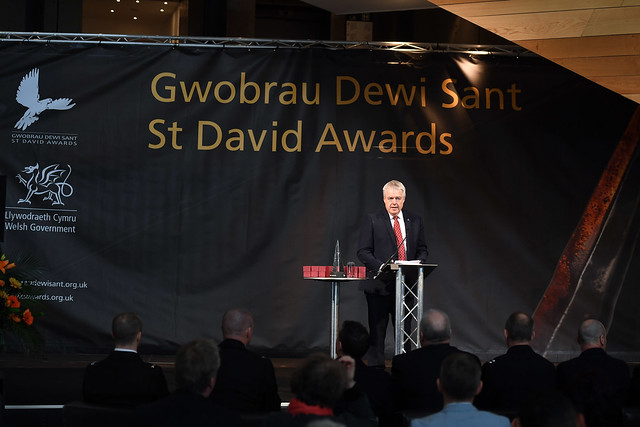
Teilyngwyr Gwobrau Dewi Sant 2017 St David Award Finalists

Proto-Celtic *uɸo-kʷrinati = reward (?)
Old Irish (Goídelc) fochraic [ˈfoxriɡʲ] = reward, recompense
terḟochraic, terfhochraic = buying, payment, reward
crenaid = to buy, sell
Middle Irish (Gaoidhleag) fochraic, fochricc = reward, recompense, payment, fee, hire, rent, compensation
fochrach = a hireling, mercenary
fochricnet = a little reward
terḟochraic, terochraic, turfhochraic = reward, recompense, price, payment, present or payment made by a bridegroom to a bride or her relations
Irish (Gaeilge) fochraig = reward, stipend, fee
Middle Welsh (Kymraec) gwobr, gwobyr = reward, prize
gwobr-wŷr = rewarder, giver or taker of bribes, briber
gober, gobruy, gobrwy, gobyr = reward, payment, fee,
Welsh (Cymraeg) gwobr/gwobrwy [ˈɡwɔbr] =reward, prize, desert, recompense, benefit, gift, tip, fee, hire, bribe
gwobrwy = fee, fine
gwobraf, gwobri, gwobru, gwobro = to reward, recompense, compensate, bribe, corrupt
gwobrwr = rewarder, giver or taker of bribes, briber
gwobrwyad = a rewarding, remuneration, bribery
gwobrwyaf, gwobrwyo = to award a prize, reward, recompense, acknowledge
gobr/gobrwy = reward, payment, fee, wages, recompense, gift, merit, desert, bribe
Middle Cornish (Cernewec) gober, gobar, gobyr = recompense, reward, fee, wagews, stipend, hire
goberna = to hire
Cornish (Kernewek) gober = earnings, income, pay, remuneration, reward, salary, wage
gober dilavur/diweythieth = unemployment benefit
gober ispoyntel = minimum wage
gober kleves = sick pay
gober omdednans = pension
gobra = to remunerate, reward
gobrena = to rent
gobrener, gorenores = tenant
Middle Breton (Brezonec) gopr, gobr = wage, salary
gopra = to bet, wager
gopraer, gopraër = mercenary, tenant, lodger
gopraff, gôbret = to put on payroll, give a salary, remunerate
Breton (Brezhoneg) gopr = salary, wages, pay, fee
gopra = to bet, wager, pay, hire
goprad = salary
gopradenn = recompense
goprañ = to put on payroll, give a salary, remunerate

Etymology: from Proto-Celtic from *uɸo (under) and *kʷrināti (to buy) [source]. Some words for to buy in Celtic languages come from the Proto-Celtic root *kʷrināti (to buy)

Proto-Celtic *dānus / *dānus = gift
Gaulish Danomaros = personal name
Old Irish (Goídelc) dán [daːn] = art, gift, poem, skill
Middle Irish (Gaoidhleag) dán = gift, bestowal, endowment, present, skill, poem, song, verse, rhyme
Irish (Gaeilge) dán [d̪ˠɑ̃ːn̪ˠ/d̪ˠaːn̪ˠ] = gift, offering, craft, calling, art, faculty, art of poetry, poem, lot, fate
dánaigh = to give, bestow
dánlann = art gallery
Scottish Gaelic (Gàidhlig) dàn [daːn] = poem, song, work, effort
dàn-mòr = epic poem
dàn-molaidh = eulogy
dàn-liriceach = lyric
dàn-fhacal = epigram
dànach = poetic, metric
dànachd = poetry
Manx (Gaelg) daan = poem
daan mooar = epic
daan moyllee = hymn
Proto-Brythonic *dọn = gift, blessing
Middle Welsh (Kymraec) daun, davn, dawn = gift, talent
dawnget, dawnged = gift, benefit, favour
dawngoeth, down-goeth = finely gifted or endowed
dawnha = to endow with a gift or benefit, to bless
donnwy, donyer, donya = to endow, bless, give, present
donyauc, donyawc, doniog = gifted, endowed, talented
Welsh (Cymraeg) dawn [dau̯n] = faculty, intellectual gift, talent, genius, humour, wit, grace, benefit, blessing, favour, reward, present, donation
dawnaf, dawno = to fare, get on
dawnaidd = gifted, endowed with or showing ability
dawnedigaeth = gift, a giving or conferring, endowment, grace
dawnged = gift, benefit, favour
dawngoeth = finely gifted or endowed
dawnhaf, dawnhau = to endow with a gift or benefit, to bless
doniaf, donio = to endow, bless, give, present
doniog = gifted, endowed, talented, bountiful, liberal, fortunate, advantageous
doniol = gifted, talented, endowed, eloquent
Middle Breton (Brezonec) donaison, donaeson, donaezon = gift, talent, donation
donaesonaff = to donate
donaesonner, donaesoner = donor
Breton (Brezhoneg) donezon = gift, talent, donation
donezoner = donor
donezoniñ = to donate, present, reward, gratify

Etymology: from Proto-Indo-European *déh₃nom (gift), from *deh₃- (to give) [source].

Words from the same PIE roots include date, donate, dose and vend in English, don (gift, talent, knack) in French, dom (talent) in Portuguese, and don (gift, present, talent, knack) in Spanish [source].

Old Irish (Goídelc) dúas = reward, gift
Middle Irish (Gaoidhleag) dúas, dúáis, duais = gift, reward (esp. a recompense give to poets)
dúasach = reward- or gift-bestowing, munificent, gift-bestower, rewarder
dúasad = act of benefiting, rewarding
frithdúas = a counter-reward, the payment made to the receiter
Irish (Gaeilge) duais = gift, reward, prize, stake, prize, prize-winning
duaisbhanna = prize-bond
duaiseach = bountiful, generous
duaiseoir = prizewinner
Scottish Gaelic (Gàidhlig) duais [duəʃ] = prize, bonus, reward, purse (in sports)
duais-bhrathaidh = bribe (reward for betrayal)
duais-roinn = dividend
duais-earrainn = dividend
duais-airgid = (monetary) prize
duais-barrachd = premium
duaiseachadh [duəʃəxəɣ] = awarding, gratifying, gratification
duaismhor duəʃ(v)ər] = liberal, bountiful

Etymology: possibly from Proto-Indo-European *deh₃- (to give) [source].

Unlimited Web Hosting - Kualo

Sources: Wiktionary, Am Faclair Beag, Online Manx Dictionary, Teanglann.ie, eDIL – Electronic Dictionary of the Irish Language, In Dúil Bélrai English – Old Irish glossary, Geiriadur Prifysgol Cymru, Gerlyver Kernewek, Gerlyvyr Cernewec, Lexicon Cornu-britannicum: A Dictionary of the Ancient Celtic Language of Cornwall, Dictionaire Favereau, TermOfis, Le dictionnaire diachronique du breton, Geriafurch, English – ProtoCeltic WordList (PDF), Etymological Dictionary Of Proto Celtic

Impeccable Peccadillos

Words for sin, fault, crime and related things in Celtic languages.

Somebody looks guilty.

Words marked with a * are reconstructions.

Proto-Celtic *kariyā = mistake, sin
Old Irish (Goídelc) caire [ˈkarʲe] = crime, fault, sin
Middle Irish (Gaoidhleag) caire, cair, coire = crime, fault, sin
cairech = criminal, guilty, sinful
cairigid = rebukes, accuses, blames
cairthech = criminal, guilty
Irish (Gaeilge) coir [kɛɾʲ/kɪɾʲ] = crime, offence; fault, transgression
coireach = offender, transgressor; wicked, sinful, guilty
coireacht = wickedness, guiltiness
coiriú = censure
coireolaí = criminologist
coiritheoir = accuser, incriminator
Scottish Gaelic (Gàidhlig) coire [kɔrʲə] = blame, fault, offence, wrong
coireach [kɤrʲəx] = culprit; guilty, to blame, faulty, responsible
coireachd [kɔrʲəxg] = culpability
Proto-Brythonic *kareð [kaˈrɛːð] = mistake, sin
Old Welsh cared = transgression, sin, crime
Middle Welsh (Kymraec) cared, karet = transgression, sin, crime
karedus = sinful, evil
Welsh (Cymraeg) caredd [ˈkarɛð] = transgression, sin, crime, lust, love
careddus = sinful, evil
careddwr = accuser, evil-doer
Middle Cornish (Cernewec) cara = to correct, chastise
Middle Breton (Brezonec) carez, garé = blame, reprimand
carez = to blame, accuse
Breton (Brezhoneg) karez = blame, incrimination
kareziñ = to blame, accuse

Etymology: from Proto-Indo-European *kh₂er- (blame, abuse). Words from the same PIE root include cārinō (I revile, blame, insult) in Latin, корить [kɐˈrʲitʲ] (to reproach, upbraid) in Russian, and коря [koˈrʲɤ̟] (to accuse, blame) in Bulgarian [source].

Old Irish (Goídelc) peccad = sin
pecthaigid = to sin
Middle Irish (Gaoidhleag) pec(c)ad = sin
pecthach = sinful, committing sin, sinner
pecthaigid, pec(c)aigid = sins. commits sin
Irish (Gaeilge) peaca [ˈpʲakə/ˈpʲaku] = sin
peacadh = offender, transgressor; wicked, sinful, guilty
peacach = sinner, sinful
peacaigh = to sin
peacúil = sinful
peacúlacht = sinfulness
Scottish Gaelic (Gàidhlig) peaca [pɛxgə] = sin
peacadh, peacachadh [pɛxgəxəɣ] = sinning, sin, transgressing
peacail [pɛxgal] = sinful
peacach [pɛxgəx] = sinner
Manx (Gaelg) peccah = human being, sinner, sin, wickedness
peccagh = human, person, transgressor, sinner
peccoil = erring, sinful, unregenerate
Proto-Brythonic *pexọd [peˈxɔːd] = sin
*pexadʉr = sinner
*pexad [peˈxɔːd] = to sin, offend
Middle Welsh (Kymraec) pechawt = sin
pechadur = sinner
pechu =to sin, offend
Welsh (Cymraeg) pechod [ˈpɛχɔd/ˈpeːχɔd] = sin
pechadur [pɛˈχadɨ̞r/pɛˈχaːdɪr] = sinner, offender
pechu [ˈpɛχɨ/ˈpeːχi] =to sin, offend
Middle Cornish (Cernewec) pech, pêch, pechad, pechas = sin, offence, transgression
pecha, peché = to sin, transgress, offend
pechadur, pechadures = sinner, transgressor
Cornish (Kernewek) pegh = guilt, sin
pegha = to sin, offend
peghador, peghadores = sinner
peghes = sin
peghus = sinful
Middle Breton (Brezonec) pechet = blame
pechiff =to sin, offend
pechezr = sinner
Breton (Brezhoneg) pec’hed = sin
pec’hiñ = to sin, offend
pec’her = sinner

Etymology: from Latin peccātum (sin), from peccō (I sin, offend), from Proto-Italic *petkāō (I sin), from Proto-Indo-European verbal root *ped- (“to walk, fall, stumble”) [source].

Words from the same roots include peccadillo, impeccable, foot, pedal, pedestrian, and pew in English, pécher (to sin) in French, pecar (to sin) in Spanish [source].

Unlimited Web Hosting - Kualo

Sources: Wiktionary, Am Faclair Beag, Online Manx Dictionary, Teanglann.ie, eDIL – Electronic Dictionary of the Irish Language, In Dúil Bélrai English – Old Irish glossary, Geiriadur Prifysgol Cymru, Gerlyver Kernewek, Gerlyvyr Cernewec, Lexicon Cornu-britannicum: A Dictionary of the Ancient Celtic Language of Cornwall, Dictionaire Favereau, TermOfis, Le dictionnaire diachronique du breton, Geriafurch, English – ProtoCeltic WordList (PDF), Etymological Dictionary Of Proto Celtic

Down Under

Words for down, below, under and related things in Celtic languages.

Spiral staircase in Conwy / Grisiau troellog yng Nghonwy

Proto-Celtic *ɸīssu = under
Old Irish (Goídelc) ís = below
sís = down, downwards, northwards
anís = below, from below
tís = below
Middle Irish (Gaoidhealg) ís = below, under
sís, sis = down, downwards, northwards, below, onwards, throughout, onwards
sísana, siosina, sisana = here below, below
anís, = (from) below, beneath
tís = below, in the north
Irish (Gaeilge) síos [ʃiːsˠ] = down (away from the speaker), to lower place or station, hanging down, drooping, trailing, to the north, to a lesser centre or remote district, following
síos suas = upside down, topsyturvy
aníos = up (from below), from the north
thíos = down, in a lower place, in the north, below, farther on in a book, written down, entered (in a ledger, etc), on the fire
thíosluaite = undermentioned
thíos-sínithe = undersigned
Scottish Gaelic (Gàidhlig) sìos [ʃiəs] = down (away from the speaker), downwards, below
shìos [hiəs] = down, below
a-nìos [əˈn̪ʲiəs] = up, upwards (towards from the speaker)
a-sìos [əˈʃiəs] = down, downwards
sìos ‘nad inntinn = depressed
a’ dol sìos = going down, experiencing a downturn, charging (in battle)
cuir sìos = to put/lay/set down
is mar sin sìos = and so on
Manx (Gaelg) sheese = below, down, downward(s)
brishey sheese = to analyse, analysis, break down, rend
sheese lesh = down the hatch, down with
soie sheese = to settle, sit down
heese = beneath, down, downhill, hereafter, lower end, under, knock-down (prices)
neese = from below up, upwards
Old Welsh is = under, underneath, beneath, below, lower than
Middle Welsh (Kymraec) is, iss = under, underneath, beneath, below, lower than
iss-hau, isheir = to sink, sink down or lower
issot, isod = under, underneath, below, beneath
Welsh (Cymraeg) is = under, underneath, beneath, below, lower than; before; lower, inferior, poorer
isâf, isáu = to come/go lower, to reduce in rank, lower the pride of, debase, degrade, humble, humiliate
isafaf, isafu = to minimize, reduce, lower
isafiad = (one’s) inferior
isod = under, underneath, below, beneath, on earth, lower down, later, further
Middle Cornish (CerneweC) isa = lowest
isot = downwards
Cornish (Kernewek) a-is = below, lower
Old Breton isel = low
Middle Breton (Brezonec) is = lower, below
Breton (Brezhoneg) is = lower, below
isdouarel = underground

Etymology: from Proto-Indo-European pedsú, from *pṓds (foot), from *ped- (to walk, step) [source]. Words from the same roots include íseal (low) in Irish, ìosal (low, humble) in Scottish Gaelic, isel (low) in Welsh and related words for low in other Celtic languages, Fuß (foot) in German and pie (foot) in Spanish [more details].

Proto-Celtic *uɸo/*ufo- = under
Old Irish (Goídelc) fo = beneath, through, throughout, towards, under
fo bésad = after the manner of, like
fo bíthin = because (of)
fo chétóir = at once, immediately
Middle Irish (Gaoidhealg) fo, fa, fá = under, underneath, into, through, about, around
Irish (Gaeilge) faoi [fˠiː] = beneath, below, bearing, supporting, about, round, against
faoi cheann = by, at, the end of
faoi adhall = in heat
faoi bhaile = at home, around
faoi bhun = beneath
Scottish Gaelic (Gàidhlig) fo [fɔ] = under, underneath, below, beneath, subordinate
fo-dhearg = infrared
fo-inntinn = subconscious
fo-ros = undergrowth
fo chleòca = under cover, in secret
Manx (Gaelg) fo = below, beneath, under, sunken, dependent, underlaying, subsidiary, junior, assistant
fo aggle = aghast, alarmed, awestricken
fo arrey = under surveillance
fo chiuney = beclamed
fo druaight = charmed
fo-heer-vooar = subcontinent
Old Welsh guo, gu =under, rather, somewhat
Middle Welsh (Kymraec) gwo, gwa, go = under, rather, somewhat
goaruoel = rather bald, baldish
Welsh (Cymraeg) go = under, rather, somewhat, slightly, partly, small, exceeding
go agos = near, almost
go dde = right, dexterous
go lew = pretty fair, middling
go is = beneath
goarfoel = rather bald, baldish
Middle Cornish (CerneweC) go = rather
Middle Breton (Brezonec) gou, gu, go, fo, uo = under
Breton (Brezhoneg) gwa-, gou- = under, sub-

Etymology: from Proto-Indo-European *upo (under, below). Words for high in Celtic languages come from the same root, as does sub(marine) in English, sumo (highest, greatest) in Spanish and summo (hightest, greatest, great) [source].

Proto-Celtic *tanā = (point in) time
Old Irish (Goídelc) tan = when, time
Middle Irish (Gaoidhealg) tan, tain = time, while, point of time, when, whenever, until, before
Irish (Gaeilge) tan [tan] = time, occasion, once upon a time, once
(an) tan = at the time that, when, whenever, since
Scottish Gaelic (Gàidhlig) tàn [taːn] =time, season
an tàn = when, at the time
Proto-Brythonic *tan =under
Middle Welsh (Kymraec) dan, tan = under, below, beneath
Welsh (Cymraeg) tan [tan] = until, under, while
dan = under, below, beneath, underneath, on the inside, less than, until, while, because, since
o dan = under
tan lw = under oath
dan yr awyr, tan awyr = under the sky, in the open air
dan ddaear = underground
dan din = sneaky, deceitful, stealthy, secret, illicit
dan y don = under water
dan draed = underfoot, in the way
Middle Cornish (Cernewec) tan = under, beneath, below
(yn) dan = under, beneath
danva = a hiding place, concealment
Cornish (Kernewek) yn-dann = below, beneath, under, underneath
yn-dann alhwedh = under lockdown
yn-dann dava = in touch
yn-dann dhor = underground
yn-dann dhowr = underwater
yn-dann gel = in secret, secretly
yn-dann hatt = confidential
yn-dann with = care of (c/o)
Old Breton tan, dan = under
Middle Breton (Brezonec) dan = bottom, back, under, underneath
Breton (Brezhoneg) dan = basement, subsoil
dindan = under, on, sub-
dindan-douar = underground, secret
dindan-vor = underwater

Etymology: from Proto-Indo-European *tn̥néh₂ (a stretch), from *ten- (to stretch). Words from the same root include contain, tenant, tone and tune in English [source].

Words marked with a * are reconstructions.

Sources: Wiktionary, Am Faclair Beag, Online Manx Dictionary, Teanglann.ie, eDIL – Electronic Dictionary of the Irish Language, In Dúil Bélrai English – Old Irish glossary, Geiriadur Prifysgol Cymru, Gerlyver Kernewek, Dictionaire Favereau, TermOfis, English – ProtoCeltic WordList (PDF), Etymological Dictionary Of Proto Celtic

Blubrry podcast hosting

Take Note!

Words for note, mark and related things in Celtic languages.

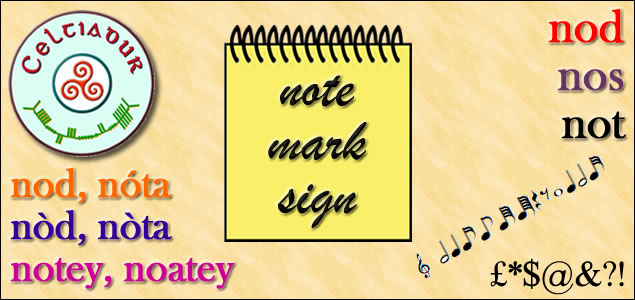
note, mark, sign

Words marked with a * are reconstructions.

Old Irish (Goídelc) not = contraction, mark, sign
Middle Irish (Gaoidhealg) not, nod = mark, sign, sign of contraction in writing, note, bear in mind
nodmar = significant
Irish (Gaeilge) nod [n̪ˠɔd̪ˠ/n̪ˠʌd̪ˠ] = scribal contraction, abbreviation, hint
nodaire = professional scribe
nodaireacht = notation, profession of scribe
nóta = (musical) note, brief record, annotation, short letter
nótáil = to note (down)
nótáilte = notable
nótaire = notary
Scottish Gaelic (Gàidhlig) nòd(h) = note
nòta = (written) note
nòtachadh = annotation
nòtaire = notary
dubh-not = crotchet, quarter note
geal-not = minim, half note
cruinn-not = semibreve, whole note
bun-nòta = footnote
nòta-deiridh = endnote
Manx (Gaelg) notey = note
noatey = banknote
Proto-Brythonic *nod = mark, brand
Middle Welsh (Kymraec) nod, not, nôd = target, goal, aim, etc
nottwy, nodi, notto = to mark, brand, seal, note, record
nodidog = excellent, splendid, notable
Welsh (Cymraeg) nod [noːd] = target, goal, aim, fame, renown, notoriety, mark sign, symbol, note, banknote, verse (in Bible)
nodach = short notes, jottings, odds and ends, trifles
nodadwy = noteworthy, notable, remarkable
nod(i)af, nodi(o) = to mark, brand, seal, note, record
nod(i)edig = noted, marked, appointed, set, specified
nodidog = excellent, splendid, notable
nodyn [ˈnɔdɨ̞n/ˈnoːdɪn] = target, aim, mark, token, note
atalnod = punctuation mark, comma
collnod = apostrophe ’
cysylltnod = hyphen –
dyfynnod = ‘quotation mark’
ebychnod = exclamation mark!, sign of aspiration (h)
hirnod = cîrcûmflêx
hynod = remarkable, notable
Middle Cornish (Cernewec) nôd, nos = mark, token
notye = to note, observe, denote
Cornish (Kernewek) nos = mark, token
nos devyn = quotation mark
nos -junya = hyphen
nosedhek = notable
nosya = to notate
nosyans = notation
noten = note
notenna = to notate (music)
notennans = notation
notennyans = annotation
noter, notores = notary, solicitor
notya = to note
notyans = memo
notyes, notys = notable
Old Breton not = note
Middle Breton (Brezonec) not = note, mention
notabl, notapl = notable
notadur = notation, (religious) censure
Breton (Brezhoneg) notenn = note
not = note
notañ, notiñ = to note
notapl = notable
notadur = notation

Etymology: from Latin nota (mark, sign, note), which is of unknown origin. Words from the same Latin root include note in English, note (note, mark, grade, bill) in French, Note (note, grade, mark) in German, and nota (note, memo, mark) in Spanish [source].

Words marked with a * are reconstructions.

sources: Wiktionary, Am Faclair Beag, Online Manx Dictionary, Teanglann.ie, eDIL – Electronic Dictionary of the Irish Language, In Dúil Bélrai English – Old Irish glossary, Geiriadur Prifysgol Cymru, Gerlyver Kernewek, Dictionaire Favereau, TermOfis, English – ProtoCeltic WordList (PDF), Etymological Dictionary Of Proto Celtic

Unlimited Web Hosting - Kualo

Ceilidh Companions

Words for companion, friend, ceilidh and related things in Celtic languages.

Cèilidh at Sabhal Mòr Ostaig
Ceilidh at Sabhal Mòr Ostaig in the Isle of Skye / Cèilidh aig Sabhal Mòr Ostaig san Eilean Sgitheanach

Words marked with a * are reconstructions.

Proto-Celtic *kēlyos = companion, servant
Primitive Irish ᚉᚓᚂᚔ (celi) = follower, devotee (genitive)
Old Irish (Goídelc) céile [ˈkʲeːlʲe] = client, companion, husband, liege, servant, spouse, subject, vassal
céilide [ˈkʲeːlʲiðʲe] = visit, visiting
coicéile = companion, comrade, friend, friendship
Middle Irish (Gaoidhealg) céile, ceile, céli = servant, bondsman, vassal, subject, fellow, companion, husband
céileachas = adultery
céilide = visit, act of visiting
coicéile, cocéle, coceli = vassal, bondsman, companion, fellow, friend
coicéilsine, cocéilsine, cocélsine = fellowship, clientship
Irish (Gaeilge) céile [ˈceːlʲə] = companion, spouse
céileachas = companionship, cohabitation, copulation
céilí = friend call, visit, social evening, Irish dancing session
céilíoch = person fond of social visits, sociable person
céilíocht = sociableness, companionableness
céiliúil = companionable
coigéile = mate, companion
coigéilsine = fellowship, companionship
Scottish Gaelic (Gàidhlig) cèile [kʲeːlə] = fellow, partner, significant other, spouse, counterpart
cèile-còmhraige = opponent, antagonist
cèile-pòsta = married partner (husband or wife)
cèileach [kʲeːləx] = entertaining
cèileachadh [kʲeːləxəɣ] = participating/sharing in, twinning, partnering (of a city)
cèiliche [kʲeːlɪçə] = visitor
cèilidh [kʲeːlɪ] = ceilidh, visit, (act of) visiting
cèilidheach [kʲeːlɪjəx] = companionable, fond of company, sociable
Manx (Gaelg) keilley = match
dy cheilley = joined, together
e cheilley = fellow
ry-cheilley = en masse, together, with each other
kaylee = ceilidh
Proto-Brythonic *kuɨlð = servant, companion
Middle Welsh (Kymraec) cilit, cilid, kilid, kilyd = servant, companion
Welsh (Cymraeg) cilydd [ˈkɪlɨ̞ð/ˈkiːlɪð] = fellow, companion, neighbour, enemy, other
cilyddol = reciprocal, mutual
at ei gilydd = together
gyda’i gilydd = together
ei gilydd = each other
o bryd i’w gilydd = from time to time
Middle Cornish (Cernewec) cele = companion, fellow, one of two
Cornish (Kernewek) kila = companion
Old Breton kiled = friend
Middle Breton (Brezonec) kile = the other (one), friend
Breton (Brezhoneg) kile = associate, stooge, colleague, sidekick

Etymology: possibly the Proto-Celtic word originally meant ‘wayfarer’, from Proto-Indo-European *ḱey- (to settle, to be lying down) [source].

The English word ceilidh [ˈkeɪli] (an informal social gathering where traditional Irish or Scottish folk music is played, with dancing and storytelling; a ceilidh dance; to dance a ceilidh) was borrowed from Scottish Gaelic and/or from Irish [source]. Someone who attends a ceilidh is apparently a ceilidher [source].

The Welsh equivalent of a ceilidh is a twmpath, which also meanings hillock, knoll, mound, pile, gathering or assembly. It’s also a known as a twmpath dawns (folk-dance, barn dance, public dance) or noson lawen (“merry/joyful evening”). In Cornish a ceilidh is a troyll, which also means spiral or swirl, and in Breton they are known as fest-noz (“night party / ”) [source].

Proto-Celtic *karants = friend
*karantodyos = friendly
Gaulish Caranto-, Carantōna = personal names
*Carantodios = personal name
Old Irish (Goídelc) cara [ˈkarɘ] = friend, relation, relative, kinsman
cairdes = friendship, alliance, pact
cairdine = friendship, alliance
caratad = friendship, alliance
caraid = to love
Middle Irish (Gaoidhealg) cara, carae [ˈkarə] = friend
cairdide = friendly
caratrad = friendship, alliance
cairdech, cairdeac, cairdeach = friendly, having many friends
cairdes, cardes, cairdius = friendship, alliance, covenant, pact, relationship, kinship
cairdemail [ˈkɑːɾˠdʲuːlʲ] = friendly
caraid, carad = to love
caratrad, caratrid = friendship, alliane
Irish (Gaeilge) cara [ˈkɑɾˠə / ˈkaɾˠə] = friend, relative
anamchara = spiritual adviser, confidant, kindred spirit, soulmate
cairdeach [ˈkɑːrdʲəx] = generous, friendly
cairdeas = friendship
cairdine = friendship, pact, truce
cairdiúil [ˈkɑːɾˠdʲuːlʲ] = friendly
cairdiúlacht = friendliness
Scottish Gaelic (Gàidhlig) caraid [karɪdʲ] = friend, relation, kinsman, Quaker
càirde [kaːr̪dʲə] = friendship, entente
càirdeas [kaːr̪dʲəs] = kinship, friendship, friendliness
càirdeach [kaːr̪dʲəx] = kin, related, friendly
Manx (Gaelg) carrey = friend, well-wisher
caardys, caarjys = friendship, kin(ship), pedigree, blood relationship, allied to
caarjoil = amiable, friendly, friendliness
caarjysagh = friendly
caarjysaght = friendliness
Proto-Brythonic *kar [kar] = friend, relative
Middle Welsh (Kymraec) kar, kereint, kerenhit, car, karant = kinsman, relative, cousin, friend, companion, dear one
keredic, keradwy, karatwy = loveable, amiable, dear, beloved
caru, karu, kary = to love, woo, court
carannawc = dear, beloved
kerenhit, kerennyd, carennydd = kindred, kinship, relationship, descent, affinity, friendship, love
Welsh (Cymraeg) câr [kaːr] = kinsman, relative, cousin, friend, companion, dear one
carad = loved
caradwy, ceradwy = loveable, amiable, dear, beloved
caru = to love, woo, court
carennydd = kindred, kinship, relationship, descent, affinity, friendship, love
Old Cornish car = friend, ally, a dear neighbour, kinsman, cousin
Middle Cornish (Cernewec) car, câr, = friend, ally, a dear neighbour, kinsman, cousin, father
caradow = beloved, loving, dear
care = to love
carense, cerense = love, friendship
Cornish (Kernewek) kar = parent, relation, relative
kara = to care for, like, love
kardewder = loving-kindness
karadow = beloved, fond, loveable, loving
karder = loveliness, splender
karer = boyfriend, lover
kares = girlfriend, relation, relative, mistress (lover)
Old Breton (Brethonoc) car = agreeable, dear
Middle Breton (Brezonec) car = friend, relative
carantez = love
caret = to love, cherish, desire
Breton (Brezhoneg) kar [ˈkɑːr] = relative, friend
karadegezh = kindness
karadek [kaˈrɑːdek] = kind, nice, amiable
karantegezh = affection, love
karantek [kaˈrãntek] = affectionate, pleasant
karantez [kaˈrãn.tɛs] = love
karedig [kaˈreːdik] = lover, loving
karout [ ˈkɑː.rut] = to love, cherish, desire
karet [ˈkɑː.ret] = favourite, beloved

Etymology: from Proto-Celtic *karāti (to love, desire), from *karos (dear, beloved), from Proto-Indo-European *kh₂-ró-s, from *keh₂- (to desire) &‎ *-rós (adjectival suffix) [source]. Words from the same PIE roots include charity, cheer, and cherish in English, caro (dear, precious, expensive) in Italian, cher (dear(ly), expensive) in French, caro (dear, expensive) in Spanish, kär (in love, enamored, dear, beloved) in Swedish, and kær (dear, adorable, cute) in Danish [source].

Irish (Gaeilge) comhar [kõːɾˠ] = combined work, mutual assistance, co-operation, partnership
Scottish Gaelic (Gàidhlig) coimheart [kɔ̃jəRʃd] = companion
Manx (Gaelg) commeeys = communion, connection, league, mess, participation, partnership, relations (between people)
Proto-Brythonic *kumpar = peer, fellow, spouse, partner, companion
Middle Welsh (Kymraec) kymar = peer, fellow, spouse, partner, companion
Welsh (Cymraeg) cymar [ˈkəmar] = equal, peer, companion, mate, fellow, spouse, consort
cymar bywyd = life partner
cymhares = female partner, wife, mate, companion, equal
cymharus = well matched, well paired, corresponding, matching, appropriate, fitting
cymheiriaeth = a coupling together, partnership
Middle Cornish (Cernewec) cespar = spouse, married person, mate
Cornish (Kernewek) kespar / kespares = partner
kesplegadow = compatible

Etymology (Brythonic words): from Latin compār (fellow, partner, equal [person], spouse), from con- (used to indicate being or bringing together), from cum (with), and pār (even, equal, like; companion, comrade, mate, spouse) [source]. The Goidelic words may come from different roots.

Words from the same roots include compare, pair, par (equal value) and peer in English, paar (pair, couple, some) in Dutch, and péire (pair) in Irish [source].

Proto-Brythonic *ko-u̯ekt- = companion, comrade, friend (?)
*ko-u̯ektii̯ŏ- = company, band or gathering of companions, troop, host, retinue
Old Welsh (Kembraec) coueidid = company, band or gathering of companions, troop, host, retinue
Middle Welsh (Kymraec) kyueith, kyweith = companion, comrade, friend
kiueithad = society, company, partnership
kyweithaed = gathering, company
kyweythas, kyweithas, keuey[th]as = soceity, company, fellowship, companionship
kweithasgar = sociable, gentle, kind(ly), gracious
kyweithit, ky()eithyd, kyweithyd = company, band or gathering of companions, troop, host, retinue
Welsh (Cymraeg) cywaith = companion, comrade, friend; association, harmony
cyweithad = society, company, partnership
cyweithäed = gathering, company
cyweithas = soceity, company, fellowship, companionship, alliance, commerce; sociable, gentle, kindly
cyweithasu = to associate, civilze, treat with courtesy
cyweithasgar = sociable, gentle, kind(ly), gracious
cyweith(i)asol = social, kind, gentle courteous
cyweithydd = company, band or gathering of companions, troop, host, retinue
Middle Cornish (Cernewec) coweth, cowyth = companion, fellow, mate, comrade
cowethas = company, society
cowethe = company, sociery
cowethes = female companion, help-mate
cowetheyans = communion, fellowship
cowethys = acquainted
Cornish (Kernewek) koweth / kowethes = companion, comrade, friend, mate, peer
kowethas = association, society
kowethasek = social
kowethegeth = friendship
kowethek = friendly
kowethus = gregarious
kowethyades, kowethyas = colleague
kowethyadow = socialable
kowethyans = company, organisation

Etymology: from Proto-Brythonic *ko- (together, equal, similar) u̯ekt- (to move, go) [source].

The Fastest Way to Learn Japanese Guaranteed with JapanesePod101.com

Sources: Wiktionary, Etymological Dictionary Of Proto Celtic, In Dúil Bélrai English – Old Irish glossary, eDIL – Electronic Dictionary of the Irish Language, Teanglann.ie, Am Faclair Beag, An etymological dictionary of the Gaelic language, Fockleyreen: Manx – English Dictionary, Online Manx Dictionary, Gaelg Corpus, Geiriadur Prifysgol Cymru, Lexicon cornu-britannicum : a dictionary of the ancient Celtic language of Cornwall, Gerlyver Kernewek, Devri : Le dictionaire diachronique du breton, Geriafurch, TermOfis



Blindness

Words for blind, one-eyed and related words in Celtic languages.

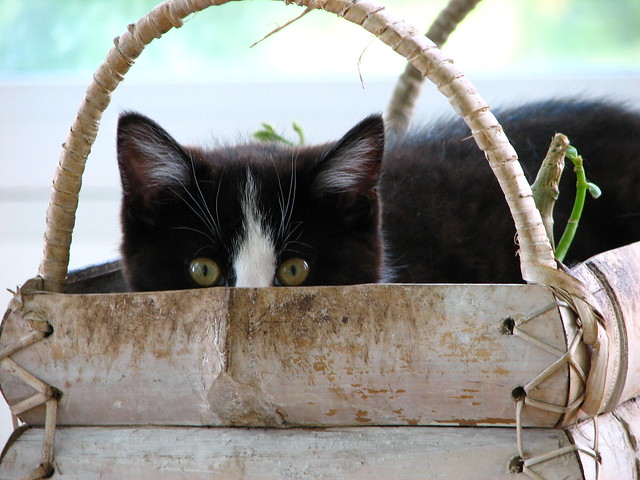
One-eyed squirrel

Proto-Celtic *dallos = blind
Old Irish (Goídelc) dall = blind
Middle Irish (Gaoidhealg) dall, dáll, = blind, dark, gloomy,
daillín = blind man
dalla(id) = to blind, deprive of sight, darken, obscure
dallóc = a little blind animal, mole, leech
Irish (Gaeilge) dall [d̪ˠaul̪ˠ/d̪ˠɑːl̪ˠ/d̪ˠɑl̪ˠ] = blind person, dull, uninformed person, dimness, gloom, obscurity, to blind, dazzle, daze, stupefy
dallacán = purblind person, dim-witted person, fool, mask
dallacántacht = purblindness, dim-wittedness
dallachar = dazzle
dalladh = blinding, dazzlement, plenty, lashings
dallaigeanta = dull-witted
dallamlán = stupid fool, dolt
Scottish Gaelic (Gàidhlig) dall [daul̪ˠ] = blind, obscure, blind person
dallaran = blind person
dalladh [dal̪ˠəɣ] = blinding, misleading
dall-bhrat = blindfold
dallanach = dark, gloomy, inebriated
dallta = blinded, deceived, mislead
Manx (Gaelg) doal = blind, sightless, unseeing
dallaghey = to befog, blind, daze, dazzle, glare
doallaghey, doalley, doallee = blind, blinding
Proto-Brythonic *dall [ˈdal͈] = blind
Middle Welsh (Kymraec) dall, dâll = blind, unseeing, dark, random
dallaf = to blind, dazzle, deceive, darken
dallineb, dallinep = blindness, folly, recklessness
Welsh (Cymraeg) dall [da(ː)ɬ] = blind, unseeing, dark, random, purblind, ignorant, rash, thoughtless, mistaken, blind person
dallaf, dallu = to blind, dazzle, deceive, darken
dallaidd = blindness, purblind
dallan = blind person
dalledig = blinded, darkened
dallineb = blindness, folly, recklessness
Old Cornish dal = blind
Middle Cornish (Cernewec) dall = blind
dalla = to (make) blind
Cornish (Kernewek) dall = blind
dalla = to blind
dallhe = to blind, dazzle
Middle Breton (Brezonec) dall, dal = blind, blunt, blinkered
dallaff, dallañ, dalliñ = to gouge out sb’s eyes, to blind, to fill a hole, to blunt, crumble
dallente, dallentez, dallezh = blindness
dallet = blinded
Breton (Brezhoneg) dall [ˈdalː] = blind, blunt, blinkered, dead end
dallentez, dallezh = blindness

Etymology: from PIE *dʰwl̥no-, from *dʰwolno (to dim, make obscure) [source].

Words from the same roots include dull and dwell in English, toll (great, nice, wonderful) in German, dol (crazy, silly, mad, mindless, irate) in Dutch, and dulls (crazy, mad) in Latvian.

Proto-Celtic *kaikos/*kayko- = one-eyed, blind
Old Irish (Goídelc) cáech [kaːi̯x] = blind in one eye, empty
cáechaid = to blind
cáechán = one-eyed person, blind creature
Middle Irish (Gaoidhealg) cáech = blind in one eye, empty
cáechaid = to blind
cáechán = one-eyed person, dimsighted creature
cáiche = state of being one-eyed, blind in one eye
cáichén = an ignorant person
Irish (Gaeilge) caoch [keːx/kiːx] = blind, purblind person / creature, empty, closed up; to blind, daze, dazzle, close, become blocked, wink
caochadh = to wink, close
caochadóir = purblind creature
caochaíl = purblindness, blockage
caochán = purblind creature, mole
caochóg = purblind person, cubby-hole
Scottish Gaelic (Gàidhlig) caoch [kɯːx] = empty, hollow, blind (creature)
caochag = empty / hollow object, dummy
caochadh [kɯːxəɣ] = blinking, shutting one eye, winking, peeping, ogling
bealach-caoch = cul-de-sac
Manx (Gaelg) kyagh = weak-eyed
kyaght = blindness
kyragh = blind
bollagh kyagh = cul-de-sac
Proto-Brythonic *koɨg = vain, empty, one-eyed, blind (?)
Middle Welsh (Kymraec) coeg, coec, koeg = vain, empty, false, deceitful; blind, one-eyed
koegi to deride, mock, deteriorate; become blind
koec ddall, koegddall = purblind, half-blind, shortsighted, one-eyed, squinting
Welsh (Cymraeg) coeg [koːɨ̯ɡ/kɔi̯ɡ] = vain, empty, false, deceitful, mean, evil, good-for-nothing, arrogant, scornful, sarcastic; blind, one-eyed, squinting
coegaf, coegi = to deride, mock, lampoon, use sarcasm; to be(come) worthless, deteriorate; to become blind, have defective eyesight, darken
coegaidd = vain, empty, haughty, conceited, saucy
coegathrawgar = pedantic
coegathro = pedant
coegbeth = worthless thing, triviality, trifle, bauble
coegddall = purblind, half-blind, shortsighted, one-eyed, squinting
Old Cornish cuic = one-eyed, blind
Middle Cornish (Cernewec) cuic = blind in one eye
Cornish (Kernewek) koog = vain, worthless, barren, infertile

Etymology: from PIE *kéh₂ikos (one-eyed, blind) [source].

Words from the same roots include caecus (blind) and caecum (uncertainity, obscurity) in Latin, cécité (blindness) in French, ciego (blind, blind person, very drunk, caecum) in Spanish, and caecum (a part of the intestine) in English [source].

Incidentally, purblind means partially blind, dim-sighted, dim-witted, unintelligent, and used to mean blind or having one eye [source].

Words marked with a * are reconstructions.

Sources: Wiktionary, Am Faclair Beag, Online Manx Dictionary, Teanglann.ie, eDIL – Electronic Dictionary of the Irish Language, In Dúil Bélrai English – Old Irish glossary, Geiriadur Prifysgol Cymru, Gerlyver Kernewek, Dictionaire Favereau, TermOfis, English – ProtoCeltic WordList (PDF), Etymological Dictionary Of Proto Celtic

Blubrry podcast hosting

Beaks and Snouts

Words for beak, snout and related things in Celtic languages.

Waiting for chip's

Proto-Celtic *gobbos = muzzle, snout, beak
Gaulish *gobbos [ˈɡob.bos] = mouth
Old Irish (Goídelc) gop = beak, snout, muzzle
Middle Irish (Gaoidhealg) gop, guib, guip = muzzle, snout, beak, point/head of a spear, thin-mouthed, sharp-pointed
Irish (Gaeilge) gob [ɡɔbˠ/ɡɞbˠ/ɡʌbˠ] = beak, bill, tip, point, projection
gobach = beaked, long-billed, sharp (expression), pointed, lipped (jug)
gobachán = sharp-featured person, beak-nosed person, sharp-tongued person, inquisitive/interfering person, chatterer, gossip
gobadh = protrusion, shooting, springing, sprouting
gobaí = bird with a long beak, person with pointed features
gobaireacht = picking, pecking, chattering, chatter, gossip
gobán = (small) tip, point, gag, dummy
goblach = beakful, mouthful, morsel, lump, chunk
Scottish Gaelic (Gàidhlig) gob [gob] = beak, bill, gob, pointed/sharp end, corner, spit (of land), point (of a fishing hook)
gobachadh = pecking, rising (wind), poking through
gobad [gobag] = talkative female, little bill, cabin hook
goban = small mouth, small beak
gobaire = chatterbox, chattterer, tell-tale
gobach [gobəx] = beaked, snouty, cheeky, chatty
Manx (Gaelg) gob = apex, headland, hook, jet, jut, nose(piece), point, prominence, promontory, beak, nib, spout, mouth, muzzle, bow (of ship)
gobbagh = beaked, billed, nibbed, prominent, salient
gob-rollian = talkative person

Etymology: from the Proto-Indo-European *ǵebʰ- (jaw, mouth). Words from the same Proto-Celtic root include gober (to swallow hole) and gobelet (goblet, cup, beaker) in French, and gob (a slang word for mouth) and goblet in English, [source].

Proto-Celtic *bekkos = beak, snout
Gaulish *bekkos = beak, snout
Proto-Brythonic *bek = beak, snout
Middle Breton (Brezonec) becq, beeg, bêg, beg = mouth, beak, snout, point, cape, summit
Breton (Brezhoneg) beg = beak, mouth, point, mouthpiece, embouchure
beg-douar = point
beg-hir = dolphin

Etymology: possibly from the Proto-Indo-European *bak- (peg, club) [source].

Words from the same roots, via the Gaulish *bekkos and the Latin beccus (beak, bill), include bec (beak, bill, mouth) in French, beco (beak, mouthpiece, burner) in Italian, bico (beak, bill, snout, rostrum) in Portuguese, pico (beak, sharp point, pickaxe, peak, spout) in Portuguese, bek (beak, snout, mouth) in Dutch, and beak in English [source].

Proto-Celtic *gulbā, *gulbīnos = beak, bill
Gaulish *gulbiā = beak, bill
Old Irish (Goídelc) gulban, gulpan = bird’s beak
Middle Irish (Gaoidhealg) gulba = beak, mouth, jaw
gulban = beak, sting
gulbanda = beaked, piercing
gulbnech = beaked, sharp-beaked
gulbnén = small beak
gulbnide = biting
gulbniugad nibbing, biting
Irish (Gaeilge) gulba = beak, bill, tip, point, projection
guilbneach = (sharp-)beaked, curlew
guilbnéan = little beak
guilbnigh = to peck
Scottish Gaelic (Gàidhlig) gulb [gul̪ˠub] = beak, nose
gulban [gul̪ˠuban] = beak, nose
guilbneach [gulubnəx] = curlew
Proto-Brythonic *gulbino- = beak, snout
Old Welsh (Kembraec) gilb = sharp point, beak, bill, snout
Middle Welsh (Kymraec) gelef, gylyf = sharp point, beak, bill, snout
gilbin, gyluin, gylfin = bird’s beak, snout
gylfinir, gelvinir, gylfinhir = curlew
Welsh (Cymraeg) gylf, glyfyf = sharp point, sharp-pointed instrument, knife, bird’s beak, bird’s bill, snout, nose, grimace
gylfin = bird’s beak, bill, snout, sharp-pointed nose, mouth, lip
gylfinaid = beakful, mouthful
gylfinir = curlew
gylfinog = beaked, rostrated, wild daffodil, narcissus
Old Cornish geluin = beak, bill
Middle Cornish (Cernewec) gelvin = beak, bill
gelvinac, gylvinac = curlew
Cornish (Kernewek) gelvin = beak, bill
gelvinek = curlew
Breton (Brezhoneg) gwlib, glawlib = curlew, whimbrel (?)

Etymology: probably of non-Proto-Indo-European origin. Words from the same root, via Gaulish *gulbiā and the Latin gulbia (piercer, chisel), gulbia (gouge) in Galician, gubia (gouge) in Spanish, gorbia (ferrule) in Italian, and gouge in English and French [source].

Words marked with a * are reconstructions.

Sources: Wiktionary, Am Faclair Beag, Online Manx Dictionary, Teanglann.ie, eDIL – Electronic Dictionary of the Irish Language, In Dúil Bélrai English – Old Irish glossary, Geiriadur Prifysgol Cymru, Gerlyver Kernewek, Dictionaire Favereau, TermOfis, English – ProtoCeltic WordList (PDF), Etymological Dictionary Of Proto Celtic

Blubrry podcast hosting

Thirty

Words for thirty and related things in Celtic languages.

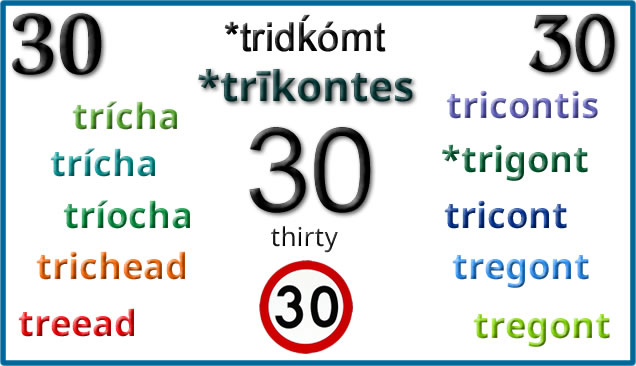
thirty

Proto-Celtic *trīkontes = thirty
Gaulish tricontis = thirty
Old Irish (Goídelc) trícha [ˈtʲrʲiːxo] = thirty
tríchatmad = thirtieth
tríchtaige = thirty day period
Middle Irish (Gaoidhealg) trícha, triúcha, tricha, triocha, tricho = thirty
tríchatmad, trichatmad, trichadmadh = thirtieth
tríchtaige, trichtaigi = period of 30 days/years, etc
tríchtach, tríteach = thirty-fold, consisting of 30
trícha cét = a military force, political or terrirtorial unit; of force of fighting men, cantred, barony (lit. ‘300’)
Irish (Gaeilge) tríocha = thirty
tríochadú = thirtieth
na tríochaidí = the thirties
tríocha céad = large territorial division, barony
Scottish Gaelic (Gàidhlig) trichead [triçəd] = thirty
tritheadamh (30ᵐʰ) = thirtieth (30ᵗʰ)
na tritheadan = the thirties
Manx (Gaelg) treead = thirty
Proto-Brythonic *trigont = thirty
Old Breton tricont, trigont = thirty
Middle Breton (Brezonec) tregont = thirty
tregontad = about thirty
tregontet, tregontvedenn, tregontvet = thirtieth
tregontkementiñ, tregontvedenniñ = to multiply by thirty
tregontvloaziad = a period of 30 years
Breton (Brezhoneg) tregont [ˈtreːɡɔ̃n(t)] = thirty
tregontved = thirtieth
tregontvedenn = thirtieth part
tragontad = around thirty

Etymology: from Proto-Indo-European *tridḱómt (thirty) from *tri- (three) and *déḱm̥ (ten) [source].

Words from the same roots include thirty in English, tridhjetë (thirty) in Albanian, երեսուն [jɛɾɛˈsun] (thirty) in Armenian, trenta (thirty) in Italian and trente (thirty) in French, and words for thirty in other Indo-European languages [source].

Thirty is also trideg (three-ten) in Welsh in the decimal version of the numbers. For other words for thirty, see the post about words for ten, as thirty is 10 on 20 in the vigesimal system.

Sources: Wiktionary, Am Faclair Beag, Online Manx Dictionary, Teanglann.ie, eDIL – Electronic Dictionary of the Irish Language, In Dúil Bélrai English – Old Irish glossary, Geiriadur Prifysgol Cymru, Gerlyver Kernewek, Gerlyvyr Cernewec, Dictionaire Favereau, TermOfis, Le dictionnaire diachronique du breton, Geriafurch, English – ProtoCeltic WordList (PDF), Etymological Dictionary Of Proto Celtic

Short Cuts

Words for short, cut and related things in Celtic languages:

Scout Cardigan Corgi

Proto-Celtic *birros = short
Old Irish (Goídelc) berr [bʲer͈] = short
berraid = to shear, clip, shave, cut, shear, tonsure
Middle Irish (Gaoidhealg) berr, bearr = short
berrad = to cut, clip, shave, cut, tonsure
Irish (Gaeilge) bearr [bʲɑːɾˠ/bʲaːɾˠ] = to clip, cut, trim, cut (hair), shave, fleece (sb)
bearradh = cutting
bearrthóir = trimmer, shearer
bearrthóireacht = trimming, cutting speech
Scottish Gaelic (Gàidhlig) beàrr = short, brief (archaic)
beàrr [bjaːr̪ˠ] = to cut, shave, crop, shear, pare, prune, clip, poll, dehorn
Manx (Gaelg) baarey = to bare, clip, cut, dress, poll, prune, shave, trimmed
baareyder = barber, cutter, shaver, clipper
baarys = tonsure
Gaulish *birros = a coarse kind of thick woollen cloth; a woollen cap or hood worn over the shoulders or head<
Proto-Brythonic *bɨrr [ˈbɨr͈] = short
Middle Welsh (Kymraec) birr, byrr = short, small, brief
bŷr-brŷd = a short meal of meat
uyrder, byrder = shortness, brevity
Welsh (Cymraeg) byr [bɨ̞r/bɪr] = short, small, brief, concise, condensed, abrupt, curt, stingy, sparing, deficient, faulty
byrbryd = light meal, lunch, snack
byrbwyll = rash, reckless, thoughtless
byrder = shortness, brevity, smallness, conciseness, scarity, deficiency
byrdra = shortness, brevity, smallness, curtness
Middle Cornish (Cernewec) ber = short, diminutive, brief
beranal = asthma, shortness of breath
Cornish (Kernewek) berr [bɛɹ] = short, brief
berrhe = to abbreviate, shorten
berrheans = abrreviation
berrskrifa = to summarise
berrwelyek = short-sighted
Middle Breton (Brezonec) berr, ber, bèr = short, brief
berr-ha-berr = very short, shortly briefly
berraat = to shorten, abbreivate, reduce
berradenn = shortening
berradur = abbreviation
Breton (Brezhoneg) berr = short, brief
berr-ha-berr = very short, shortly briefly
berradenn = shortening
berradur = abbreviation

Etymology: unknown

Words from the same Proto-Celtic root, via Latin and Gaulish, include beret in English, béret (beret) in French, berret (cap) in Gascon, biretta (a square cap worm by Roman Catholic priests) in English and Italian, berretto (beanie, cap) in Italian, barrete (biretta, cap) in Portuguese, birrete (biretta) in French, and βίρρος [ˈβir.ros] (a type of cloak or mantle) in Ancient Greek [source].

Proto-Celtic *gerros = short
*gari- = short
Old Irish (Goídelc) gerr, gearr = short, a short time, castrated
gerraid = to cut, mutilate, shorten, carve
garait [ˈɡarədʲ] = short
Middle Irish (Gaoidhealg) gerr [ɡʲer͈] = short
gairaid = to cut short, cut off, mutilate
garit, garait, gairit = short (time/distance/length)
Irish (Gaeilge) gearr [ɟɑːɾˠ/ɟaːɾˠ] = short; to cut, shorten, reduce
gearrachán = cutting remark
gearradh = cutting, cut, levy, rate, speed
gearrán = gelding, pack-horse, small horse, nag, strong-boned woman
gearróg = short bit, scrap, short drill or furrow, short stocky girl, short answer
gearrthóg = cutting, snippet, trimmings, cutlet
gearrthóir = cutter, chisel
gairid [ˈɡaɾʲədʲ] = short, near, close
Scottish Gaelic (Gàidhlig) geàrr [gʲaːr̪ˠ] = short, thick-set, squat, dumpy, brief, concise, succinct, scanty; to cut, carve, sever, dock
goirid [gɤrʲɪdʲ] = short, brief, brusque
giorraich [gʲir̪ɪç] = abbreviate, abrige, shorten, curtail
giorrachadh [gʲir̪ˠəxəɣ] = abbreviation, abridgement, summary
Manx (Gaelg) giare = abbreviated, abridged, abrupt, brief, brusque, compact, concise, curt, short, summary
giarey = to abbreviate, abridge, axe, carve castrate, clip, cut
girraghey = to abbreviate, abridge, contract, shorten

Etymology: from the Proto-Indo-European *ǵʰer- (short). Words from the same PIE root include ह्रस्व [ˈɦɾɐs̪.ʋɐ] (short, small, dwarfish, little, low; a dwarf) in Sanskrit, and ह्रस्व [ɦɾəs̪.ʋᵊ] (a short vowel) in Hindi, and possibly girl in English [source].

Sources: Wiktionary, Am Faclair Beag, Online Manx Dictionary, Teanglann.ie, eDIL – Electronic Dictionary of the Irish Language, In Dúil Bélrai English – Old Irish glossary, Geiriadur Prifysgol Cymru, Gerlyver Kernewek, Gerlyvyr Cernewec, Dictionaire Favereau, TermOfis, Le dictionnaire diachronique du breton, Geriafurch, English – ProtoCeltic WordList (PDF), Etymological Dictionary Of Proto Celtic