Adventures in Etymology – Office Opus

In this Adventure in Etymology, we find connections between the word office and words like copy, manure, opera, opulence and opus.

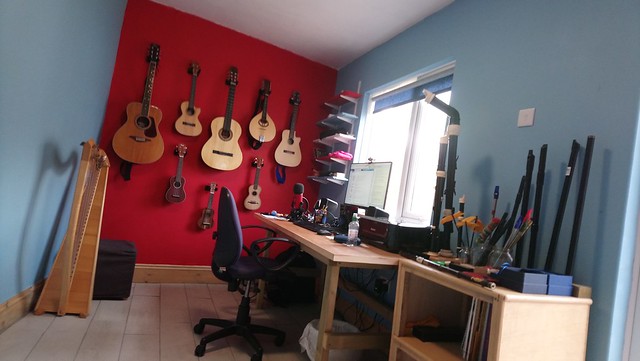
My studio / office
My garden office / studio

An office [ˈɒfɪs/ˈɔfɪs] is:

  • A room, set of rooms, or building used for non-manual work.
  • A position of responsibility.
  • An official position, particularly high employment within government.
    (other meanings are available)

It comes from Middle English office [ɔˈfiːs(ə)] (employment, occupation, obligation), from Old French office (office, job, service), from Latin officium (duty, service, office, obligation) from opificium (work), from opifex (someone who does [creative / constructive] work) from opus (work), from PIE *h₃ep- (to work, toil, make, ability) [source].

Words from the same roots include copy, manure, opera, operate, opulence and opus (a work of music or art) in English; usine (factory) in French; ofício (craft, trade, profession) in Portuguese; oficina (office, workshop, laboratory) in Spanish, and ufficio (office) and officina (workshop, laboratory) in Italian [source].

Hang on, manure? It comes from Middle English maynouren (to supervise, reign, exercise one’s authority), from Anglo-Norman meinourer, from Old French manouvrer (to work, make, create), from Vulgar Latin *manuoperare (to work by hand), from Latin manū (by hand) and operārī (to work). The word manoeuvre comes from the same roots [source].

You can also listen to this podcast on: Apple Podcasts, Amazon Music, TuneIn, Podchaser, Podbay or Podtail and other pod places.

If you would like to support this podcast, you can make a donation via PayPal or Patreon, or contribute to Omniglot in other ways.

Radio Omniglot podcasts are brought to you in association with Blubrry Podcast Hosting, a great place to host your podcasts. Get your first month free with the promo code omniglot.

The Fastest Way to Learn Japanese Guaranteed with JapanesePod101.com

I also write about words, etymology and other language-related topics on the Omniglot Blog, and I explore etymological connections between Celtic languages on the Celtiadur blog.

Unlimited Web Hosting - Kualo

Celtic Pathways – Tan Oaks

In this episode we discover the possible Celtic roots of words such as tan, tannin and Tannenbaum.

September

The Proto-Celtic word *tannos means green oak, and comes from Proto-Indo-European *(s)dʰnwos/*(s)dʰonu (fir).

Related words in the Celtic languages include:

  • tinne = the letter t in the Ogham alphabet (ᚈ) in Irish
  • tinne [tʲenə] = the letter t (ᚈ) in Ogham; gorse, whin, furze (archaic) in Scottish Gaelic
  • taneru = to tan (hide) in Welsh
  • glastanen gelyn = holm oak in Cornish
  • tann = sessile oaks in Breton

For more about words for oak and related things, see the Celtiadur post: Oak (trees)

Words from the same Proto-Celtic roots, via Gaulish *tannos (oak) and Latin tannum (oak bark), include tan (pulped oak bark used in the tanning process of leather) in French, tano (stem, slip) in Galician, tanería (tannery) in Spanish, Tannenbaum (fir tree, Christmas tree) in German, θάμνος (thámnos – bush) in Greek, and tan, tannery, tannin (tannic acid) in English.

Words from the same PIE roots include thanë (cranberry bush) in Albanian, and धनु (dhanu – bow, Sagittarius) in Sanskrit. [source].

Radio Omniglot podcasts are brought to you in association with Blubrry Podcast Hosting, a great place to host your podcasts. Get your first month free with the promo code omniglot.

The Fastest Way to Learn Japanese Guaranteed with JapanesePod101.com

Celtic Pathways – Grinding Pebbles

In this episode of the Celtic Pathways podcast, we discover the possible Celtic roots of words for gravel in English and other languages.

Roof Gravel

Gravel [ˈɡɹævəl] is small fragments of rock, used for laying on the beds of roads and railways, and as ballast, and other things (other meanings are available).

It comes from Middle English gravel / gravail(le) (sand, gravel, shingle, pebbles), from Old French gravele (gravel), a diminutive of grave (gravel, seashore), from Medieval Latin grava, possibly from Gaulish grava, from Proto-Celtic grāwā (gravel, pebbles), from Proto-Indo-European *gʰroh₁weh₂, from *gʰreh₁w- (to grind) [source].

Words from the same Proto-Celtic roots in the modern Celtic languages include gro (gravel, shingle, gravelly shore, strand) in Welsh, grow (gravel) in Cornish, and grouan (gravel) in Breton [source].

For more details of words for gravel and related things in Celtic languages, see the Celtiadur post Gritty Gravel.

Words from the same Proto-Celtic roots in the non-Celtic languages include grava (gravel) in Catalan, grève (flat, sandy land along the sea or a large river) in French, grava (gravel) in Spanish, and grave (gravel, shore, gravelly ground) in Occitan [source].

Words from the same PIE roots in other languages include: grit, groat, grout and gruel in English, Grieß (semolina) in German, grjót (coarse stones, rubble) in Icelandic, gryt (a badger’s sett, a fox’s den) in Swedish, riutta (reef) in Finnish, and grúodas (frozen mud or earth) in Lithuanian [source].

Incidentally, one Old English word for gravel was ċeosol [ˈtʃeo.sol], which comes from Proto-West-Germanic *kesul (small stone, pebble). This became chisel and chessil (gravel or pebbles) in modern English, and is cognate with Kiesel (pebble) in German, kiezel (pebble, flint, silicon) in Dutch, and kisel (silicon) in Swedish [source].

Radio Omniglot podcasts are brought to you in association with Blubrry Podcast Hosting, a great place to host your podcasts. Get your first month free with the promo code omniglot.

The Fastest Way to Learn Japanese Guaranteed with JapanesePod101.com

Adventures in Etymology – Weaving Text

In this Adventure in Etymology, we unweave the origins of the word text.

afternoon reads

A text [tɛkst] is:

  • A writing consisting of multiple glyphs, characters, symbols or sentences.
  • A book, tome or other set of writings.
  • A brief written message transmitted between mobile phones. (other meanings are available)

It comes from Middle English text, from Old French texte (text), from Latin textus (woven, texture, structure, tissue, connection), from texō (to weave, knit, plait, intertwine), from Proto-Italic *teksō, from Proto-Indo-European *tḗtḱ-ti (to create, produce, cut, hew) or *teḱ-se-t, both of which come from *teḱ- (to sire, beget) [source].

Words from the same roots include architect, context, subtle, technical, textile and texture in English, tisser (to weave, plait) in French, tessere (to weave, plot) in Italian, and tekst (text, lyrics) in Dutch [source].

In Old English, one word for text was traht [trɑxt], which also means passage, exposition, treatise or commentary. It comes from traht(n)ian (to treat, comment on, expound, consider), from Proto-West-Germanic *trahtōn (to consider, think of, strive for, seek, discuss), from Latin tractō (to tug, drag, handle, discuss) [source]. The modern English word tract (A small booklet such as a pamphlet, often for promotional or informational uses; a treatise or discourse on a subject) comes from the same roots [source].

If you would like to support this podcast, you can make a donation via PayPal or Patreon, or contribute to Omniglot in other ways.

Radio Omniglot podcasts are brought to you in association with Blubrry Podcast Hosting, a great place to host your podcasts. Get your first month free with the promo code omniglot.

The Fastest Way to Learn Japanese Guaranteed with JapanesePod101.com

I also write about words, etymology and other language-related topics on the Omniglot Blog, and I explore etymological connections between Celtic languages on the Celtiadur blog.

Unlimited Web Hosting - Kualo

Adventures in Etymology – Terminal Boundaries

In this Adventure in Etymology, we determine the limits of the word term, and find out how it’s connected to the Daleks in Dr Who.

Eurostar
St Pancras International Station – a major railway terminus in London

A term [tɜːm/tɝm] is:

  • That which limits the extent of anything; limit, extremity, bound, boundary, terminus.
  • A chronological limitation or restriction, a limited timespan.
  • Any of the binding conditions or promises in a legal contract.
  • A word or phrase (e.g., noun phrase, verb phrase, open compound), especially one from a specialised area of knowledge.
  • Part of a year, especially one of the divisions of an academic year.
  • Duration of officeholding, or its limit; period in office of fixed length.
  • With respect to a pregnancy, the period during which birth usually happens (approximately 40 weeks from conception).

It comes from Middle English terme (limit, end, goal, boundary), from Old French terme (limit, boundary), from Latin terminus (boundary, limit, end, period of time), from Proto-Italic *termenos (boundary stone), from Proto-Indo-European *térmn̥ (boundary, end), possibly from *ter(h₂)- (to pass through) [source].

Words from the same roots include terminal, terminus, determine, avatar, thorough and through in English, terme (conclusion, end, term [word, expression], deadline, rent) in French, término (end, terminus, finish, conclusion, period, term) in Spanish, and τέρμα (térma – conclusion, end, goal, finishing line) in Greek [source].

What links term with the Daleks*? Well, the Daleks’ favourite expression, Exterminate!, comes from the same roots, via Latin exterminātus (expelled, exiled, banished, abolished, destroyed) from exterminō (I expel, exile, banish, etc), from ex- (out, away) & terminō (I finish, close, end) [source].

Daleks

*Dalek = A member of a species of extraterrestrial cyborg mutants who appear in the television programme Doctor Who and are known for travelling in metallic shells, having monotone, mechanically distorted voices, repeating a limited number of phrases, and their fanatical obsession with exterminating other, non-Dalek beings. The word Dalek either comes from the Kaleds, the beings they evolved from, or from Dals (gods) in their (fictional) language [source].

The Terminator

Incidentally, the word terminator also comes from the same roots, via Latin terminātor (he who sets bounds), from terminō (I finish, close, end), from terminus (end, limit) [source].

Here’s a little ditty I wrote in October 2024 called Terms & Conditions, which is about all those pesky terms & conditions that few of us ever read, and even fewer understand.

You can also listen to this podcast on: Apple Podcasts, Amazon Music, TuneIn, Podchaser, Podbay or Podtail and other pod places.

If you would like to support this podcast, you can make a donation via PayPal or Patreon, or contribute to Omniglot in other ways.

Radio Omniglot podcasts are brought to you in association with Blubrry Podcast Hosting, a great place to host your podcasts. Get your first month free with the promo code omniglot.

The Fastest Way to Learn Japanese Guaranteed with JapanesePod101.com

I also write about words, etymology and other language-related topics on the Omniglot Blog, and I explore etymological connections between Celtic languages on the Celtiadur blog.

Unlimited Web Hosting - Kualo

Celtic Pathways – Garters

In this episode, we discover the Celtic roots of words for garter in English and French.

Garter

The English word garter refers to a band around the leg to hold up a sock or stocking. It comes from Old Northern French gartier (garter), from Old French garet (knee, leg), from Vulgar Latin *garra (shank, calf), from Gaulish *garrā (leg), from Proto-Celtic *garros (calf, shank), possibly from PIE *ǵʰes- (hand, to take) [source].

Words in the modern Celtic languages from the same Proto-Celtic root include: gar [ɡar] (leg, shank, thigh, ham) in Welsh, garr [ɡarː/ɡɒr] (leg, stem) in Cornish, and gar [ɡɑːr] (leg, paw) in Breton [source].

Words from the same Proto-Celtic root in other languages include: jarret (hock) and jarretière (garter) in French, and possibly garra (claw, talon, hand, paw, spirit) in Spanish, and garra (shank, tail, claw) in Catalan [source].

Words from the same PIE root include chiropractor, million and surgeon in English; dorë (hand) in Albanian; paže (arm) in Czech, and pažastis (armpit) in Lithuanian [source].

Chiropractor comes from Ancient Greek χείρ (kheír – hand) & πρᾶξις (prâxis – action, activity, practice) [source]; million comes ultimately from the PIE root *ǵʰéslom (thousand) or literally “full hand” [source]; and surgeon comes from Ancient Greek χειρουργός (kheirourgós – craftsman, surgeon), from χείρ (kheír – hand) & ἔργον (érgon – work) [source]

Incidentally, the English word hock [hɒk/hɑk] (also written hough) can refer to the hollow behind the knee, the tarsal joint of an animal such as a horse or pig, and the meat from that part of an animal. It’s also the name of a type of wine from the Hochheim region of Germany [source].

See the Celtiadur post Legs & Feet for more details of words for shank, calf, leg, foot and related things in Celtic languages. I also write about words, etymology and other language-related topics on the Omniglot Blog.

Radio Omniglot podcasts are brought to you in association with Blubrry Podcast Hosting, a great place to host your podcasts. Get your first month free with the promo code omniglot.

The Fastest Way to Learn Japanese Guaranteed with JapanesePod101.com

Celtic Pathways – Jeans

In this episode we discover the possible Celtic roots of the word jeans, and also the place names Genoa and Geneva.

Boots and Jeans

Jeans are trousers made from denim cotton, traditionally dyed dark blue, and also known as blue jeans. The word jeans is an abbreviation of jean fustian, from Middle English Gene (Genoa, Genovese) and fustian (a strong cotton fabric) [source].

Gene comes from Latin Genua (Genoa), which like Geneva, possibly comes from the Proto-Celtic *genwā ([river] bend) from PIE *ǵénw-eh₂, from *ǵónu (knee), which is also the root of the Proto-Celtic word *glūnos (knee) [source].

Related words in the modern Celtic languages include:

  • glúin [ɡl̪ˠuːnʲ] = knee, generation, step, node in Irish
  • glùin [ɡl̪ˠuːn̪ʲ] = knee, generation, lap in Scottish Gaelic
  • glioon [ɡlʲuːnʲ] = joint, knee in Manx
  • glin [ɡliːn] = knee in Welsh
  • glin [ɡliːn] = knee in Cornish
  • glin [ɡlĩːn] = knee in Breton

Other words from the same PIE roots include genuflect (to bend the knee, grovel) and knee in English; genou (knee) in French; knie (knee) in Dutch and Afrikaans; gju [ɟu/ɡjũː] (knee) in Albanian, and γόνατο [ˈɣɔnatɔ] (knee) in Greek [source].

Incidentally, the k in knee was pronounced in Middle Engish kne [kneː] and Old English cnēow [kne͜oːw] [source], and also in Early Modern English until about the 16th or 17th century, when it quietly disappeared in speech [source].

See the Celtiadur post Knees for more details of words for knee and related things in Celtic languages. I also write about words, etymology and other language-related topics on the Omniglot Blog.

Radio Omniglot podcasts are brought to you in association with Blubrry Podcast Hosting, a great place to host your podcasts. Get your first month free with the promo code omniglot.

The Fastest Way to Learn Japanese Guaranteed with JapanesePod101.com

Celtic Pathways – Groovy Furrows

In this episode we’re looking at Celtic words for furrow, trench, ditch and related things, and words in other languages that come from the same roots.

Furrowed

The Proto-Celtic word *ɸrikā means furrow and comes from Proto-Indo-European *pr̥keh₂ (furrow), from *perḱ- (to open, rip up, dig) [source].

Related words in the modern Celtic languages include:

  • eitre [ˈɛtʲəɾʲə] = furrow, groove, ridge in Irish
  • eitre = trench, furrow in Scottish Gaelic
  • eerey = furrow length, plough length in Manx
  • rhych [r̥ɨːχ/r̥iːχ] = trench, ditch, furrow, groove, wrinkle, cleft, cleavage in Welsh
  • reg = line, furrow in Breton

Words from the same Proto-Celtic roots, via Gaulish *rikā (furrow) and Latin riga (line, stripe), include raie (stripe, parting, line) in French, porca (ridge between furrows) in Italian, alporquia (layering) in Portuguese, porcoi (haystack, heap, pile, bunch) in Romanian, and erreka (river, stream, ravine) in Basque [source].

Words from the same PIE roots include furrow, farrow and pig in English, Furche (furrow) in German, fåra (furrow, groove) in Swedish, porsas (piglet, pork) in Finnish, and arc [aɾˠk] (piglet) in Irish [source].

Orkney Islands

Incidentally, the Orkney Islands get their name from Old Norse Orkneyjar (“seal islands”), from Old Norse ørkn (seal) and ey (island). The ørkn part is thought to be a misinterpretation of the Pictish name orc (piglet), which ultimately comes from the PIE root *perḱ- (to dig, etc) [source].

More about words for Furrowed Trenches and related tools in Celtic languages.

You can find more connections between Celtic languages on the Celtiadur blog. I also write about words, etymology and other language-related topics on the Omniglot Blog.

Radio Omniglot podcasts are brought to you in association with Blubrry Podcast Hosting, a great place to host your podcasts. Get your first month free with the promo code omniglot.

The Fastest Way to Learn Japanese Guaranteed with JapanesePod101.com

Celtic Pathways – Tin

In this episode, we’re looking into the Celtic roots of some Romance tins.

french tinned butter biscuits

The Proto-Celtic word *stagnos means tin and probably comes from the Proto-Indo-European *sth₂gʰ-nó-s (standing, firm), from *steh₂- (to stand) [source].

Related words in the modern Celtic languages include:

  • stán = tin, tin vessel in Irish
  • staoin [sdɯːn̪ʲ] = tin, pewter in Scottish Gaelic
  • stainney = tin, can, tin-plate in Manx
  • (y)staen [ˈ(ə)staɨ̯n] = tin, pewter in Welsh
  • sten [stɛːn / steːn] = tin in Cornish
  • staen [ˈstɛːn] = tin in Breton

Words from the same Celtic roots, via Gaulish *stagnom (tin) and Latin stannum (tin, silver-lead alloy), include estany (tin) in Catalan, étain (tin) in French, stagno (tin) in Italian, and estanho (tin) in Portuguese [source].

I forgot to mention in the recording that the symbol for the element tin is Sn, which comes from Latin stannum, and the English words such as stannary (of or pertaining to tin mining, especially in Cornwall), and stanniferous (containing or producing the metal tin) come from the same roots [source].

Words from the same PIE roots include cost, distant, estate, instant, obstinate, stand, stem and stool in English [source], and words from heel in Celtic languages, such as sawdl in Welsh and sáil in Irish [source].

Incidentally, the word tin comes from Middle English tyn(ne) (tin), from Old English tin (tin), from Proto-Germanic *tiną (tin), probably from a pre-Indo-European language [source].

More about words for Tin and related tools in Celtic languages.

You can find more connections between Celtic languages on the Celtiadur blog. I also write about words, etymology and other language-related topics on the Omniglot Blog.

Radio Omniglot podcasts are brought to you in association with Blubrry Podcast Hosting, a great place to host your podcasts. Get your first month free with the promo code omniglot.

The Fastest Way to Learn Japanese Guaranteed with JapanesePod101.com

Adventures in Etymology – Antique

In this Adventure in Etymology, we find out what links the word antique with words such as eye, window and Antigua.

Antiques

Antique [ænˈtiːk] can mean:

  • An old object perceived as having value because of its aesthetic or historical significance (noun)
  • Having existed in ancient times, descended from antiquity; out of date, old (adjective)
  • to search or shop for antiques; to make (an object) appear to be an antique in some way (verb)

It comes from French antique (ancient, old), from Latin antīquus (old, ancient, aged, classic, traditional) from Proto-Indo-European *h₂énti-h₃kʷ-o-s (“facing the front, in front of the eye”), from *h₂énti (opposite, near, in front, before) and *h₃ekʷ- (to see, eye) [source].

Words from the same Latin root (antīquus) include antic in English, antik (ancient, antique) in German, and antiguo (old, ancient, vintage) in Spanish [source].

Antigua

The island of Antigua in the Caribbean also gets its name from the same roots, via Spanish antigua (ancient, old), and was originally named Santa María de la Antigua by Christopher Columbus to honour a mural known as Virgen de la Antigua or Santa María de la Antigua in Seville Cathedral (see below) [source].

Chapel of the Virgen de la Antigua

Other words from the PIE root *h₂énti (in front, before) include and and words beginning with ante-/ant(i)- such as antechamber and anticlockwise in English, antes (before, earlier, sooner) in Spanish, and anzi (on the contrary, indeed, actually) in Italian [source].

Other words from the PIE root *h₃ekʷ- (to see, eye) include eye, ocular, ogle and window in English, occhio (eye) in Italian, wyneb (face, surface) in Welsh, and oineach (honour, reputation) in Irish [source].

You can also listen to this podcast on: Apple Podcasts, Amazon Music, TuneIn, Podchaser, Podbay or Podtail and other pod places.

If you would like to support this podcast, you can make a donation via PayPal or Patreon, or contribute to Omniglot in other ways.

Radio Omniglot podcasts are brought to you in association with Blubrry Podcast Hosting, a great place to host your podcasts. Get your first month free with the promo code omniglot.

The Fastest Way to Learn Japanese Guaranteed with JapanesePod101.com

I also write about words, etymology and other language-related topics on the Omniglot Blog, and I explore etymological connections between Celtic languages on the Celtiadur blog.

Unlimited Web Hosting - Kualo