Celtic Pathways – Rich Kingdoms

In this episode we discover the Celtic roots of words for kingdom, rich and related things in Germanic, Romance and other languages.

Kings & Queens

The Proto-Celtic word *rīgyom means kingdom, and comes from Proto-Indo-European *h₃rḗǵs (king). Related words in Proto-Celtic include *rīxs (king) and *rīganī (queen) [source]

Related in the modern Celtic languages include:

  • [ɾˠiː] = king and banríon [bˠau(n̪ˠ)ˈɾˠiːnʲ] = queen in Irish
  • rìgh [r̪ʲi] = king and banrigh [bãũn̪r̪ʲɪ] = queen in Scottish Gaelic
  • ree [ɾiː] = king and benrein = queen in Manx
  • rhi [r̥iː] = king and rhiain (woman, girl, queen, lady) in Welsh
  • ri = king in Cornish
  • ri [ˈʁiː] = king in Breton

More details of words for king, queen and related things in Celtic languages can be found in the Celtiadur post Kings and Queens.

The Proto-Celtic word *rīgyom (kingdom) was borrowed into Proto-Germanic as *rīkiją (rulership, goverment, authority, realm, kingdom), and is the root of such words as rijk (realm, kingdom, empire, state) in Dutch, Reich (empire, state, realm) in German, říše (realm, empire, kingdom) in Czech, and rike (realm, kingdom, empire, nation) in Swedish [source].

The Proto-Celtic word *rīxs (king) was borrowed into Proto-Germanic as *rīkijaz (kingly, royal, noble, mighty, powerful, rich), which became rich in English, ryk (rich, wealthy) in Afrikaans, ricco (rich, wealthy, affluent) in Italian, and rikas (rich, wealthy, opulent, plentiful) in Finnish [source].

The Proto-Celtic word *rīxs (king) also found its way into names such as Friedrich and Heinrich in German, Henrik in Dutch (and other languages), and Roderick, Frederick, Henry and Richard in English [source].

Other words from PIE root *h₃rḗǵs (king) include rey (king) and reina (queen) in Spanish, रानी (rānī – queen, princess) in Hindi, and royal, regal, viceroy and maybe realm in English [source].

Incidentally, the continents of America (initially it referred just to South America, then to North America as well) were named after the Italian explorer Amerigo Vespucci, and the name Amerigo comes ultimately from the Proto-Germanic name Amalarīks, from amalą (hard work, stuggle) and *rīks (king, ruler), from Proto-Celtic *rīxs (king) [source].

Radio Omniglot podcasts are brought to you in association with Blubrry Podcast Hosting, a great place to host your podcasts. Get your first month free with the promo code omniglot.


Celtic Pathways – Engaged Hostages

In this episode we discover the Celtic roots of words for hostage in Germanic languages, and words related to engagement in Finnic languages.

Give me the best tuna can, or I will kill the hostage!

The Proto-Celtic word *geistlos means hostage or bail, and comes from Proto-Indo-European *gʰeydʰ- (to yearn for, to desire) [source]

Descendents in the modern Celtic languages include:

  • giall [ɟiəl̪ˠ] = hostage, pledge in Irish
  • giall [gʲiəl̪ˠ] = hostage, pledge in Scottish Gaelic
  • gioal = pledge, stake, wager in Manx
  • gwystl [ɡwɨ̞sdl] = pledge, assurance, security in Welsh
  • gostel = hostage, riot in Cornish
  • gouestl [ˈɡwestl] = hostage, pledge, guarantee in Breton

More details of words for hostage and related things in Celtic languages can be found in the Celtiadur post Captive Hostages.

Words from the same Proto-Celtic root, via Proto-Germanic *gīslaz (hostage), include gijzelen (to take hostage) in Dutch, Geisel (hostage) in German, and gissel (hostage) in Norwegian [source].

The Finnish words kihlata (to betroth) and kihlajaislahja (engagement present), the Estonian word kihlatu (to betroth) also come from the same Proto-Celtic roots via Proto-Germanic *gīslaz (hostage) and Proto-Finnic *kihla (pledge, bet, wager, engagement gift) [source].

Words from the same PIE root (*gʰeydʰ-) include geisti (to desire, crave, covet) in Lithuanian, gaidīt (to wait, expect) in Latvian, ždát (to ask) in Czech, and ждати (ždáty – to wait for, expect) in Ukrainian [source].

Radio Omniglot podcasts are brought to you in association with Blubrry Podcast Hosting, a great place to host your podcasts. Get your first month free with the promo code omniglot.


Celtic Pathways – Birches

In this episode we unearth the Celtic roots of words for birch (tree) in various languages.

Birch forest

The Proto-Celtic word *betuyā means birch tree, and comes from Proto-Indo-European *gʷetu-yo-s, from *gʷet- (resin, gum) [source].

Descendents in the modern Celtic languages include:

  • beith = birch (tree), letter B in Ogham (ᚁ) in Irish
  • beithe [behə] birch, birch wood/forest in Scottish Gaelic
  • beih = birch (tree) in Manx
  • bedw [ˈbɛdʊ] = birch(es), birch grove, maypole, birch-rod in Welsh
  • besow = birches in Cornish
  • bezv [ˈbɛ(z)w] = birches in Breton

More details of words for birch in Celtic languages can be found in the Celtiadur post Birch (trees).

Words from the same Proto-Celtic roots, via Gaulish *bitu/betua and Latin *betius, include betulla (birch) in Italian, bouleau (birch) in French, βετούλη (vetoúli – birch) in Greek, and abedul (birch) in Spanish [source].

The botanical Latin name for the genus, Betula (birch), also comes from the same roots [source].

Incidentally, the English word birch comes from Middle English birche (birch), from Old English bierċe (birch), from Proto-West Germanic *birkijā (birch), from Proto-Germanic *birkijǭ (birch), from PIE *bʰerHǵos (birch), from *bʰerHǵ- (to shine, to gleam, whiten) [source].

Words from the same roots possibly include: bredh (fir tree) in Albanian, björk (birch) in Swedish, béržas (birch) in Lithuanian and březen (March) in Czech [source].

Radio Omniglot podcasts are brought to you in association with Blubrry Podcast Hosting, a great place to host your podcasts. Get your first month free with the promo code omniglot.


Celtic Pathways – Herons

In this episode we uncover the possible Celtic roots of words for heron in Romance languages.

Heron

The Proto-Celtic word *korxsā / *korxsiyos means heron or crane [source], and possibly comes from Proto-Indo-European *(s)kreik- (to screech, creak), which is imitative in origin [source].

Descendants in the modern Celtic languages include:

  • corr [kəuɾˠ] = (grey) heron, stork, crane, leg-necked person in Irish
  • corra [kɔr̪ˠə] = heron, stork, crane in Scottish Gaelic
  • coar = heron, stork, crane in Manx
  • crychydd [ˈkrəχɨ̞ð / ˈkrəχɪð] = heron in Welsh
  • kerghydh = heron in Cornish
  • kercʼheiz [kɛrˈɣɛjs] = heron in Breton

Words from the same Proto-Celtic roots, via Celtiberian *cárcia (heron) or Gaulish curcio (heron), possibly include garza (heron) in Galician, garza (heron) in Spanish, and garça (heron) in Portuguese [source].

The Welsh word crëyr [ˈkreː.ɨ̞r / ˈkreː.ɪr], which means heron or egret, probably comes from the same PIE roots, as do reiger (heron) in Dutch, Reiher (heron) in German, häger (heron) in Swedish, heron and egret in English, and haikara (heron, stork) in Finnish [source].

More details of heron-related words can be found in the Celtiadur post Herons.

Radio Omniglot podcasts are brought to you in association with Blubrry Podcast Hosting, a great place to host your podcasts. Get your first month free with the promo code omniglot.



Celtic Pathways – Cheesy Hills

In this episode, we uncover the possible Celtic roots of words for hillsides and rough scrub land in Romance languages.

Cwm Idwal

The Proto-Celtic words *brigā (hill, fortress) and *brixs (hill), both come from Proto-Indo-European *bʰérǵʰ-s (something high up, fortified) [source].

Related words in the modern Celtic languages include:

  • brí [bʲɾʲiː] = brae, hill in Irish
  • bre [bre] = hill, headland in Scottish Gaelic
  • bre [bre] = hill, hillock, mountain, hill-country, upland, peak in Welsh
  • bre [brɛ: / bre:] = hill in Cornish – appears as Bray or Brae in placenames
  • bre [breː] = hill, mountain in Breton

For more details of related words in the Celtic languages, see the Celtiadur post Hills.

Words from the same Proto-Celtic root, via Gaulish *brigā (hill, fortress) and Latin *brigna (rocky terrain), possibly include bricco (hill, crag, ridgeside) in Italian, breña (scrub, brush, rough ground) in Spanish and Galician, and brenha (scrub, complication, confusion) in Portuguese [source].

Words from the same PIE roots include burrow and borough, (and place names ending in burg(h), boro(ugh), bury, etc.) in English, Burg (castle) in German, burcht (citadel, castle, borough, burrow) in Dutch, and bourg (market town, village) in French – also found in place names, such as Strasbourg and Luxembourg [source].

My take

Incidentally, the French cheese brie comes from and is named after the historic region of Brie in northern France, which gets its name from Gaulish *brigā (hill, fortress), from Proto-Celtic *brigā (hill, fortress) [source].

Radio Omniglot podcasts are brought to you in association with Blubrry Podcast Hosting, a great place to host your podcasts. Get your first month free with the promo code omniglot.


Celtic Pathways – Bearing Cradles

In this episode we discover the Celtic roots of words for cradle, crib and related things in Portuguese and other languages.

berço

The Proto-Celtic word *bereti means to carry or bear, and comes from Proto-Indo-European bʰéreti (to be carrying), from *bʰer- (to bear, carry) [source].

Related words in the modern Celtic languages include:

  • beir [bʲɛɾʲ] = to bear, give birth to; lay (eggs) in Irish
  • beir [berʲ] = to take hold; bring forth, bear, produce, carry in Scottish Gaelic
  • behr = to bear (give birth to) in Manx
  • beru = to flow, drip, drizzle in Welsh
  • perthi = to bear, endure, put up with, stand, suffer, tolerate in Cornish (not entirely sure about this one)
  • berañ [ˈbeːrã] = to drip, flow in Breton

For more details of related words in the Celtic languages, see the Celtiadur post Birth.

Words from the same Proto-Celtic root via Proto-Celtic *bertā (bundle, burden ?), Gaulish *berta and Latin berciolum (cradle), include berço (cradle, crib, birthplace) in Portuguese, bressol (cradle) in Catalan, berceau (cradle, crib, birthplace, arch, vault) in French, and berså (arbour, bower) in Swedish (borrowed from French) [source].

Words from the same PIE roots include barn, barrow, bear, berth, birth and burden and ferret in English, baren (to bear, give birth to, cause) in Dutch, brouette (wheelbarrow) in French, and Bürde (burden) in German [source].

Radio Omniglot podcasts are brought to you in association with Blubrry Podcast Hosting, a great place to host your podcasts. Get your first month free with the promo code omniglot.


Celtic Pathways – Sooty Soot

In this episode we discover the possible Celtic roots of words for soot in English, French and various other languages.

Anybody else smell smoke??

The Proto-Celtic word *sūdyā means soot and comes from Proto-Indo-European *suh₃d- (soot [?]), or from sed- (to sit) [source].

Related words in the modern Celtic languages include:

  • súiche [ˈsˠuːçɪ] = soot in Irish
  • sùith [suːj] = soot in Scottish Gaelic
  • sooie = smut, soot in Manx
  • huddygl [ˈhɨ̞ðɨ̞ɡl / ˈhɪðɪɡl] = soot in Welsh
  • hudhygel = soot in Cornish
  • huzil [ˈhyː(z)il] = soot in Breton

For more about words for soot and related things in Celtic languages, see the Celtiadur post: Soot.

Words from the same Proto-Celtic root, via Gaulish *sūdiā (soot [?]), include sutge (soot) in Catalan, suie (soot) in French, and maybe soot in English, sot (soot) in Swedish, sadza (soot) in Polish, сажа (saža – soot) in Russian, and saze (soot) in Czech [source].

Incidentally, another Welsh word for soot is fflacs, which refers specifically to soot blown down a chimney on a windy day [source].

Radio Omniglot podcasts are brought to you in association with Blubrry Podcast Hosting, a great place to host your podcasts. Get your first month free with the promo code omniglot.
The Fastest Way to Learn Japanese Guaranteed with JapanesePod101.com

Celtic Pathways – Country Gardens

In this episode we uncover links between words for country and land in Celtic languages, and words for garden, wood and related things in other languages.

Bodnant
Bodnant Garden / Gardd Bodnant

The Proto-Celtic word *mrogis means border(land), march, mark, region, country, territory or province, and comes from Proto-Indo-European *mórǵs (frontier, border) [source]

Related words in the modern Celtic languages include:

  • brugh = dwelling, mansion in Irish
  • brugh [bruh] = broch (a type of Iron Age stone tower with hollow double-layered walls – see below), fortified tower, large house, mansion, fairy mound in Scottish Gaelic
  • brogh = broch in Manx
  • bro [broː] = region, country, land, neighbourhood, border, limit, boundary in Welsh
  • bro = country, land in Cornish
  • bro [broː] = counry(-side) in Breton

For more about words for border, land, country and related things in Celtic languages, see the Celtiadur post: Region and Country

Mousa Broch

Words from the same Proto-Celtic root, via Gaulish *brogis and Latin brogi-/broges, include brolo (vegetable garden, orchard, grove) in Italian, and breuil (wood, copse, coppice) in French, bröol (a lawn or vegetable garden surrounding house) in Cimbrian, and Brühl (enclosed land, (wet/swampy) meadow) in German (found mainly in place names).

Words from the same PIE root include margin, and march (a border region; formal, rhythmic way of walking) in English, and marge (margin, markup) in French, marca (brand, make, trademark) in Italian [source], Mark (a fortified border area, marches) in German, and mark (field) in Danish, as in Denmark [source].

Radio Omniglot podcasts are brought to you in association with Blubrry Podcast Hosting, a great place to host your podcasts. Get your first month free with the promo code omniglot.

The Fastest Way to Learn Japanese Guaranteed with JapanesePod101.com

Episode 3 – Irish (Gaeilge)

This episode is about the Irish language, or Gaeilge, as it’s known in Irish. I talk about my own Irish learning journey and adventures. Then look at the history of the language and its current state, and talk a bit about the language itself, with examples to illustrate its structure.

It features some Irish tunes, played by me, on the tin whistle, mandolin, low whistle and harp, and one of my own compositions, played on the melodica. It is mostly in English, with some bits of Irish.

You can find music for Sackow’s / Tripping Up The Stairs, the jig I play on the whistle at the beginning of this episode, here.

The slow air I play on the low whistle, Amhrán na Leabhar (The Song of the Books), was written by Tomás Rua Ó Súilleabháín (1785-1848), a school teacher and poet who lost all his possessions, including his books, in a storm when they were being ferried between Derrynane Bay to Valentia Harbour. He wasn’t in the boat at the time, and wrote this song afterwards. It is also known as Cuan Bhéil Inse [source]. You can hear it, with words, at:

The tune I play on the harp is John O’Conner / Seán ó Conchubhair, which was written by Turlough O’Carolan. It is also known as the Belfast Almanac or Plaxty O’Conner.

There is another, rather faster, version here:

You can music for it here.

The tune I play on the melodica is at end of the podcast, The Saturday Hornpipe / Cornbib Ddydd Sadwrn, is one I wrote a few years ago. You can hear a longer version at:

Information about Irish
http://www.omniglot.com/writing/irish.htm
http://www.omniglot.com/writing/ogham.htm
http://www.omniglot.com/writing/clogaelach.htm
https://en.wikipedia.org/wiki/Irish_language
https://en.wikipedia.org/wiki/History_of_the_Irish_language
https://en.wikipedia.org/wiki/Primitive_Irish
https://en.wikipedia.org/wiki/Old_Irish
https://en.wikipedia.org/wiki/Middle_Irish

Here are some videos in and about Irish:

This is a silly little video I made in Irish based on songs:

If you would like to support this podcast, you can make a donation, or contribute to Omniglot in other ways.


Episode 2 – Scottish Gaelic (Gàidhlig)

This episode is about Scottish Gaelic (Gàidhlig). I talk about the current state of the language, its history, how it is used, about my experiences of learning it, and share some observations I’ve collected from other Gaelic speakers and learners.

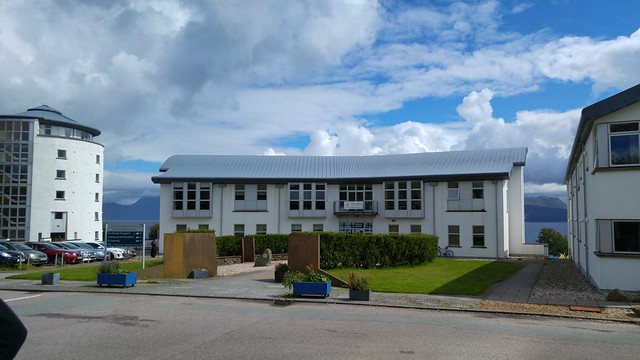
Last week I was at Sabhal Mòr Ostaig, a college on the Isle of Skye where you can do courses in Scottish Gaelic languages, songs, traditional music, dance, drama, and other subjects. I have done quite a few courses in Scottish Gaelic songs since 2008.

Sabhal Mòr Ostaig

You can hear some examples of spoken Gaelic here:

Here is a silly little video I made to practise my Scottish Gaelic:

More information about Scottish Gaelic
http://www.omniglot.com/writing/gaelic.htm

The music in this podcast is a piece I wrote After The Rain / Ar Ôl Y Glaw:

If you would like to support this podcast, you can make a donation, or contribute to Omniglot in other ways.