Celtic Pathways – Cumbersome Confluences

In this episode we disencumber the cumbersome and confluent Celtic roots of words like encumber.
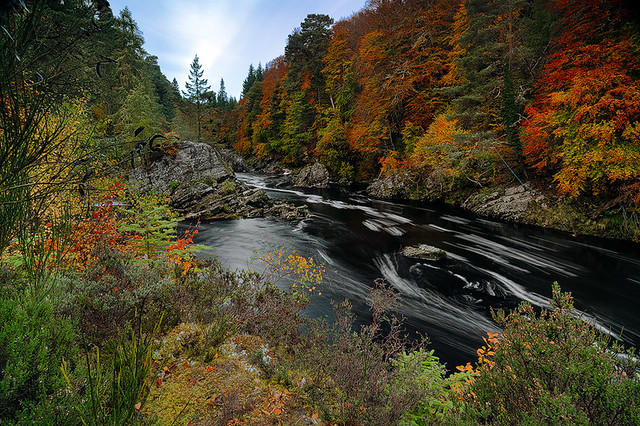
The meeting of the waters

The Proto-Celtic word *kombereti means to bring together and comes from Proto-Celtic *kom- (with, together) and *bereti (to bear), from PIE *bʰéreti (to be carrying) [source].

Descendants in the modern Celtic languages include:

  • cumar = ravine, channel, rut in Irish
  • comar [komər] = confluence, concourse in Scottish Gaelic
  • cymer [ˈkəmɛr] = confluence, meeting of waters, meeting place or clash of armies in Welsh
  • kemper = confluence, junction of streams in Cornish
  • kember [ˈkɛm.bɛr] = confluence in Breton

Words from the same Proto-Celtic roots, via Gaulish *comberos (river dam) and Latin combrus (river dam), possibly include encombrer (to block off, clutter, congest, encumber, burden) in French, ingombrare (to encumber, clutter, choke) in Italian, and cumbersome, encumber and incumbrance in English [source].

You can be encumbered and unencumbered in English, but can you be simply cumbered? Yes, you can. Cumber is an old word that means to slow down, hinder or burden. It comes from Middle English combren (to trouble, vex, annoy), from Old French combre (dam, dike), from Latin combrus etc. [source].

Other words related to cumber include cumberer (one that cumbers), cumberless (unencumbered), and cumberground (a totally worthless object or person, something that is just in the way).

Radio Omniglot podcasts are brought to you in association with Blubrry Podcast Hosting, a great place to host your podcasts. Get your first month free with the promo code omniglot.


Celtic Pathways – Cheesy Hills

In this episode, we uncover the possible Celtic roots of words for hillsides and rough scrub land in Romance languages.

Cwm Idwal

The Proto-Celtic words *brigā (hill, fortress) and *brixs (hill), both come from Proto-Indo-European *bʰérǵʰ-s (something high up, fortified) [source].

Related words in the modern Celtic languages include:

  • brí [bʲɾʲiː] = brae, hill in Irish
  • bre [bre] = hill, headland in Scottish Gaelic
  • bre [bre] = hill, hillock, mountain, hill-country, upland, peak in Welsh
  • bre [brɛ: / bre:] = hill in Cornish – appears as Bray or Brae in placenames
  • bre [breː] = hill, mountain in Breton

For more details of related words in the Celtic languages, see the Celtiadur post Hills.

Words from the same Proto-Celtic root, via Gaulish *brigā (hill, fortress) and Latin *brigna (rocky terrain), possibly include bricco (hill, crag, ridgeside) in Italian, breña (scrub, brush, rough ground) in Spanish and Galician, and brenha (scrub, complication, confusion) in Portuguese [source].

Words from the same PIE roots include burrow and borough, (and place names ending in burg(h), boro(ugh), bury, etc.) in English, Burg (castle) in German, burcht (citadel, castle, borough, burrow) in Dutch, and bourg (market town, village) in French – also found in place names, such as Strasbourg and Luxembourg [source].

My take

Incidentally, the French cheese brie comes from and is named after the historic region of Brie in northern France, which gets its name from Gaulish *brigā (hill, fortress), from Proto-Celtic *brigā (hill, fortress) [source].

Radio Omniglot podcasts are brought to you in association with Blubrry Podcast Hosting, a great place to host your podcasts. Get your first month free with the promo code omniglot.