Celtic Pathways – Cumbersome Confluences

In this episode we disencumber the cumbersome and confluent Celtic roots of words like encumber.
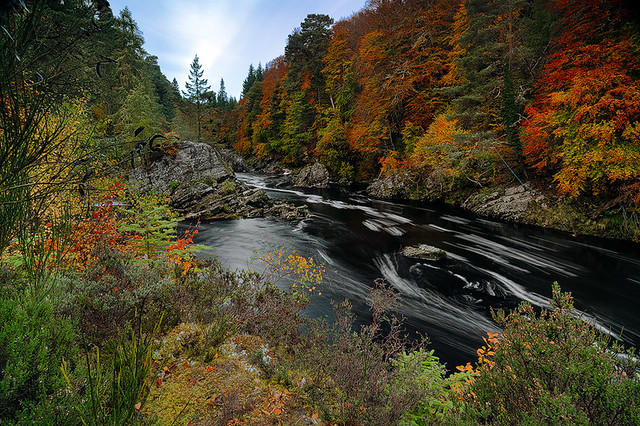
The meeting of the waters

The Proto-Celtic word *kombereti means to bring together and comes from Proto-Celtic *kom- (with, together) and *bereti (to bear), from PIE *bʰéreti (to be carrying) [source].

Descendants in the modern Celtic languages include:

  • cumar = ravine, channel, rut in Irish
  • comar [komər] = confluence, concourse in Scottish Gaelic
  • cymer [ˈkəmɛr] = confluence, meeting of waters, meeting place or clash of armies in Welsh
  • kemper = confluence, junction of streams in Cornish
  • kember [ˈkɛm.bɛr] = confluence in Breton

Words from the same Proto-Celtic roots, via Gaulish *comberos (river dam) and Latin combrus (river dam), possibly include encombrer (to block off, clutter, congest, encumber, burden) in French, ingombrare (to encumber, clutter, choke) in Italian, and cumbersome, encumber and incumbrance in English [source].

You can be encumbered and unencumbered in English, but can you be simply cumbered? Yes, you can. Cumber is an old word that means to slow down, hinder or burden. It comes from Middle English combren (to trouble, vex, annoy), from Old French combre (dam, dike), from Latin combrus etc. [source].

Other words related to cumber include cumberer (one that cumbers), cumberless (unencumbered), and cumberground (a totally worthless object or person, something that is just in the way).

Radio Omniglot podcasts are brought to you in association with Blubrry Podcast Hosting, a great place to host your podcasts. Get your first month free with the promo code omniglot.





Adventures in Etymology – An Assembly of Things

This Adventure in Etymology is an assembly of words about the word thing, or something like that.

Pointless things?

Meanings of thing [θɪŋ] include:

  • That which is considered to exist as a separate entity, object, quality or concept.
  • A word, symbol, sign, or other referent that can be used to refer to any entity.
  • An individual object or distinct entity.

It comes from Middle English thing (thing, substance, object), from Old English þing (thing, matter, concern, event, meeting, court, case, reason, means), from Proto-West Germanic *þing (court, session, lawsuit, affair, matter, thing, object) from Proto-Germanic *þingą (time, date, meeting, assembly, council, case, matter, issue), from Proto-Indo-European *tenk-ó-, from *tenk- (to be suitable) [source].

So, its meaning changed from being suitable, to a suitable or scheduled time, to an assembly, to a specific issue discussed at an assembly, to issues, objects or things in general. Which is quite something.

There are related words in other Germanic languages that also mean thing, and other things. For example, ding (matter, thing) in Dutch [source] (and Afrikaans), Ding (thing, girl, boy) in German [source], and Déngen (thing, object) in Luxembourgish [source].

The Alþingi
The Alþingi

However, in Norwegian, ting can mean thing, court or assembly [source], ting means thing, assembly or parliament in Danish [source], and þing means assembly, meeting, council or parliament in Icelandic, and the parliament of Iceland is called the Alþingi – see above [source].

Other words from the same roots include tinka (quarrel, disagreement, shortage, lack, tight situation) in Finnish, tinge (to bargin, haggle) in Danish, þinga (to hold a meeting) in Icelandic, dungi (to employ) in Esperanto, and gedeihen (to thrive, flourish, prosper) in German [source].

You can also listen to this podcast on: Apple Podcasts, Amazon Music, TuneIn, Podchaser, Podbay or Podtail and other pod places.

The theme tune for this podcast is The Unexpected Badger / Y Mochyn Daear Annisgwyl, a piece I wrote and recorded in 2017.

If you would like to support this podcast, you can make a donation via PayPal or Patreon, or contribute to Omniglot in other ways.

Radio Omniglot podcasts are brought to you in association with Blubrry Podcast Hosting, a great place to host your podcasts. Get your first month free with the promo code omniglot.

The Fastest Way to Learn Japanese Guaranteed with JapanesePod101.com

I also write about words, etymology and other language-related topics on the Omniglot Blog, and I explore etymological connections between Celtic languages on the Celtiadur blog.


Adventures in Etymology – Ridiculous

In this Adventure in Etymology, we’re risking ridicule and getting rather ridiculously ridiculous.

Ridiculous

Ridiculous [ɹɪˈdɪkjələs/ɹɪˈdɪkjʊləs] means deserving or ridicule, foolish, absurd, astonishing, extreme or unbelievable.

It comes from Latin rīdiculus [riːˈd̪ɪkʊɫ̪ʊs̠] (laughable, funny, amusing, silly, absurd, ridiculous), from rīdeō (to laugh (at), ridicule, mock), the origins of which are not known [source].

Words from the same roots include ridicule (mocking words or behaviour; to make fun of), risible (ludicrous, ridiculous, provoking laughter) and derisory (laughably small or inadequate) in English, ridere (to laugh) in Italian, sourire (to smile) in French, and ridikül (ridiculous) in German [source].

The rare English word ridibund (inclined to and easily brought to laughter, happy), and the anatomical term risorius (the facial muscle used when smiling) also come from the same roots [source]

You can also listen to this podcast on: Apple Podcasts, Amazon Music, TuneIn, Podchaser, Podbay or Podtail and other pod places.

The theme tune for this episode is The Unexpected Badger / Y Mochyn Daear Annisgwyl, a piece I composed and recorded in 2017.

If you would like to support this podcast, you can make a donation via PayPal or Patreon, or contribute to Omniglot in other ways.

Radio Omniglot podcasts are brought to you in association with Blubrry Podcast Hosting, a great place to host your podcasts. Get your first month free with the promo code omniglot.

The Fastest Way to Learn Japanese Guaranteed with JapanesePod101.com

I also write about words, etymology and other language-related topics on the Omniglot Blog, and I explore etymological connections between Celtic languages on the Celtiadur blog.

Unlimited Web Hosting - Kualo