Adventures in Etymology – Harmonious Reason

Are the words harmony and reason connected? Let’s find out in this Adventure in Etymology.

Singing in Pontio / Canu ym Mhontio

Meanings of harmony [ˈhɑː.mə.ni] include:

  • Agreement or accord.
  • A pleasing combination of elements, or arrangement of sounds.
  • Two or more notes played simultaneously to produce a chord.

It comes from Middle English armonie (harmonious sounds, song, music, harmony), from Old French (h)armonie (harmony, musical instrument), from Latin harmonia (harmony, music, peace), from Ancient Greek ἁρμονία (harmonía – joint, union, agreement, concord of sounds), from or related to ἁρμόζω (harmózō – I fit together), from PIE *h₂er- (to join, fit, fix together) [source].

Meanings of reason [ˈɹiː.zən] include:

  • A cause.
  • A motive for an action or a determination.
  • Rational thinking.

It comes from Middle English reso(u)n (reason), from Anglo-Norman raisun (logic, logical reasoning), from Latin ratiō (reason, calculation, procedure), from reor (to reckon, calculate, think), from Proto-Italic rēōr (to reckon, calculate, think), from PIE *h₂reh₁- (to think, reason, arrange), from *h₂er- (to join, fit, fix together) [source].

Other words from the same roots possibly include arachnid, art, ordinary, ornament, ratio and read in English, Rede (stream, current, flow) in German, araña (spider, chandelier) in Spanish, arment (herd of cattle or horses) in Catalan, гармония [ɡɐrˈmonʲɪjə] (harmony) in Russian [source].

One word for harmony (and melody) in Old English was swinsung, which came from swinsian (to sing) from Proto-West Germanic *swinisōn, from Proto-Germanic *swinisōną, from Proto-Germanic *swin- (to sound), from PIE *swenh₂- (to sound) [source].

Words from the same roots include assonance, sonata, sonnet, sound and swan in English, seinn (to play [an instrument], sing, warble, chatter) in Irish, honni (to claim, assert) in Welsh, and dzon (bell) in Polish [source].

If you would like to support this podcast, you can make a donation via PayPal or Patreon, or contribute to Omniglot in other ways.

Radio Omniglot podcasts are brought to you in association with Blubrry Podcast Hosting, a great place to host your podcasts. Get your first month free with the promo code omniglot.

The Fastest Way to Learn Japanese Guaranteed with JapanesePod101.com

I also write about words, etymology and other language-related topics on the Omniglot Blog, and I explore etymological connections between Celtic languages on the Celtiadur blog.


Adventures in Etymology – Doomed Pride

In this Adventure in Etymology we find out what links the word doom with words for judgement, courts and pride.

Maribo - Domhus (courthouse, 1920)

As a noun, doom [duːm] can mean:

  • Destiny, especially terrible
  • An undesirable fate
  • Dread; a feeling of danger

As a verb, to doom can mean:

  • To pronounce judgment or sentence on sb
  • To condem
  • To fix irrevocably the ill fate of sb

It comes from Middle English doom [doːm] (a judgement, [legal] decision, justice, authority), from Proto-West Germanic *dōm (judgement), from Proto-Germanic *dōmaz (judgement, fame, repute), from PIE *dʰóh₁mos (that which is put), from *dʰeh₁- (to do, put, place) [source].

English words from the same roots include deed, deem, defect and wisdom and other words ending in -dom [source].

Words in other languages from the same roots include doem (doom, condemnation, verdict, judgement) in Dutch, domare (judge, referee, umpire) in Swedish, domhus (courthouse) in Danish, дума (thought, meditation, duma [Russian legislature]) in Russian, duma (pride) in Polish, and dáil (tryst, betrothal, legislature) in Irish [source].

Incidentally, one word for court in Old English was dōmhūs (“judgement house”). It’s cognate with Danish domhus, and became dome-howse (a judgement hall) in Middle English [source].

If you would like to support this podcast, you can make a donation via PayPal or Patreon, or contribute to Omniglot in other ways.

Radio Omniglot podcasts are brought to you in association with Blubrry Podcast Hosting, a great place to host your podcasts. Get your first month free with the promo code omniglot.

The Fastest Way to Learn Japanese Guaranteed with JapanesePod101.com

I also write about words, etymology and other language-related topics on the Omniglot Blog, and I explore etymological connections between Celtic languages on the Celtiadur blog.


Adventures in Etymology – Wholesome Health

In this Adventure in Etymology we examine the origins of the word health and related things.

Healthy no QR

Meanings of health [hɛlθ] include:

  • The state of being free from physical or psychological disease, illness, or malfunction.
  • A state of well-being or balance, often physical but sometimes also mental and social.

It comes from Middle English helthe [ˈhɛlθ(ə)] (soundness, health, recovery, remedy), from Old English hǣlþ [xæːlθ] (health, healing, cure), from Proto-Germanic *hailiþō [ˈxɑi̯.li.θɔː] (wholeness, health), from *hailaz [ˈxɑi̯.lɑz] (whole, intact, entire, healthy), from PIE *kéh₂ilos (healthy, whole) [source].

Words from the same roots include heal, whole, wholesome, holy and hale in English, heel [ɦeːl] (complete, full, whole, very) in Dutch, hele (to heal) in Danish, целя [tsɛˈlʲa̟] (to heal, cure) in Bulgarian, cały [ˈtsa.wɘ] (whole, complete, entire) in Polish [source].

Health should not be confused with health, an obsolete English word meaning a warrior, hero or man, which comes from Proto-Germanic *haliþaz [ˈxɑ.li.θɑz] (hero), and is related to words such as Held [hɛlt] (hero, protagonist) in German, held [ɦɛlt] (hero) in Dutch, and hjälte [ˈjɛlˌtɛ] (hero, main male protagonist in a work of fiction) in Swedish [source].

If you would like to support this podcast, you can make a donation via PayPal or Patreon, or contribute to Omniglot in other ways.

Radio Omniglot podcasts are brought to you in association with Blubrry Podcast Hosting, a great place to host your podcasts. Get your first month free with the promo code omniglot.

The Fastest Way to Learn Japanese Guaranteed with JapanesePod101.com

I also write about words, etymology and other language-related topics on the Omniglot Blog, and I explore etymological connections between Celtic languages on the Celtiadur blog.



Adventures in Etymology – Rest Awhile

What does the word while have to do with resting? Let’s find out in this Adventure in Etymology on Radio Omniglot.

Lying in the sun

While [waɪl / wæl] as a noun means an uncertain duration of time, a period of time, or an uncertain long (or short) period of time. As a conjunction it means during that same time, although or as long as, and as a verb it means to pass (time) idly, e.g. to while away hours, days, etc. or to occupy or entertain (sb) in order to let time pass.

It comes from Middle English whyle [ˈhwiːl(ə)] (while), from Old English hwīl [xwiːl] (while, period of time), from Proto-West Germanic *hwīlu (period of time, pause, while), from Proto-Germanic *hwīlō [ˈxʷiː.lɔː] (time, while, break, pause, period of rest), from Proto-Indo-European *kʷyeh₁- (to rest, rest, peace) [source].

Words from the same PIE root include pokój (room, peace) in Polish, quedo (quite, still) in Spanish, quitter (to leave, quit) in French, tranquillo (calm, sober, tranquil) in Italian, hvile (rest, repose) in Danish, and quiet, quit, quite, quiescent, acquiesce, tranquil, requiem, and coy in English [source].

I hope that reading and/or listening to this podcast has been worth your while. In a while, there will be a new Adventure in Etymology. Meanwhile, you might find it worthwhile to while away a little (or long) while look at / listening to past episodes of this and other Radio Omniglot podcasts.

By the way, if someone tells you they’ll do something in a little while or in a while, how long would you expect to wait?

If you would like to support this podcast, you can make a donation via PayPal or Patreon, or contribute to Omniglot in other ways.

Radio Omniglot podcasts are brought to you in association with Blubrry Podcast Hosting, a great place to host your podcasts. Get your first month free with the promo code omniglot.

The Fastest Way to Learn Japanese Guaranteed with JapanesePod101.com

I also write about words, etymology and other language-related topics on the Omniglot Blog, and I explore etymological connections between Celtic languages on the Celtiadur blog.


Adventures in Etymology – Sticky Climbs

In this Adventure in Etymology we uncover the sticky roots of the word climb.

Red squirrel

Meanings of climb [klaɪm] include:

  • To ascend, rise or go up
  • To mount, move upwards
  • To scale, get to the top of
  • To move by gripping with the hands and using the feet

It comes from Middle English climben [ˈkli(ː)mbən / ˈkli(ː)mən] (to climb, scale, ascend) – the b was no longer pronounced in Late Middle English – from Old English climban [ˈklim.bɑn] (to climb), from Proto-West Germanic *klimban (to climb), from Proto-Germanic *klimbaną (to climb), probably from *klibāną (to stick, adhere) from Proto-Indo-European *gley- (to smear, to stick, putty, glue) [source].

Words from the same roots possibly include glue, gluten, clay, to cleave, cliff, cloth in English, klimmen (to climb) and kleven (to stick, glue) in Dutch, glynu (to stick, adhere) in Welsh, and glina (clay, loam) in Polish [source].

The English word clamber (to climb with difficulty or in a haphazard fashion) possibly also comes from the same roots, and is related to klambra (to clamp) in Icelandic and klamra (to cling) in Swedish [source].

Incidentally, the word to cleave can mean both to split or sever something with a sharp instrument, and to adhere, cling, or stick fast to something. The second meaning shares common roots with climb, but the first doesn’t [source]

Instead, it comes from Middle English cleven (to cleave, split, slice), from Old English clēofan (to cleave, split), from Proto-West Germanic *kleuban (to split, cleave), from Proto-Germanic *kleubaną (to split, cleave), from Proto-Indo-European *glewbʰ- (to cut, to slice) [source].

Related words include cleft and glyph in English, kloof (gap, gorge, ravine) in Dutch (and in Afrikaans and South African English), and глубокий [ɡɫʊˈbokʲɪj] (deep, profound) in Russian [source].

If you would like to support this podcast, you can make a donation via PayPal or Patreon, or contribute to Omniglot in other ways.

Radio Omniglot podcasts are brought to you in association with Blubrry Podcast Hosting, a great place to host your podcasts. Get your first month free with the promo code omniglot.

The Fastest Way to Learn Japanese Guaranteed with JapanesePod101.com

I also write about words, etymology and other language-related topics on the Omniglot Blog, and I explore etymological connections between Celtic languages on the Celtiadur blog.


Celtic Pathways – Sooty Soot

In this episode we discover the possible Celtic roots of words for soot in English, French and various other languages.

Anybody else smell smoke??

The Proto-Celtic word *sūdyā means soot and comes from Proto-Indo-European *suh₃d- (soot [?]), or from sed- (to sit) [source].

Related words in the modern Celtic languages include:

  • súiche [ˈsˠuːçɪ] = soot in Irish
  • sùith [suːj] = soot in Scottish Gaelic
  • sooie = smut, soot in Manx
  • huddygl [ˈhɨ̞ðɨ̞ɡl / ˈhɪðɪɡl] = soot in Welsh
  • hudhygel = soot in Cornish
  • huzil [ˈhyː(z)il] = soot in Breton

For more about words for soot and related things in Celtic languages, see the Celtiadur post: Soot.

Words from the same Proto-Celtic root, via Gaulish *sūdiā (soot [?]), include sutge (soot) in Catalan, suie (soot) in French, and maybe soot in English, sot (soot) in Swedish, sadza (soot) in Polish, сажа (saža – soot) in Russian, and saze (soot) in Czech [source].

Incidentally, another Welsh word for soot is fflacs, which refers specifically to soot blown down a chimney on a windy day [source].

Radio Omniglot podcasts are brought to you in association with Blubrry Podcast Hosting, a great place to host your podcasts. Get your first month free with the promo code omniglot.

The Fastest Way to Learn Japanese Guaranteed with JapanesePod101.com

Celtic Pathways – Calamitous Swords

In this episode we discover the possible Celtic roots of some words for sword, hammer and related things in Romance and Slavic languages.

Swords

The Proto-Celtic word *kladiwos means sword, and comes from Proto-Celtic *kladeti (to stab, dig), from Proto-Indo-European *kl̥h₂dʰ-é-ti, from *kelh₂- (to beat, strike) [source].

Related words in the modern Celtic languages include:

  • claíomh [kl̪ˠiːvˠ/kl̪ˠiːw] = sword in Irish
  • claidheamh [kl̪ˠajəv] = sword in Scottish Gaelic
  • cliwe = sword in Manx
  • cleddyf [ˈklɛðɨ̞v/ˈkleːðɪv] = sword, blade, brace (on a door or wall) in Welsh
  • kledha = sword in Cornish
  • kleze [ˈkleː.ze] = sword, glaive (a light lance with a long, sharp-pointed head) in Breton

For more about words for sword and related things in Celtic languages, see the Celtiadur post: Swords & Spikes

Words directly from the same Proto-Celtic root *kladiwos (sword) include kladivo (hammer, gavel) in Croatian, kladivo (hammer, sledgehammer) in Czech, kladivo (hammer, stamp, maul, hammerhead) in Slovak, kladivo (hammer, sledgehammer) in Slovenian [source].

Words from the same Proto-Celtic root *kladiwos (sword), via Gaulish *kladyos (sword), and Latin gladius (sword, death, a gladiatorial contest), possibly include gladiator, gladiolus and glaive in English, esglai (fright) in Catalan, ghiado (sword, dagger, knife, frost, cold), and giaggiolo (iris [flower]) in Italian, gládio (sword, power, strength) in Portuguese and glaïeul (gladiolus) in French [source].

Words from the same PIE roots include calamity, clade, clergy, cleric, clerk, coup, and glaive in English, коля (kolja – to slaughter, butcher) in Bulgarian, kłoda (log, trunk, beehive, barrel) in Polish, and Holz (wood) in German [source].

Radio Omniglot podcasts are brought to you in association with Blubrry Podcast Hosting, a great place to host your podcasts. Get your first month free with the promo code omniglot.

The Fastest Way to Learn Japanese Guaranteed with JapanesePod101.com

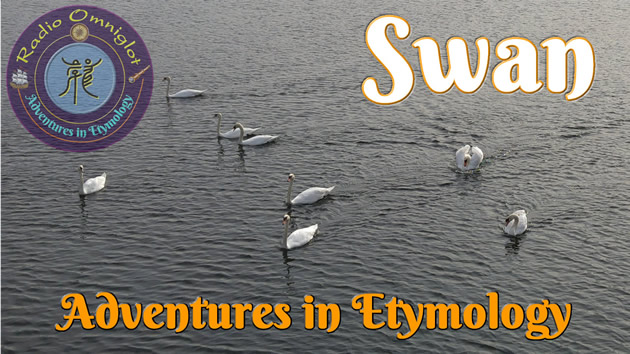
Adventures in Etymology – Swan

In this Adventure in Etymology we’re looking into the origins of the word swan.

Swan

A swan [swɒn/swɑn] is:

  • Any of various species of large, long-necked waterfowl, of genus Cygnus (bird family: Anatidae), most of which have white plumage.
  • One whose grace etc. suggests a swan.

It comes from Middle English swan [swan] (swan, swan meat), from Old English swan [swɑn] (swan), from Proto-West-Germanic *swan (swan) from Proto-Germanic *swanaz [ˈswɑ.nɑz] (swan, literally “the singing bird”), probably Proto-Indo-European *swenh₂- (to sound) [source].

Words from the same roots include sound, sonnet and sonata in English, zwaan [zʋaːn] (swan) in Dutch, Schwan [ʃvaːn] (swan, the constellation Cygnus) in German, sonar [soˈnaɾ] (to sound, ring) in Spanish, suonàre [swoˈna.re] (to play [an instrument], to sound, to ring) in Italian, and possibly dzwon [dzvɔn] (bell) in Polish [source].

Incidentally, the English word sonar, as in a device that uses hydrophones to locate objects underwater, is an acronym of Sound Navigation and Ranging, and was coined by Frederick Vinton Hunt, an American inventor, scientist and professor of acoustic engineering at Havard University in 1942.

Initially, the name ‘bearing and deviation indicator’ (BDI) was used for the system developed by Hunt and his team at the Harvard Underwater Sound Laboratory in 1941. The Navy Bureau of Ships asked him to come up with a more interesting name to make the job of an acoustic ranging technician sound more glamorous. He suggested SONAR, and said that it stood for Sound Navigation and Ranging – so it is in fact a backronym (an acronym based on an existing word) [source].

By the way, an adult male swan is a cob, which comes from Middle English cobbe (male swan, gang leader, bully) [source]. An adult female swan is a pen, the origins of which are uncertain [source], and a baby swan is a cygnet, which comes from Middle English signet (a young swan), from Anglo-Norman cignet, a diminutive of Old French cigne (swan), from Latin cycnus [ky.knus] (swan, [singing] poet), from Ancient Greek κύκνος (kúknos – swan, a type of ship) [source]. Baby swans are also known as swanlings [source].

You can also listen to this podcast on: Apple Podcasts, Amazon Music, TuneIn, Podchaser, Podbay or Podtail and other pod places.

If you would like to support this podcast, you can make a donation via PayPal or Patreon, or contribute to Omniglot in other ways.

Radio Omniglot podcasts are brought to you in association with Blubrry Podcast Hosting, a great place to host your podcasts. Get your first month free with the promo code omniglot.

The Fastest Way to Learn Japanese Guaranteed with JapanesePod101.com

I also write about words, etymology and other language-related topics on the Omniglot Blog, and I explore etymological connections between Celtic languages on the Celtiadur blog.

Unlimited Web Hosting - Kualo

Adventures in Etymology – Folk

In this Adventure in Etymology we’re looking into the origins of the word folk.

Ciarán Ó Maoinigh, Caitlín Nic Gobhann and Cathal Ó Curráín at Oideas Gael, Donegal, Ireland, July 2017
Some folk playing folk music

Folk [fəʊk / foʊk] can refer to:

  • People, persons
  • One’s relatives, especially one’s parents (e.g. my folks)
  • Short for folk music
  • A people; a tribe or nation; the inhabitants of a region, especially the native inhabitants. (Archaic)

It comes from Middle English folk [fɔlk] (people, nation, group, family, kin, relatives, humanity), from Old English folc [folk] (people, nation, tribe, crowd) from Proto-Germanic fulką [ˈɸul.kɑ̃] (people, tribe), *fulkaz (crowd, army), possibly from PIE *pleh₁- (to fill) [source].

Words from the same roots include fill, pleb, plenty, plural, plus and public in English, pul̃kas [ˈpʊlkɐs] (flock, crowd, regiment) in Lithuanian, pułk [puwk] (regiment) in Polish, and Volk [fɔlk] (people, native, tribe) in German [source].

The French word plouc [pluk] (country bumpkin, yokel) also comes from the same roots, via Breton plouk [pluːk] (yokel), from ploue [pluːe] (parish, countryside) Proto-Brythonic *pluɨβ (countryside, parish, common people) and Latin plēb(ē)s (common people, plebians) [source].

Related words in other Celtic languages include pluw (parish) in Cornish, and plwy(f) [pluːɨ̯(v) / plʊi̯(v)] (parish, poor relief, parishioners, people) in Welsh [source].

For more details, see the post about Land, Parishes & Enclosures on the Celtiadur.

You can also listen to this podcast on: Apple Podcasts, Amazon Music, TuneIn, Podchaser, Podbay or Podtail and other pod places.

If you would like to support this podcast, you can make a donation via PayPal or Patreon, or contribute to Omniglot in other ways.

Radio Omniglot podcasts are brought to you in association with Blubrry Podcast Hosting, a great place to host your podcasts. Get your first month free with the promo code omniglot.

The Fastest Way to Learn Japanese Guaranteed with JapanesePod101.com

I also write about words, etymology and other language-related topics on the Omniglot Blog, and I explore etymological connections between Celtic languages on the Celtiadur blog.

Unlimited Web Hosting - Kualo

Celtic Pathways – Heather

In this episode we look into the Celtic roots of words for heather in some Romance languages.

Heather

The Proto-Celtic word *wroikos means heather. Its origins are uncertain, and it possibly comes from a non-Indo-European substrate source [source].

Related words in the modern Celtic languages include:

  • fraoch [fˠɾˠeːx] = heather, heath, moor in Irish
  • fraoch [frɯːx] = heather in Scottish Gaelic
  • freoagh = heather, heath in Manx
  • grug [ɡrɨːɡ / ɡriːɡ] = heather, heath in Welsh
  • grug [ɡryːɡ / ɡriːɡ] = heather, heath in Cornish
  • brug [bryːk] = heather in Breton

Words from the same Proto-Celtic roots, via Gaulish and Latin, include brezo (heath) in Spanish, breixo (heather) in Galician, brugo (heather) and brughiera (heath, moor) in Italian, and bruyère (heath, heather, brier) in French [source].

Related words in other languages possibly include vřes (heather) in Czech, wrzos (heather) in Polish, viržis (heather) in Lithuanian, and ericaceous (Of or pertaining to the heath family; Acid-loving, acidic) in English [source].

Incidentally, the word heather comes from Old English *hǣddre (heather), from hǣþ (wasteland, wilderness, heath), from Proto-Germanic *haiþī [ˈxɑi̯.θiː] (heath, wasteland), possibly from PIE *kóy-t-os (forest, wasteland, pasture) [source].

Other words from the same roots include heath in English, heide (heath, heathland, heather) in Dutch, Heide (heath, heathland, nation, country) in German [source], and also coed (forest, wood, trees) in Welsh, koos (forest) in Cornish, and koad (wood, forest) in Breton [source].

More about words for Heather, and Trees, Wood(s) & Forests, in Celtic languages.

You can find more connections between Celtic languages on the Celtiadur blog. I also write about words, etymology and other language-related topics on the Omniglot Blog.

Radio Omniglot podcasts are brought to you in association with Blubrry Podcast Hosting, a great place to host your podcasts. Get your first month free with the promo code omniglot.

The Fastest Way to Learn Japanese Guaranteed with JapanesePod101.com