Celtic Pathways – Engaged Hostages

In this episode we discover the Celtic roots of words for hostage in Germanic languages, and words related to engagement in Finnic languages.

Give me the best tuna can, or I will kill the hostage!

The Proto-Celtic word *geistlos means hostage or bail, and comes from Proto-Indo-European *gʰeydʰ- (to yearn for, to desire) [source]

Descendents in the modern Celtic languages include:

  • giall [ɟiəl̪ˠ] = hostage, pledge in Irish
  • giall [gʲiəl̪ˠ] = hostage, pledge in Scottish Gaelic
  • gioal = pledge, stake, wager in Manx
  • gwystl [ɡwɨ̞sdl] = pledge, assurance, security in Welsh
  • gostel = hostage, riot in Cornish
  • gouestl [ˈɡwestl] = hostage, pledge, guarantee in Breton

More details of words for hostage and related things in Celtic languages can be found in the Celtiadur post Captive Hostages.

Words from the same Proto-Celtic root, via Proto-Germanic *gīslaz (hostage), include gijzelen (to take hostage) in Dutch, Geisel (hostage) in German, and gissel (hostage) in Norwegian [source].

The Finnish words kihlata (to betroth) and kihlajaislahja (engagement present), the Estonian word kihlatu (to betroth) also come from the same Proto-Celtic roots via Proto-Germanic *gīslaz (hostage) and Proto-Finnic *kihla (pledge, bet, wager, engagement gift) [source].

Words from the same PIE root (*gʰeydʰ-) include geisti (to desire, crave, covet) in Lithuanian, gaidīt (to wait, expect) in Latvian, ždát (to ask) in Czech, and ждати (ždáty – to wait for, expect) in Ukrainian [source].

Radio Omniglot podcasts are brought to you in association with Blubrry Podcast Hosting, a great place to host your podcasts. Get your first month free with the promo code omniglot.



Celtic Pathways – Shovelling Oars

In this episode we uncover the Celtic roots of words for oar, to row and related things in Basque.

Viking long boat race (58)

The Proto-Celtic word *rāmyos means oar, spade or shovel and comes from the Proto-Indo-European *h₁reh₁- (to row) [source].

Descendants in the modern Celtic languages include:

  • rámh [ɾˠɑːv] = oar in Irish
  • ràmh [r̪ˠaːv] = oar, paddle in Scottish Gaelic
  • raue = rowing in Manx
  • rhaw [r̥aːu̯] = shovel, spade in Welsh
  • reuv = shovel in Cornish
  • roev = spade in Breton

Words from the same Proto-Celtic root include arraun (oar, rowing), arraundu (to row), arrauean (rowing), arraunlari (rower, oarsman), and arraunontzi (rowing boat, rowboat) in Basque [source].

Words from the same PIE root include row, rudder and trireme (a galley with three banks of oars) in English, riem (oar, paddle) in Dutch, rojen (to row) in German, remiero (rowing) in Italian, radeau (raft) in French [source].

The name Russia also comes from the same PIE roots, via Medieval Latin Russia, Old East Slavic Русь (Rusĭ – inhabitants of Rus*), Byzantine Greek Ῥῶς (Rhôs – Rus), probably Proto-Finnic *roocci (person from the coast of Roden, later a Swede), Old East Norse *roþs- (related to rowing); Old Norse róðr (steering oar), and Proto-Germanic *rōþrą (rudder) [source].

*Rus refers to Kievan Rus’, the medieval East Slavic state established by Scandinavian warrior merchants in the 9th century, whose capital was in Кꙑевъ (Kyjevŭ – Kyiv), and the inhabitants of this state [more details].

Moreover, words for Sweden and Swedish in Finnic and Sami languages come from the same PIE roots, and include ruotsi (Swedish [language]) in Finnish, Rootsi (Sweden) in Estonian, and Ruoŧŧa (Sweden) in Northern Sámi [source].

Radio Omniglot podcasts are brought to you in association with Blubrry Podcast Hosting, a great place to host your podcasts. Get your first month free with the promo code omniglot.


Adventures in Etymology – Grass

In this Adventure in Etymology we find out whether the words grass, graze and green are connected.

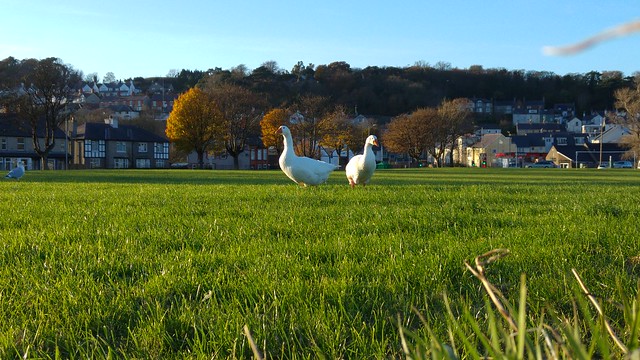
Gertie and Bertie

Grass [ɡɹɑːs/ɡɹas/ɡɹ̠æs] is:

  • Any plant of the family Poaceae, characterized by leaves that arise from nodes in the stem and leaf bases that wrap around the stem, especially those grown as ground cover rather than for grain.

It comes from Middle English gras [ɡras] (grass, herb, pasture, meadow, fodder), from Old English græs [ɡræs] (grass), from Proto-Germanic *grasą [ˈɣrɑ.sɑ̃] (grass) from Proto-Indo-European *gʰreh₁- (to grow, become green) [source].

Words from the same roots include grow, green, gray/grey, graze and herb in English, groen (green) in Dutch, grasen (to graze) in German, and rohi (grass, medicine) in Estonian [source].

Incidentally, in British slang, a grass is an informer, police informer, or one who betrays a group (of criminals, etc) to the authorities. This is probably an abbreviation of grasshopper (police officer, informant), which is rhyming slang for copper (police officer) or shopper (informant).

So we’d better not let the grass grow under our feet and kick this into the long grass, because the grass is always greener on the other side of the fence and if we listen carefully, we can hear the grass grow.

Other grass-related idioms and expressions are available, and I wrote a song about the grass appearing greener called The Other Side. It goes something like this:

You can also listen to this podcast on: Apple Podcasts, Amazon Music, TuneIn, Podchaser, Podbay or Podtail and other pod places.

If you would like to support this podcast, you can make a donation via PayPal or Patreon, or contribute to Omniglot in other ways.

Radio Omniglot podcasts are brought to you in association with Blubrry Podcast Hosting, a great place to host your podcasts. Get your first month free with the promo code omniglot.

The Fastest Way to Learn Japanese Guaranteed with JapanesePod101.com

I also write about words, etymology and other language-related topics on the Omniglot Blog, and I explore etymological connections between Celtic languages on the Celtiadur blog.

Unlimited Web Hosting - Kualo