Quintuple

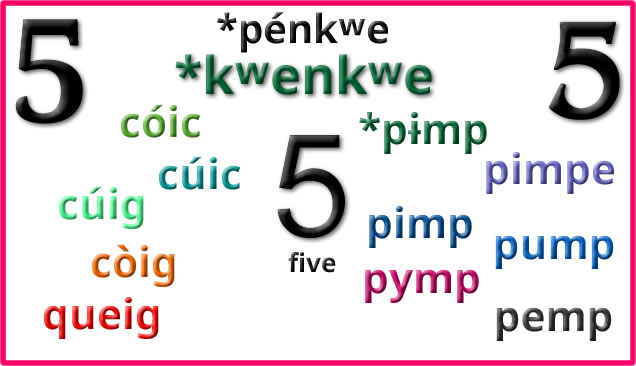
Words for five and related things in Celtic languages:

five

Proto-Celtic *kʷenkʷe = five
*kʷenkʷetos = fifth
Old Irish (Goídelc) cóic [koːɡʲ] = five
cóiced [ˈkoːɡʲeð] = fifth
cóicer = five people, five things
coíca = fifty
Middle Irish (Gaoidhealg) cóic, cúic = five
cóiced, cúced, coigid = fifth
cóicer, cóicir, cuicir = five people/things
cóic deac = fifteen
coíca, coícad, cóic deich = fifty
Irish (Gaeilge) cúig [kuːɟ] = five
cúigiú [kuːˈɟuː/ˈkuːɟu] = fifth
cúigear [ˈkuːɟəɾˠ] = five people/things
cúige = one of five divisions of Ireland, province
caoga = fifty
cúigbhliantúil = five-yearly, quinquennial
cúigchodach = fivefold, quintuple
cúigréad = quintet
Scottish Gaelic (Gàidhlig) còig [koːgʲ] = five
còigeamh(5ᵐʰ) fifth (4ᵗʰ))
còignear [koːgʲn̪ʲər] = five (people)
còigearan [koːgʲəran] = quintuplet
còig-fillte = quintuple, fivefold
caogad [kɯːgəd] = fifty
Manx (Gaelg) queig [kwɛɡ] = five
queigagh, queigoo = fifth
queigad = fifty
queigin, queig-lhiatteean = pentagon
queigane = quintuplet
queig-filley = quintuple, five-fold
Proto-Brythonic *pɨmp [pɨmp] = five
*pɨmped [pɘmˈpɛːd] = fifth
Gaulish pimpe, pempe = five
pimpetos = fifth
Old Welsh pimp = five
petguaret = fifth
pimmunt = fifty
Middle Welsh (Kymraec) pimp, pym(p), pvmp, pum(p) = five
pimphet, pemhet, pimhed, pymhed, pymhet = fifth
pymthec = fifteen
pymwnt, pumhwnt, pemhwnt, pummwnt = fifty
pvmplyc, pymplyg, pumplyg = quintuple, fivefold
Welsh (Cymraeg) pump [pɨ̞mp/pɪmp] = five
pumed [pɛdˈwɛrɨ̞ð] (5ed) = fifth
pumplyg = quintuple, fivefold, folded five times
pumpunt = five pounds, five-pound note, fiver
pedwaraid = set of five, fivesome
pumseiniol = pentatonic (music)
Middle Cornish (Cernewec) pymp, pemp = five
pympes = fifth
pymthec, pemdhac = fifteen
Cornish (Kernewek) pymp = five
pympes, pempes = fifth
pymthek, pemdhek = fifteen
pympbys, pempbes = starfish (“five finger”)
Old Breton pemp = five
Middle Breton (Brezonec) pemp, puemb = five
pempet, peempet, pempvet = fifth
pempaat = to group into five
pempkement = quintuple
pempkementiñ = to quintuple
pempkogneg = pentagon
Breton (Brezhoneg) pemp [pɛmp/pɛ̃mp] = five
pemp(v)et = fifth
pemzek = fifteen
pempad = quintet
pempkorneg = pentagon

Etymology: from Proto-Indo-European *pénkʷe (five) [source].

English words from the same roots include five, fifth, fifty, fifty, quintet, and words beginning with penta-, such as pentathlon and pentameter [source].

Sources: Wiktionary, Am Faclair Beag, Online Manx Dictionary, Teanglann.ie, eDIL – Electronic Dictionary of the Irish Language, In Dúil Bélrai English – Old Irish glossary, Geiriadur Prifysgol Cymru, Gerlyver Kernewek, Gerlyvyr Cernewec, Dictionaire Favereau, TermOfis, Le dictionnaire diachronique du breton, Geriafurch, English – ProtoCeltic WordList (PDF), Etymological Dictionary Of Proto Celtic

Fourfold

Words for four and related things in Celtic languages:

four

Proto-Celtic *kʷetwares = four
*kʷetwariyos = fourth
Gaulish petru, petuar = four
petuarios = fourth
Old Irish (Goídelc) cethair [ˈkʲeθirʲ] = four
cethramad [ˈkʲeθraṽað] = fourth
cethracha = forty
cethrar = four people
cethardúil = four elements
Middle Irish (Gaoidhealg) cethair = four
cethramad = fourth
cethrar = four people
cethracha = forty
cetharchair = four-sided, square, rectangular
cethairríad = four-wheeled chariot or carriage
cethardenus = space of four days
cethardóit = group of four
cetharaird = the four points of the compass, the four quarters, the world, universe
Irish (Gaeilge) ceathair [ˈcahəɾʲ/ˈcæɾʲ] = four, quadruped
ceithre [ˈcɛɾʲə/ˈçɛɾʲə] = four
ceathrar [ˈcahɾˠəɾˠ/cæːɾˠ] = four people
ceathracha = forty
ceathrú [cahˈɾˠuː] = quarter, thigh, quatrain
ceathrúnach = quartermaster
ceathairbhliantúil = quadrennial
ceathairchodach = fourfold, quadruple
ceathairchosach = fourfooted, quadruped
ceathairéad = quartet
ceathairfhillte = quarto, fourfold
Scottish Gaelic (Gàidhlig) ceithir [kʲehɪrʲ] = four
ceathramh [kʲɛrəv] (4mh) fourth (4th)
ceathrar [kʲɛrər] = four (people)
ceathrad [kʲɛrəd] = forty
cairteal [kar̪ˠʃdʲal] = quarter; quarters, lodgings
ceithir-chasach = quadruped, four-legged animal
ceithir-cheàrnach = quadrilateral
ceithir-fillte = quadruple, fourfold, four-ply
Manx (Gaelg) kiare [kʲeːə(r)] = four, foursome, quartet
kiarroo, (yn) chiarroo = (the) fourth
kerroo = fourth, quarter, quatrain
kiarad = forty
kiare-fillagh, kiare-filley = fourfold, quadruple
kiare-lhiatteeagh, kiare-lhiatteean = four-sided, quadrilateral
kiare-chassagh = four-footed, four-legged, quadruped
Proto-Brythonic *pedwar [pɛdˈwaːr] = four
*pėdwėrɨð [pe̝dwe̝ˈrˑɨːð] = fourth
Old Welsh petguar = four
petguaret = fourth
Middle Welsh (Kymraec) pedwar, peduar = four (m)
pedeyr, pedair, pedeir = four (f)
pedweryd = fourth (m)
pedwyred = fourth (m)
pedwar deg, pedeir deg = fourteen
pedwar/pedeir ar bymthec = nineteen
pedwar ugein(t) = eighty
Welsh (Cymraeg) pedwar [ˈpɛdwar] = four (m)
pedair [ˈpɛdai̯r/ˈpeːdai̯r] = four (f)
pedwerydd [pɛdˈwɛrɨ̞ð] (4ydd) = fourth (m)
pedwaredd [pɛdˈwarɛð] (4edd) = fourth (f)
pedwarplyg = quadruple
pedwaraf, pedwaru = to divide into four, quarter
pedwaraid = set of four, foursome
pedwar ar ddeg = fourteen
pedwar ar bymtheg = nineteen
pedwar deg = forty
pedwar ugain = eighty
Middle Cornish (Cernewec) peswar = four (m)
pedar = four (f)
peswere, pyswere = fourth
peswardhec, pazawardhak = fourteen
padzhar iganz = eighty
padzhar iganz ha deg = ninety
Cornish (Kernewek) peswar, pajar = four (m)
peder = four (f)
peswora, pajwora = fourth
peswartrosek = fourfooted
peswardhek = fourteen
peswar ugens = eighty
Old Breton petguar = four
petguare = fourth
Middle Breton (Brezonec) peuar, puar = four
peuare, pevare = fourth
peuarzec, pévarzecq, piarzeg = fourteen
peuaruguent, pêver huguent, pévar uguent = eighty
pevar-benveg = quartet
pevarc’hartier = to cut in quarters
pévar c’hemend = quadruple
pevar(-)c’hementi(ñ) = to quadruple
Breton (Brezhoneg) pevar = four (m)
peder = four (f)
pevare = fourth
pevarved = fourth (m)
pedervet = fourth (f)
pevarzek = fourteen
pevar-ugent = eighty
pevarad = quartet
pevarzuek = quadrilatéral

Etymology: from Proto-Indo-European *kʷetwóres (four) and *kʷetwr̥yós (fourth) [source].

English words from the same roots include four, quarter, quart, quartet, quaruple, and words beginning with tetra-, such as tetradecimal (a 14-base counting system) [source].

Sources: Wiktionary, Am Faclair Beag, Online Manx Dictionary, Teanglann.ie, eDIL – Electronic Dictionary of the Irish Language, In Dúil Bélrai English – Old Irish glossary, Geiriadur Prifysgol Cymru, Gerlyver Kernewek, Gerlyvyr Cernewec, Dictionaire Favereau, TermOfis, Le dictionnaire diachronique du breton, Geriafurch, English – ProtoCeltic WordList (PDF), Etymological Dictionary Of Proto Celtic

Threesome

Words for three and related things in Celtic languages:

three

Proto-Celtic *trīs = three
*tritiyos = third (in a sequence)
*trisano- = third (fraction)
Celtiberian Tiriś = three
Gaulish treis = three (m)
tiđres = three (f)
Lusitanian *trīs = three
Old Irish (Goídelc) tri, trí [tʲrʲiː] = three
tress = third (in a sequence)
trían = third (fraction)
tríar = three (people)
tréide = three things
trédenus = three days
tréimse = three months
Middle Irish (Gaoidhealg) trí = three
tress = third (in a sequence), one of three
trímad = third (in a sequence)
trían = third (fraction)
tríar = three persons, trio, three things
tréimse = three months, a quarter (of a year)
Irish (Gaeilge) trí [tʲɾʲiː] = three
tríú [tʲɾʲiːuː] = third (in a sequence), third part
triúr [tʲɾʲuːɾˠ] = three (people)
triantán = triangle
triantánacht = trigonometry
triantánaigh = to triangulate
tríoiseach = three-dimensional
Scottish Gaelic (Gàidhlig) trì [triː] = three
treas [tres] (3ˢ) third (3ʳᵈ)
treasamh (3ᵐʰ) third (3ʳᵈ)
triùir [truːrʲ] = three (people)
trì-fillte = triple, threefold, three-ply
trian [triən] = third (part)
triantan [triəndan] = triangle
iantanachd [iantanachd] = trigonometry
Manx (Gaelg) tree [t̪riː] = three
troor = three (people), threesome, triad, Trinity, trio, trinity
treeoo, trass = third
trooane, troorane = triangle
Proto-Brythonic *tri [triː] = three (m)
*teir = three (f)
*trɨdɨð [trɨˈdɨːð] = third (m)
*trɨdeð = third (f)
Old Welsh *tri [triː] = three (m)
*teir = three (f)
tritid = third (in a sequence)
trean = third (fraction)
Middle Welsh (Kymraec) tri = three (m)
teir, tair = three (f)
trited, trydet, trydyd = third
teir coglaỼc, trichonglaỼc, trichongloc = triangular, three-cornered
trydeblyc, tridyblic = three times, threefold, triple
Welsh (Cymraeg) tri [triː] = three (m),
tair [tai̯r] = three (f)
triawd = trio, threesome, triology, triple
trichorn = three-horned, three-cornered, tricorn hat
tric(h)onglog = triangular, three-cornered
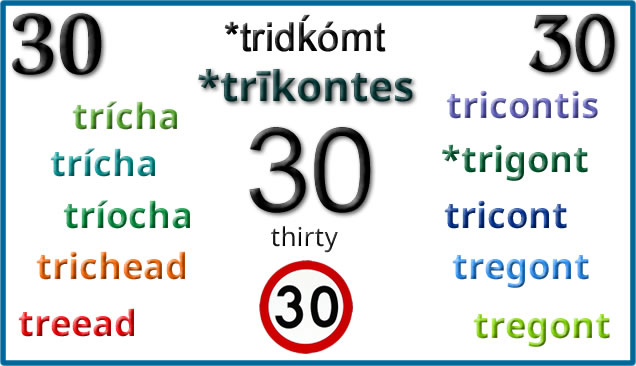
tri deg = thirty
tridyblyg = three times, threefold, triple, triplicate
trionglyn = triangle
trydydd (3ydd) = third (m)
trydedd (3edd) = third (f)
teirgwaith = three times, thrice, on three occasions
Middle Cornish (Cernewec) tri, trei = three (m)
teir, teyr = three (f)
triddydh = the space of three days
tridzha = third
trihans = three hundred
trindas, trinsys = Trinity
triugans = three score, sixty
trivorh = three-pronged
Cornish (Kernewek) tri, trei = three (m)
trei = three (f)
tredhek, terdhek = thirteen
tressa, tryja = third
triasen = triplet
trihorn = triangle
tryflek = threefold, triple
teyrgweyth = three times
Old Breton tri = three
Middle Breton (Brezonec) tri, try = three (m)
teir, teyr = three (m)
tri-c’hard = three quarters
tri-ugent = sixty
tri-chant = three hundred
triad = trio, group of three
tric’hogn, tricoign, tric’horn = triangle
Breton (Brezhoneg) tri = three (m)
teir [ˈte.iʁ] = three (f)
trived (m) teirved (f) = third
trizek = thirteen
tri-ugent = sixty
trifarzh = three quarters
tric’horn, tric’hogn = triangle

Etymology: from Proto-Indo-European *tréyes (three – m) and *tisres (three – f) [source].

English words from the same roots include tertiary, three, thrice, three, triad, tripod, triple and triplex [source].

Sources: Wiktionary, Am Faclair Beag, Online Manx Dictionary, Teanglann.ie, eDIL – Electronic Dictionary of the Irish Language, In Dúil Bélrai English – Old Irish glossary, Geiriadur Prifysgol Cymru, Gerlyver Kernewek, Gerlyvyr Cernewec, Dictionaire Favereau, TermOfis, Le dictionnaire diachronique du breton, Geriafurch, English – ProtoCeltic WordList (PDF), Etymological Dictionary Of Proto Celtic

Top Peaks

Words for top, peaks and related things in Celtic languages.
The Crowded Summit of Snowdon

Proto-Celtic *barros = top, point, peak
Gaulish Cunobarrus = personal name
Old Irish (Goídelc) barr = abundance, crop, crown, surplus, top, top, tree-top
Middle Irish (Gaoidhealg) barr = top, tip, end, crop, produce, climax, end, crown, supremacy, preeminence, transcendence
Irish (Gaeilge) barr [bˠɑːɾˠ] = tip, point, top, summit, upper part, surface, crop, yield, result, addition, excess, superiority, extremity
barrachas = predominance, surplus
barradh = hindrance
barraí = champion, superior person, arrogant person, bully
barraicín = tip, toe (of foot, stocking), toe-cap
barraíocht = excess
Scottish Gaelic (Gàidhlig) bàrr [baːr̪ˠ] = apex, crest, crown, summit, tip, top, zenith, surface, crop, produce, cream, son
barrachd = more, predominance, preponderance
barraidheachd = more, predominance, preponderance
barran = crest, hood, band(age), swaddling clothes
Manx (Gaelg) baare = apex, cap, climax, end, point, summit, tip, top, crest (of a wave), curl, interval, ruin, bare, film on milk, surface, crown
baarey = to bare, clip, dress, poll, prune, shave; trimmed
Middle Welsh (Kymraec) barr, bar [bar] = top, summit crest
Welsh (Cymraeg) bar [bar] = head, top, summit, crest, bush, tuft, branch
barbiaf, barbio = to trim, shave
Middle Cornish (Cernewec) bar = top, summit, branch
Cornish (Kernewek) barr = summit
Old Breton barr = branch, summit, ridge, peak
Middle Breton (Brezonec) barr, bar = branch, summit, ridge, peak
Breton (Brezhoneg) barr = summit, surface, access, paroxysm

Words marked with a * are reconstructions.

Etymology: from Proto-Indo-European *bʰr̥s-ó-s, from *bʰers- (point, top, tip). Words from the same PIE roots include barley in English, farine (flour) in French, bara (bread) in Welsh, Cornish and Breton, bairín (loaf) in Irish, and related words in Celtic languages [source].

Words from the same Proto-Celtic roots, via Gaulish, include baràz (bramble) in Romansh, barra (garret, loft, upper platform) in Galician [source].

Sources: Wiktionary, Am Faclair Beag, Online Manx Dictionary, Teanglann.ie, eDIL – Electronic Dictionary of the Irish Language, In Dúil Bélrai English – Old Irish glossary, Geiriadur Prifysgol Cymru, Gerlyver Kernewek, Gerlyvyr Cernewec, Dictionaire Favereau, TermOfis, Le dictionnaire diachronique du breton, Geriafurch, English – ProtoCeltic WordList (PDF), Etymological Dictionary Of Proto Celtic

The Fastest Way to Learn Japanese Guaranteed with JapanesePod101.com

Leaves

Words for leaves, foliage and related things in Celtic languages.

Here be trees!

Proto-Celtic *dolyā = leaf
Gaulish doula, dula = leaf
Old Irish (Goídelc) duilne = leaf
Middle Irish (Gaoidhealg) duille = leaf, foliage
duillebad = foilage
duillebar = leafage, foilage
duillech = leafy, abounding in foliage, leaf-shaped
Irish (Gaeilge) duille [d̪ˠɪlʲə] = leaf, foliage, eyelid, glory, wealth, handout, leaflet
duilleach = leafy, leaf-shaped, leaf-patterned
duilleachán, duilleoigín = leaflet
duilleog = leaf, page (of book), sheet (of paper)
duilligh = to foliate
duilliúr = leaves, foliage, greenery
Scottish Gaelic (Gàidhlig) duille [dɯl̪ʲə] = sheath, blade
duille-dhoras = valve
duilleach = foliage, leaf
duilleag = leaf, page, sheet, lobe, sternum
duilleach = leafy
duilleagach = leafy, abounding in leaves
Manx (Gaelg) duilley = leaf
duillag = page, pamphlet, sheet, leaf
duillaghey = foliation, infoliate, leaf
Proto-Brythonic *döl = leaf
Middle Welsh (Kymraec) deil = leaves, leaf, foliage, herbs
deilyar = with rustling leaves
deilyawc = leafy, green with foliage
deiloed = a tryst in a leafy bower
Welsh (Cymraeg) dail = leaves, leaf, foliage, (medicinal) herbs, (metal) foil
deiliaf, deilio = to bear/put forth leaves, to shoot or sprout (into foliage), to bear progeny
deiliant = sprouting of leaves, foliage, leafage
deiliar = with rustling leaves
deiliedig = bearing leaves, leafy
deilig = small leaf, leaflet
deiliog = leafy, green with foliage, leaf-like, laminated, foliate
dalen = leaf (of a book/table), sheet (of paper), plate, (metal) foil
Old Cornish delen = leaf
Middle Cornish (Cernewec) delen = leaf
deil = leaves
Cornish (Kernewek) delen = leaf
delennek = leafy
Old Breton dol = leaf, foliage
Middle Breton (Brezonec) deil, del = leaf
Breton (Brezhoneg) deil, del = leaf, foliage

Words marked with a * are reconstructions.

Etymology: from Proto-Indo-European *dʰelh₁- (to grow). Words from the same roots include դալար (dalar – green, verdant, young) in Armenian, dal (I exit, go out, leave) in Albanian, and θάλλω (thállō – to bloom, sprout, grow) in Ancient Greek, [source].

Sources: Wiktionary, Am Faclair Beag, Online Manx Dictionary, Teanglann.ie, eDIL – Electronic Dictionary of the Irish Language, In Dúil Bélrai English – Old Irish glossary, Geiriadur Prifysgol Cymru, Gerlyver Kernewek, Gerlyvyr Cernewec, Dictionaire Favereau, TermOfis, Le dictionnaire diachronique du breton, Geriafurch, English – ProtoCeltic WordList (PDF), Etymological Dictionary Of Proto Celtic
The Fastest Way to Learn Japanese Guaranteed with JapanesePod101.com

Sweet and Gentle

Words for dear, gentle, sweet and related things in Celtic languages.

Brodie Bichon Frise 9 weeks old

Proto-Celtic *koimos = dear, nice
Gaulish Coemo = name
Old Irish (Goídelc) cáem [koːi̯ṽ] = beloved, dear, fair, lovely, friend, noble
caíme = beauty, loveliness, charity, kindliness
Middle Irish (Gaoidhealg) cáem, cáomh = dear, precious, beloved, belonging to the family; fair, beautiful, lovely
cáemach = a noble
cáemaid = treats kindly, is gracious towards, cherishes
cáemaigid = to make smooth
cáemdae = fair, beautiful
cáemthach = friend, companion; company, companionship
Irish (Gaeilge) caomh [keːvˠ/kiːvˠ/kiːw] = dear one, companion, gentle, noble, person, dear, mild, pleasant, lovely, smooth
caomhantas = conservation, preservation
caoimhe = gentleness, mildness, sweetness, loveliness, smoothness
caomhach = attendant, protective
caomhnaí = companion
caoimhnaigh to cherish, preserve, conserve, protect
caomhnóir = guardian, protector, patron
caomhnú = preservation, conservation, protection
macaomh = young person, youth, boy, lad, cub (scout)
Scottish Gaelic (Gàidhlig) caomh [kɯːv] = kind, gentle, tender, beloved; kindness, gentleness, friend, beloved, object
caomhnadh [kɯ̃ːvnəɣ] = saving, conservation, economising, reserving, booking, reservation, sparing
caomhnachas [kɯ͂vnəxəs] = economy, frugality
caomhail [kɯːval] = friendly, gentle, kind
caomhan [kɯːvan] = kind/mild-mannered person, nobleman
caomhag [kɯːvag] = affectionate/gentle woman, lass(ie)
caomhalachd [kɯːvəl̪ˠəxg] = kindness
caomhradh [kɯ̃ːvra] = euphemism
caomh-chompanach = bosom friend/pal
Proto-Brythonic *kʉβ̃ = ?
Middle Welsh (Kymraec) ku, cu, cû = dear, beloved
kideb, kudeb = fondness, affection, dearness
Welsh (Cymraeg) cu [kɨː/kiː] = dear, beloved, amiable, pleasant, precious, beautiful; dear one, precious thing
cuaidd = loving, affectionate, precious
cudeb, cudab = fondness, affection, dearness
cudeg = fair and amiable
cuder = fondness, affection
mamgu = grandmother
tadcu = grandfather
Middle Cornish (Cernewec) cuf, cûf = dear, amiable, beloved, loving
cuef = dear, kindly
Cornish (Kernewek) kuv = affectionate, amiable, amicable, dear, kind, kindly, pleasant; beloved, darling
kuv kolon = sweetheart
kuvder = kindness
Old Breton cum = bright, brilliant, light, candle
Middle Breton (Brezonec) cuff, cûn, cuñ, kunv = affable, soft, sweet, gentle, mild
cuffhat, cuñhaat, kuñvaat = to become affable
cuffhadur, cuñhadur, kuñvadur = affability, moral sweetness
cuffheat, kuneet, kuñvaet = softened, soothed
Breton (Brezhoneg) kuñv [ˈkỹː] = benign, mild
kuñvded = mildness
tad-kuñv = great grandfather
mab-kuñv = great grandson
moereb-kuñv = great aunt

Words marked with a * are reconstructions.

Etymology uncertain [source].

The name Kevin comes from the Irish name Caoimhín [ˈkiːvʲiːnʲ] from the Middle Irish Caoimhghin [ˈkəiṽʲʝiːnʲ] from the Old Irish Cóemgein [ˈkoiṽʲɣʲinʲ], (also written Cáemgein/Cǽimgen), from cáem (beloved, dear) and gein (birth). Variants include Kevan, from the Irish diminutive version Caoimheán, and Caoimhe (anglicised as Keeva or Kweeva), a feminie version [source].

Versions of Kevin in other Celtic languages include Caomhan in Scottish Gaelic, Keveen in Manx, and Cefin in Welsh.

Proto-Celtic *kanis/*kani- = good, nice
Old Irish (Goídelc) caín [ˈkaːi̯nʲ] = fine, good, fair, beautiful, lovely
caíngním [ˈkaːi̯nʲɣʲnʲiːṽ] = good deed
Middle Irish (Gaoidhealg) caín = fine, good, fair, beautiful, soft, smooth, clement
Irish (Gaeilge) caoin [kiːnʲ] = smooth, delicate, gentle, refined
caoinbhéas = gentle, decent, habit
caoinbhéasach = gentle-mannered, decent
caoindéanta = fine, delicate (feature/figure)
caoine = smoothness, gentleness
Scottish Gaelic (Gàidhlig) caoin [kɯːn̪ʲ] = kind, mild, pleasant gentle, tender, delightful; dry, seasoned (hay)
caoin-bheusach = refined
feur-caoin = hay
Manx (Gaelg) keain = sweet-tempered, tender (memory)
Middle Welsh (Kymraec) cein, kein = fine, fair, beautiful; the first and best liquor brought to the hall
Welsh (Cymraeg) cain [kai̯n] = fine, fair, beautiful, bright, excellent, refined
cain wybodau, celfau cain = belles lettres, fine arts
Middle Breton (Brezonec) qan, qen, quen = beautiful, brilliant
Breton (Brezhoneg) ken = beautiful, brilliant

Words marked with a * are reconstructions.

Etymology: unknown, possibly from a non-Proto-Indo-European language [source]

Sources: Wiktionary, Am Faclair Beag, Online Manx Dictionary, Teanglann.ie, eDIL – Electronic Dictionary of the Irish Language, In Dúil Bélrai English – Old Irish glossary, Geiriadur Prifysgol Cymru, Gerlyver Kernewek, Gerlyvyr Cernewec, Dictionaire Favereau, TermOfis, Le dictionnaire diachronique du breton, Geriafurch, English – ProtoCeltic WordList (PDF), Etymological Dictionary Of Proto Celtic
The Fastest Way to Learn Japanese Guaranteed with JapanesePod101.com

Baskets

Words for baskets and related things in Celtic languages.

Baskets

Proto-Celtic *kleibo = (?)
Old Irish (Goídelc) clíab = basket, breast, chest, ribcage
Middle Irish (Gaoidhealg) clíab = basket, skep, bee-hive, coracle, currach, breast, bosom
cliabach = slender-bodied
cliabaire = infant
cliabán = cradle, bird-trip, bird-cage
Irish (Gaeilge) cliabh [klʲiəvˠ/klʲiəw] = ribbed frame; body, chest, bosom; creel, pannier basket
cliabhadóir = creel-maker
cliabhadóireacht = creel-making
cliabhaire = basket-carrier, travelling poultry-dealer
cliabhán = cradle, wicker cage
cliabhrach = bodily frame, chest, thorax; (person of) large frame
Scottish Gaelic (Gàidhlig) cliabh [kliəv] = basket, creel, pannier, ribcage, straightjacket
cliabhadh [kliəvəɣ] = (act of) putting into a creel
cliabhan = small creel, small hamper, wreckage, broken timbers
cliabhadair, cliabhair [kliəvədɪrʲ] = basket-maker
Manx (Gaelg) clean = pannier, potato creel, twig basket; cot, cradle
Middle Welsh (Kymraec) kauell, cawell = basket, pannier, cradle
cawelleit = basketful, hamperful, quiverful
Welsh (Cymraeg) cawell = basket, pannier; cradle; fish-trap, creel, cage; quiver; belly, breast
cawellaf, cawellu = to put into a hamper or basket; cradle
cawellaid = basketful, hamperful, quiverful
cawellig = little basket
cawellwr = basket-maker, maker of wicker fish-traps
Middle Cornish (Cernewec) cawal, cauwal, cowal = hamper, basket, pannier
cawel gwanan beehive
Cornish (Kernewek) kowel = hamper, basket, cage
kowel gwenen beehive
kowel-gwari = playpen
kowella = to cage
Old Breton cauell, cauèl, queuel, qavell = cradle, trap, locker
Middle Breton (Brezonec) kavell, kavel, kevell, cauell = cradle, trap, locker
kavell-bez = tomb
kavellad = contents of a trap
kavellañ = to put in a basket
Breton (Brezhoneg) kavell = cradle, trap, locker
kavell-bez = tomb

Etymology: from the Proto-Indo-European *ḱley- (to lean) [source]. Celtic words for fence, hurdle, lattice and related things come from the same root: more details, as do words for left and related things.

Words from the same Proto-Celtic root, via Gaulish and Latin, include claie (wicker rack, trellis, hurdle) in French and cheda (wattled laterals at the base of a traditional cart) in Galician [source].

Words from the same PIE root include client, climate, clinic, incline and lean in English, leunen (to lean) in Dutch, lehnen (to lean) in German, chinàre (to bend) in Italian, and clemente (lenient) in Spanish [source].

Old Irish (Goídelc) ces = basket
Middle Irish (Gaoidhealg) ces = basket, hamper, pannier, bee-hive, skep, causeway of hurdles
Irish (Gaeilge) cis [cɪʃ] = wicker container, basket, crate, plaited or crossed twigs as support for causeway
ciseach = wattled causeway, improved path, footbridge, over soft ground or drain, hamper
ciseachán = breadbasket, stomach
ciseán = (wicker) basket
ciseadóir = wicker-worker, basket-maker
ciseadóireacht = wicker-work, basketry
ciseog = shallow basket (for potatoes, etc)
cispheil = basketball
Scottish Gaelic (Gàidhlig) cis [kʲiʃ] = (large) woven/wicker basket, wickerwork panel, hurdle
ciseach [kʲiʃəx] = wickerwork path/bridge
ciseag, cisean, ciosan = small woven basket or creel, kishie
cisean [kliəvədɪrʲ] = basket-maker
Manx (Gaelg) kishan = skep
kishan pabyr = waste paper basket
kishan shellan = hive

Etymology: from Old Norse kista (chest, box), from Latin cista (trunk, chest, casket), from Ancient Greek κίστη (kístē – box, chest, casket), from Proto-Indo-European *kisteh₂ (woven container) [source].

Words from the same roots include chest in English, kist (chest, box, trunk, coffer) in Scots, Kiste (box, crate, case, chest) in German, ciste (chest, coffer, treasure, fund) in French, cesta (basket, hamper) in Spanish [source].

Irish (Gaeilge) bascaed = basket
Scottish Gaelic (Gàidhlig) basgaid [basgɪdʲ] = basket
basgaid-arain = breadbasket
basgaid-bidhe = hamper
basgaid-sgudail = wastebasket
ball-basgaid = basketball
Manx (Gaelg) basca(i)d, baskad, bastag = pannier, potato creel, twig basket; cot, cradle
bastag arran = breadbasket
bastageyr = basket maker
Middle Welsh (Kymraec) basged, bascet, basced = basket, basketful
basgedeit = basketful, hamperful
Welsh (Cymraeg) basgeg = basket, basketful
basgedaf, basgedu = to place in a basket, to make baskets
basged(i)aid = basketful, hamperful
basgedwaith = basketry, basketwork, wickerwork
basgedwr, basgedydd = basket-maker
Middle Cornish (Cernewec) basced = basket
Cornish (Kernewek) basket = basket

Etymology: from Middle English basket, from Anglo-Norman bascat (basket), possibly from Late Latin bascauda (a woven mat or vessel to hold basketwork), from Proto-Celtic *baskis (bundle, load), from Proto-Indo-European *bʰask- (bundle), or non-Indo-European source.

Words from the same Proto-Celtic root include bâche (tarpaulin, canvas sheet, cover) in French, vascullo (broom, bundle of straw) in Galician, basket in English, فَشْقَار (fašqār – a heap of sheaves) in Arabic [source].

Other words from the PIE root *bʰask- include fascis (bundle, burden, load, high office) in Latin, and possibly bast (fibre made from certain plants used for matting and cord) in English, bast (bast, raffia) in Danish, bast (inner bark, velvet, skin, hide) in Dutch, and bashkë (together, simultaneously) in Albanian [source].

There are more details on the Burdensome Loads Celtiadur post, and the Celtic Pathways Baskets episode.

Words marked with a * are reconstructions.

Sources: Wiktionary, Am Faclair Beag, Online Manx Dictionary, Teanglann.ie, eDIL – Electronic Dictionary of the Irish Language, In Dúil Bélrai English – Old Irish glossary, Geiriadur Prifysgol Cymru, Gerlyver Kernewek, Gerlyvyr Cernewec, Dictionaire Favereau, TermOfis, Le dictionnaire diachronique du breton, Geriafurch, English – ProtoCeltic WordList (PDF), Etymological Dictionary Of Proto Celtic
The Fastest Way to Learn Japanese Guaranteed with JapanesePod101.com

Region and Country

Words for region, country and related things in Celtic languages.

Marches 040519 884

Words marked with a * are reconstructions.

Proto-Celtic *mrogis = border(land), march, mark; region, country, territory, province
Gaulish *brogis = border(land) (?)
Old Irish (Goídelc) mruig [mruɣʲ] = cultivated land; march, borderland, country, territory
Middle Irish (Gaoidhealg) bruig = land, cultivated land, holding, region, district, border, (farm)house, abode, hall, mansion, castle
Irish (Gaeilge) brugh = dwelling, mansion
brughaidh = landowner, hosteler
Scottish Gaelic (Gàidhlig) brugh [bruh] = broch, fortified tower, large house, mansion, fairy mound, underground house
brughadair [bru.ədɪrʲ] = broch dweller, fairy mound dweller, elf
brughaire [bru.ɪrʲə] = inhabitant of a fairy mound
Manx (Gaelg) brogh = broch
Proto-Brythonic *broɣ [ˈbroːɣ] = country, region, territory
Middle Welsh (Kymraec) bro = region, country, land
Welsh (Cymraeg) bro [broː] = region, country, land, neighbourhood, native haunt; border, limit, boundary, march; vale, lowland
broaidd = pleasant like a vale
Middle Cornish (Cernewec) bro = country, region, land, territory, coast
Cornish (Kernewek) bro = country, land
Middle Breton (Brezonec) bro = country, nation, region
broa = to return to the country
broad = inhabitants, compatriots
broadel = national
Bro-C’hall = France
Bro-Gernev = Cornwall
Bro-Saoz = England
Bro-Skos = Scotland
Breton (Brezhoneg) bro [broː] = counry(-side)
broadadur = naturalization
broadeladur = nationalisation
broadelañ = to naturalize (a person)
Bro-C’hall = France
Bro-Saoz = England
Bro-Skos = Scotland

Etymology: from the Proto-Indo-European *morǵ- (frontier, border). Words from the same Proto-Celtic root, via Gaulish and Latin, include brolo (vegetable garden, orchard, grove) in Italian, and breuil (wood, copse, coppice) in French [source].

Words from the same PIE root include margin, mark (boundary, border, frontier) and march (a border region) in English, and marge (margin, markup) in French, margine (margin, border, edge) in Italian, and margen (margin, edge, leeway) in Spanish [source], Mark (a fortified border area, marches) in German, mark (field) in Danish, and marg (march, boundary) in Irish (via Old Norse) [source].

Sources: Wiktionary, Am Faclair Beag, Online Manx Dictionary, Teanglann.ie, eDIL – Electronic Dictionary of the Irish Language, In Dúil Bélrai English – Old Irish glossary, Geiriadur Prifysgol Cymru, Gerlyver Kernewek, Dictionaire Favereau, TermOfis, Dictionnaire de la langue gauloise, English – ProtoCeltic WordList (PDF), Etymological Dictionary Of Proto Celtic
The Fastest Way to Learn Japanese Guaranteed with JapanesePod101.com

Scotland

Words for Scotland and related things in Celtic languages.

Views from Sabhal Mòr Ostaig

Proto-Celtic *albiyū = luminous world, upper world, world; high mountain, alp; alpine pasture, Britain
Gaulish Albiorix = place name
Albiorica = place name
Old Irish (Goídelc) Albu [ˈalbu] = Scotland, Britain
Middle Irish (Gaoidhealgcausecause) Albu = Scotland, Britain
Albanach = an inhabitant of Albu, Scottish
Irish (Gaeilge) Alba [ˈalˠəbˠə] = Scotland (dated)
Albain [ˈaləbˠənʲ] = Scotland
Gaeilge na hAlban = Scottish Gaelic
Albainis = Scots (language)
Albanach = Scotsman, Scot, Scottish
Albain Nua = Nova Scotia
Scottish Gaelic (Gàidhlig) Alba [ˈal̪ˠabə] = Scotland
Albannach = Scot, Scotsman, Scottish
Albinish = Scots (language)
Gàidhlig (na hAlba) = Scottish Gaelic
Alba Nuadh = Nova Scotia
Manx (Gaelg) Nalbin, Albin, Albey = Scotland
Albinagh = Scots, Scotch, Scottish
Albinee = Scottish people
Albinish = Scots (language)
Gaelg Albinagh, Gaelg ny Halbey = Scottish Gaelic
(Yn) Albin Noa, Nalbin Noa = Nova Scotia
Proto-Brythonic *ėlβɨð [e̝lˈβɨːð] = world
Old Welsh elbid [ˈelvɨð] = (upper) world, earth, land, country, district
Middle Welsh (Kymraec) eluit, eluyt, eluyd = world. earth, land, country, district
eluyten, eluyden, elvydenn = earth, land, country, region
Albbu = Scotland
Albanyeit = Scot
Welsh (Cymraeg) elfydd = world. earth, land, country, district, neighbourhood; element
elfydden = earth, land, country, region
elfyddiaeth = chemistry
elfyddol  = material
(yr) Alban [ˈalban] = Scotland
Albanaidd = Scottish
Albaneg = Scots (language), Scottish Gaelic, Pictish
Albanes = Scottish woman or girl
Albanwr = Scot (m)
Alban Newydd = Nova Scotia
Cornish (Kernewek) Alban = Scotland, Scot (m)
albanek = Scottish
Albanes = Scot (f)
Alban Nowydh = Nova Scotia
Middle Breton (Brezonec) albaneg = Scots (language)
Breton (Brezhoneg) Albanad, albanat = Scottish
albaneg, albanek = Scots (language)

Etymology: from the Proto-Indo-European *h₂elbʰós (white). Alban in Welsh and Cornish was borrowed from Irish or Scottish Gaelic [Source].

Words from the same Proto-Celtic root include Albion (England – poetic) and Alps in English, Albiōn (Britain) in Gallo-Latin, Albānia (Caucasian Albania, Albania, Scotland) in Latin, and words for the Alps in many other languages [Source].

Words from the same PIE root include albino and elf in English, albus (white, clear, bright) in Latin, and alb (white, clean, pure) in Romanian [Source].

The country of Albania got its English name from the Byzantine Greek Ἀλβανία (Albanía), which referred to an ancient region and kingdom south of Caucasus mountains, east of Armenia and west of the Caspian Sea, also known as Caucasian Albania. The Greek name came from the Latin Albānus (Albania), which refers to Albania, Caucasian Albania or Scotland, and probably came from Proto-Celtic [Source].

Scotland in Breton is Bro Skos and Nova Scotia is (Bro-)Skos Nevez. Bro means country or region, and comes from the Proto-Brythonic *broɣ (country, region, territory), from the Proto-Celtic *mrogis (border, march, region, country, territory, province), from the PIE *morǵ- (frontier, border). Cognates in other Celtic languages include bro (region, country, land, border, limit) in Welsh, and bro (country, land) in Cornish [Source]. Skos was probably borrowed from the French Ecosse (Scotland).

Words marked with a * are reconstructions.

Sources: Wiktionary, Am Faclair Beag, Online Manx Dictionary, Teanglann.ie, eDIL – Electronic Dictionary of the Irish Language, In Dúil Bélrai English – Old Irish glossary, Geiriadur Prifysgol Cymru, Gerlyver Kernewek, Dictionaire Favereau, TermOfis, English – ProtoCeltic WordList (PDF), Etymological Dictionary Of Proto Celtic
The Fastest Way to Learn Japanese Guaranteed with JapanesePod101.com

Taking Hold

Words for to take, hold and related things in Celtic languages.

Breton Dancers

Proto-Celtic *gabyeti = to grab, seize, take, hold
*gabaglā = taking
*atigabaglā = distraint (the legal right of a landlord to seize the property of a tenant in the event of nonpayment of rent)
Celtiberian kabizeti = (?)
Gaulish *gabi- = to give (?)
*gabali = taking, seizure
Old Irish (Goídelc) gaibid [ˈɡavʲiðʲ] = to hold, grasp, take, seize, capture, gain (victory), put on (clothing), recite, declare
gabál = taking
argaib [arˈɡavʲ] = to seize, capture
athgabáil = recovery
congaibid [konˈɡavʲ] = to contain, preserve, keep, uphold
conocaibid [konˈhoɡəvʲ] = to raise, rise, uplift, exalt, extol
fogaibid [foˈɡavʲ] = to find, discover, get, gain, obtain
Middle Irish (Gaoidhealg) gaibid = to hold, grasp, take, seize, capture, gain (victory), put on (clothing), recite, declare
gabáil = taking
athgabáil = the process of recovery of debts, etc. by distraint, plunder, booty
aurgaibid = to seize, capture
congmaid = to contain, preserve, keep, uphold
Irish (Gaeilge) gabh [ɡavʲ/ɡo(ː)] = to take, arrest, go, come
gabháil = taking
aisghabh = to retake, recover possession of
athghabháil = recapture, recovery, re-engagement
gabh mo leithscéal = excuse me
urghabh = to seize, capture
Scottish Gaelic (Gàidhlig) gabh [gav] = take, go, recite, break (in)
ath-ghabh = retake, recover, regain, impound
gabh mo lethsgeul = excuse me, pardon
gabhail [gahal] = taking, lease, tenure, conquest
Manx (Gaelg) gow = to take
gow my leshtal = excuse me, sorry, I beg your pardon
goaill = acceptance, affect, apprehend, apprehension, arrest, capture, catch, contraction, engage, seizure, receive, take
aaghoaill = to recapture, reconquer, re-engage, retake
Proto-Brythonic *gabal- = breadth, side
*gavaɣl = to hold, grasp
Old Welsh gabael = to hold, grasp, grip
Middle Welsh (Kymreac) gauayleu, gauael = to hold, grasp, grip
gauaelant, gauaelu, gavailio = to hold tight, take hold, clutch
adauael, adafael = distraint (in law), distress, pledge
Welsh (Cymraeg) gafael [ˈɡavaɨ̯l/ˈɡaːvai̯l] = to hold, grasp, grip
gafaeladwy = available
gafaelaf, gafaelio = to hold tight, take hold, clutch, grip, arrest, grapple, snatch, seize
gafaeliad = a holding, hold, grasp, capture, attachment, comprehension, adherence, spasm
adafael = distraint (in law), distress, pledge
Middle Cornish (Cernewec) gaval = to hold, lay hold of, grasp, have
gavel = a hold, a grasp
Cornish (Kernewek) gavel = capacity, grasp
Old Breton gabael = to hold (?)
adgabael = to recover (?)

Etymology: from the Proto-Indo-European *gʰeh₁bʰ- (to grab, take) [source].

The Spanish word gavilla (sheaf, gang, band) comes from the same Proto-Celtic root, via the Late Latin gabella and the Gaulish *gabali (taking, seizure) [source].

Words from the same PIE roots include able, debt, debit, doubt and habit in English, avere (to have) in Italian, avoir (to have) in French, and haber (to hold, possess) in Spanish [source].

Words marked with a * are reconstructions.

The Fastest Way to Learn Japanese Guaranteed with JapanesePod101.com

Sources: Wiktionary, Am Faclair Beag, Online Manx Dictionary, Teanglann.ie, eDIL – Electronic Dictionary of the Irish Language, In Dúil Bélrai English – Old Irish glossary, Geiriadur Prifysgol Cymru, Gerlyver Kernewek, Lexicon Cornu-britannicum: A Dictionary of the Ancient Celtic Language of Cornwall, Dictionaire Favereau, TermOfis, Le dictionnaire diachronique du breton, Etymological Dictionary Of Proto Celtic