Quintuple

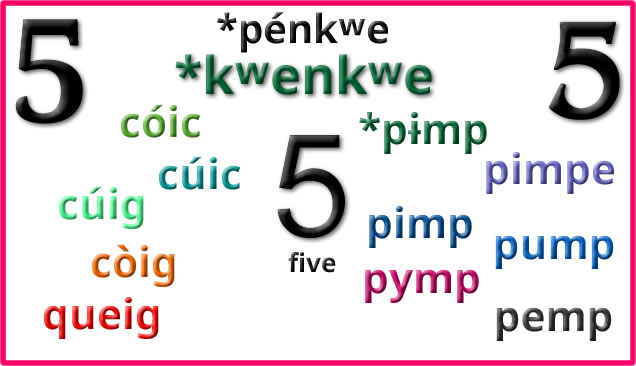
Words for five and related things in Celtic languages:

five

Proto-Celtic *kʷenkʷe = five
*kʷenkʷetos = fifth
Old Irish (Goídelc) cóic [koːɡʲ] = five
cóiced [ˈkoːɡʲeð] = fifth
cóicer = five people, five things
coíca = fifty
Middle Irish (Gaoidhealg) cóic, cúic = five
cóiced, cúced, coigid = fifth
cóicer, cóicir, cuicir = five people/things
cóic deac = fifteen
coíca, coícad, cóic deich = fifty
Irish (Gaeilge) cúig [kuːɟ] = five
cúigiú [kuːˈɟuː/ˈkuːɟu] = fifth
cúigear [ˈkuːɟəɾˠ] = five people/things
cúige = one of five divisions of Ireland, province
caoga = fifty
cúigbhliantúil = five-yearly, quinquennial
cúigchodach = fivefold, quintuple
cúigréad = quintet
Scottish Gaelic (Gàidhlig) còig [koːgʲ] = five
còigeamh(5ᵐʰ) fifth (4ᵗʰ))
còignear [koːgʲn̪ʲər] = five (people)
còigearan [koːgʲəran] = quintuplet
còig-fillte = quintuple, fivefold
caogad [kɯːgəd] = fifty
Manx (Gaelg) queig [kwɛɡ] = five
queigagh, queigoo = fifth
queigad = fifty
queigin, queig-lhiatteean = pentagon
queigane = quintuplet
queig-filley = quintuple, five-fold
Proto-Brythonic *pɨmp [pɨmp] = five
*pɨmped [pɘmˈpɛːd] = fifth
Gaulish pimpe, pempe = five
pimpetos = fifth
Old Welsh pimp = five
petguaret = fifth
pimmunt = fifty
Middle Welsh (Kymraec) pimp, pym(p), pvmp, pum(p) = five
pimphet, pemhet, pimhed, pymhed, pymhet = fifth
pymthec = fifteen
pymwnt, pumhwnt, pemhwnt, pummwnt = fifty
pvmplyc, pymplyg, pumplyg = quintuple, fivefold
Welsh (Cymraeg) pump [pɨ̞mp/pɪmp] = five
pumed [pɛdˈwɛrɨ̞ð] (5ed) = fifth
pumplyg = quintuple, fivefold, folded five times
pumpunt = five pounds, five-pound note, fiver
pedwaraid = set of five, fivesome
pumseiniol = pentatonic (music)
Middle Cornish (Cernewec) pymp, pemp = five
pympes = fifth
pymthec, pemdhac = fifteen
Cornish (Kernewek) pymp = five
pympes, pempes = fifth
pymthek, pemdhek = fifteen
pympbys, pempbes = starfish (“five finger”)
Old Breton pemp = five
Middle Breton (Brezonec) pemp, puemb = five
pempet, peempet, pempvet = fifth
pempaat = to group into five
pempkement = quintuple
pempkementiñ = to quintuple
pempkogneg = pentagon
Breton (Brezhoneg) pemp [pɛmp/pɛ̃mp] = five
pemp(v)et = fifth
pemzek = fifteen
pempad = quintet
pempkorneg = pentagon

Etymology: from Proto-Indo-European *pénkʷe (five) [source].

English words from the same roots include five, fifth, fifty, fifty, quintet, and words beginning with penta-, such as pentathlon and pentameter [source].

Sources: Wiktionary, Am Faclair Beag, Online Manx Dictionary, Teanglann.ie, eDIL – Electronic Dictionary of the Irish Language, In Dúil Bélrai English – Old Irish glossary, Geiriadur Prifysgol Cymru, Gerlyver Kernewek, Gerlyvyr Cernewec, Dictionaire Favereau, TermOfis, Le dictionnaire diachronique du breton, Geriafurch, English – ProtoCeltic WordList (PDF), Etymological Dictionary Of Proto Celtic

Fourfold

Words for four and related things in Celtic languages:

four

Proto-Celtic *kʷetwares = four
*kʷetwariyos = fourth
Gaulish petru, petuar = four
petuarios = fourth
Old Irish (Goídelc) cethair [ˈkʲeθirʲ] = four
cethramad [ˈkʲeθraṽað] = fourth
cethracha = forty
cethrar = four people
cethardúil = four elements
Middle Irish (Gaoidhealg) cethair = four
cethramad = fourth
cethrar = four people
cethracha = forty
cetharchair = four-sided, square, rectangular
cethairríad = four-wheeled chariot or carriage
cethardenus = space of four days
cethardóit = group of four
cetharaird = the four points of the compass, the four quarters, the world, universe
Irish (Gaeilge) ceathair [ˈcahəɾʲ/ˈcæɾʲ] = four, quadruped
ceithre [ˈcɛɾʲə/ˈçɛɾʲə] = four
ceathrar [ˈcahɾˠəɾˠ/cæːɾˠ] = four people
ceathracha = forty
ceathrú [cahˈɾˠuː] = quarter, thigh, quatrain
ceathrúnach = quartermaster
ceathairbhliantúil = quadrennial
ceathairchodach = fourfold, quadruple
ceathairchosach = fourfooted, quadruped
ceathairéad = quartet
ceathairfhillte = quarto, fourfold
Scottish Gaelic (Gàidhlig) ceithir [kʲehɪrʲ] = four
ceathramh [kʲɛrəv] (4mh) fourth (4th)
ceathrar [kʲɛrər] = four (people)
ceathrad [kʲɛrəd] = forty
cairteal [kar̪ˠʃdʲal] = quarter; quarters, lodgings
ceithir-chasach = quadruped, four-legged animal
ceithir-cheàrnach = quadrilateral
ceithir-fillte = quadruple, fourfold, four-ply
Manx (Gaelg) kiare [kʲeːə(r)] = four, foursome, quartet
kiarroo, (yn) chiarroo = (the) fourth
kerroo = fourth, quarter, quatrain
kiarad = forty
kiare-fillagh, kiare-filley = fourfold, quadruple
kiare-lhiatteeagh, kiare-lhiatteean = four-sided, quadrilateral
kiare-chassagh = four-footed, four-legged, quadruped
Proto-Brythonic *pedwar [pɛdˈwaːr] = four
*pėdwėrɨð [pe̝dwe̝ˈrˑɨːð] = fourth
Old Welsh petguar = four
petguaret = fourth
Middle Welsh (Kymraec) pedwar, peduar = four (m)
pedeyr, pedair, pedeir = four (f)
pedweryd = fourth (m)
pedwyred = fourth (m)
pedwar deg, pedeir deg = fourteen
pedwar/pedeir ar bymthec = nineteen
pedwar ugein(t) = eighty
Welsh (Cymraeg) pedwar [ˈpɛdwar] = four (m)
pedair [ˈpɛdai̯r/ˈpeːdai̯r] = four (f)
pedwerydd [pɛdˈwɛrɨ̞ð] (4ydd) = fourth (m)
pedwaredd [pɛdˈwarɛð] (4edd) = fourth (f)
pedwarplyg = quadruple
pedwaraf, pedwaru = to divide into four, quarter
pedwaraid = set of four, foursome
pedwar ar ddeg = fourteen
pedwar ar bymtheg = nineteen
pedwar deg = forty
pedwar ugain = eighty
Middle Cornish (Cernewec) peswar = four (m)
pedar = four (f)
peswere, pyswere = fourth
peswardhec, pazawardhak = fourteen
padzhar iganz = eighty
padzhar iganz ha deg = ninety
Cornish (Kernewek) peswar, pajar = four (m)
peder = four (f)
peswora, pajwora = fourth
peswartrosek = fourfooted
peswardhek = fourteen
peswar ugens = eighty
Old Breton petguar = four
petguare = fourth
Middle Breton (Brezonec) peuar, puar = four
peuare, pevare = fourth
peuarzec, pévarzecq, piarzeg = fourteen
peuaruguent, pêver huguent, pévar uguent = eighty
pevar-benveg = quartet
pevarc’hartier = to cut in quarters
pévar c’hemend = quadruple
pevar(-)c’hementi(ñ) = to quadruple
Breton (Brezhoneg) pevar = four (m)
peder = four (f)
pevare = fourth
pevarved = fourth (m)
pedervet = fourth (f)
pevarzek = fourteen
pevar-ugent = eighty
pevarad = quartet
pevarzuek = quadrilatéral

Etymology: from Proto-Indo-European *kʷetwóres (four) and *kʷetwr̥yós (fourth) [source].

English words from the same roots include four, quarter, quart, quartet, quaruple, and words beginning with tetra-, such as tetradecimal (a 14-base counting system) [source].

Sources: Wiktionary, Am Faclair Beag, Online Manx Dictionary, Teanglann.ie, eDIL – Electronic Dictionary of the Irish Language, In Dúil Bélrai English – Old Irish glossary, Geiriadur Prifysgol Cymru, Gerlyver Kernewek, Gerlyvyr Cernewec, Dictionaire Favereau, TermOfis, Le dictionnaire diachronique du breton, Geriafurch, English – ProtoCeltic WordList (PDF), Etymological Dictionary Of Proto Celtic

Threesome

Words for three and related things in Celtic languages:

three

Proto-Celtic *trīs = three
*tritiyos = third (in a sequence)
*trisano- = third (fraction)
Celtiberian Tiriś = three
Gaulish treis = three (m)
tiđres = three (f)
Lusitanian *trīs = three
Old Irish (Goídelc) tri, trí [tʲrʲiː] = three
tress = third (in a sequence)
trían = third (fraction)
tríar = three (people)
tréide = three things
trédenus = three days
tréimse = three months
Middle Irish (Gaoidhealg) trí = three
tress = third (in a sequence), one of three
trímad = third (in a sequence)
trían = third (fraction)
tríar = three persons, trio, three things
tréimse = three months, a quarter (of a year)
Irish (Gaeilge) trí [tʲɾʲiː] = three
tríú [tʲɾʲiːuː] = third (in a sequence), third part
triúr [tʲɾʲuːɾˠ] = three (people)
triantán = triangle
triantánacht = trigonometry
triantánaigh = to triangulate
tríoiseach = three-dimensional
Scottish Gaelic (Gàidhlig) trì [triː] = three
treas [tres] (3ˢ) third (3ʳᵈ)
treasamh (3ᵐʰ) third (3ʳᵈ)
triùir [truːrʲ] = three (people)
trì-fillte = triple, threefold, three-ply
trian [triən] = third (part)
triantan [triəndan] = triangle
iantanachd [iantanachd] = trigonometry
Manx (Gaelg) tree [t̪riː] = three
troor = three (people), threesome, triad, Trinity, trio, trinity
treeoo, trass = third
trooane, troorane = triangle
Proto-Brythonic *tri [triː] = three (m)
*teir = three (f)
*trɨdɨð [trɨˈdɨːð] = third (m)
*trɨdeð = third (f)
Old Welsh *tri [triː] = three (m)
*teir = three (f)
tritid = third (in a sequence)
trean = third (fraction)
Middle Welsh (Kymraec) tri = three (m)
teir, tair = three (f)
trited, trydet, trydyd = third
teir coglaỼc, trichonglaỼc, trichongloc = triangular, three-cornered
trydeblyc, tridyblic = three times, threefold, triple
Welsh (Cymraeg) tri [triː] = three (m),
tair [tai̯r] = three (f)
triawd = trio, threesome, triology, triple
trichorn = three-horned, three-cornered, tricorn hat
tric(h)onglog = triangular, three-cornered
tri deg = thirty
tridyblyg = three times, threefold, triple, triplicate
trionglyn = triangle
trydydd (3ydd) = third (m)
trydedd (3edd) = third (f)
teirgwaith = three times, thrice, on three occasions
Middle Cornish (Cernewec) tri, trei = three (m)
teir, teyr = three (f)
triddydh = the space of three days
tridzha = third
trihans = three hundred
trindas, trinsys = Trinity
triugans = three score, sixty
trivorh = three-pronged
Cornish (Kernewek) tri, trei = three (m)
trei = three (f)
tredhek, terdhek = thirteen
tressa, tryja = third
triasen = triplet
trihorn = triangle
tryflek = threefold, triple
teyrgweyth = three times
Old Breton tri = three
Middle Breton (Brezonec) tri, try = three (m)
teir, teyr = three (m)
tri-c’hard = three quarters
tri-ugent = sixty
tri-chant = three hundred
triad = trio, group of three
tric’hogn, tricoign, tric’horn = triangle
Breton (Brezhoneg) tri = three (m)
teir [ˈte.iʁ] = three (f)
trived (m) teirved (f) = third
trizek = thirteen
tri-ugent = sixty
trifarzh = three quarters
tric’horn, tric’hogn = triangle

Etymology: from Proto-Indo-European *tréyes (three – m) and *tisres (three – f) [source].

English words from the same roots include tertiary, three, thrice, three, triad, tripod, triple and triplex [source].

Sources: Wiktionary, Am Faclair Beag, Online Manx Dictionary, Teanglann.ie, eDIL – Electronic Dictionary of the Irish Language, In Dúil Bélrai English – Old Irish glossary, Geiriadur Prifysgol Cymru, Gerlyver Kernewek, Gerlyvyr Cernewec, Dictionaire Favereau, TermOfis, Le dictionnaire diachronique du breton, Geriafurch, English – ProtoCeltic WordList (PDF), Etymological Dictionary Of Proto Celtic

One Alone

Words for one and related things in Celtic languages:

One

Proto-Celtic *oinos/*oyno- = one
*oynānos = alone, personally
Old Irish (Goídelc) oen [oːi̯n] = one
oenar [ˈoːi̯nər] = one person, alone, by oneself
oentu [ˈoːi̯n͈tu] = oneness, unity
oínḟer [oːi̯nʲer] = one person
Middle Irish (Gaoidhealg) óen = one, the same, single, only, unique
oenar = a single individual, one alone, one person
oentu = oneness, unity, association, fellowship, alliance
Irish (Gaeilge) aon [eːn̪ˠ/iːnˠ] = one, any, same, only
aonad = unit
aonadach = unitary
aonán = individual
aonar = one, lone, person, single, solitary
aonarach = single, solitary, lone
aonaracht = singularity, solitude
aonarán = single, solitary person
aontaigh = to unite
aonú = first
Scottish Gaelic (Gàidhlig) aon [ɯ̃ːn] = one, same, sole, approximately, about
aonachd = unity, union
aonaich = to combine, coalesce, unite, intergrate
aonaichte = united, integrated
aonan = one item/thing/person
aonar = one (person), (state of being) alone
aonanag = onesie
aonaranach = alone, desolate, deserted, lone, solitary
aonrachd = solitude, solitariness
Manx (Gaelg) un [eːn/ɯːn/uːn] = one
unnane = one, identical, ace (in cards)
nane = one
unnaneagh = particular, singular, unanimous
unnaneysee, unnaneysey = to unite
unnaneysit = united
Proto-Brythonic *ʉn [ʉːn] = one
Old Welsh un = one
ungueid = once
Middle Welsh (Kymraec) un, vn [ʉn] = one, single, individual
unbin, vnbenn, unbyn = dictator, monarch, tyrant, despot, chief
unkyrn, vncorn, ynkorn = unicorn, one-horned
unweith, vn weith, vnwaith = once
Welsh (Cymraeg) un [ɨːn/iːn] = one, single, individual, only, sole, unique, special, united, combined
unaf, uno = to unite, unify, coalesce, amalgamate, combine, join, connect, agree, be reconciled
unaidd = united, unary
unawd = solo (music/dance)
unawdr, unawdydd = soloist
unben = dictator, monarch, tyrant, despot, chief
unbriodas = monogamy
uncorn, ungorn = unicorn, one-horned, chimney-stack
unwaith = once, (on) one occasion, (at) one or any time, sometime
Middle Cornish (Cernewec) un = one, individual
uncorn = unicorn
unsel = only, alone
unver = of one mind, unanimous, agreed
unya = to make one, unite, join
unwyth = once
Cornish (Kernewek) unn, udn [ˈʏn/ˈɪᵈn] = one, only, single, sole
unnik = individual, only, single, sole, unique
unplek = singular
unran = one-piece
unsel = only
unses = unit, unity
untu = one-sided, unilateral
unver = agreed, in agreement, unanimous
unweyth = incidentally, once, only
unya = to unite
Old Breton (Brethonoc) un = one
Middle Breton (Brezonec) un, unn, unan, vnan, en, eun, oun = one
unanaat = to unify
unanadur = unification
unanded = uniqueness
unander = singular
unanelezh = unit, unity
Breton (Brezhoneg) un, unan = one, someone, unit, unity
unvanadur = unification
unander = singular
unvaniñ = to unify
unanelezh = uniqueness

Etymology: possibly from Proto-Indo-European *(h₁)óynos (one, single) [source].

English words from the same roots include one, a, an and oenology (the study of wines and winemaking) [source].

Sources: Wiktionary, Am Faclair Beag, Online Manx Dictionary, Teanglann.ie, eDIL – Electronic Dictionary of the Irish Language, In Dúil Bélrai English – Old Irish glossary, Geiriadur Prifysgol Cymru, Gerlyver Kernewek, Gerlyvyr Cernewec, Dictionaire Favereau, TermOfis, Le dictionnaire diachronique du breton, Geriafurch, English – ProtoCeltic WordList (PDF), Etymological Dictionary Of Proto Celtic

Revenge

In this post we’re looking into words for revenge and related things in Celtic languages.

Revenge illustration

Proto-Celtic *dīgalā = revenge, vengeance
Old Irish (Goídelc) dígal [ˈdʲiːɣal] = revenge, vengeance, punishment
Middle Irish (Gaoidhealg) dígal = avenging, punishing; vengeance, punishment
Irish (Gaeilge) díoghail = vengeance, retribution, punishment; to avenge, punish
Scottish Gaelic (Gàidhlig) dìoghail [dʲiə.al] = revenge, vengeance
dìoghailte = revenged, avenged, retaliated
Manx (Gaelg) jeeyll, jeeill = damage, harmfulness, havoc, injury, prejudice, vandalism
Proto-Brythonic *diɣal = (?)
Old Welsh digal = vengeance, revenge, retribution, punishment
Middle Welsh (Kymraec) dial = vengeance, revenge, retribution, punishment
dialaeth = vengeance, revenge, punishment
Welsh (Cymraeg) dial [ˈdɪ.al/ˈdiː.al] = vengeance, revenge, retribution, punishment
dialaeth = vengeance, revenge, punishment
dialaethaf, dialaethu = to wreak vengeance upon, punish
dialaf, diala, dialu = to avenge, revenge, retaliate
dialaidd = revengeful, retributive
dialbren = gallows, gibbet, rack
dialedd = vengeance, retribution, nemesis, pain, disease, plague
dialeddwr = avenger, punisher
Middle Cornish (Cernewec) dyal, dial = revenge
Cornish (Kernewek) dial = retribution, revenge
Middle Breton (Brezonec) dial = vengeance, revenge
Breton (Brezhoneg) dial = vengeance, revenge, to take revenge

Words marked with a * are reconstructions.

Etymology: from *dī- (from, of) and‎ *galā (might, ability), possibly from Proto-Indo-European *ḱley- (naked, head) [source]. Words from the same PIE root include callow in English, kaal (smooth, bland, plain, bald) in Dutch, and kahl (bald, hairless, barren) in German [source].

Other words from the Proto-Celtic root *galā include gal (ardour, valour, fury) in Irish, gal (ardour, valour, fury, vapour, steam) in Scottish Gaelic, gaal/gall (vapour) in Manx, gâl (enemy, adversary) in Welsh, gal (outcast, villain) in Cornish, and gal (violent, intense, urgent) in Middle Breton [source].

The Proto-Celtic word *galnati (to be able) comes from the same root. Descendents include gallu (to be able to, to have power (to)) in Welsh, gallos (to be able to, can, ability, might, power) in Cornish, and gallout (to be able to) in Breton [source].

Sources: Wiktionary, Am Faclair Beag, Online Manx Dictionary, Teanglann.ie, eDIL – Electronic Dictionary of the Irish Language, In Dúil Bélrai English – Old Irish glossary, Geiriadur Prifysgol Cymru, Gerlyver Kernewek, Gerlyvyr Cernewec, Dictionaire Favereau, TermOfis, Le dictionnaire diachronique du breton, Geriafurch, English – ProtoCeltic WordList (PDF), Etymological Dictionary Of Proto Celtic

The Fastest Way to Learn Japanese Guaranteed with JapanesePod101.com

Scotland

Words for Scotland and related things in Celtic languages.

Views from Sabhal Mòr Ostaig

Proto-Celtic *albiyū = luminous world, upper world, world; high mountain, alp; alpine pasture, Britain
Gaulish Albiorix = place name
Albiorica = place name
Old Irish (Goídelc) Albu [ˈalbu] = Scotland, Britain
Middle Irish (Gaoidhealgcausecause) Albu = Scotland, Britain
Albanach = an inhabitant of Albu, Scottish
Irish (Gaeilge) Alba [ˈalˠəbˠə] = Scotland (dated)
Albain [ˈaləbˠənʲ] = Scotland
Gaeilge na hAlban = Scottish Gaelic
Albainis = Scots (language)
Albanach = Scotsman, Scot, Scottish
Albain Nua = Nova Scotia
Scottish Gaelic (Gàidhlig) Alba [ˈal̪ˠabə] = Scotland
Albannach = Scot, Scotsman, Scottish
Albinish = Scots (language)
Gàidhlig (na hAlba) = Scottish Gaelic
Alba Nuadh = Nova Scotia
Manx (Gaelg) Nalbin, Albin, Albey = Scotland
Albinagh = Scots, Scotch, Scottish
Albinee = Scottish people
Albinish = Scots (language)
Gaelg Albinagh, Gaelg ny Halbey = Scottish Gaelic
(Yn) Albin Noa, Nalbin Noa = Nova Scotia
Proto-Brythonic *ėlβɨð [e̝lˈβɨːð] = world
Old Welsh elbid [ˈelvɨð] = (upper) world, earth, land, country, district
Middle Welsh (Kymraec) eluit, eluyt, eluyd = world. earth, land, country, district
eluyten, eluyden, elvydenn = earth, land, country, region
Albbu = Scotland
Albanyeit = Scot
Welsh (Cymraeg) elfydd = world. earth, land, country, district, neighbourhood; element
elfydden = earth, land, country, region
elfyddiaeth = chemistry
elfyddol  = material
(yr) Alban [ˈalban] = Scotland
Albanaidd = Scottish
Albaneg = Scots (language), Scottish Gaelic, Pictish
Albanes = Scottish woman or girl
Albanwr = Scot (m)
Alban Newydd = Nova Scotia
Cornish (Kernewek) Alban = Scotland, Scot (m)
albanek = Scottish
Albanes = Scot (f)
Alban Nowydh = Nova Scotia
Middle Breton (Brezonec) albaneg = Scots (language)
Breton (Brezhoneg) Albanad, albanat = Scottish
albaneg, albanek = Scots (language)

Etymology: from the Proto-Indo-European *h₂elbʰós (white). Alban in Welsh and Cornish was borrowed from Irish or Scottish Gaelic [Source].

Words from the same Proto-Celtic root include Albion (England – poetic) and Alps in English, Albiōn (Britain) in Gallo-Latin, Albānia (Caucasian Albania, Albania, Scotland) in Latin, and words for the Alps in many other languages [Source].

Words from the same PIE root include albino and elf in English, albus (white, clear, bright) in Latin, and alb (white, clean, pure) in Romanian [Source].

The country of Albania got its English name from the Byzantine Greek Ἀλβανία (Albanía), which referred to an ancient region and kingdom south of Caucasus mountains, east of Armenia and west of the Caspian Sea, also known as Caucasian Albania. The Greek name came from the Latin Albānus (Albania), which refers to Albania, Caucasian Albania or Scotland, and probably came from Proto-Celtic [Source].

Scotland in Breton is Bro Skos and Nova Scotia is (Bro-)Skos Nevez. Bro means country or region, and comes from the Proto-Brythonic *broɣ (country, region, territory), from the Proto-Celtic *mrogis (border, march, region, country, territory, province), from the PIE *morǵ- (frontier, border). Cognates in other Celtic languages include bro (region, country, land, border, limit) in Welsh, and bro (country, land) in Cornish [Source]. Skos was probably borrowed from the French Ecosse (Scotland).

Words marked with a * are reconstructions.

Sources: Wiktionary, Am Faclair Beag, Online Manx Dictionary, Teanglann.ie, eDIL – Electronic Dictionary of the Irish Language, In Dúil Bélrai English – Old Irish glossary, Geiriadur Prifysgol Cymru, Gerlyver Kernewek, Dictionaire Favereau, TermOfis, English – ProtoCeltic WordList (PDF), Etymological Dictionary Of Proto Celtic

The Fastest Way to Learn Japanese Guaranteed with JapanesePod101.com

Taking Hold

Words for to take, hold and related things in Celtic languages.

Breton Dancers

Proto-Celtic *gabyeti = to grab, seize, take, hold
*gabaglā = taking
*atigabaglā = distraint (the legal right of a landlord to seize the property of a tenant in the event of nonpayment of rent)
Celtiberian kabizeti = (?)
Gaulish *gabi- = to give (?)
*gabali = taking, seizure
Old Irish (Goídelc) gaibid [ˈɡavʲiðʲ] = to hold, grasp, take, seize, capture, gain (victory), put on (clothing), recite, declare
gabál = taking
argaib [arˈɡavʲ] = to seize, capture
athgabáil = recovery
congaibid [konˈɡavʲ] = to contain, preserve, keep, uphold
conocaibid [konˈhoɡəvʲ] = to raise, rise, uplift, exalt, extol
fogaibid [foˈɡavʲ] = to find, discover, get, gain, obtain
Middle Irish (Gaoidhealg) gaibid = to hold, grasp, take, seize, capture, gain (victory), put on (clothing), recite, declare
gabáil = taking
athgabáil = the process of recovery of debts, etc. by distraint, plunder, booty
aurgaibid = to seize, capture
congmaid = to contain, preserve, keep, uphold
Irish (Gaeilge) gabh [ɡavʲ/ɡo(ː)] = to take, arrest, go, come
gabháil = taking
aisghabh = to retake, recover possession of
athghabháil = recapture, recovery, re-engagement
gabh mo leithscéal = excuse me
urghabh = to seize, capture
Scottish Gaelic (Gàidhlig) gabh [gav] = take, go, recite, break (in)
ath-ghabh = retake, recover, regain, impound
gabh mo lethsgeul = excuse me, pardon
gabhail [gahal] = taking, lease, tenure, conquest
Manx (Gaelg) gow = to take
gow my leshtal = excuse me, sorry, I beg your pardon
goaill = acceptance, affect, apprehend, apprehension, arrest, capture, catch, contraction, engage, seizure, receive, take
aaghoaill = to recapture, reconquer, re-engage, retake
Proto-Brythonic *gabal- = breadth, side
*gavaɣl = to hold, grasp
Old Welsh gabael = to hold, grasp, grip
Middle Welsh (Kymreac) gauayleu, gauael = to hold, grasp, grip
gauaelant, gauaelu, gavailio = to hold tight, take hold, clutch
adauael, adafael = distraint (in law), distress, pledge
Welsh (Cymraeg) gafael [ˈɡavaɨ̯l/ˈɡaːvai̯l] = to hold, grasp, grip
gafaeladwy = available
gafaelaf, gafaelio = to hold tight, take hold, clutch, grip, arrest, grapple, snatch, seize
gafaeliad = a holding, hold, grasp, capture, attachment, comprehension, adherence, spasm
adafael = distraint (in law), distress, pledge
Middle Cornish (Cernewec) gaval = to hold, lay hold of, grasp, have
gavel = a hold, a grasp
Cornish (Kernewek) gavel = capacity, grasp
Old Breton gabael = to hold (?)
adgabael = to recover (?)

Etymology: from the Proto-Indo-European *gʰeh₁bʰ- (to grab, take) [source].

The Spanish word gavilla (sheaf, gang, band) comes from the same Proto-Celtic root, via the Late Latin gabella and the Gaulish *gabali (taking, seizure) [source].

Words from the same PIE roots include able, debt, debit, doubt and habit in English, avere (to have) in Italian, avoir (to have) in French, and haber (to hold, possess) in Spanish [source].

Words marked with a * are reconstructions.

The Fastest Way to Learn Japanese Guaranteed with JapanesePod101.com

Sources: Wiktionary, Am Faclair Beag, Online Manx Dictionary, Teanglann.ie, eDIL – Electronic Dictionary of the Irish Language, In Dúil Bélrai English – Old Irish glossary, Geiriadur Prifysgol Cymru, Gerlyver Kernewek, Lexicon Cornu-britannicum: A Dictionary of the Ancient Celtic Language of Cornwall, Dictionaire Favereau, TermOfis, Le dictionnaire diachronique du breton, Etymological Dictionary Of Proto Celtic

Halves and Sides

Words for half, side and related things in Celtic languages.

half moon....

Proto-Celtic *letos = side
*ɸletos = breadth, side
Primitive Irish *ᚂᚓᚈᚐᚄ / *letas = half, direction, side
Old Irish (Goídelc) leth [l͈ʲeθ] = half, direction, side
Middle Irish (Gaoidhealg) leth = half, side
Irish (Gaeilge) leath [lʲah/lʲæx/l̠ʲæ] = side, part, direction; half, part, portion
leathach = divided in two, two-part
leithead = breadth, width
leathadh = spreading, spread, diffusion, scattering, broadcasting
Scottish Gaelic (Gàidhlig) leth [l̪ʲeh] = half, side, share
leth-ghlic = half-witted
leth-leanabh = twin
leth-oireachas = separation, partiality, isolationism, favouritism
leisgeul = excuse, apology, pretext (from leth and sgeul [story])
Manx (Gaelg) lieh = part, half, behalf, makeshift
lieh fuinnit = half-baked
lieh henn = middle aged
Proto-Brythonic *lled = breadth, side
Middle Welsh (Kymreac) let, llet, led = year (of age)
Welsh (Cymraeg) lled [ɬeːd] = breadth, width, beam (of boat), latitude, amplitude, extent, diameter, thickness; half, part(ly), fairly, moderately
lleda(e)naf, lleda(e)nu = to spread out, scatter abroad, disseminate
lladaf, lledu = to became broad(er) / wide(r), broaden, open out, expand, become widespread
lleden = flat-fish, flat or sprawling (person/thing), flattish mass, blade, fluke
Middle Cornish (Cernewec) les = breadth, width, latitude
Cornish (Kernewek) les = breadth, width
lesa = to expand, spread
lesans = expansion, spread
Middle Breton (Brezonec) led = width, wideness, breadth; horizontally
ledan = wide, large, broad, vast, big
ledañ, lediñ, ledek = to stretch out, extend, spread (out)
ledanaat = to widen, broaden, stretch
Breton (Brezhoneg) led = wide, large, broad, spreading
a-led = horizontal
ledan = vast, wide
ledañ = to spread, generalize
ledanded = width, breadth

Etymology: from the Proto-Indo-European *pléth₂-os (breadth), from *pleth₂- (broad, flat) [source]. Words from the same PIE roots include field, flan, flat and fold (a pen for animals) in English, flat in English, and πλατεία (plateía – town square) in Greek [source].

Proto-Celtic *santeros = middle, half
Proto-Brythonic *hanter = half
Old Welsh hanther = half
Middle Welsh (Kymreac) hanner, hanher = half, middle
Welsh (Cymraeg) hanner [ˈhanɛr/ˈhanar] = half, middle, midday, midnight, side, part
hanner-cylchynol = semicircular
hanner dydd = midday, noon
hanner nos = midnight
Middle Cornish (Cernewec) hanter = half, a moiety
hanter dŷdh = midday
hanter nôs = midnight
Cornish (Kernewek) hanter = half
hantera = to halve
hanterdydh = midday, noon
hantergylgh = hemisphere
hanterkans = fifty
hanter-mis = fortnight, two weeks
hanter-nos = midnight
hanter-our = half-hour
hanter-pennwari = semi-final
hanter termyn = half time
Middle Breton (Brezonec) hanter = half
hanterañ, hanteriñ = to halve, cut in half
hanter-kant = fifty
hanter-war-hanter = neck and neck, tied
Breton (Brezhoneg) hanter [ˈhɑ̃n.tɛʁ] = half
hanter dro = u-turn
hanterad = mediator
hanterenn = half time
hanternoz = midnight

Etymology: from the Proto-Indo-European *sm̥teros (one of the two), from *sem- (one) and *-teros (contrastive suffix) [source]. Other words from the PIE root *sem- (one) include: same, seem, semi, similar and single in English [source].

Words marked with a * are reconstructions.

Sources: Wiktionary, Am Faclair Beag, Online Manx Dictionary, Teanglann.ie, eDIL – Electronic Dictionary of the Irish Language, In Dúil Bélrai English – Old Irish glossary, Geiriadur Prifysgol Cymru, Gerlyver Kernewek, Dictionaire Favereau, TermOfis, English – ProtoCeltic WordList (PDF), Etymological Dictionary Of Proto Celtic

The Fastest Way to Learn Japanese Guaranteed with JapanesePod101.com

Magic and Spells

Today we’re looking at words for magic, spells, charms, prayers and related things in Celtic languages.

Witch

Proto-Celtic *brixtā = spell, magical formula, incantation
Celtiberian *bruxtia
Gaulish brixtia
Old Irish (Goídelc) bricht = charm, spell, incantation
Middle Irish (Gaoidhealg) bricht = incanation, charm, magic spell
Irish (Gaeilge) briocht = charm, spell, amulet
briocht sí = fairy charm
briocht a chanadh = to chant a spell
briocht draíochta = magic spell
Proto-Brythonic *briθ [ˈbriːθ] = charm, incantation
Middle Welsh (Kymraec) lleturith, lledrith, ledryth = magic, spell, charm, enchantment
llethrithawc, lledrithyawc, lleturithawc = magic, magical, enchanted
Welsh (Cymraeg) lled(f)rith = magic, spell, charm, enchantment; apparition, spectre, phantom; illusion, delusion, fantasy, imagination
lledrithaid = pretence, dissembling, deception
lledrithiaf, lledrithio = to counterfeit, fake, pretend, simulate
lledrithiog = magic, magical, enchanted
Old Breton brith = charm, incantation (?)
Breton (Brezhoneg) bre = incantation, magic

Etymology: from the Proto-Indo-European *bʰerHǵ- (enlighten). Words that probably come from the same Proto-Celtic root, via the Celtiberian *bruxtia, include bruja (witch, crone, hag, owl) in Spanish, bruxa (witch, hex) in Galician, bruxa (witch) in Portuguese, and bruixa (witch) in Catalan [source].

Old Irish (Goídelc) druídecht, draídecht = magic, wizardry, secret lore and arts of the druids
Middle Irish (Gaoidhealg) druídecht, draídecht, dráoidheachd = secret lore and arts of the druids, occult science, wizardry
Irish (Gaeilge) dríocht [ˈd̪ˠɾˠihaxt̪ˠə] = druidic art, druidism, witchcraft, magic, charm, enchantment
draíochtach = magical, bewitching, entrancing
draíochtúil = magic, magical
Scottish Gaelic (Gàidhlig) draoidheachd [drɯjəxg] = magic, socery, druidism
eun-draoidheachd = augury
slat-draoidheachd = magic wand/td>
Manx (Gaelg) druaight = charm, druid
druaightagh = charmer, charming, druid, magician, occult
druaightys = charming, druid, druidism, magic
fo druaight = charmed
Welsh (Cymraeg) derwyddiaeth [dɛrˈwəðjaɨ̯θ/dɛrˈwəðjai̯θ] = druidism, the druid cult
Cornish (Kerneweg) drewydhieth = druidism
Breton (Brezhoneg) drouizelezh / drouiziezh = druidism

Etymology: these words come from the same roots as words for druid.

Old Irish (Goídelc) ortha = prayer, incantation, spell, charm
oráit = prayer
Middle Irish (Gaoidhealg) ortha, órtha = prayer, incantation, spell, charm
orthanach = of prayers, wont to pray
oróit, oráit, oráid, oraoid = prayer, speech, oration
anoráit, anóráid = curse
Irish (Gaeilge) ortha = incantation, spell, charm, prayer
im ortha = unsalted butter used in charm-cure
óráid = oration, speech, address
óráideach = oratorical, declamatory.
óráidí = orator, speech-maker
óráidíocht = oratory, speech-making
Scottish Gaelic (Gàidhlig) ortha [ɔr̪ˠə] = incantation, (magical) prayer, amulet
ortha-bhàis = death incantation
ortha-ghràidh = love amulet / charm
òraid [ɔːrɪdʲ] = address, speech, lecture, talk
òraidiche [ɔːrɪdʲɪçə] = lecturer, orator, speechmaker
òraidearachd = oratory
talla-òraid = lecture hall / theatre
Manx (Gaelg) oraid = address, oration, speech
oraatagh = orator, speaker, oratorial
oraataght = oration
Proto-Brythonic *arọd = prayer, oration
Old Welsh (Kembraec) araut = speech, language, eloquence, address, oration
Middle Welsh (Kymraec) araỽd, arawt, araỽt, arawd = speech, language, eloquence, address, oration
Welsh (Cymraeg) arawd = speech, language, eloquence, address, oration, utterance, report, eulogy, prayer
arawduriaeth = oratory, rhetoric
Middle Cornish (Cernewec) areth = speech, oration
Cornish (Kerneweg) areth = lecture, oration, speech
arethek = rhetorical
arethor, arethores = lecturer, orator, speaker
arethva = platform
arethya = to lecture

Etymology: from Latin ōrātiō (speech, discourse, language, oration), from ōrō (to speak as an orator, plead, pray) from Latin ōs, ōris (mouth), or from Proto-Indo-European *h₂er- (to pronounce a ritual) [source].

The words for prayer and oration come from this Latin root, and the words for charm and incantation may do as well [source]. The Brythonic words come via Vulgar Latin *arātiō [source].

Words from the same roots include oration in English, oración (oration, sentence, clause, prayer) in Spanish, and oratorio (oratory, oratorio, oratorical, solemn) in Italian.

Old Irish (Goídelc) sén = blessing, charm, incantation, omen, prosperity, sign, snare
sénaid = to bless, charm (with spell), deny, reject, repudiate, sign
Middle Irish (Gaoidhealg) sén, seon, seún, sena, séna = sign, omen, augury, portent, incantation, charm, blessing, good luck, prosperity, happiness
sénaid, seanaidh = to mark with a sign, bless, put a spell on, put a charm on
Irish (Gaeilge) séan [ʃeːnˠ] = sign, omen, good luck, prosperity; to mark with a sign, to bless
séanaire = diviner, augur
séanaireacht = divination, augury
Scottish Gaelic (Gàidhlig) seun [ʃiən] = charm, magic invocation, protective spell
seunach [ʃiənəx] = charming, enchanting, charm-like
seunadair [ʃiənədɪrʲ] = enchanter
seunadaireachd [ʃiənədɪrʲəxg] = conjuring, enchanting
seunail [ʃiənal] = charmed, magical, happy, prosperous
seunmhorachd [ʃiənvərəxg] = magical power(s)
seunta [ʃiən̪ˠdə] = charmed, enchanted
seuntachan [ʃiəndəxan] = charm, enchantment
Manx (Gaelg) sheean = charm, fortune
Proto-Brythonic *suɨɣn = spell, incantation (?)
Middle Welsh (Kymraec) swyn, suen, = spell, incantation, sorcery, witchcraft, magic, remedy, charm
swyno, suyno = to charm, fascinate, allure, cast a spell (on), bewitch
swynedig, sỽynedic, swynedic = charmed, fascinated, charming, bewitched, blessed, happy
Welsh (Cymraeg) swyn [suːɨ̯n / sʊi̯n] = spell, incantation, sorcery, witchcraft, magic, remedy, charm
swyn(i)o = to charm, fascinate, allure, cast a spell (on), bewitch, divine, bless, protect
swynaidd = charming, enchanting
swynedig = charmed, fascinated, charming, bewitched, blessed, happy
swynwr, swynydd = sorcerer, magician, bewitcher, soothsayer
swynyddiaeth = sorcery, witchcraft, magic
Middle Cornish (Cernewec) sona, sone = to bless, hallow, sanctify, consecrate, charm
zona = to charm, hallow
Cornish (Kerneweg) sona = to bless, charm
sonell = charm
Breton (Brezhoneg) saouzan = disorientation, bewilderment, stupor, hypnosis
saouzanan, saouzanañ = to disorientate, hypnotise, go astray, misplace
saouzanidigezh = hypnotism
saouzanus = hypnotic

Etymology: from Latin signum (sign, mark, signal, miracle), from Proto-Italic *seknom (sign, statue), from Proto-Indo-European *sek- (to cut) or *sekʷ- (to follow). [source].

Words from the same roots include sign and signal in English, seña (sign, indication, gesture) and sino (destiny, fate, lot) in Spanish, and Segen (blessing) in German [source].

Proto-Celtic *soitos. *soyto- = magic
Proto-Brythonic *hʉd = magic, charm
hʉdol = charming, illusory
Middle Welsh (Kymraec) hut, hud = magic, wizardry, sorcery, witchcraft
hûdadwy, hydadwy = persuasive, enticing, seducible
Welsh (Cymraeg) hud [hɨːd/hiːd] = magic, wizardry, sorcery, witchcraft, spell, enchantment, charm, fascination, allurement, persuasion
hudadwy = persuasive, enticing, seducible
hudaf, hudo = to fashion or produce by magic, conjure, cast a spell upon, enchant, charm, entice, allure, persuade, seduce, beguile
hudaidd = alluring, charming, seductive
hudol = charming, enchanting, enticing, alluring, illusory, deceptive, deceitful
Old Cornish hudol = charming, illusory
Middle Cornish (Cernewec) huder = a deceiver, hypocritic, juggler, sorcerer
hudol = sorcerer
Cornish (Kerneweg) hus = charm, enchantment, illusion, magic, sorcery, spell
husa = to charm, create an illusion, enchant
Middle Breton (Brezonec) hud = magic
hudek, hudel = magic, magical
hudiñ = to charm, enchant, bewitch, delight
hudour = magician, wizard
hudouriezh = magic
Breton (Brezhoneg) hud = magic
hudek = magic, magical
hudour = magician, wizard

Etymology: from the Proto-Indo-Etymology *sh₂oy-tó-s (magic), from *sh₂ey (to bind, fetter) [source]. Words from the same PIE roots include seiður (magic, witchcraft, sorcery) in Icelandic, sejd (sorcery, witchcraft, magic potion) in Swedish, and seid (magic) in Norwegian [source].

Middle Irish (Gaoidhealg) pis(e)óc = charm, spell, sorcery, witchcraft
Irish (Gaeilge) piseog = charm, spell, superstition
piseogach = practising charms or spells, superstitious
piseogacht = superstitious practices
piseogaí = charm-setter, superstitious person
Scottish Gaelic (Gàidhlig) pisreag [ʃiən] = charm, spell, ensorcellment, sorcery, superstition
Manx (Gaelg) pishag = charm, incantation, spell, witchcraft
pishagagh = incantatory, magical, sorcerer, superstitious
pishagys = enchantment, magic
Middle Cornish (Cernewec) pystyc = witchery, magic, sorcery
pystry = witchcraft, magic, sorcery
Cornish (Kerneweg) pystri = magic, sorcery
pystrier = sorcerer, warlock, wizard
pystriores = sorcereress

Etymology: probably from Latin pyxis (a small box, for holding medicines or toiletries), from Ancient Greek πυξίς (puxís – box, tablet, cylinder), from πῠ́ξος (púxos – boxwood) [source]. The Hibero-English word piseog (an evil spell, curse) comes from the same roots, via Irish [source].

Old Irish (Goídelc) airnigde [ˈar͈ʲn͈ʲiɣʲðʲe] = prayer, praying
ar·neget = to pray
Middle Irish (Gaoidhealg) airnigde, airnaigde, airna(i)gthe, urnaidhi, urnaith = praying, prayer
airnaigid, ernaigit = to pray
airnaigthech, ernaigtech, urnaigtheach = prayerful, devout
Irish (Gaeilge) urnaí [uːɾˠˈn̪ˠiː / ˈʌɾˠn̪ˠi] = praying, prayer
urnaitheach = prayful, devout
Scottish Gaelic (Gàidhlig) ùrnaigh [ur̪ˠn̪ʲɪ] = praying, prayer
ùrnaigheach [ur̪ˠn̪ʲijəx] = pertaining to or abounding in prayers
Manx (Gaelg) yeearree = prayer, request, urge, wish, desire, aspiration; to solicit, importune
yeearreeagh = wistful, soliciting, yearning

Etymology: uncertain [source].

Middle Irish (Gaoidhealg) paitir, paidear = the Lord’s Prayer, paternoster
Irish (Gaeilge) paidir [ˈpˠɑdʲəɾʲ / ˈpˠædʲəɾʲ] = Paternoster, prayer
An Phaidir, Paidir an Tiarna = the Lord’s Prayer
paidreoireacht = praying
paidrín = Rosary
Scottish Gaelic (Gàidhlig) paidir [padʲɪrʲ] = the Lord’s Prayer, Pater Noster, rosary
Manx (Gaelg) padjer [ˈpaːʒər] = prayer, devotion
Padjer y Çhiarn = the Lord’s Prayer
goaill padjer = to pray, prayer

Etymology: from Latin pater (father), the first word of the Lord’s Prayer in Latin (Pater noster) [source].

The Fastest Way to Learn Japanese Guaranteed with JapanesePod101.com

Sources: Wiktionary, Am Faclair Beag, Online Manx Dictionary, Teanglann.ie, eDIL – Electronic Dictionary of the Irish Language, In Dúil Bélrai English – Old Irish glossary, Geiriadur Prifysgol Cymru, Gerlyver Kernewek, Dictionaire Favereau, TermOfis, English – ProtoCeltic WordList (PDF), Etymological Dictionary Of Proto Celtic

Unlimited Web Hosting - Kualo

Speckled and Spotted

Today we’re looking at words for speckled, spotted and related things in Celtic languages.

Speckled

Proto-Celtic *brikkos = speckled, spotted
Gaulish *brikkos
Old Irish (Goídelc) brecc [bʲrʲek] = checked, flecked, speckled, spotted, variegated
brecht = variegated
brechtnaigthe = variegated
Middle Irish (Gaoidhealg) brecc, breac, brec = speckled, spotted, variegated, patterned, ornamented, dappled
brecht = variegated, varied, various
brecht(g)na = many-hued
Irish (Gaeilge) breac [bʲɾʲak] = speckled, dappled, indifferent
breacachan = variegation
breachadh = speckling, dappling; variegation, scribbling writing, lightening (of colour)
breacaimsir = middling, fair but unsettled weather
breacaire = carver, engraver, engraving tool, scribbler
breacaireacht = variegation, chequering, carving, engraving, scribbling, doodling
breacán = tartan, plaid
Scottish Gaelic (Gàidhlig) breac [brʲɛxg] = speckled, spotted, spotty, dappled, variegated
breacadh = speckling, spotting, chequering, sprinkling, scattering
breacanach = pertaining to tartan, plaided
breacaichte = spotted, stippled
breac-seun = freckle
Breac a’ Mhuilinn = The Milky Way
Manx (Gaelg) breck = brindle, dapple-grey, medley, piebald, pied, speckle, spot, spotty, tartan, chequered, spotted, variegated
breck greiney = freckle
breck kiark = chickenpox
breckag = fleck of colour
breckan = brindle, medley, colour, plaid, tartan
breckanagh = tartan
breckey = brindle, chequering, dapple, freckle, mottle
Proto-Brythonic *brɨx = speckled, spotted
Middle Welsh (Kymraec) brych, brech = mottled, spotted, speckled
Middle Welsh (Kymraec) brych, brech = mottled, spotted, brindled
brychy = to dapple, mottle
brychau, brychav, brychæ = spots, marks, stains
brychedic, bryçedig = mottled, brindled, speckled, spotted
Welsh (Cymraeg) brych [brɨːχ/briːχ] = mottled, spotted, brindled, variegated, stained, defiled, freckled, spot, mark, blemish, stain, afterbirth, placenta
brychaf, brychu = to dapple, mottle, mark, stain, sully
brychau = spots, marks, stains
brych(i)edig = mottled, brindled, speckled, spotted
brech [brɛχ] = rash, pox, inoculation, vaccination, cowpox
brechaf, brechu, brecho = to vaccinate, innoculate
brechedig = vaccinated, vaccinee
brechiad = vaccination, inoculation, injection
brechlyn = vaccine
Cornish (Kernewek) brygh = pox, smallpox, spot
brygh rudh = measles
brygh yar = chickenpox
bryghlin = vaccine
bryghlina = to vaccinate
bryghlinans = vaccination
Middle Breton (Brezonec) brech, bræch = smallpox, vaccine, sheep pox
brahaing, brehain, brec’hagn = sterile
Breton (Brezhoneg) brec’h [ˈbrɛːx] = smallpox, vaccine
brec’hidigezh = vaccination
brec’h-den = smallpox, vaccine
brec’h-nij = chickenpox
brec’h-zu = thyphus

Etymology: from the Proto-Indo-European *perḱ- (motley, coloured, spotted) source]. Words for trout in Celtic languages are probably related.

Words from the same PIE root include perch in English, färg (colour) in Swedish, väri (colour) in Finnish, Farbe (colour, paint, dye) in German, and barva (colour, paint, ink) in Czech [source].

Proto-Celtic *ɸerkos, *ferko- = perch, speckled
Old Irish (Goídelc) erc = speckled, spotted, cow, salmon
Middle Irish (Gaoidhealg) erc = speckled, dark red, trout, salmon, a spotted or red-eared cow
Scottish Gaelic (Gàidhlig) earc [ɛr̪ˠxg] = speckled, spotted, striped, dark/blood red
Middle Welsh (Kymraec) erch = mottled, speckled, dappled, dun, bay, dusky, dark
Welsh (Cymraeg) erch [ɛrχ] = mottled, speckled, dappled, dun, bay, dusky, dark
erchlas = dapple-grey (of horse), dark blue colour
erchyll = horrible, hideous, ghastly, dire, terrible, dreadful, awful, frightful

Etymology: from the Proto-Indo-European *perḱ- (motley, coloured, spotted) source].

Proto-Celtic *mrixtos = painted, speckled
Proto-Brythonic *briθ [ˈbriːθ] = painted, speckled, variegated
Old Welsh brith = variegated, coloured
Middle Welsh (Kymraec) brith, breith, braith = variegated, coloured
Welsh (Cymraeg) brith [briːθ] = variegated, coloured, chequered, mottled, pied, spotted, speckled, brindled, grey; numerous, abundant
brith(i)af, brith(i)o = to colour, variegate, speckle, dapple, adorn, embroider, to turn grey (hair), to curdle, blot
brithder = spottedness, speckledness, gaudiness
britheg [ˈbriθɛɡ] = snake’s head fritillary (Fritillaria meleagris)
brithyll = (brown) trout
bara brith = bara brith (Welsh current loaf, lit. “speckled bread”)
Middle Cornish (Cernewec) brith = streaked, motley, variegated, parti-coloured, pied, speckled
brithel, breithil = mackerel
Cornish (Kernewek) brith = streaked, striped, tartan
britha = to dapple, mottle, streak
brithednek = freckled
brithel = mackerel
brithen = freckle
brithennek = freckled; fallow deer
brithki = mongrel
brithlen = tapestry
brithweyth = mosaic
brithys = dappled, mottled, spotted
Middle Breton (Brezonec) bris, brih, breh, briz = colourful, stained, dirty, piebald
brizadur = speckles, freckles
Breton (Brezhoneg) brizh = colourful, stained, piebald
brizhadenn = freckle
brizhellet = dappled, flecked

Etymology: from the Proto-Indo-European word *mr̥gʷ-tó-s, from *mergʷ- (dark, coloured) [source].

Sources: Wiktionary, Am Faclair Beag, Online Manx Dictionary, Teanglann.ie, eDIL – Electronic Dictionary of the Irish Language, In Dúil Bélrai English – Old Irish glossary, Geiriadur Prifysgol Cymru, Gerlyver Kernewek, Dictionaire Favereau, TermOfis, English – ProtoCeltic WordList (PDF), Etymological Dictionary Of Proto Celtic

The Fastest Way to Learn Japanese Guaranteed with JapanesePod101.com