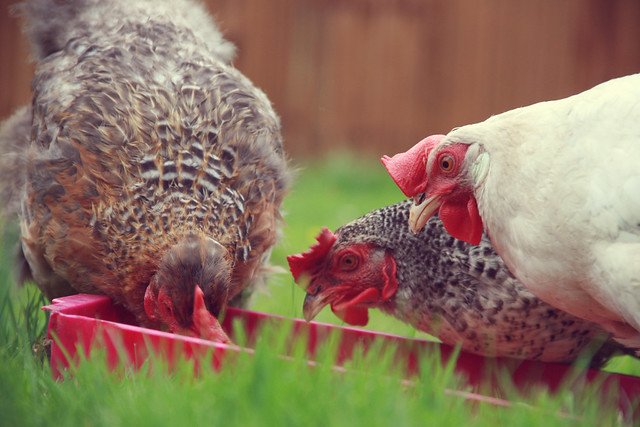
Hens & Chickens

Words for hen, chicken and related things in Celtic languages:

Hens

Proto-Celtic *kerkā = hen
Old Irish (Goídelc) cerc [kʲerk] = hen, female bird
Middle Irish (Gaoidhealg) cerc [kʲerk] = hen, female bird
Irish (Gaeilge) cearc [kaɾˠk] = hen, female bird
cearcach = gallinaceous (relating to, or resembling the domestic fowl)
Scottish Gaelic (Gàidhlig) cearc [kʲɛrxg] = hen, chicken; poultry; female crab or lobster
cearc-uisge = moorhen
cearc-Fhrangach = turkey
cearc-fhraoich = female red grouse, moorhen
cearcach = of, or belonging to a hen or hens
Manx (Gaelg) kiark = fowl, hen, hen bird, female bird
kiark

Etymology: from the Proto-Indo-European *ḱer- (to grow, nourish) [source]. These words are possibly related to words for heron and crane in Celtic languages.

English words from the same root include cereal, create, increase, creature, crew and crescent [source].

Proto-Celtic *yarā = chicken
Gaulish Iaros = personal name
Old Irish (Goídelc) eirín = pullet, young hen
Middle Irish (Gaoidhealg) eréne, éirín(e) = chicken, chick, pullet
Irish (Gaeilge) eireog = pullet, chicken; young girl, tiny woman
Scottish Gaelic (Gàidhlig) eireag [erʲag] = pullet, young chick(en) (between 8 months and 1 year old)
Manx (Gaelg) earrag = pullet, poult
Old Welsh iar = hen
Middle Welsh (Kymraec) yar = hen
yeyr, yeir = domestic fowls, chickens
yares = flock of chichens
ieirdy = hen-house, hen-coop
Welsh (Cymraeg) iâr [jaːr] = hen, hen-bird
ieir = domestic fowls, chickens
iarbren = perch for hens, hen-roost
iardy, ieirdy = hen-house, hen-coop
iares = flock of chichens
iargyw = chichen, young fowl
ieirwr = poulterer
Middle Cornish (Cernewec) iar, yar = hen, female bird
Cornish (Kernewek) yar = chicken, hen
yar frankres = free-range hen
yar gowellys = battery hen
yar Gyni = turkey
bregh/brygh yar = chicken pox
yarji = chichen coop, hen house
Middle Breton (Brezonec) yar, iar = chicken, hen
Breton (Brezhoneg) yar = chicken, hen

Etymology: unknown

Sources: Wiktionary, Am Faclair Beag, Online Manx Dictionary, Teanglann.ie, eDIL – Electronic Dictionary of the Irish Language, In Dúil Bélrai English – Old Irish glossary, Geiriadur Prifysgol Cymru, Gerlyver Kernewek, Gerlyvyr Cernewec, Dictionaire Favereau, TermOfis, Le dictionnaire diachronique du breton, Geriafurch, English – ProtoCeltic WordList (PDF), Etymological Dictionary Of Proto Celtic

Birds and Larks

Words for bird and (sky)lark in Celtic languages.

Proto-Celtic *ɸetnos = bird
Gaulish Etnosus = bird(?)
Old Irish (Goídelc) én [eːn] = bird
Irish (Gaeilge) éan [eːnˠ] = bird, young bird, chick
Scottish Gaelic (Gàidhlig) eun [ian] = bird, fowl, chicken
Manx (Gaelg) eean [jiːən] = chick, fowl, young (of birds); juvenile, cheeky child, brat
Proto-Brythonic edn = bird
Old Welsh atar = birds
Middle Welsh (Kymraec) edn [ˈɛdn] = bird
Welsh (Cymraeg) edn [ˈɛdn] = bird, fowl, fly, bee
adar [ˈadar] = birds
aderyn [aˈdɛrɨ̞n / aˈdeːrɪn] = bird
Old Cornish hethen = bird
Cornish (Kernewek) edhen = bird
Middle Breton ezn = bird
Breton (Brezhoneg) evn = bird

Etymology: from the Proto-Indo-European *péth₂r̥ (wind, feather), which is also the root of the English word feather [source].

Breton (Brezhoneg) labous = bird

Etymology: unknown

Old Irish (Goídelc) uiseóc = lark
Middle Irish (Gaoidhealg) (f)uiseóg = lark, skylark
Irish (Gaeilge) fuiseog = lark, skylark
Scottish Gaelic (Gàidhlig) uiseag [ɯʃag] = lark, skylark
Manx (Gaelg) ushag [ˈoʒaɡ] = bird, shuttlecock

Etymology: unknown

Proto-Celtic *alaudā = bird
Gaulish *alauda [ˈa.lau.daː] = skylark

Etymology: unknown. Also the root of the Latin alauda (lark, skylark), and words for (sky)lark in Romance languages, such as the French alouette, the Spanish alondra and the Italian allodola [source].

Welsh (Cymraeg) ehedydd [ɛˈhɛdɨ̞ð / ɛˈheːdɪð] = lark, skylark; flier, one that flies, bird or fowl
Old Cornish evidit = lark, skylark
Middle Breton ehuedez = lark, skylark

Etymology (Welsh): from ehedeg (to fly) and -ydd (-er) [source].

Cornish (Kernewek) ahwesydh = lark, skylark
Breton (Brezhoneg) alc’hweder = lark, skylark

Etymology: unknown

Words marked with a * are reconstructions.

Sources: Wiktionary, Am Faclair Beag, MacBain’s Dictionary, In Dúil Bélrai English – Old-Irish Glossary, teanglann.ie, On-Line Manx Dictionary, Geiriadur Prifysgol Cymru, Gerlyver Kernewek, Dictionnaire Favereau

Skylark

Foxes

Words for fox in Celtic languages.

Old Irish (Goídelc) sinnach / sindach = fox
Irish (Gaeilge) sionnach [ˈʃɪn̪ˠəx / ʃɪˈn̪ˠɑx / ˈʃɪn̪ˠax] = fox
Scottish Gaelic (Gàidhlig) sionnach [ˈʃun̪ˠəx] / seannach [ˈʃan̪ˠəx] = fox, bagpipe reed
Manx (Gaelg) shynnagh = fox

Etymology: unknown

Irish (Gaeilge) madra rua [madəɣ ‘r̪ˠuəɣ] = fox, red fox
Scottish Gaelic (Gàidhlig) madadh-ruadh [madəɣ ‘r̪ˠuəɣ] = fox, red fox

Etymology: from the Old Irish madrad (dog) and the rúad (red) [source].

Scottish Gaelic (Gàidhlig) balgair [bal̪ˠagɛrʲ] = fox

Etymology: unknown.

Proto-Celtic *loɸernos = fox
Gaulish *louernos = fox
Old Irish (Goídelc) loarn = fox
Proto-Brythonic llowern = fox
Old Welsh louern = fox
Middle Welsh (Kymraec) llewyrn = fox
Welsh (Cymraeg) llewyrn = foxes
Old Cornish louuern = fox
Cornish (Kernewek) lowarn = fox
Old Breton louuern = fox
Middle Breton louarn = fox
Breton (Brezhoneg) louarn [ˈluː.aʁn] / luhern = fox

Etymology: from Proto-Indo-European *h₂wlop- (fox) [source].

Welsh (Cymraeg) llwynog [ˈɬʊɨ̯nɔɡ] = fox, a cunning, craft or willy person, bundle
llwynoges = vixen, female fox
llwynogyn = little fox

Etymology: from llwyn (bush, shrub, brake, thicket, copse, grove, arbour, woods, forest) and the suffix -og, from Latin lignum (firewood, tree), Proto-Indo-European *leǵ-no- (that which is collected) [source].

Welsh (Cymraeg) cadno [ˈkadnɔ] = fox; craft person, foxy, deceptive day; bundle of straw used for constructing an air passage in a stack of corn not well-seasoned; skid, scotch, trigger
cadnawes = vixen, female fox

Etymology: probably from the personal name Cadno, from cad (battle), from the Proto-Celtic *katus (battle), from the Proto-Indo-European *kéh₃tus (fight); and the suffix -no, from the Proto-Celtic *gnāw- (knowing) [source].

Words marked with a * are reconstructions.

Sources: Wiktionary, Am Faclair Beag, MacBain’s Dictionary, In Dúil Bélrai English – Old-Irish Glossary, teanglann.ie, On-Line Manx Dictionary, Geiriadur Prifysgol Cymru, Gerlyver Kernewek, Dictionnaire Favereau

Fox

Deer

Words for deer in Celtic languages. There were several different words for deer in Proto-Celtic: *wēdus, *karwos, *ellan(t)ī-, *danī- and *yorkos, and also *sidos (stag). They may have referred to different types of deer, but it is not certain which types, apart from *yorkos, which is a roe deer.

Deer

Words marked with a * are reconstructions.

Proto-Celtic *wēdus [ˈweː.dus] = wild
Old Irish (Goídelc) fíad [fʲiːa̯ð] = wild animals, game, especially deer
Middle Irish (Gaoidhealg) fíad, fiad = wild animals, game, esp. deer
fíadamail = deer-like, wild, uncultivated
Irish (Gaeilge) fia [fʲiə] = deer
Scottish Gaelic (Gàidhlig) fiadh [fiəɣ] = deer
fiadhach [iə.əx] = deer hunting, venision, wildness, wilderness
fiadhachadh = deer hunting
Manx (Gaelg) feeaih, feeaïh = deer, hart
feeaihagh = deer hunting
feeaihaght = deer hunt

Etymology: from the Proto-Indo-European *weydʰ- (wood, wilderness) [source].

Proto-Celtic *karwos = deer, stag
Gaulish caruus, carvos, *caruos = deer
Old Irish (Goídelc) carbh = deer
Middle Irish (Gaoidhealg) cairrḟiad, cairrfiadh = stag
Irish (Gaeilge) carria / cairrfhiadh = deer, stag
Scottish Gaelic (Gàidhlig) cair-fhiadh / carbh-fheadh = hart, stag
Manx (Gaelg) çharroo, charroo = stag
Proto-Brythonic *karw = deer, stag
Old Welsh *caru = deer
Middle Welsh (kymraec) caru, carv, keyru, carw, karw = deer, hart, stag
carwaidd = having the attributes of a stag, pertaining to a stag, noble, wise
carwnaid, karwnaid = stag’s leap, a great leap
Welsh (Cymraeg) carw [ˈkaru / ˈkaːru] = deer, hart, stag; lord, nobleman, patron
carw coch / carw rhudd = red deer, stag
carw Llychlyn = reindeer
carwfarch = camel, elephant
carwfil = stag, camel
Old Cornish caruu = stag
Middle Cornish carow = stag
Cornish (Kernewek) karow = stag, buck, hart, stag
karow ergh = caribou, reindeer
karow rudh = red deer
Middle Breton caro, carv, caru = deer
Breton (Brezhoneg) karv [ˈkarw / ˈkɑːro] = deer, roe deer, red deer
karv-erc’h = caribou, reindeer
karvez = doe
karvig = fawn
karvken = deer hide

Etymology: from Proto-Indo-European *ḱerh₂wós, from *ḱerh₂- (horn) [source].

Proto-Celtic *sidos = stag
Old Irish (Goídelc) séd = deer
Middle Irish (Gaoidhealg) ség, ség, sedh = deer
Middle Welsh (Kymraec) hit, hyd, hed, hydd = stag, hart
hyddgarw, hawddgar = stag, deer, lord, patron, wise leader, horse
hyddgen, hydgen = deer-skin, buckskin
hyddgi = buck-hound, stag-hound, greyhound
Welsh (Cymraeg) hydd = stag, hart
hyddaidd = having the attributes of a stag, cervine
hyddgarw = stag, deer, lord, patron, wise leader, horse
hyddgen, hyddgroen = deer-skin, buckskin
hyddgi = buck-hound, stag-hound, greyhound
hyddgig = venison
Cornish (Kernewek) hedh = buck, hart, stag
Old Breton (Brethonoc) hed = deer, fallow deer
Middle Breton (Brezonec) heizes, eizec = doe, hind
Breton (Brezhoneg) heizez = doe, hind
heizezig = darling

Etymology: uncertain

Proto-Celtic *ellan(t)ī- / *agliones = deer
Old Irish (Goídelc) ag [aɣ] = bullock, cow, ox, deer, stag
Middle Irish (Gaoidhealg) ag, agh = cow, ox, deer, stag
Irish (Gaeilge) agh = cow, ox
agh alla = deer
agh dára = cow, ox
Scottish Gaelic (Gàidhlig) agh [ɤɣ] = heifer, hind
Middle Welsh (Kymraec) eilon, eilion = deer, hart, stag
Welsh (Cymraeg) eil(i)on = deer, hart, stag

Etymology: possible from the same root as the English word eland (a type of antelope found in South Africa), which from the Dutch eland (elk), from the Old High German elent.

Proto-Celtic *ou̯ījkā = ?
Gaulish cerua = ?
Old Welsh eguic = hind, deer
Middle Welsh (Kymraec) eguic, euic, euychet, euchyc, ewic, ewig = deer, hart, stag
ewigaidd = pertaining to hind(s), hind-like
Welsh (Cymraeg) ewig = hind, doe, roe; graceful light-footed woman; deer, hart
ewigfa = deer-park
Old Cornish euhic = hind, deer
Middle Cornish (Cernewec) ewic, euhic, ewig = hind, deer
Cornish (Kernewek) ewik = deer, doe, hind
ewik ergh = caribou, reindeer
ewik gowr = elk, moose
ewik rudh = red deer

Etymology: possibly from the Proto-Indo-European *h₂ówis (sheep) [source]

Proto-Celtic *yorkos = roebuck, deer
Gaulish iorkos, iorcos = deer
Proto-Brythonic *jorx = deer, stag
Welsh (Cymraeg) iwrch [jʊrχ] = roe-deer, roebuck
Old Cornish yorch = roe-deer
Middle Cornish (Cernewec) iorch, yorch = roe buck
iorches = roe deer
Cornish (Kernewek) yorgh = roe deer
yorghes = (female) roe deer
Old Breton iorch = roe deer
Middle Breton (Brezonec) yourch = roe deer
Breton (Brezhoneg) yourc’h [ˈjurx] = roe deer, venison, intrepid boy, wild
yourc’hez = (female) roe deer

Etymology: from the Proto-Indo-European *york- (antelope, gazelle) [source].

Proto-Celtic *danī- = deer
Middle Welsh (Kymraec) danys, danas = deer, fallow deer
Welsh (Cymraeg) danas, danys, daenas [ˈdanas] = deer, fallow deer
Middle Breton (Brezonec) dem = deer, fallow deer
Breton (Brezhoneg) demm = deer, fallow deer

Etymology: related to the French daim (hind, doe), from the Latin dāma (fallow deer, buck, doe) [source]

Sources: Wiktionary, Etymological Dictionary Of Proto Celtic, In Dúil Bélrai English – Old Irish glossary, eDIL – Electronic Dictionary of the Irish Language, Teanglann.ie, Am Faclair Beag, An etymological dictionary of the Gaelic language, Fockleyreen: Manx – English Dictionary, Online Manx Dictionary, Gaelg Corpus, Geiriadur Prifysgol Cymru, Lexicon cornu-britannicum : a dictionary of the ancient Celtic language of Cornwall, Gerlyver Kernewek, Devri : Le dictionaire diachronique du breton, Geriafurch, TermOfis

Roundness

Words for round and related things in Celtic languages.

Sabhal Mòr Ostaig

Words marked with a * are reconstructions.

Proto-Celtic *krundis = round
Old Irish (Goídelc) cruinn = round, globular, circular
Middle Irish (Gaoidhealg) cruinn, cruind = round, globular, circular, compact, precise
cruinne, cruindae = roundness, rotundity, round mass, universe, world, thrift, hoarding
cruinniucc, cruindiucc = dew-drop
Irish (Gaeilge) cruinn [kɾˠiːnʲ / kɾˠɪn̠ʲ] = round; gathered; exact, accurate; clear, coherent; concentrated; frugal, sparing, miserly
cruinne = roundness
cruinneachán = dome
cruinneog = round object, (small) orb, globe
cruinneogach = globular
cruinnteach = rotunda
Scottish Gaelic (Gàidhlig) cruinn [krɯin̪ʲ] = round, circular, spherical; rotund; neat, succinct, well-formed; assembled, gathered together
cruinne [krɯn̪ʲə] = roundness, globe, sphere, orb
cruinneachail [krɯn̪ʲəxal] = (ac)cumulative
cruinneachan [krɯn̪ʲəxan] = round heap/pile
cruinneachd [krɯn̪ʲəxg] = roundness
cruinnte [krɯn̪ʲdʲə] = curved, rounded
Manx (Gaelg) cruinn = accurate, detailed, unambigous, round, spherical, circular, circumstantial, compact, consummate, exact, scrupulous, strict
cruinnid = circularity, closeness, roundness, strictness, compactness
cruinnaghey = assemblage, congregation, enclose, focus, gather, huddle, round
Proto-Brythonic *krunn = round
Old Welsh (Kembraec) crunn = round, circular, rotund
Middle Welsh (Kymraec) cronn, crwn, cron = round, circular, rotund
Welsh (Cymraeg) crwn [krʊn] = round, circular, rotund, spherical, globular; cylindrical; fat, plump, fleshy; complete, entire; young, small
crynder = roundness
cân gron = round (in music); continual harping upon the same string
hirgrwn = oval
Middle Cornish (Cernewec) cren = round, circular
Cornish (Kernewek) krenn = round
Old Breton (Brethonoc) cren, cron = round
Middle Breton (Brezonec) crenn = round
crennaat = to round off
crenaff, crenna [ˈkrɛnːã] = to round up
Breton (Brezhoneg) krenn [ˈkrɛnː] = medium, round, rounded, full
krennañ [ˈkrɛnːã] = to trim, shorten, slice
krennaat = to round off
krennadur = rounding, trimmings
krennder = roundness

Etymology: unknown, possibly borrowed from a non-Indo-European language [Source].

The Fastest Way to Learn Japanese Guaranteed with JapanesePod101.com

Sources: Wiktionary, Am Faclair Beag, Online Manx Dictionary, Teanglann.ie, eDIL – Electronic Dictionary of the Irish Language, In Dúil Bélrai English – Old Irish glossary, Geiriadur Prifysgol Cymru, Gerlyver Kernewek, Dictionaire Favereau, TermOfis, English – ProtoCeltic WordList (PDF), Etymological Dictionary Of Proto Celtic

Unlimited Web Hosting - Kualo

Gentle treasure

Words for gift, treasure, benefit in Celtic languages.

Proto-Celtic *moinis = treasure, precious object
Old Irish (Goídelc) moín = gift, benefit
Irish (Gaeilge) maoin [mˠiːnʲ] = gift, benefit, property, wealth, treasure (term of endearment)
Scottish Gaelic (Gàidhlig) maoin [mɯːn̪ʲ] = asset, wealth, fund, gear, goods
Manx (Gaelg) mayn = property, good order
Proto-Brythonic *muɨn = beautiful
Old Welsh muin = worth, value
Middle Welsh (Kymraec) mwyn = worth, value
Welsh (Cymraeg) mwyn [muːɨ̯n / mʊi̯n] = tender, mild, gentle, meek, amiable, loving, kind, obliging, courteous, noble, fair, pleasant, sweet-sounding, melodious, soft, soothing
Old Cornish muin = gracile
Old Breton moin = delicate
Middle Breton moen = thin
Breton (Brezhoneg) moan [ˈmwãːn] = thin, slender

Etymology: from the Proto-Indo-European moynis [Source].

Words marked with a * are reconstructions.

Sources: Wiktionary, , Am Faclair Beag, MacBain’s Dictionary, In Dúil Bélrai English – Old-Irish Glossary, teanglann.ie, On-Line Manx Dictionary, Geiriadur Prifysgol Cymru, Gerlyver Kernewek, Dictionnaire Favereau

Treasure 013-1

Pigs

Words for pig and related beasts in Celtic languages:

Pigs

Words marked with a * are reconstructions.

Proto-Celtic *mokkus = pig
*mokk(w)yatis = swineherd
Old Irish (Goídelc) mucc [muk] = pig, sow; a war engine: a shed to cover sappers
muccaid [ˈmukiðʲ] = swineherd
muccaidecht [ˈmukiðʲext] = herding swine
Middle Irish (Gaoidhealg) muc, mucc = pig, sow
muc(c)ach = pertaining to swine
muc(c)aid = swineherd
muc(c)aidecht = herding swine
muc(c)álach = a brood or litter of pigs
muc(c)lach = piggery
Irish (Gaeilge) muc [mˠʊk] = pig; heap, bank, drift; scowl; sow
mucachán = (of person) pig, swine
mucaire = slovenly worker
mucaireacht = slovenly work
mucais = pit sty; dirty, slovely person; hogback
muicí = swineherd
muicíocht = swine-herding
Scottish Gaelic (Gàidhlig) muc [muxɡ] = pig, sow
mucag [muxgag] = little pig, piggy, (rose)hip
mucaidh = swineherd
mucaireachd = swineherding, herding pigs
muicfheoil [muçgʲɔl] = pork
muc-mhara [muxgˈvarə] = whale
muc-stigean = porpoise
Manx (Gaelg) muc = hog, swine, pig, grunter
muclagh = piggery, pigsty, sty
muick = swine
bochilley muickey = swineherd
muc hallooin = aardvark
muc varrey = whale, porpoise
Proto-Brythonic *mox = pig
*möxjad = swineherd
Middle Welsh (Kymraec) moch = pigs, swine
mochduy = pigsty
mochawg = piggish, swinish
meichiat, meicheit, meichad = swineherd
Welsh (Cymraeg) moch [moːχ] = pigs, swine, hogs; greedy, dirty, lazy, drunk, or immoral persons; small pumps used underground in coal-mines to remove water
mochyn [ˈmɔχɨ̞n / ˈmoːχɪn] = pig, swine, hog
mocha, mochi, mochian = to behave like a pig, wallow, grunt, defile, sully
mochach = contemptible or swinish people
mochaidd = swinish, filthy, dirty, vile, immoral, greedy
mochdra = filthiness, dirtines
mochdy = pigsty
mochgig = pork, ham, bacon
mochog = piggish, swinish
mochwr = swineherd, pig-dealer, untidy workman
meich(i)ad = swineherd
Middle Cornish (Cernewec) moch, môch = pigs
mochyn = pig
Cornish (Kernewek) mogh [mɔːx / moːʰ] = pigs, swine
Old Breton moch = pigs, swine
mochiat = swineherd
Middle Breton (Brezonec) moch = pigs, swine
Breton (Brezhoneg) moc’h [moːχ] = pigs, swine
moc’haer = swineherd

Etymology: borrowed from a non-Indo-European substrate language. Words from the same Proto-Celtic root include mocke (a slovenly woman) in Middle Dutch and moche (sow, female pig) in Middle High German [source].

Old Irish (Goídelc) cullach [ˈkul͈ax] = boar, stallion
muccullach = boar
Middle Irish (Gaoidhealg) cullach, colach = boar, stallion
Irish (Gaeilge) collach [kəˈl̪ˠɑx / ˈkɔl̪ˠəx / ˈkʌl̪ˠax] = boar (male pig); male crab; crude, fleshy, person
Scottish Gaelic (Gàidhlig) cullach = mature male (unneutered) animal (such as boars, hogs, etc)
Manx (Gaelg) collagh = boar, male, stallion
collagh muc = boar (domestic)
Welsh (Cymraeg) ceilliog = having testicles, uncastrated, entire, male
Middle Breton (Brezonec) callouch, qalloc’h, calloc’h = entire, standard, stallion
Breton (Brezhoneg) kalloc’h = entire

Etymology: from Proto-Celtic *kalljo- (testicle).

Proto-Celtic *t(w)orkos = boar (pig)
Old Irish (Goídelc) torc [tork] = (wild) boar, chieften, hero
Middle Irish (Gaoidhealg) torc = (wild) boar, chieftan, hero
Irish (Gaeilge) torc [t̪ˠɔɾˠk / t̪ˠʌɾˠk] = (wild) boar, hog; portly, corpulent person, man of substance
torcán = little, young boar; small corpulent person
torc allta = wild boar
torc-chú = boar hound
torcshleá = boar-spear
Scottish Gaelic (Gàidhlig) torc = [tɔr̪ˠxg] = boar, hog
torc-nimhe, torc-fiadhaich = wild boar
Middle Welsh (Kymraec) tỽrch, twrch, tyrch = hog, (wild) boar, mole
Welsh (Cymraeg) twrch [tʊrχ] = hog, (wild) boar, mole
twrch (y) coed = woodlouse
twrch daear = mole, badger
tyrchu, tyrchio = to burrow, dig (up), root up, nuzzle, rummage; to catch (moles)
tyrchaidd = hoglike, hoggish, swinish, greedy
tyrchwr, trychydd = mole-catcher, bulldozer
Old Cornish torch = hog
Middle Cornish (Cernewc) torch = hog
Cornish (Kernewek) torgh = hog, boar
Old Breton torch = boar
Middle Breton (Brezonec) tourch = boar, ram; a debauched man
Breton (Brezhoneg) tourc’h = boar, macho, debauched

Etymology: from the Proto-Indo-European *twerḱ- (to cut) [source]. English words from the same PIE root include trunk, truculent and sarcasm [source].

Proto-Celtic *sukkos = pig
Old Irish (Goídelc) socc = pig, sow
Middle Irish (Gaoidhealg) suic, socc, soc = snout, ploughshare
Irish (Gaeilge) soc [sˠɔk] = sow
socach = nozzled, snouted, beaked, pointed
socadán = person with pointed face, nosy person, interloper, busybody
Scottish Gaelic (Gàidhlig) soc [sɔxg] = beak, snout, sockt, ploughshare, short, chubby person
socach [sɔxgəx] = snouted, beaked
Manx (Gaelg) sock = bow, nose, snout, tow; ploughshare, nozzle
Proto-Brythonic *hux = pig
*sux = ploughshare
Welsh (Cymraeg) hwch [huːχ] = sow, pig, swine, dirty creature
Old Cornish hoch = pig, hog
Middle Cornish (Cernewec) hoch = pig, hog
hochwayu = hog-spear
Cornish (Kernewek) hogh = hog, pig, swine
hogh Gyni = Guinea pig
hoghwuwa = to pigstick
hoghwuwans = pig sticking
Old Breton hoch = sow
Middle Breton (Brezonec) houch, houc’h, hoh = sow
oc’hal, hoc’ha, hoc’he = to grunt, oink
oc’hellât, houc’hellat = to burrow, dig
hoch-goez, houch guez = wild boar
oh mor, hoc’h-mor = porpoise
houc’h-tourc’h = boar
Breton (Brezhoneg) houc’h = pig (male, often neutered)

Etymology: from the Proto-Indo-European suH- (pig, hog, swine). The English word hog was possibly borrowed into Old English from Welsh. Other words from the same Proto-Celtic root include socket in English, and soc (ploughshare) in French [source].

Proto-Celtic *ɸorkos = piglet
Gaulish *orkos = pork, piglet
Old Irish (Goídelc) orc [ork] = piglet
Middle Irish (Gaoidhealg) orc = young pig
Irish (Gaeilge) arc(án) = piglet
Scottish Gaelic (Gàidhlig) orc [ɔr̪ˠxg] = young animal, offspring (esp. piglet or sheep); whale (archaic)
orcan [ɔr̪ˠxgan] = piglet, young pig
Manx (Gaelg) ark = young pig, piglet, sucking pig
Pictish orc = piglet, young pig

Etymology: from the Proto-Indo-European pórḱos (piglet), which is also the root of the English word farrow (a litter of piglets), and the German word Ferkel (piglet) [source].

The name Orkney comes from the Old Norse Orkneyjar (seal islands), from orkn (seal) and ey (island). It is thought that Norwegian settlers reinterpreted the original Pictish tribal name element orc (piglet) [source].

Proto-Celtic *banwos = pig
Gaulish Banuus, Banuo = pig
Old Irish (Goídelc) banb [ban͈v] = piglet, young pig
Middle Irish (Gaoidhealg) banb, bainb = young pig
Irish (Gaeilge) banbh [ˈbˠanˠəvˠ] = piglet; Ace of Hearts
Middle Irish (Gaoidhealg) banb, bainb = young pig
Scottish Gaelic (Gàidhlig) banbh [banav] = young pig, piglet
banbhan [banavan] = small piglet
banbhradh [banavrəɣ] = herd of piglets
Manx (Gaelg) bannoo = sucking pig, piglet
Middle Welsh (Kymraec) banv = (young) pig, piglet
Welsh (Cymraeg) banw = (young) pig, piglet, weaned pig, hog; young animal
Old Cornish baneu = sow
Middle Cornish (Cernewec) banb = sow
Cornish (Kernewek) banow = sow
Middle Breton (Brezonec) banv = sow, pig
Breton (Brezhoneg) banv = mother sow

Etymology: unknown – possibly from a non-Indo-European language [source].

Proto-Brythonic *porxell = piglet
Middle Welsh (Kymraec) porchell, parchell = (young) pig, piglet
Welsh (Cymraeg) porchell [ˈpɔrχɛɬ] = sucking-pig, piglet, little pig, porker, pig, swine, hog
Old Cornish porchel = young pig, piglet
Middle Cornish (Cernewec) porhel = young pig, piglet
Cornish (Kernewek) porghel = young pig, piglet
porghellik = piglet, sucking pig
Old Breton porchill = piglet
Middle Breton (Brezonec) porhell, porchell, porchel = piglet
porchelles = sow
Breton (Brezhoneg) porc’helleg = piglet

Etymology: from the Late Latin porcellus (piglet), from the Latin porcus (pig), from the Proto-Italic *porkos (pig) from the Proto-Indo-European pórḱos (piglet) [source]. Words from the same PIE root include varken (pig) in Dutch, pork in English, and porc (pig, pork) in French [source].

Words marked with a * are reconstructions.

Sources: Wiktionary, Am Faclair Beag, Online Manx Dictionary, Teanglann.ie, eDIL – Electronic Dictionary of the Irish Language, In Dúil Bélrai English – Old Irish glossary, Geiriadur Prifysgol Cymru, Gerlyver Kernewek, Gerlyvyr Cernewec, Dictionaire Favereau, TermOfis, Le dictionnaire diachronique du breton, Geriafurch, English – ProtoCeltic WordList (PDF), Etymological Dictionary Of Proto Celtic
Horses

Words for horse, stallion, mare, foal and related things in Celtic languages.

Ceffylau / Horses

Note: the commonly-used words for horse in each Celtic language are: capall in Irish, each in Scottish Gaelic, cabbyl in Manx, ceffyl in Welsh, margh in Cornish, and marc’h in Breton.

Words marked with a * are reconstructions.

Proto-Celtic *kaballos, *kapallos, *kappilos = horse
Gaulish *caballos = horse
Old Irish (Goídelc) capall [ˈkapal͈] = horse
Middle Irish (Gaoidhealg) capall, capail = horse
Irish (Gaeilge) capall ˈkapˠəl̪ˠ] = horse, mare
capallach = equine
capaillín = pony
capall maide = wooden, vaulting horse, hobby-horse
Scottish Gaelic (Gàidhlig) capall [kahbəl̪ˠ] = mare, colt, horse, small horse
capall-aibhne = hippopotamus
capall-coille = capercaillie
capall-mara = seahorse
capallach [kahbəl̪ˠəx] = pertaining to or abounding in mares/colts
capallan [kahbəl̪ˠan] = small horse, pony
Manx (Gaelg) cabbyl = horse, mount
cabbyl awin = hippopotamus
cabbyl assylagh = mule
Proto-Brythonic *kėfɨl = horse
Middle Welsh (Kymraec) keffyl, ceffyl = horse
keffylyn = little horse, nag, pony
cavall, cauall = horse, steed
Welsh (Cymraeg) ceffyl [ˈkɛfɨ̞l / ˈkɛfɪl] = horse, nag, hobby
ceffyl yr afon = hippopotamus
ceffylaf, ceffylu = to put on horseback, put one to ride the high horse, extol
ceffylaidd = pertaining to horses, equine, horsy
ceffylan = little horse, nag
ceffyles = mare
ceffylyn = little horse, nag, pony
cafall = horse, steed
Middle Cornish (Cernewec) cevil, kevil = horse
Old Breton (Brethonoc) cefel = horse

Etymology: uncertain – related to the Late Latin caballus (horse, nag) and Ancient Greek καβάλλης (kabállēs – nag) and maybe Persian کول (kaval – second class horse of mixed blood). Possibly ultimately from PIE *kebʰ- (worn-out horse, nag). Words from the same roots include cheval (horse) in French, cavalier in English and caballo (horse) in Spanish [source].

The Breton word kefeleg (woodcock) comes from the same Proto-Brythonic root, as does kevelek (woodcock) in Cornish and cyffylog (woodcock) in Welsh [source].

Proto-Celtic *markos = horse
Galatian *μάρκαν (márkan) = horse
Gaulish *markos = horse
Old Irish (Goídelc) marc [mark] = horse
Middle Irish (Gaoidhealg) marc = horse
Irish (Gaeilge) marc [mˠaɾˠk] = horse (literary / archaic)
marcach = horseman, rider, jockey; cavalryman, Cavalier
marcachas = horsemanship
marchaigh = to ride
marcaíocht = riding, horsemanship, ride drive lift
Scottish Gaelic (Gàidhlig) marc [marxk] = charger (warhorse – literary)
marc-shluagh = horsemen, riders, cavalry
marchach = equestrian, mounted; riding
Manx (Gaelg) mark = horse
mark-sleih = horseman
markiagh = to ride, riding, cavalier, equestrian, horseman, jockey, rider
markiaghey = riding
markiaght = drive, equitation, horsemanship, (horse) riding, lift, rider
Proto-Brythonic *marx = horse
Middle Welsh (Kymraec) march = horse
Welsh (Cymraeg) march [marχ] = horse, stallion, war-horse, steed
marchaidd = pertaining to a horse, horsy, horselike, equine
marchallu = horsepower
marchasyn = jackass, male donkey
marchdy = stable
marchfeddyg = horse doctor, farrier
marchfilwr = dragoon, cavalryman, cavalier, trooper
marchog = horseman, rider, jockey, mounted warrior, knight
Old Cornish march = horse
Middle Cornish (Cernewec) march = horse
Cornish (Kernewek) margh [ˈmaɾx] = horse
marghek = knight, rider
margh-leska = rocking horse
marghnerth = horsepower
marghogeth = to ride (a horse)
marghti = stable
Old Breton (Brethonoc) marh = horse
Middle Breton (Brezonec) march = horse
marcheg, marhec = horseman, rider, knight
marecat = to ride (a horse)
marheguez = to ride (a horse), to dominate
Breton (Brezhoneg) marc’h [marx] = horse, easel
marc’h-tan [marxˈtãː.n] = motorbike
marc’heg [ˈmar.ɣɛk] = horseman, rider, knight
marc’hegkaat [mar.ɣe.ˈkɑːt] = to ride (a horse)
marc’hegañ =
marc’hegezh [marˈɣeːɡɛs] = to ride (a horse), to dominate
marc’hegiezh = chivalry, cavalry

Etymology: thought to be from the Proto-Indo-European *márkos, which is also the root of the English words mare and marshal, the French word maréchal (marshal), and related words in other languages [source].

Proto-Celtic *ekʷos [ˈe.kʷos] = horse
Celtiberian ekua- = horse
Gaulish epos = horse
Primitive Irish *ᚓᚊᚐᚄ (*eqas) [exʷah] = horse
Old Irish (Goídelc) ech [ex] = horse
Middle Irish (Gaoidhealg) ech = horse
airech = packhorse
Irish (Gaeilge) each [ax] = horse, steed (archaic)
eachach = abounding in horses
eachaí = horseman, jockey, equine
eachaire = horse-attendant, groom
each-chumhacht = horse-power
eachmharcach = horseman
Scottish Gaelic (Gàidhlig) each [ɛx] = horse
each-aibhne = hippopotamus
each-coimhlinge = racehorse
eachach [ɛxəx] = pertaining to or abounding in horses, horsy
eachaire [ɛxɪrʲə] = equerry
eachan [ɛxan] = small horse, yarnwindle
eachlach [ɛxl̪ˠəx] = horse groom, jockey
Manx (Gaelg) agh [ax] = steed, riding horse
aghee = equine
aghlagh, aghragh = equestrian
eagh = horse, racehorse, riding horse, steed
eagh marrey = sea horse
eagh-veg = hobbyhorse
Early Brittonic *epālos = foal
Proto-Brythonic *eb [ɛːb] = horse
*ebọl [ɛˈbɔːl] = foal
Old Welsh eb = horse
Middle Welsh (Kymraec) ep, ebawl = colt, foal
ebawluarch, ebolfarch, ebawlfarch = colt, young horse
ebolyauc, eboliauc = in foal, capable of bearing a foal
Welsh (Cymraeg) ebol [ˈɛbɔl / ˈeːbɔl] = colt, foal, sucker
eboles [ɛˈbɔlɛs] = filly, foal
ebolaidd = coltish, frisky, playful, wanton
ebolfarch = colt, young horse
cyfeb = mare in foal
ebolig = coltish
eboliog = in foal, capable of bearing a foal
Middle Cornish (Cernewec) ebel = foal, colt
Cornish (Kernewek) ebel = horse
Old Breton (Brethonoc) ebol = horse
Middle Breton (Brezonec) ebeul = foal, filly
Breton (Brezhoneg) ebeul [ˈe.bøl] = foal
ebeulan, ebeuliañ = to foal
ebeulez = filly
keneb = mare in foal

Etymology: from the Proto-Indo-European *h₁éḱwos, which is also the root of the Latin word for horse, equus, and the English word equine, and related words in English and other languages [source]. The horse goddess, Epona, may be related as well.

Proto-Celtic *uɸorēdos = horse
Gaulish *werēdos = horse
Proto-Brythonic *gworuɨð = horse
Middle Welsh (Kymraec) goruytaur, goruit, gorwyd , gorŵydd = steed, horse
gorwyddfarch = (war-)horse, steed
Welsh (Cymraeg) gorwydd = steed, horse
gorwyddfarch = (war-)horse, steed

Etymology: from the Proto-Celtic *uɸo- (under) and *rēdo- (to ride; riding, chariot), from Proto-Indo-European *(H)reydʰ- (to ride). Words from the same Celtic roots include palfrey (a small horse with a smooth, ambling gait), Pferd (horse) in German, and vereda (path, lane) in Spanish [source].

Proto-Celtic *(φ?)lārek- = mare
Old Irish (Goídelc) láir = mare
Middle Irish (Gaoidhealg) láir, lair = mare
Irish (Gaeilge) láír [l̪ˠɑːɾʲ] = mare
An Láír Bhán = the Milky Way
láír bhán = hobby-horse
láíreog = little mare, young mare, filly, well-built girl, woman
Scottish Gaelic (Gàidhlig) làir [l̪ˠaːrʲ] = mare
Manx (Gaelg) laair = mare
laaireen = small mare

Etymology: possibly from PIE *pōlH- (animal young), which is also the root of pony and foal in English, pollo (chicken) in Spanish, and poule (hen) in French [source].

Proto-Celtic *kanxstikā = mare
Middle Welsh (Kymraec) cassec, kassec = mare
Welsh (Cymraeg) caseg [ˈkasɛg] = mare
Old Cornish casec, cassec, casac = mare
Middle Cornish (Cernewec) casek = mare
Cornish (Kernewek) kasek = mare
Middle Breton (Brezonec) casec, casecq = mare
Breton (Brezhoneg) kazeg [ˈkɑː.zek] = mare

Etymology: from Proto-Indo-European *ḱonḱ- (horse) [source]. Words from the same root possibly include henchman in English, hengst (stallion) in Dutch, and häst (horse, knight) in Swedish [source].

Proto-Celtic *stirrākos = small animal, chick
Old Irish (Goídelc) serrach = colt, faol
Middle Irish (Gaoidhealg) serrach = colt, faol
Irish (Gaeilge) searrach = colt, faol
searrachúil = foal-like, lively, flighty
Scottish Gaelic (Gàidhlig) searrach [ʃɛr̪ˠəx] = colt, faol, filly
searrachan [ʃɛr̪ˠəxan] = little foal
searrach-ruadh = buzzard
Manx (Gaelg) sharragh = faol
sharraghoil = faol-like

Etymology: from PIE *stirp- (progeny). Words from the same root possibly include estirpe (lingeage) in Spanish, and sterpo (dry twig or branch, brushwood) in Italian [source].

The Fastest Way to Learn Japanese Guaranteed with JapanesePod101.com

Sources: Wiktionary, Am Faclair Beag, Online Manx Dictionary, Teanglann.ie, eDIL – Electronic Dictionary of the Irish Language, In Dúil Bélrai English – Old Irish glossary, Geiriadur Prifysgol Cymru, Gerlyver Kernewek, Dictionaire Favereau, TermOfis, English – ProtoCeltic WordList (PDF), Etymological Dictionary Of Proto Celtic

Unlimited Web Hosting - Kualo

Bald & bare

Words for bald / bare in Celtic languages:

Proto-Celtic *mailos = bald, bare
Primitive Irish ᚋᚐᚔᚂᚐᚌᚅᚔ (mailagni) = bald, bare
Old Irish (Goídelc) máel [maːi̯l] = bald, bare, shaved, shorn, tonsured; (of cattle) hornless; blunt, flattened, obtuse, pointless, exposed, defenceless
Irish (Gaeilge) maol [mˠeːl̪ˠ / mˠiːlˠ] = bald, bare, unprotected; flat (in music)
Scottish Gaelic (Gàidhlig) maol [mɯːl̪ˠ] = bare, blunt, hornless, polled; easily deceived; dense, dull; flat (in music)
Manx (Gaelg) meayl = bald, hairless, bleak (place), hornless, obtuse; flat (in music)
Proto-Brythonic *moɨl = bold
Old Welsh mail = sea
Middle Welsh (Kymraec) moel = sea
Welsh (Cymraeg) moel [moːɨ̯l / mɔi̯l] = bald, bald-headed, crop-haired, tonsured, beardless; bare, barren, mere; unadorned, plain, discourteous, barefaced; empty (hands); hornless, earless; lacking a tower (of a castle), defective; (bare) mountain, (treeless) hill, top of a hill or mountain, summit, mound; heap
Cornish (Kernewek) mool = bald, bare
Middle Breton moel = bald, bare
Breton (Brezhoneg) moal = bald, bare, naked

Etymology: uncertain, possibly related to the Proto-Germanic *maitaną (cut) [source].

Sources: Wiktionary, Am Faclair Beag, teanglann.ie, On-Line Manx Dictionary, Geiriadur Prifysgol Cymru, Gerlyver Kernewek, Dictionnaire Favereau

Sumburgh Head

Seas

Words for sea, ocean and related things in Celtic languages.

Newquay

Words marked with a * are reconstructions.

Proto-Celtic *mori = sea
Primitive Irish *ᚋᚑᚏᚔᚅ (*morin) = sea
Old Irish (Goídelc) muir [murʲ] = sea
muirbolc = inlet
romuir = ocean, sea
Middle Irish (Gaoidhleag) muir = the sea, ocean
Irish (Gaeilge) muir [mˠɪɾʲ] = sea
muirbhealach = sea route, seaway
muirbhrúcht = tidal wave, (sea) eruption, invasion (by sea)
muirí = marine, maritime
muireolaí = oceanographer
muireolaíicht = oceanography
Scottish Gaelic (Gàidhlig) muir [murʲ] = sea
muireil [murʲal] = maritime
muir-acainneach = seaworthy
muir-èolas = hydrography
muir-làn = high water/tide
muir-thìreach = amphibious
muir-tràghadh = low tide, low-water
Manx (Gaelg) mooir = sea
mooiroil = marine
mooiragh = dune, estuary, maritime, mariner
mooir-oaylleeaght = oceanography
mooir-lane = high tide
mooir-hraie = low tide
Proto-Brythonic *mor = sea
Middle Welsh (Kymraec) mor, myr, mŷr = sea, ocean
morad, mor-rad = produce of the sea
morawl = sea-inlet, estuary
morben = promontory, headland, cape, coast, sea-shore, isthmus
moravl, morawl = marine, maritime, naval
kefn[f]or, kefynvor = ocean, the main flood
Welsh (Cymraeg) môr [moːr] = sea, ocean, the deep; plenty, abundance, copiousness
morad = produce of the sea, revenue accruing from the sea, custom(s)
moraf, mori = to anchor (a boat)
morafl = sea-inlet, estuary
morben = promontory, headland, cape, coast, sea-shore, isthmus
morol = marine, maritime, naval
cefnfor = ocean, the main flood
Middle Cornish mor = sea
morec = of the sea, maritime
morhoch = porpoise
morlenol = tide, influx of the sea
mortrig = the ebb of the sea
morva = a place near the sea, marsh
morvil = whale
morvoren = mermaid
Cornish (Kernewek) mor = sea
mor bras, mor broas = ocean
mora = to put to sea
mordardha = to surf
mordrik = low tide
mordu = navy
morek = maritime
morvil = whale
morvoren = mermaid
Middle Breton mor = sea
mor-bras = ocean
Breton (Brezhoneg) mor [ˈmoːr] = sea, tide
mor-bras = ocean
morad = tide
moraer [mo’raɛr] = marine, navigator, boatman
morañ [ˈmoːrã] = to launch, to set afloat (a ship)
morlaer [ˈmorlaɛr] = pirate
morlu [ˈmorly] = fleet, navy
morour [ˈmoː.rur] = oceanologist
morvil [ˈmor.vil] = whale, cetacean

Etymology: from the Proto-Indo-European móri (sea, standing water), from *mer- (sea, lake, wetland), which is also the root for the English word mere, as in Windermere [source].

Old Irish (Goídelc) fairrge [ˈfar͈ɡʲe] = ocean, sea
Middle Irish (Gaoidhleag) fairrge, fairge = the open sea, ocean, extent, expanse
Irish (Gaeilge) farraige [ˈfˠaɾˠɪɟɪ] = sea, billow, swell
farraigeach = seaman, seafarer
farraigeoireacht = (act of) seafaring
Scottish Gaelic (Gàidhlig) fairge [farʲagʲə] = sea, ocean, (sea) swell, turbulence of the ocean
Manx (Gaelg) faarkey [ˈføːɹkə] = sea, ocean, billow, breaker, large wave, swell

Etymology: possibly related to Old Irish fairsiung (ample, broad) [source].

Proto-Celtic *kawnos = port, haven
Old Irish (Goídelc) cúan [kuːa̯n] = ocean, sea
Middle Irish (Gaoidhleag) cúan = bay, gulf, harbour
Irish (Gaeilge) cuan [kuən̪ˠ] = haven, harbour, bow, curve, bowed, stooped
Scottish Gaelic (Gàidhlig) cuan [kuən] = ocean, bay, inlet (archaic), haven (archaic)
cuan-eòlaiche = oceanographer
cuan-eòlas = oceanography
Manx (Gaelg) keayn [kiᵈn] = sea, ocean

Etymology: from Proto-Indo-European *kapno-, *keh₂p- (to grasp) [source].

Proto-Celtic *liros = sea, ocean
Old Irish (Goídelc) ler [ˈl͈ʲer] = ocean, sea
Middle Irish (Gaoidhleag) ler, lera = sea, ocean
Irish (Gaeilge) lear [l̠ʲaɾˠ] = sea, ocean (literary/archaic)
thar lear = overseas, abroad, across/beyond the sea
Scottish Gaelic (Gàidhlig) lear [l̪ʲɛr] = sea, ocean (poetic)
thar lear = overseas (poetic)
Old Welsh (Kembraec) lirou = sea, ocean
Middle Welsh (Kymraec) llyr = sea, ocean
llyryed = to sail, voyage
Welsh (Cymraeg) llŷr = sea, ocean, watercourse, channel
llyriaf, llyrio = to sail, voyage

Etymology: either borrowed from an unknown substrate language or from Proto-Indo-European *leyH- [source].

Middle Welsh (Kymraec) gueilgi, gweilgi = sea, ocean, the deep; flood, torrent
Welsh (Cymraeg) gweilgi = sea, ocean, the deep; flood, torrent

Etymology: from Proto-Celtic *wailos (wolf, howler) and Welsh ci (dog), perhaps because the sound of the sea was likened to a wolf howling, or the sea was seen as like a wolf. It is cognate with the Irish faolchú (wild dog, wolf), and the Scottish Gaelic faol-chù (wolf) [source].

Sources: Wiktionary, Am Faclair Beag, Online Manx Dictionary, Teanglann.ie, eDIL – Electronic Dictionary of the Irish Language, In Dúil Bélrai English – Old Irish glossary, Geiriadur Prifysgol Cymru, Gerlyver Kernewek, Lexicon Cornu-britannicum: A Dictionary of the Ancient Celtic Language of Cornwall, Dictionaire Favereau, TermOfis, Le dictionnaire diachronique du breton, Etymological Dictionary Of Proto Celtic
The Fastest Way to Learn Japanese Guaranteed with JapanesePod101.com