Herons

Words for heron and related creatures in Celtic languages.

Heron

Words marked with a * are reconstructions.

Proto-Celtic *korxsā / *korxsiyos = heron, crane
Celtiberian *cárcia = heron
Gaulish curcio- = heron
Old Irish (Goídelc) corr = crane, heron, stork, crane
Middle Irish (Gaoidhealg) corr = (grey) heron, stork, crane, leg-necked person
Irish (Gaeilge) corr [kəuɾˠ] = (grey) heron, stork, crane, leg-necked person
Scottish Gaelic (Gàidhlig) corra [kɔr̪ˠə] = heron, stork, crane
Manx (Gaelg) coar = heron, stork, crane
Proto-Brythonic *krɨxɨð = heron
Middle Welsh (Kymraec) crychyd, krechydd, crechydd = heron
Welsh (Cymraeg) crychydd [ˈkrəχɨ̞ð / ˈkrəχɪð] = heron
Old Cornish cherhit = heron
Middle Cornish (Cernewec) cerhidh = heron
Cornish (Kernewek) kerghydh = heron
Old Breton corcid = heron
Middle Breton (Brezonec) quercheiz, querch-eïz, querc’heiz, qarc’hleyz kerc’heiz = heron
Breton (Brezhoneg) kercʼheiz [kɛrˈɣɛjs] = heron

Etymology: possibly from Proto-Indo-European *(s)kreik- / *(s)kreig- (to screech, creak), which is imitative in origin [source]. Words for heron in Galician & Spanish (garza) and Portuguese (garça), probably come from the Celtiberian root [source].

Words from the same PIE root may include reiger (heron) in Dutch, Reiher (heron) in German, häger (heron) in Swedish, heron and egret in English, and haikara (heron, stork) in Finnish [source].

Gaulish crehyr = heron
Proto-Brythonic *krexVr = heron
Middle Welsh (Kymraec) crehyr, creir, cr(e)yr = heron
Welsh (Cymraeg) crëyr [ˈkrɛ.ɨ̞r / kreː.ɪr] = heron
Middle Breton (Brezonec) querhair = heron

Etymology: possibly from the Proto-Indo-European *(s)ḱrey- (to scream, screech) [source].

Proto-Celtic *garanos = crane
Gaulish garanus = crane
Proto-Brythonic *garan = crane, heron
Middle Welsh (Kymraec) caran, garan = crane, heron
Welsh (Cymraeg) garan [ˈɡaran] = crane, heron
Old Cornish garan = crane
Middle Cornish (Cernewec) garan = crane
Cornish (Kernewek) garan = crane
Old Breton (Brethonoc) garan = crane
Middle Breton (Brezonec) garan = crane
Breton (Brezhoneg) garan [ˈɡɑː.rãn] = crane (bird, tool), groove, gallery
garanadur = grooving
garanan = to groove

Etymology: from Proto-Indo-European *gérh₂n-o-s, from *gerh₂- (crane, to cry hoarsely) [source]. Words from the same roots include crack, croon, crow and possibly grouse in English, kraai (crow) in Dutch, Krähe (crow) in German [source].

The Fastest Way to Learn Japanese Guaranteed with JapanesePod101.com

Sources: Wiktionary, Etymological Dictionary Of Proto Celtic, In Dúil Bélrai English – Old Irish glossary, eDIL – Electronic Dictionary of the Irish Language, Teanglann.ie, Am Faclair Beag, An etymological dictionary of the Gaelic language, Fockleyreen: Manx – English Dictionary, Online Manx Dictionary, Gaelg Corpus, Geiriadur Prifysgol Cymru, Lexicon cornu-britannicum : a dictionary of the ancient Celtic language of Cornwall, Gerlyver Kernewek, Devri : Le dictionaire diachronique du breton, Dictionaire Favereau, TermOfis

Unlimited Web Hosting - Kualo

Oak (trees)

Words for oak (tree) and related things in Celtic languages.

Here be trees!

Words marked with a * are reconstructions.

Proto-Celtic *daru [d̪ˠaɾʲ] = oak
Gaulish Dervo = used in placenames
Old Irish (Goídelc) dair [d̪ˠaɾʲ] = oak
Middle Irish (Gaoidhealg) dair, daur = an oak, the letter D in the Ogham alphabet (ᚇ)
dairbre, dairbhre = an oak, oakling, a grove of oak grees, an oak wood
dairde, daurde = oaken
dair-ḟid, dauruth = an oak wood
Irish (Gaeilge) dair [d̪ˠaɾʲ] = oak, the letter D in the Ogham alphabet (ᚇ)
dairbhre = oaks, oak-grove
daireach = planted with / full of oaks
doire [ˈd̪ˠɛɾʲə] = oak-wood; wood, grove, thicket
Scottish Gaelic (Gàidhlig) dair [darʲ] = oak (archaic), the letter D, ᚛ᚇ᚜ in Ogham
dairbhre = oak, nursery or grove of oaks
darach [darəx] = oak, oaken, made of oak; ship (poetic)
darag [darag] = small/dwarf oak, stunted/branchy tree (which is not useable for working)
Manx (Gaelg) darragh = oak, oaken, oak grove, oak wood
darrag = oak, beam, cast (fishing), snood, hairline
darree = oak
Proto-Brythonic *dar [ˈdar] = oak tree
Middle Welsh (Kymraec) dar, dâr = oak
derwd(y) = oak house, oratory, prayer house, coffin
derwin, deruin = make of oak, oaken, abounding in oaks, strong, robust, oak timber
Welsh (Cymraeg) dâr [ˈdaːr] = oak tree, foremost warrior, leader, mighty lord
derw = oak trees
derwen [ˈdɛrwɛn] = oak tree
derwin = make of oak, oaken, abounding in oaks, strong, robust, oak timber
der(w)lwyn = oak grove, oak wood
Old Cornish dar = oak
Middle Cornish (Cernewec) dar = an oak
Cornish (Kernewek) dar [daːr / dæːr] = oak
derwen = oak tree
derw = oak trees
Old Breton daeru = oaks
Middle Breton (Brezonec) deru = oaks
Breton (Brezhoneg) dar [dɑːr] = oak
derv [ˈdɛrw/ˈdɛː.ro] = oaks
dervenneg = with oak trees
dervoed [dɛʁwət] = oak grove, oak wood

Etymology: from the Proto-Indo-European *dóru (tree) [source].

Words from the same Proto-Celtic root possibly include làrix (larch) in Catalan, lariks (larch) in Dutch learag (larch) in Scottish Gaelic, larch in English, Lärche (larch) in German, and lærk (larch) in Danish [source].

Words from the same PIE root include δόρυ (dóry – spear) in Greek, dervà (tar, resin) in Lithuanian terva (tar) in Finnish, dearbh (sure, certain) in Irish, tree, trim, and trough, true in English, and trä (wood) in Swedish [source].

Proto-Celtic *tannos = green oak
Gaulish *tannos = oak
Old Irish (Goídelc) tinne = holly, elder
Middle Irish (Gaoidhealg) tinne = holly, elder, the letter t in the Ogham alphabet (ᚈ)
Irish (Gaeilge) tinne = the letter t in the Ogham alphabet (ᚈ)
Scottish Gaelic (Gàidhlig) teine/tinne [tʲenə] = gorse, whin, furze (archaic), the letter t (ᚈ) in Ogham
Welsh (Cymraeg) taneru, tener(i)o = to tan (hide)
tanerdy = tannery
tanerwr = tanner (of hides)
Old Cornish tannen = oak (?)
Middle Cornish (Cernewec) tonnen = bark
glastanen, glastennen, glastan = (scarlet) oak
Cornish (Kernewek) glastanen gelyn = holly/holm oak
glastanen gork = cork oak
Middle Breton (Brezonec) glastann(enn) = holm oak(s)
Breton (Brezhoneg) tann [tānː] = sessile oaks
tannañ = to tan
glastann = holm oaks

Note: the Welsh words were borrowed from English tanner, which ultimately comes from Proto-Celtic *tannos, via French, Latin and Gaulish.

Etymology: from Proto-Celtic *(s)tannos, the Proto-Indo-European *(s)dʰnwos/*(s)dʰonu (fir). Words from the same Proto-Celtic roots, via Gaulish and Latin tannum (oak bark), include tan (pulped oak bark used in the tanning process of leather) in French, tano (stem, slip) in Galician, tanería (tannery), Tannenbaum (fir tree, Christmas tree) in German, θάμνος (thámnos – bush) in Greek, and tan, tannery, tannin (tannic acid) in English.

Words from the same PIE roots include thanë (cranberry bush) in Albanian, and धनु (dhanu – bow) in Sanskrit. [source].

The Fastest Way to Learn Japanese Guaranteed with JapanesePod101.com

Sources: Wiktionary, Etymological Dictionary Of Proto Celtic, In Dúil Bélrai English – Old Irish glossary, eDIL – Electronic Dictionary of the Irish Language, Teanglann.ie, Am Faclair Beag, An etymological dictionary of the Gaelic language, Fockleyreen: Manx – English Dictionary, Online Manx Dictionary, Gaelg Corpus, Geiriadur Prifysgol Cymru, Lexicon cornu-britannicum : a dictionary of the ancient Celtic language of Cornwall, Gerlyver Kernewek, Devri : Le dictionaire diachronique du breton, Dictionnaires bilingues de Francis Favereau / Edition Skol Vreizh, TermOfis

Unlimited Web Hosting - Kualo

Doctor

Words for doctor and related things in Celtic languages.

Doctor

Words marked with a * are reconstructions.

Middle Irish (Gaoidhealg) dochtúir, doctúir = learned ma, teacher, professor, physician
Irish (Gaeilge) dochtúir [d̪ˠɔxˈt̪ˠuːɾʲ / ˈd̪ˠʌxt̪ˠuɾʲ] = doctor
dochtúireacht = doctorate, medical practice, doctoring
Scottish Gaelic (Gàidhlig) dotair [dɔhdɛrʲ] = doctor, surgeon, physician
dotaireachd [dɔhdɪrʲəxg] = doctorate, knowledge of medicine, (act of) curing, healing
dotaireas [dɔhdɪrʲəs] = doctorate, knowledge of medicine
Manx (Gaelg) doghtoor = doctor
doghtoorahgt = doctorate
Middle Welsh (Kymraec) doethur = doctor, teacher, sage, learned man
Welsh (Cymraeg) doethur, doethor = doctor, teacher, sage, learned man
Cornish (Kernewek) doktour = doctor

Etymology: from the Latin doctor (teacher, instructor), from doceō (teach), from the Proto-Italic *dokeō (tell, inform, teach, instruct), from the Proto-Indo-European *deḱ- (to take) [source].

Proto-Celtic *lī(φ)agi- = doctor
Old Irish (Goídelc) líaig = leech, doctor, physician
fáithlíaig = doctor, physician
leiges = healing, medicine, curing
Middle Irish (Gaoidhealg) líaig, liag, leaga, lega, lieig = leech, doctor, physician, adviser, healer
leiges. leges, leighis = healing, medical treatment, cure, remedey, medicine, medicament, curing, healing
leigesamail = medicinal, healing
leigisid, leigiste = medicinal, healing, to cure, to heal
Irish (Gaeilge) lia [l̠ʲiə] = healer, physician
lia ban = gynaecologist
lia súl = oculist
leigheas = art of healing, medicine, medical treatment
leigheasach = healing, curative, medicinal
leigheasóir = healer, curer
leigheasra = cures, medicines
Scottish Gaelic (Gàidhlig) lèigh [l̪ʲeː] = physician, surgeon
lèighadair = pharmacist
lèigheadairachd = pharmacy
lèigheadh = (act of) healing
leigheas [l̪ʲe.əs] = curing, healing, medicine
lèigheil = medical
lighiche [l̪ʲi.ɪçə] = healer, physician, surgeon
Manx (Gaelg) (fer/ben) lhee = (male/female) doctor, physician
lheihys = cure, curing, heal(ing), remedy
lheihyssagh = curable, curative, healing

Etymology: possibly from Proto-Germaic *lēkiz (healing, medicine, healer), or directly from the Proto-Indo-European *h₂leg- (to care for) [source]. Words from the same Proto-Celtic / PIE root possibly include leech in English, læknir (medical practitioner, doctor) in Icelandic, läkare (doctor, physician) and läka (to heal) in Swedish, lääkäri (phyisican, doctor) in Finnish, and læge (doctor, physician, surgeon) in Danish [source].

Old Irish (Goídelc) midach = physician
Middle Irish (Gaoidhealg) midach, midech, midaig = physician
Proto-Brythonic *meðïg = doctor
Middle Welsh (Kymraec) metic, medyc, med(d)ic, meddig = doctor, medical practitioner, physician, surgeon, healer
methygaeth = (science of) medicine, surgery, drug
medyges, meddyges female doctor or healer, female herbalist
medegynyaeth, medeginyaeth, medegynyaeth = medicine, remedy, medical treatment, surgery, cure, healing
Welsh (Cymraeg) meddyg [ˈmɛðɪɡ / ˈmeːðɪɡ] = doctor, medical practitioner, physician, surgeon, healer
meddyg(i)adwy = curable, treatable
meddyg(i)aeth = (science of) medicine, surgery, drug
meddygu = to practise medicine, to treat medically, to prescribe, to heal, to cure
meddyges female doctor or healer, female herbalist
meddygfa = surgery, clinic, pharmacy, hospital
meddygin(i)aeth = medicine, remedy, medical treatment, surgery, cure, healing
meddygol = medical, medicinal, healing, curative
Old Cornish medhec = physician
Middle Cornish (Cernewec) methic, medhic = physician
Cornish (Kernewek) medhek [mɛðɛk / ‘mɛðɐk] = doctor, physician
medhegel = medical
medhegieth = medical science, medicine
medhegiethel = medicinal
medhegneth = medication, medicine
medhegva = clinic, (doctor’s) surgery
medhegvael = clinical
Middle Breton (Brezonec) mezec = doctor
mezeyaff = to treat, to care for
mezeyet, mezeguet = medicine
mezegioez = medicine
Breton (Brezhoneg) mezeg [ˈmeː(z)ek] = doctor
mezegañ [meˈ(z)eː.ɡã] = to care for (medically), to treat
mezegiezh [me(z)eˈɡiːɛs] = medicine

Etymology: from the Latin medicus (doctor), from medeor (I heal, cure, remedy), from the Proto-Italic *medēōr (to heal), from Proto-Indo-European *med- (to measure, give advice, heal). Words from the same roots include medico (doctor, physician, medical) in Italian, medicus (doctor, physician) in Dutch, medic, medical, medicine, meditate and remedy in English, and médico (doctor, physician) in Spanish [source].

Sources: Wiktionary, Etymological Dictionary Of Proto Celtic, In Dúil Bélrai English – Old Irish glossary, eDIL – Electronic Dictionary of the Irish Language, Teanglann.ie, Am Faclair Beag, An etymological dictionary of the Gaelic language, Fockleyreen: Manx – English Dictionary, Online Manx Dictionary, Gaelg Corpus, Geiriadur Prifysgol Cymru, Lexicon cornu-britannicum : a dictionary of the ancient Celtic language of Cornwall, Gerlyver Kernewek, Devri : Le dictionaire diachronique du breton, Geriafurch, TermOfis


Shoulders

Words for shoulder and related things in Celtic languages.

Shouldered

Words marked with a * are reconstructions.

Old Irish (Goídelc) gúala = shoulder
Middle Irish gúala, gualann, gūaluinn = shoulder
gúaillech = shouldered, branched, branching
gúaillid = companion, comrade
gúalaire = load, burden
Irish (Gaeilge) gualainn [ˈɡuˑəl̪ˠənʲ] = shoulder
guailleadóireacht = (act of) shouldering, swaggering
guailleáil = to shoulder, to jostle with shoulder, to lurch with shoulders, to saunter, to swagger
guailleálaí = shoulderer, lurcher, saunterer, swaggerer
guailleán = shoulder-strap, braces
guailleog = epaulet(te)
guaillí = companion
guaillíocht = companionship
Scottish Gaelic (Gàidhlig) guaille [guəl̪ˠə] = shoulder
guailleach [guəl̪ˠəx] = pertaining to shoulders
guailleachan / guailleag [guəl̪ʲəxan / guəl̪ʲag] = shoulder-mantle, shawl
gualann [guəl̪ˠən̪ˠ] = shoulder, corner of a house, tack (nautical), brow (geography), shoulder (of mutton), shaft (of a cart), curve of a (ship’s) bow
Manx (Gaelg) geaylin = shoulder, corner (of house)
geayliney = shoulder
geaylinagh = shouldered
geaylaig = epaulette

Etymology: from Proto-Indo-European *gew- (to bend, curve, arch, vault) [source]. Words from the same roots include cuttlefish, gown, kidney, chitterling and gyration in English, Kuhle (hollow, depression) in German, kiel (keel) in Dutch, gonna (skirt) in Italian, and keula (bow, prow) in Finnish [source].

Proto-Celtic *skēdos = wing, shoulder
Old Irish (Goídelc) scíath = wing
Middle Irish scíath = wing
scíathán, sgíthéan, sgiathán = wing
scíathánach = winged
Irish (Gaeilge) sciathán [sˠciəˈhɑ̃ːn̪ˠ] = wing, side, extension, part, piece, arm
sciathánach = winged, long-armed
An tOileán Sciathánach = Isle of Skye
Scottish Gaelic (Gàidhlig) sgiath [sgʲiə] =wing, fin
sgiathan [sgʲiahan] = small wing
sgiathach [sgʲiəhəx] = pertaining to shoulders
sgiathadaich [sgʲiəhədɪç] = fluttering
sgiathadh [sgʲiəhəɣ] = (act of) flying
sgiathag [sgʲiəhag] = little wing
sgiathaire [sgʲiə.ɪrʲə] = winger (in sports)
An t-Eilean Sgitheanach = Isle of Skye
Manx (Gaelg) skian [skʲiən] = wing, pinion, mudguard, baffle
skianagh = winged, finned, pinioned, winged creature
Ellan Skianagh = Isle of Skye
Proto-Brythonic *skuïð = shoulder
Old Welsh (Kembraec) iscuid = shoulder
Middle Welsh (Kymraec) ysgwyt, ysgwyd, ysgỽyd = shoulder
ysgwydawc, yscwyddoc, ysgwyddoc = shoulder(-blade), (upper part of) arm, shoulder (meat), having shoulders
Welsh (Cymraeg) ysgwydd [ˈəsɡwɨ̞ð / ˈəsɡʊi̯ð] = shoulder
ysgwyddo = to shoulder, push with the shoulder(s), hustle, jostle, support, shrug
ysgwyddiad = standing out, jutting out, projection, protusion, cornice
ysgwyddog = shoulder(-blade), (upper part of) arm, shoulder (meat), having shoulders
ysgwyddol = scapular, like a shoulder in shape
Old Cornish scuid =shoulder
Middle Cornish (Cernewec / Kernuak) scuid, scudh, scoudh, scôdh, scûdh = shoulder
scuidlien = a hood
Cornish (Kernewek) skoodh [sko:ð / sku:ð] = shoulder
skoodhya = to assist, back, help, second, support
skoodhyans = assistance, help, support
skoodhyer = assistant, exponent, fan, supporter
Middle Breton (Brezonec) scoaz = shoulder
Breton (Brezhoneg) skoaz [ˈskwɑː(s)] = shoulder, help
skoazek = (person) with broad shoulders, killer whale
skoazell [ˈskwɑː.(z)ɛl] = help, assistance
skoazellañ [skwa.ˈ(z)ɛ.lːã] = to help, to rescue, to subsidize
skoazeller = assistant, helper, auxiliary
skoaziañ [ˈskwa(z)jã] = to support, to help, to assist

Etymology: unkown, possibly from Proto-Indo-European *skeyd- (to split, divide) [source].

The Fastest Way to Learn Japanese Guaranteed with JapanesePod101.com

Sources: Wiktionary, Etymological Dictionary Of Proto Celtic, In Dúil Bélrai English – Old Irish glossary, eDIL – Electronic Dictionary of the Irish Language, Teanglann.ie, Am Faclair Beag, An etymological dictionary of the Gaelic language, Fockleyreen: Manx – English Dictionary, Online Manx Dictionary, Gaelg Corpus, Geiriadur Prifysgol Cymru, Lexicon cornu-britannicum : a dictionary of the ancient Celtic language of Cornwall, Gerlyver Kernewek, Devri : Le dictionaire diachronique du breton, Geriafurch, TermOfis


Thick

Words for thick and related things in Celtic languages.

Thick & Thin

Words marked with a * are reconstructions.

Proto-Celtic *tegus = thick
Old Irish (Goídelc) tiug [tʲiu̯ɣ] = thick, dense
tiget = thickness
Middle Irish (Gaoidhealg) tiug = thick, dense, solid, density, press, crowd
tiugaigid = to thicken
Irish (Gaeilge) tiú = thick, dense
tiubh [tʲuː / tʲʊ(w)] = thick, dense, closely set; fast
tiubhaigh = to thicken, conventrate
tiúchan = concentration
Scottish Gaelic (Gàidhlig) tiugh [tʲu] = thick; stout, portly, buxom; fat, viscous (paint); frequent
strong>tiughachadh [tʲu.əxəɣ] = (act of) thickening, squeezing
strong>tiughad(as) [tʲu.əd(əs)] = thickness
strong>tiughaich [tʲu.ɪç] = thicken, squeeze
strong>tiughalach [tʲu.əl̪ˠəx] = dregs
Manx (Gaelg) chiu = stout, thick, heavy, blubber, thick-set ( hedge), strong (solution), whipped (cream), intense; foggy, turbid
cheeid = thickness, density, grossness
chiughey = to become heavy, to clot, to concentrate, to congeal, to thicken
Proto-Brythonic *teɣ = thick
Old Welsh teu = thick
Middle Welsh (Kymraec) tew, teỽ, tev = thick, strong, sturdy, deep
teỽder, tewder thickness, depth, density, fatness
tewet, tewhet, teỽet = thickness, depth, fat
tewhau, tevhau = to make or become fat, to fatten, to thicken, to congeal
Welsh (Cymraeg) tew [teːu̯ / tɛu̯] = thick; made of thick cloth; strong, sturdy, powerful; deep
tewder thickness, depth, density, fatness, corpulence, obesity, hardness (of hearing)
tewed = thickness, depth, fat
tewhad = fattening, thickening, coagulation, condensation
tewhau = to make or become fat, to fatten, to thicken, to congeal
Middle Cornish (Cernewec) tew = thick, gross, fat, foggy
tewder = thickness, grossness, fatness
tewraga = to thicken
Cornish (Kernewek) tew [tɛˑʊ] = fat, bulky, dense, thick, chubby
tewder = bulk, consistency, density, thickness
tewhe = to thicken, fatten
Middle Breton teu, teo = thick, fat, big
teuhat = to thicken, grow
teuder, teoder = thickness, size
Breton (Brezhoneg) tev [ˈtew] = thick, fat, big, obese, opaque
tevaat {teˈvɑːt] = to thicken, grow
tevded [ˈtew.det] = thickness, size
tevder [ˈtew.dɛr] = thickness, size
tevdur = thickening, enlargment, coagulation

Etymology: from Proto-Indo-European *tégus (thick), from *teg- (to cover) [source]. Words from the same roots include thick, protect, thatch, thug and tile in English, dik (thick, fat, cool, nice) in Dutch, dick (thick, fat) in German, tjock (thick, fat) in Swedish, tykky (thick snow or rime on trees) in Finnish, and deahkki (muscle) in Northern Sami [source].

Proto-Celtic *remros = fat, thick
Old Irish (Goídelc) remor [ˈr͈ʲeβ̃or] = fat, stout, thick
Middle Irish (Gaoidhealg) remor, reamur, remar = stout, thick, bulky, corpulent
remraigid = to thicken, fatten, make stout
Irish (Gaeilge) ramhar [ɾˠauɾˠ / ˈɾˠãuəɾˠ] = fat, thick
ramharaigh = to fatten, thicken, batter, stupefy
ramharú = fattening, coagulation, fulling, dulling stupefying, beating
Scottish Gaelic (Gàidhlig) reamhar [r̪ˠãũ.ər] = fat, plump, meaty, fleshy
reamhrachd [r̪ˠɛ͂ũrəxg] = fatness, state of being overweight
ro-reamhar = obese
Manx (Gaelg) roauyr = fat, thick, stout, gross, bulky, plump, overweight
roauyragh = fattening, fatness, fat person
roauyraghey = to fatten, to thicken, to gain weight, fattening, thickening
roauyrey = fat
Proto-Brythonic *rreβ̃ = (?)
Middle Welsh (Kymraec) ref = thick, stout, great, large
Welsh (Cymraeg) rhef = thick, stout, great, large, bundle
rhefder = thickness, stoutness, girth

Etymology: unknown [source].

Sources: Wiktionary, Etymological Dictionary Of Proto Celtic, In Dúil Bélrai English – Old Irish glossary, eDIL – Electronic Dictionary of the Irish Language, Teanglann.ie, Am Faclair Beag, An etymological dictionary of the Gaelic language, Fockleyreen: Manx – English Dictionary, Online Manx Dictionary, Gaelg Corpus, Geiriadur Prifysgol Cymru, Lexicon cornu-britannicum : a dictionary of the ancient Celtic language of Cornwall, Gerlyver Kernewek, Devri : Le dictionaire diachronique du breton, Geriafurch, TermOfis


Bad

Words for bad and related things in Celtic languages.

Good

Words marked with a * are reconstructions.

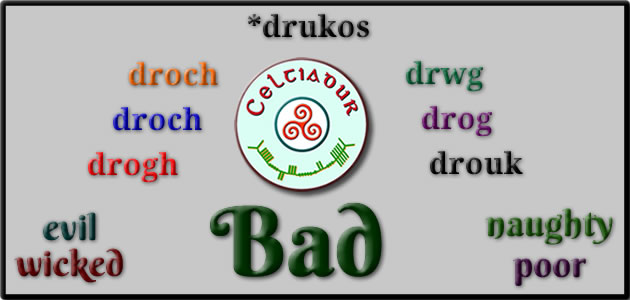
Proto-Celtic *drukos = bad
Gaulish druco- = bad
Old Irish (Goídelc) droch [drox] = bad, ill
Middle Irish (Gaoidhealg) droch = bad
Irish (Gaeilge) droch [drɔx] = bad, poor, evil, ill, un-
drochbhéas = vice, bad habit
drochmheas = contempt
drochobair = bad work, mischief
drochrath = ill luck, misfortune
drochrud = bad thing, inferior thing, bad/evil person, devil
drochrún = evil intention
drochuair = evil hour, unfortunate occasion
Scottish Gaelic (Gàidhlig) droch [drɔx] = bad, evil, wicked, mischievous, sad, calamitous, dark, obscure, secretive
droch-aigne = ill-will
droch-allaidh = libel
droch-chòrdadh = disagreement
droch-fhàistinneach = ominous
droch-mhèin = malice
droch-thuarach = sinister
Manx (Gaelg) drogh [drɔx] = evil, wicked, bad, abusive, unenviable, misfortune, badness, ill, sinister, vile
drogh aghtalys = misbehaviour, misconduct
drogh chaaynt = bad language, smut, swearing
drogh chonagh = misfortune
drogh hraghtey = to smuggle, smuggling
drogh oor = bad luck, ill-times, misfortune
Proto-Brythonic *drug = bad
Middle Welsh (Kymraec) druc, dryg, drỽc, drwc = bad
drycaruer , drygarver, drycarver = bad habit, abuse, misuse
drygdafod = scurrilous language, evil tongue
Welsh (Cymraeg) drwg [druːɡ] = bad, rotten, putrid; poor, piteous, wretched; sorry, grievous, sad; unfavourable, causing disquiet; injurious, harmful; unpleasant (taste); indecent, obscene (words); counterfeit, false; bad; harsh, cruel, severe, ruthless; corrupt, depraved, sinful, wicked, mischievous, naughty
strong>drwgabsen = malicious defamation, slander
drwgafer = bad habit, abuse, misuse
drwgdafod = scurrilous language, evil tongue
drwgenwog = infamous, notorious, disreputable
Middle Cornish (Cernewec) droc, drôg, drog = evil, wickedness, harm, injury, wrong, bad, wicked, hurtful, mischievous
droca, droga = worst
drocoleth = an evil deed, ill doing, injury, damage
droga, droaga = to do harm, hurt, injure
drogbrederys = evil-minded, malicious, envious
drogbres = ill will, spite, grudge
drogdavasec = ill-tongued, foul-mouthed, back-biting, reviling
drogger = ill report, infamy, reproach
droggeriit = infamous, reproachful
droggras = revenge, requital
drogober, drôk-ober = an evil deed, a crime
Cornish (Kernewek) drog [drɔ:g / dro:g] = bad, harm, hurt, ill, wrong, evil, invalid, nasty, naughty, wicked, wrong
drogdybi = to suspect
drogedh = vice
drogfara = to behave badly
drogga = wrong
droghandla = to abuse, mishandle
droglam = accident, crash, mishap
drogober = crime
drogboeror, drogoberores criminal, culprit
drogura = to smear
drokoleth = widkedness
drokter = wickedness
Middle Breton (Brezoneg) drouc = bad, illness, anger
drouc Ælez = the devil, bad angel
drouc auantur = misfortune, bad luck
droucyez, drouguyez = wickedness, malice, animosity
drouc =
drouc =
Breton (Brezhoneg) drouk [druːk] = bad, evil, naughty
droug [druːk] = bad, wickedness
drougiezh [druˈɡiːɛs] = wickedness, malice, animosity
droukrañsus [druˈɡrãsːys] = angry, resentful
droukaat = to become bad, make bad
drouziwezh [dru.ˈziː.wɛs] = defeat, disaster
dizrouk [ˈdi.zruk] = inoffensive, without anger

Etymology: possibly from the Proto-Indo-European *dʰrewgʰ- (to deceive) [source]. Word from the same roots include dream in English, droom (dream) and driegen (to deceive) in Dutch, Traum (dream) and trügen (to deceive, be deceptive) in German [source].

Proto-Celtic *dognawos = badly grown (?)
Old Irish (Goídelc) dona [ˈdona] = unlucky, unfortunate
Middle Irish (Gaoidhealg) dona = unfortunate, unlucky, wretched
donaide = ill-disposed, wretched
donán = miserable creature, wretch
donas = ill-luck, misfortune, calamity
donogad = act of making wretched
Irish (Gaeilge) dona [ˈd̪ˠɔn̪ˠə/ˈd̪ˠʌnˠə] = unfortunate, unlucky, bad, poor, wretched, ill
donacht = badness, wretchedmess, misfortune, illness
donagar = bad condition, misfortune
donaigh = to make worse, aggravate, become word, deteriorate, injure, maim
donaire = wretch
donaireacht = wretchedness
donaisín = little wretch, weakling
donas = ill-luck, misfortune, affliction, misery, mischief
Scottish Gaelic (Gàidhlig) dona [dɔnə] = bad, not well
donachas [dɔnəxəs] = mischief, harm, bad luck, mishap, devil
donachd [dɔnəxg] = mischief, harm, bad luck, mishap
donad [dɔnəd] = degree of badness, severity
donadas [dɔnədəs] = badness, evil
donas [dɔnəs] = mischief, harm, bad luck, devil
donasag [dɔnəsag] = imp
Manx (Gaelg) donney [ɔlk] = calamitous, ill-advised, inauspicious, unfortunate, unlucky, very ill, woeful, unhappy
donnan = dolt, dunce, stupid person, worse
donnys = affliction, bad luck, mischief, woe

Etymology: possibly from the Proto-Indo-European *ǵneh₃- (to recognise, know) [source]. Words from the same root include can, canny, gnome, ignore, know and quaint in English [source].

Proto-Celtic *ulkos = evil, bad
Old Irish (Goídelc) olc [olk] = bad, evil
olcas = badness
Middle Irish (Gaoidhealg) olc, olcc = evil, bad, wrong, misfortune
olcach = hurtful, injurious, harm, injury
olcas = badness
Irish (Gaeilge) olc [ɔl̪ˠk] = evil, harm, bad, harmful, poor, wretched, ill-disposed, hardly, scarcely
olcach = causing evil, harmful, injurious.
olcas = badness, evil, bad state, bad nature, spite
Scottish Gaelic (Gàidhlig) olc [ɔl̪ˠxg] = evil, wicked, bad, infamous, ill, iniquity
olcag [ɔl̪ˠxgag] = little brat (female)
olcair [ɔl̪ˠxgɛrʲ] = evildoer
olcas [ɔl̪ˠxgəs] = wickedness, badness
Manx (Gaelg) olk [ɔlk] = bad, evil, ill, injury, lousy, truculence, unfavourable, vicious, wicked, mischief, naughty, sinful
olkeyr = criminal, culprit, evil-doer, offender, mischief-maker
olkid = badness, evilness
olkys = badness, evilness, iniquity, mischief
olkyssagh = baleful, elfish, diabolical, iniquitous, malicious, malignant, mischievous, naughty, vicious, wicked

Etymology: from the Proto-Indo-European *h₁elḱ- (bad [?]) [source]. Words from the same root include ill and possibly ulcer in English, illa (badly, poorly, not well) in Swedish, and ilkeä (bad, mean, wicked, evil) in Finnish [source].

Sources: Wiktionary, Am Faclair Beag, Online Manx Dictionary, Teanglann.ie, eDIL – Electronic Dictionary of the Irish Language, In Dúil Bélrai English – Old Irish glossary, Geiriadur Prifysgol Cymru, Gerlyver Kernewek, Lexicon Cornu-britannicum: A Dictionary of the Ancient Celtic Language of Cornwall, Dictionaire Favereau, TermOfis, Le dictionnaire diachronique du breton, Etymological Dictionary Of Proto Celtic