Surfaces

Words for surface, skin and related things in Celtic languages:

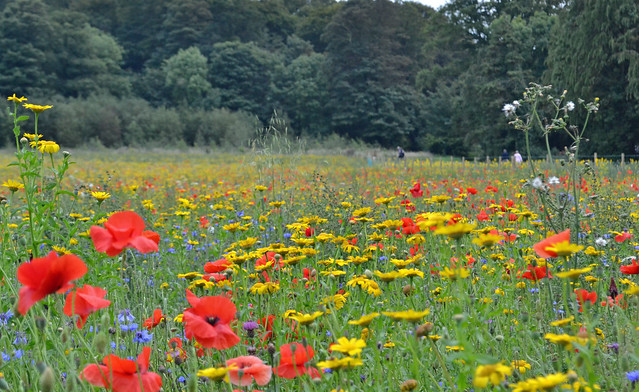
Wildflower meadow at Mount Stewart

Words marked with a * are reconstructions.

Proto-Celtic *tondā = surface, skin
Gaulish *tondā = surface, skin
Old Irish (Goídelc) tonn, tond = surface, skin
Irish (Gaeilge) tonn [t̪ˠɑun̪ˠ / t̪ˠuːn̪ˠ / t̪ˠʌn̪ˠ] = surface, skin
faoi mo thoinn = under my skin, within me
Scottish Gaelic (Gàidhlig) tonn [tɔun̪ˠ] = skin, hide
Middle Welsh (Kymraec) tonn, ton, ton(n)en = ley, unploughed land
Welsh (Cymraeg) ton [tɔn] = ley, unploughed land, turf, sod, sward, green, lawn, (earth’s) surface’ skin, rind, crust, peel, appearance, look
tonnen = skin, rind, crust, peel, surface, sod, sward, bog, swamp, quagmire
tondir = ley, lea-land
toniaraf, toniaru = to cover with planks, boards, etc
Middle Cornish (Cernewec) ton = unploughed land, meadow, lay
Cornish (Kernewek) tonn = grass
Old Breton tonnenn = rind, surface
Middle Breton ton = rind, surface
Breton (Brezhoneg) tonn = rind, surface

Etymology: from the Proto-Indo-European *tend- (to cut off). Words from the same Gaulish / Proto-Celtic roots include tonne in English and French, tunna / tonna (tun, box) in Latin, and tona (surface, kin, bark) in Galician [source].

Proto-Celtic *krokkeno- = skin
Old Irish (Goídelc) croiccenn [ˈkrokʲen͈] = skin, hide, bark, husk
Irish (Gaeilge) craiceann [ˈkɾˠacən̪ˠ / ˈkɾˠæcən̪ˠ] = skin, surface
cruachraicneach = hide-bound
Scottish Gaelic (Gàidhlig) craiceann [krɛçgʲən̪ˠ] = skin, parchment
craiceannaiche = skinner
far-chraiceann = epidermis
fo-chraiceann = hypodermic
pàipear-craicinn = parchment
Manx (Gealg) crackan [ˈkraːɣən] = skin, pelt, fur, hide, rind, peel, slough
crackanagh = (of the) skin, cutaneous
aachrackan = veneer
fochrackanagh = hypodermic
crackan screeuee = parchment
Proto-Brythonic *krʉn = skin
Old Welsh groen = skin
Middle Welsh (Kymraec) croen, cruyn, croyn, crwyn = skin, hide, pelt
Welsh (Cymraeg) croen [kroːɨ̯n / krɔi̯n] = skin, hide, pelt, peel, rind, surface, crust; film; a crusty or contemptible fellow
croeni, croenio = to form skin, skin over, heal up
croendenau = thin-skinned, sensitive, easily hurt, touchy
croendew = thick-skinned, insensible, insensitive, callous
croenen = thin skin, cuticle, pellicle, film
Middle Cornish (Cernewec) crochen = skin
Cornish (Kernewek) kroghen = hide
kroghen lagas = eyelid
kroghendanow = sensitive
Middle Breton kroc’hen, krec’hen, krec’hin = skin, crust, membrane
Breton (Brezhoneg) kroc’hen [ˈkʁoːχɛn] = skin, crust
kroc’henenn = membrane

Etymology: probably loaned from a non-Indo-European substrate language [source].

Old Irish (Goídelc) pell = animal skin, rug
Middle Irish (Gaoidhealg) pell, peall = (animal) skin, fur, rug, blanket
Irish (Gaeilge) peall [pʲaul̪ˠ/pʲal̪ˠ] = pelt, skin, hide, rug, blanket, piece of coarse cloth
peallach = hairy, matted, coarse-spun
peallóg = (piece of) coarse cloth, woman dressing rough clothing
Scottish Gaelic (Gàidhlig) peall [pjaul̪ˠ] = shaggy hide/skin, mat, rough cloth/sheet, bunch of matter hair
Proto-Brythonic *pall = (?)
Middle Welsh (Kymraec) pall = cloak, curtain, covering, pall, tent, tabernacle, throne, bed of state
Welsh (Cymraeg) pall [paɬ] = cloak, curtain, covering, pall, tent, tabernacle, throne, bed of state
Cornish (Kernewek) pall = mantle

Etymology: from Latin palla (cloak, mantle), from pellis (skin), possibly from Proto-Indo-European *pel- (to cover, to wrap, skin, hide, cloth), or possibly a substrate loan. Words from the same roots include camouflage, film, muffle, pall and pelt in English, piel (skin, fur) in Spanish, and peau (skin, hide, fur) in French [source].

Sources: Wiktionary, Am Faclair Beag, Online Manx Dictionary, Teanglann.ie, eDIL – Electronic Dictionary of the Irish Language, In Dúil Bélrai English – Old Irish glossary, Geiriadur Prifysgol Cymru, Gerlyver Kernewek, Gerlyvyr Cernewec, Dictionaire Favereau, TermOfis, Le dictionnaire diachronique du breton, Geriafurch, English – ProtoCeltic WordList (PDF), Etymological Dictionary Of Proto Celtic

The Fastest Way to Learn Japanese Guaranteed with JapanesePod101.com

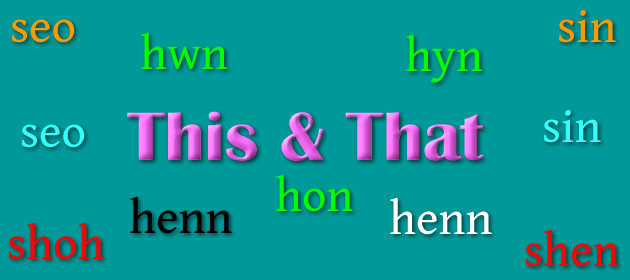
This & That

Words for this and that in Celtic languages.

That & That

Proto-Celtic *so [so] = this
Gaulish so = this
Old Irish (Goídelc) so, sa, se, sea, seo, siu = this
Irish (Gaeilge) seo [ʃɔ] = this, here
anseo = here, in this place
go dtí seo = up to now
faoi seo = by now
roimhe seo = before this, formerly
seo dhuit = here, take it
seo linn = here we go
seo leat = come on
seo d’am (agat)! = now is your chance!
Scottish Gaelic (Gàidhlig) seo [ʃɔ] = this, these
seo, seo … = (well) now then, …
an-seo = here
an déidh seo = after this, afterwards, hereupon, later on
chuige seo = hitherto, until now
feadh an-seo = around here, hereabouts
gu seo = up until now
roimhe seo = before, by now
Manx (Gaelg) shoh = this, this here
ad shoh = those, those here
ayns shoh = here
myr shoh = in this manner, thus
roish shoh = previously
(yn chiaghtin) shoh cheet = coming / next (week)

Etymology: from the Proto-Indo-European *só (this, that), which is also the root of the English words this, that, the, then, than and there [source].

Proto-Celtic *sindos = this
*sondo- = that
Gaulish sinde, sindas = that
Old Irish (Goídelc) sin [sʲinʲ] = that
in [inʲ] = the
Irish (Gaeilge) sin [ʃɪnʲ / ʃɨ̞nʲ] = that
an [ənˠ / ə.n̠ʲ / ə] = the
ó shin = ago, back, since then, from then
mar sin = like that, thus
mar sin de = in that case, therefore
agus mar sin de = and so on
go dtí sin = up to that point, until then
iar sin = after that, thereupon
roimhe sin = before that
faoi sin = by then
Scottish Gaelic (Gàidhlig) sin [ʃin] = that, those, there
an, am, a’ = the
an-sin = there, therein, thither, then
sin thu! = well done, bravo!, well done
mar sin dheth = consequently …, so, therefore
uime sin = therefore, thereupon, then
Manx (Gaelg) shen = that
yn = the
ad shen = those
ayns shen = there
myr shen = in that manner, so, therefore, thus
roish shen = before then, prior to that
Old Welsh hinn = this, that
ir = the
Middle Welsh (Kymraec) hvnn, hunn, hun, hon, hwnn = this, that
y, yr, ‘r = the
Welsh (Cymraeg) hyn [hɨ̞n /hɪn] = this, these, this time,this place, these, they; such (a), so much, so many
hynny = that, that time, that place, that number/amount, those
hyn a hyn = so much, so many, a certain quantity, such and such
ar hyn o bryd = now, at this (point in) time, at the present moment
hwn [hʊn] = this (one), he (him, she (her), it; that (with masculine nouns)
hwnnw, hwnna = that
hwn a hwn = such a one, such as such a person, so-and-so
hwn/hon/hyn a’r llall = this and that; this, that and the other
hon [hɔn] = that (with feminine nouns)
honno, honna = that
y, yr, ‘r = the
Middle Cornish (Cernewec) hen = this
henna = the one there, that one, that
homma = this female here, this one, this
hon = this female, this
an = the
Cornish (Kernewek) henn, hedn = that
henna, honna = that (one)
dres henna = moreover, besides
wosa henna = after that, later, thereafter
an = the
Middle Breton henn, hen = that, after that
an, ar, al = the
Breton (Brezhoneg) an, ar, al = the

Etymology: from the Proto-Indo-European *sḗm (one) or *só (this, that) [source].

Old Irish (Goídelc) siút, sút = that, yon
út = yon, yonder
Irish (Gaeilge) siúd [ʃuːd̪ˠ] = that, yon
ansiúd = yonder, there beyond
úd = yon, yonder, that … over there
Scottish Gaelic (Gàidhlig) siud [ʃid] = that (over there), yon (those)
an-siud = there, yonder
Manx (Gaelg) shid = yonder, that
ad shid = those
ayns shid hoal = over yonder

Etymology: uncertain

Words marked with a * are reconstructions.

Sources: Wiktionary, Am Faclair Beag, Online Manx Dictionary, Teanglann.ie, eDIL – Electronic Dictionary of the Irish Language, In Dúil Bélrai English – Old Irish glossary, Geiriadur Prifysgol Cymru, Gerlyver Kernewek, Gerlyvyr Cernewec, Dictionaire Favereau, TermOfis, Le dictionnaire diachronique du breton, Geriafurch, English – ProtoCeltic WordList (PDF), Etymological Dictionary Of Proto Celtic

The Fastest Way to Learn Japanese Guaranteed with JapanesePod101.com

Waves

Words for wave and related things in Celtic languages.

Newquay

Proto-Celtic *tundā = wave, billow
Old Irish (Goídelc) tonn [ton͈] = wave, outpouring, sea, abundance, bog, swamp
Middle Irish (Gaoidhealg) tonn = wave, outpouring, sea, abundance, bog, swamp
Irish (Gaeilge) tonn [t̪ˠɑun̪ˠ/t̪ˠuːn̪ˠ/t̪ˠʌn̪ˠ] = wave
tonn tuile = tidal wave
tonn teasa = heat-wave
tonn turrainge = shock wave
tonnach = wavy, billowy
tonnadh = to wave, surge
tonnáil = waving, rippling, undulation
tonná = wavelet, ripple
tonnúil = wavy, undulating
Scottish Gaelic (Gàidhlig) tonn [tɔun̪ˠ] = wave, tilde, quantity of liquid, pile, heap
tonn-fuaime = soundwave
tonn-taomaidh, tonn-tuile = tidal wave
tonn-crithe = shockwave
tonnadh = undulating, undulation, vomiting
tonnan, tonnag = small wave
tonnach = waved, wavy
tonnachd = waviness
Manx (Gaelg) tonn = wave, billow
tonn hiass = heat-wave
tonn hidee = tidal wave
tonn inçhyn = brainwave
tonnagh = undulating, billowy, wavy
tonnaghey to undulate, surge, bilow, undulation
tonnaght = undulation, waviness
Proto-Brythonic *tonn = wave
Old Welsh tonnou = wave
Middle Welsh (Kymraec) tonn, ton = wave
Welsh (Cymraeg) ton [tɔn] = wave, the sea; wavelength
ton lanw = tidal wave
ton radio = radio wave
tonfedd = wavelength
tonffurf = waveform
toniad = undulation, oscillation, frequency, modulation, intonation
tonial = surge or swell (of waves)
tonniant = fluctuation
tonni = to undulate, ripple, oscillate, surge
tonnog = wavy, billowy, rough, choppy, roling, undulating
tonyddol = melodious, intoning, tonic, intonational
Middle Cornish (Cernewec / Kernuak) ton = wave
Cornish (Kernewek) tonn = wave
tonnek = wavy
tonnhes, tonnhys = wavelength
Middle Breton) tonn = wave
Breton (Brezhoneg) tonn = wave

Etymology: possibly from the Proto-Indo-European *(s)tewd- (to hit, beat), or from the Proto-Celtic *tondā (surface, skin), or from the PIE *temh₁- (to cut) [source].

The PIE root *(s)tewd- (to hit, beat) is the origin of the Irish tit (to fall, collapse, descend), the Scottish Gaelic tuit (to fall, happen, slip), and the Manx tuitt (to fall, happen, slip) [source]. English words from the same root include study, studio, student and obtuse [source].

The the Proto-Celtic *tondā (surface, skin) is the root of the Gaulish *tondā, from which we get tonn (surface, skin) in Irish, tonn (skin, hide) in Scottish Gaelic, ton (turf, sod, sward, surface) in Welsh, ton (unploughed land, meadow) in Cornish, and tonn (rind, dermis, surface) in Breton.

It was borrowed into Latin as tunna / tonna (tun [a large cask], box), which became tonne (tonne, ton) in French, which was borrowed into English as tonne (a unit of mass equal to 1000kg; a score of 100 in darts) [source].

Words marked with a * are reconstructions.

Sources: Wiktionary, Am Faclair Beag, Online Manx Dictionary, Teanglann.ie, eDIL – Electronic Dictionary of the Irish Language, In Dúil Bélrai English – Old Irish glossary, Geiriadur Prifysgol Cymru, Gerlyver Kernewek, Gerlyvyr Cernewec, Dictionaire Favereau, TermOfis, Le dictionnaire diachronique du breton, Geriafurch, English – ProtoCeltic WordList (PDF), Etymological Dictionary Of Proto Celtic

The Fastest Way to Learn Japanese Guaranteed with JapanesePod101.com

Sailing

Words for sail and related things in Celtic languages.

sailing ship

Proto-Celtic *siglom = sail, course, run
Old Irish (Goídelc) séol [sʲeːu̯l] = sail
Middle Irish (Gaoidhealg) séol = sail
séolaid = to sail
Irish (Gaeilge) seol [ʃoːl̪ˠ/ʃɔːlˠ] = sail; covering, canopy; drift, tend, course, direction, flow, motion
seoladh = to sail, sailing; course, direction, guidance, dispatch
seoladóir = shipper
seoladóireacht = shipping
seolchrann = mast
seoltóir = sailor, sender, remitter, drover, (electrical) conductor
seoltóireacht = sailing
long seol = sailing ship
Scottish Gaelic (Gàidhlig) seòl [ʃɔːl̪ˠ] = sail; navigate, direct, guide, govern, regulate
seòlaid = shipping route, passage, sway(ing), nervous movement
seòl-mara = tide
seòladair = sailor
seòladaireach = nautical
Manx (Gaelg) shiauill = sail, navigate,
shiauilley = to sail, navigate, sailing
shiauilteyr = ferryman, sailor, seafarer, seaman
shiaulteyragh = nautical
Proto-Brythonic *hɨɣl = sail, course, run
Old Welsh huil = sail
Middle Welsh (Kymraec) hwyl, hvyl, huyl = sail
Welsh (Cymraeg) hwyl [huːɨ̯l/hʊi̯l] = sail, sheet, covering, pall; journey, progress, revolution, orbit, course, route, career, rush, assault; hilarity, jollity, mirth, amusement, fun, humour
hwylbawl, hwylbolyn = boom, bowspirt
hwylbren = mast, flagstaff
hwyldroaf, hwyldroi = to tack, change course, veer
hwylfa = way, narrow road or street, lane, path, alley, voyage
hwylfwrdd = sailboard, windsurfer
hwylfyrddio = to sailboard, windsurf
hwylio = to sail, embark, set out on a voyage or journey, navigate
hwyliwr = navigator, mariner, sailor, leader, organizer
Old Cornish guio = sail
Middle Cornish (Cernewec / Kernuak) gol, goyl, guil = sail (of a ship)
gwelan gôl = sail yard
Cornish (Kernewek) gool = sail
golya = to sail
skath-wolya = sailing boat
gorhel golyow = sailing ship
Breton (Brezhoneg) gouel = sail
gouelier = to sail
gouelierezh = sailmaker

Etymology: uncertain. Possibly from the Old English seġ(e)l (sail), from the Proto-Germanic *segl (sail), from *seglą (sheet, sail), the origins of which are uncertain. Possibly cognate with the Latin sagum (coarse woolen coat), from the Gaulish *sagos (wool cloak). Related words include sail in English, zeil (sail, tarpaulin) in Dutch, Segel (sail) in German, and sejl (sail) in Danish [source].

Words marked with a * are reconstructions.

Here’s Leis an Lurgainn, a song in Scottish Gaelic about sailing:

Sources: Wiktionary, Am Faclair Beag, Online Manx Dictionary, Teanglann.ie, eDIL – Electronic Dictionary of the Irish Language, In Dúil Bélrai English – Old Irish glossary, Geiriadur Prifysgol Cymru, Gerlyver Kernewek, Gerlyvyr Cernewec, Dictionaire Favereau, TermOfis, Le dictionnaire diachronique du breton, Geriafurch, English – ProtoCeltic WordList (PDF), Etymological Dictionary Of Proto Celtic

The Fastest Way to Learn Japanese Guaranteed with JapanesePod101.com

Trembing

Words for trembling, fever and related words in Celtic languages. I chose these words because I have a bit of a fever at the moment.
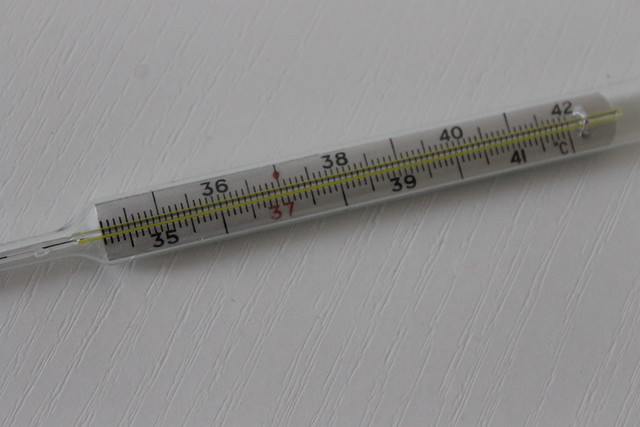
Thermometer

Proto-Celtic *kritos = fever, trembling, shaking
Old Irish (Goídelc) crith [ˈkʲr͈ʲiθ] = shaking, trembling
crithnaigid = to shake, tremble
Middle Irish (Gaoidhealg) crith = shaking, trembling, a shake, tremble
crothaid = shakes, causes to tremble, brandishes
Irish (Gaeilge) crith [crʲɪ(h) / crʲɪç] = tremble, shiver, tremor, shudder, vibration, quiver; to tremble, shake
critheagla = quaking fear, terror, timorousness
crithloinnir = shimmer
crithlonraigh = to shimmer
creathán = to tremble, quiver
creathánach = trembling, quivering, vibratory
creathánaí = trembler
Scottish Gaelic (Gàidhlig) crith [krʲih] = quake, shudder, shock, shake, tremble, shiver, vibrate; quaking, shuddering, shocking, shaking, trembling, shivering
critheanaich = trembling
crith-cheòl = warbling, quavering, trills (in music)
crith-thalmhainn = earthquake
crithnich = quake, shudder, shake, tremble, shiver, vibrate
Manx (Gaelg) crie = to shake
craa = to shake
Old Welsh crit = shivering, trembling, fever
Middle Welsh (Kymraec) crid, cryt, kryt = shivering, trembling, fever
crynei, krynu, krennit = to tremble, quake, shiver, shake
Welsh (Cymraeg) cryd [krɨːd / kriːd] = shivering, trembling, dread, fear, ague, fever, disease
crydu, crydio = to shake, tremble, quake
crynu = to tremble, quake, shiver, shake, brandish, vibrate, quaver, gnash, twinkle
echryd = dread, terror, fright, fear, trembling, shivering, tremor; fearful, dreadful, frightful
ysgryd = shiver, trembling, shudder, fright, horror, agony
Middle Cornish (Cernewec) crenne, cranna = to tremble, quake
Cornish (Kernewek) kren = shake
krena, kerna = to shake, shiver, tremble
krenans = vibration
Krener, Krenores = Quaker
dorgrys = earthquake
Old Breton crit = shivering, trembling
Middle Breton (Brezonec) kren, crezn, creen, crein = trembling
crenaff = to tremble
crezn doüar, crein doüar = earthquake
Breton (Brezhoneg) kren = trembling
krenañ = to tremble
kren-douar = earthquake
krendourarel = seismic

Etymology: from the Proto-Indo-European *krit-, from *(s)kreyt-, from *(s)ker- (twist, turn, bend) [source].

The English word scree (loose stony debris on a slope), comes from the same PIE root, via the Old Norse skriða (landscape, landslip) and the Proto-Germanic *skrīþaną (to crawl, glide, walk) [source].

Words marked with a * are reconstructions.

Sources: Wiktionary, Am Faclair Beag, Online Manx Dictionary, Teanglann.ie, eDIL – Electronic Dictionary of the Irish Language, In Dúil Bélrai English – Old Irish glossary, Geiriadur Prifysgol Cymru, Gerlyver Kernewek, Gerlyvyr Cernewec, Dictionaire Favereau, TermOfis, Le dictionnaire diachronique du breton, Geriafurch, English – ProtoCeltic WordList (PDF), Etymological Dictionary Of Proto Celtic

The Fastest Way to Learn Japanese Guaranteed with JapanesePod101.com

Sieving Riddles

Today we’re looking at the words for sieve and related things in Celtic languages.

Sieving Flour

Words marked with a * are reconstructions.

Proto-Celtic *krētros = sieve
Old Irish (Gaoidhealg) críathar = sieve
Middle Irish (Gaoidhealg) críathar = sieve, riddle
críatharach = marsh, morass, boggy wasteland
críathrad = act of winnowing, sifting, riddling
críathraid = sifts, riddles, spreads
Irish (Gaeilge) criathar [ˈcɾʲiəhəɾˠ / ˈcɾʲiːhəɾˠ] = sieve, riddle
criathach = pitted, perforated, swampy
criathrú = winnowing, sifting, honeycombing
criathradóir = winnower, sifter, maker of sieves
criathraigh = to sieve, winnow, riddle, sift, honeycomb
criathróir = animal surefooted on boggy ground
criathar meala = honeycomb
criathar mín = fine sieve
Scottish Gaelic (Gàidhlig) criathar [krʲiə.ər] = riddle, sieve
criathar-tomhais = bushel (measure and implement)
criathar-garbh = riddle (implement)
criatharair [krʲiəhərɛrʲ] = sieve-maker
criathradh [krʲiarəɣ] = (act of) filtering
Manx (Gaelg) creear = sieve, riddle
creearey = sieve, pan, sift, riddle
creear meein = fine sieve
creear garroo = rough sieve
jannoo creear = to honeycomb
Proto-Brythonic *kruɨdr = wandering, sieve
Old Welsh cruitr = winnowing shovel
Middle Welsh (Kymraec) cruidir, crwydr = sieve
Welsh (Cymraeg) crwydr [ˈkrʰʊɨ̯dr̩ / ˈkrʰʊi̯dr̩] = a wandering, a roaming; misfortune, trouble, confusion, rout, dispersion; a straying, aberration, error; winnowing-fan, winnowing-shovel, sieve
crwydro = to wander, roam, stroll, gad about, stray, go astray, deviate, digress
crwydredig = wandering, vagrant, roving, stray
crwydro = barn, granary, farm building
crwydrwr = wanderer, vagrant, vagabond, rover, nomad
Old Cornish croider = sieve, riddle
Middle Cornish croider, crodar = sieve, riddle
Cornish (Kernewek) kroder = coarse sieve, strainer, riddle
kroder kroghen = bodhrán, hold-all
Old Breton croitir = sieve, riddle
Middle Breton croezr = sieve, riddle
Breton (Brezhoneg) krouer = sieve, riddle, screen
krouerañ = to sift, riddle, sieve
krouer liammoù = link generator
rakkroueriañ = pre-screening

Etymology: from the Proto-Indo-European *krey-trom (sieve) from *krey- (to sift, separate, divide) [source]. Words from the same PIE root include crime, crisis, riddle and secret in English, ceart (right, correct, true) in Irish, and crynu (to tremble, shake) and ergryn (horror, dread) in Welsh [source].

Proto-Celtic *sītlā = vase
Old Irish (Goídelc) síthal = bucket
síthlaid = to filter, sift, strain
soithech = container, vessel
Middle Irish síthal, sitheal = a vessel for drawing water, a bucket
síthlaid, síthlaigid, síthóilid = to strain, filter, sift, scour, sweep across, flow away, melt
soithech, soitheach = vessel, container (for liquids), blood vessel, boat
Irish (Gaeilge) síothal [ʃiː(h)ˈl̪ˠɑːn̪ˠ] = vessel for drawing water, pail, bucket (literary)
síothlaigh = to strain, filter, drain away, subside, settle, expire, die
síothlán = strainer, filter, colander
síothlóir = (of person) strainer, filterer (person), weakly, dying person
síothlú = filtration, percolation, subsidence, abatement, expiry, death
Scottish Gaelic (Gàidhlig) sìol [ʃiəl̪ˠ] = compose, settle, filter, strain
sìol(t)achan [ʃiəl̪ˠ(d)əxan] = filter, strainer
sìoltag [ʃiəl̪ˠdag] = strainer, filter, sieve
sìol(t)an [ʃiəl̪ˠ(d)an] = filter, strainer, sieve
sìoltachair [ʃiəl̪ˠdəxɛrʲ] = filter feeder
sìoltachadh [ʃiəl̪ˠdəxəɣ] = (act of) filter feeding
Manx (Gaelg) sheeley = to flow, run, drip, trickle, dribble, seep, oose, filter, strain, drain
sheelaghey = to strain off, to filter, to refine, clarification, sober
Proto-Brythonic *sidl, *hidl = filter, sieve (?)
Middle Welsh (Kymraec) hidl, hidyl, hityl = filter, strainer, sieve
hitler, hidlir, hidlaw = to strain, filter, purify, cleanse, percolate, pour, sprinkle, scatter, sift
hidleit, hidlaid = strained, clarified, clear, flowing
Welsh (Cymraeg) hidl, hiddl = filter, sieve, strainer
hidl(i)ad = straining, filtration, percolation
hidlai = strainer, filter
hidlaid = strained, clarified, clear, flowing
hidlo = to strain, filter, purify, cleanse, percolate, pour, sprinkle, scatter, sift
hidlwr, hidlydd = strainer, filter
Cornish (Kernewek) sidhel [ˈɹɔːz] = filter, strainer, colander
sidhla = to filter, strain, sift, sieve, percolate, purify, cleanse
Middle Breton (Brezonec) sizl = filter, strainer
sila, sizla = to filter
Breton (Brezhoneg) sil [siːl] = filter, strainer
silad = filtrate, grout
siladenn = filtering
siladur = filtering, filtration
silañ = to filter
silerezh = filtering, percolation

Etymology: possibly from Proto-Indo-European *seh₁- (to impress, insert, sow, plant), and influenced by Latin situla (a vessel used to hold water, a voting urn, basin, jar) [source]. Words from the same PIE root include siets (sieve, sifter) in Latvian, sito (sieve, filter) in Polish, (to) sow, season, seminar and seed in English, zaaian (to sow, plant seed, spread) in Dutch, sold (sieve) in Danish [source].

Old Irish (Goídelc) scacaid = to filter, sift, strain
Middle Irish (Gaoidhealg) scacaid, scacad, sgacadh = to strain, filter, sift, purify
Irish (Gaeilge) scag = to strain, filter, drain off, refine, sift, screen, derive, spring (from a source)
scagach = permeable, porour, thin, flimsy, sparse
scagachán = filtration
scagacht = porosity
scagadh = filtration, refinement, assortment, critical examination
scagaire = filter, screen, filterer, sifter, refiner
scagaireacht = (act of) filtering, sifting, refining
Scottish Gaelic (Gàidhlig) sgag [sgag] = split, crack, chap

Etymology: possibly from Old Norse [source].

Proto-Celtic *wokro- = (?)
Middle Welsh (Kymraec) goger, gogr, gogyr = sieve, riddle, screen, strainer
Welsh (Cymraeg) gogr [ˈɡɔɡɔr / ˈɡoːɡɔr] = sieve, riddle, screen, strainer
gogrwr, gogrydd = sieve-maker, sifter
gogru [ˈɡɔɡrɨ̞ / ˈɡɔɡri] = to sieve, sift

Etymology: from PIE *sker- (to separate, cut off) [source].

Sources: Wiktionary, Etymological Dictionary Of Proto Celtic, In Dúil Bélrai English – Old Irish glossary, eDIL – Electronic Dictionary of the Irish Language, Teanglann.ie, Am Faclair Beag, An etymological dictionary of the Gaelic language, Fockleyreen: Manx – English Dictionary, Online Manx Dictionary, Gaelg Corpus, Geiriadur Prifysgol Cymru, Lexicon cornu-britannicum : a dictionary of the ancient Celtic language of Cornwall, Gerlyver Kernewek, Devri : Le dictionaire diachronique du breton, Geriafurch, TermOfis


Waterfalls

Today we’re looking at the words for waterfall and related things in Celtic languages.

IMGR8167-ed

Proto-Celtic *riyatros = waterfall
Old Irish (Goídelc) ríathor = torrent
Irish (Gaeilge) riathar = torrent (literary)
Old Welsh réátir = torrent
Middle Welsh (Kymraec) raeadyr, raiader, rhaiadr = cataract, waterfall
Welsh (Cymraeg) rhaeadr [ˈr̥ʰeɨ̯.adr̩ / ˈr̥ʰei̯.adr̩] = waterfall, cataract, cascade, torrent
rhaeadru = to fall or pour in a cascade or waterfall, fall steeply, gush, flow, stream
rhaeadraidd = like a waterfall
rhaeadriad = the act of falling or flowing like a waterfall

Etymology: from the Proto-Indo-European *h₃reiH- (to flow) [source].

Old Irish (Goídelc) ess = rapids, waterfall
Irish (Gaeilge) eas = waterfall, cascade, cataract; swift current, rapid
easach = having, abounding in waterfalls, cascading
Scottish Gaelic (Gàidhlig) eas [es] = waterfall, cataract, cascade
easach [esəx] = abounding in waterfalls
easachan [esəxan] = small waterfall
easan [esan] = small waterfall; thin gruel
easgraich [esgrɪç] = torrent
easraich [esrɪç] = plunge pool, waterfall lake; bustle, commotion
eas muilinn = mill-race
con-eas = multiple waterfalls
poll-easa = plunge pool
Manx (Gaelg) eas = cascade, cataract, chute, shoot, waterfall
easan = small waterfall, small cataract
mwyllin roie’n eas = water mill

Etymology: unknown [source].

Middle Welsh (Kymraec) ysgwt, ysgwd, ysgŵd = waterfall, cataract, cascade
Welsh (Cymraeg) sgwd [skuːd] = waterfall, cataract, cascade, chute, millstream, mill-race, sluice, floodgate (South Wales)

Etymology: unknown [source].

Middle Welsh (Kymraec) pistill = waterfall, cataract, cascade
Welsh (Cymraeg) pistyll = waterfall, cataract, cascade, chute, millstream, mill-race, sluice, floodgate (South Wales)
pistyll yr ysgyfaint = trachea
Cornish (Kernewek) pistyl = little waterfall
pistylla = to spout

Etymology: possibly from the Latin pistillum (pestle), which is also the root of the English word pestle [source].

Cornish (Kernewek) dowrlam = waterfall
Breton (Brezhoneg) lamm-dour = waterfall

Etymology: from dowr / dour (water) and lam / lamm (leap).

Words marked with a * are reconstructions.

Sources: Wiktionary, Am Faclair Beag, Online Manx Dictionary, Teanglann.ie, eDIL – Electronic Dictionary of the Irish Language, In Dúil Bélrai English – Old Irish glossary, Geiriadur Prifysgol Cymru, Gerlyver Kernewek, Gerlyvyr Cernewec, Dictionaire Favereau, TermOfis, Le dictionnaire diachronique du breton, Geriafurch, English – ProtoCeltic WordList (PDF), Etymological Dictionary Of Proto Celtic

The Fastest Way to Learn Japanese Guaranteed with JapanesePod101.com

Emptiness

Today we’re looking at the words for empty, soft and related things in Celtic languages.

View from Sabhal Mòr Ostaig

Proto-Celtic *wāstos = empty
Old Irish (Goídelc) fás = empty, vacant, deserted
fásaogod to empty, despoil
Middle Irish (Gaoidhealg) fás = empty, vain, futile, vacant
Irish (Gaeilge) fás [fˠɑːsˠ / fˠaːsˠ] = waste, vacant, empty, void; wild, luxuriant
fásach = waste, desert; uncultivated, uninhabited region; empty, deserted place
fásaigh = to lay waste, leave uncultivated
Scottish Gaelic (Gàidhlig) fàs [faːs] = empty; barren, waste, uncultivated, fallow, desolate
fàsach = desert, wilderness, empty place
fàsaich = to depopulate, lay waste to a place, desolate
fàslach = hollow, void, cavity
fàslail = desolate, lonely, solitary
Manx (Gaelg) faase = feeble, weak; desolate, void, barren, infirm
faasagh = desert, desolate, waste place, wilderness
faaselagh = weakest part, poor part of lawn
faasoil = desert

Etymology: from the Proto-Indo-European *h₁weh₂- (to leave, abandon) [source].

Old Irish (Goídelc) folam = empty
Middle Irish (Gaoidhealg) folam, falam = empty, uninhabited, shallow, barren, destitute, vain, worthless
folma = emptiness
Irish (Gaeilge) folamh [ˈfˠɔl̪ˠəvˠ / ˈfˠaːl̪ˠə / ˈfˠɔlˠuː] = empty
folmhaigh = to empty, discharge, exhaust; purge, evacuate
folmhach empty, vacant, sapce, gap (between teeth)
Scottish Gaelic (Gàidhlig) falamh [fal̪ˠəv] = empty, hollow, void
falamhachd = emptiness, voidness, vacancy, vacuum, void
falamhaich = to empty, void, evacuate
falamhaichte = emptied
Manx (Gaelg) follym = void, flat, shallow, barren, vacuous, waste, blank, empty, hollow, blank
folmaghey = to empty, void, hollow, vacate, deflate

Etymology: possibly from the Old Irish lomm (bare, naked, smooth) [source].

Middle Irish (Gaoidhealg) cúacca = empty
Proto-Brythonic *gwag = empty, vacant
Old Welsh guac = empty, desolate, vacant
Middle Welsh (Kymraec) gwac, gwag = empty, desolate, vacant
Welsh (Cymraeg) gwag [ɡwaːɡ] = empty, desolate, vacant, void, barren; meaningless, senseless, unsubstantial, frivolous, null and void, invalid
gwagedd = vanity, vainglory, conceit, empitness, unreality
gwagio = to empty, make empty, become empty
gwagle = empty place or space, vacuum, void, gap, chasm, space
Middle Cornish gwag = hungry, vain, void, vacant, at leisure; void, vacuum, hunger
Cornish (Kernewek) gwag = blank, empty, hollow, hungry, unfurnished, unoccupied, vacant
gwaga = to break into a cavity
gwagen = blank
gwagla = vacancy
gwagva = vacuum
gwakhe = to empty, vacate
Middle Breton goac = soft, tender
goacat = to soften
Breton (Brezhoneg) gwak = soft, tender
gwakaat = to soften
gwakadur = softening

Etymology: from the Vulgar Latin *vacus, from the Latin *vacuus (empty), from vacō (I am empty, void), from the Proto-Italic *wakos (empty), from the Proto-Indo-European *h₁weh₂- (to lack, empty) [source].

A Breton word for empty is goullo or gollo, the origins of which are not known.

Words marked with a * are reconstructions.

Sources: Wiktionary, Am Faclair Beag, Online Manx Dictionary, Teanglann.ie, eDIL – Electronic Dictionary of the Irish Language, In Dúil Bélrai English – Old Irish glossary, Geiriadur Prifysgol Cymru, Gerlyver Kernewek, Gerlyvyr Cernewec, Dictionaire Favereau, TermOfis, Le dictionnaire diachronique du breton, Geriafurch, English – ProtoCeltic WordList (PDF), Etymological Dictionary Of Proto Celtic

The Fastest Way to Learn Japanese Guaranteed with JapanesePod101.com

Copper

Today we’re looking at the words for copper and related things in Celtic languages.

copper pots

Proto-Celtic *omiyom = copper, bronze
Old Irish (Goídelc) umae, humae [ˈu.ṽe] = copper, bronze, brass
Middle Irish (Gaoidhealg) uma = copper, bronze, brass
Irish (Gaeilge) umha = copper, copper alloy, bronze
umhadhaite = bronze-coloured, bronzed
umhaí = worker in copper or bronze
cré-umha = bronze
cré-umhaigh = to bronze
salachar-umha = verdigris
Scottish Gaelic (Gàidhlig) umha [ũ.ə] = bronze, copper, brass
umhach = coppery, brassy
umha-dhathte = copper-coloured, bronze-coloured
ceàrd-umha = coppersmith
Linn an Umha = the Bronze Age
meirg-umha = verdigris
Manx (Gaelg) ooha = bronze
cur ooha er = to bronze, bronzing
Yn Eash Ooha = the Bronze Age
Proto-Brythonic *öβ̃ɨð = bronze, copper
Old Welsh emid, emed = bronze, copper
Middle Welsh (Kymraec) euyð, euyd = bronze, copper
Welsh (Cymraeg) efydd [ˈɛvɨ̞ð / ˈeːvɪð] = bronze, brass, copper; made of bronze brass or copper; brazen; bronze colour, coppery
efyddaf, efyddu = to cover or adorn with brass or copper, to braze
efyddaid = made of bronze or brass; brazen, brazed
efyddog = brassy, coppery
efyddwr = brass-smith, copper-smith
medal efydd = bronze medal
mwyn efydd = copper ore, copper mine
Oes yr Efydd = Bronze Age

Words marked with a * are reconstructions.

Etymology: possibly from the Proto-Celtic *omos (raw), from the Proto-Indo-European *h₂eh₃mós (raw, uncooked, bitter, sour) [source].

Some words from the same PIE root, via the Latin amārus (bitter, harsh, sour, dire), include amaro (bitter) in Italian, amer (bitter, sour) in French, amarillo (yellow, golden coloured) in Spanish [source], and marulă (lettuce) in Romanian [source].

Irish (Gaeilge) copar [ˈkopˠəɾˠ] = copper
gabha copair = coppersmith
coparás = copperas, copper sulphate
Scottish Gaelic (Gàidhlig) copar [kɔhbər] = copper
coparach = cuperous, like copper, coppery
copar-dubhaidh = copperas, green vitriol (iron(II) sylphate)
Manx (Gaelg) cobbyr, copuir = copper
cobbyragh = copperish, cupric
gaaue cobbyr = coppersmith
plait cobbyr = copperplate
Middle Welsh (Kymraec) copyr, copr, kopyr = copper
Welsh (Cymraeg) copr, copor, coper = copper; something of little value; red hair
gof copr = copper-smith
gwaith copr = copper-works, vessels made of copper
mwyn copr = copper ore, copper mine
Cornish (Kernewek) kober [stɛːn / steːn] = copper
kobrek = copper (colour)
Breton (Brezhoneg) kouevr = copper
kouevrek = cupric (relating to or containing copper)
kouevrus = cuprous (relating to or containing copper)

Etymology: from the Middle English coper (copper, bronze), from the Old English copor (copper), from the Proto-Germanic *kuprą (copper), from the Latin Latin cuprum (copper) from the Ancient Greek Κύπρος (Cyprus – where large reserves of copper can be found). The Breton word kouevr was borrowed from the French cuivre (copper, brass), from the same Latin root [source].

Sources: Wiktionary, Am Faclair Beag, Online Manx Dictionary, Teanglann.ie, eDIL – Electronic Dictionary of the Irish Language, In Dúil Bélrai English – Old Irish glossary, Geiriadur Prifysgol Cymru, Gerlyver Kernewek, Gerlyvyr Cernewec, Dictionaire Favereau, TermOfis, Le dictionnaire diachronique du breton, Geriafurch, English – ProtoCeltic WordList (PDF), Etymological Dictionary Of Proto Celtic

The Fastest Way to Learn Japanese Guaranteed with JapanesePod101.com

Doors

Today we’re looking at the words for door, gate, port, harbour and related things in Celtic languages.

Priory Church of St Mary in Chepstow, Wales

Words marked with a * are reconstructions.

Proto-Celtic *dwār = door
Gaulish *durom = door – was borrowed into Latin and appeared in placenames such as Augustodurum (now Bayeux), and Nemetodurum (now Nanterre)
Proto-Brythonic *dor = door
Old Welsh dor = door
Middle Welsh (Kymraec) dor = door
Welsh (Cymraeg) dôr [druːs] = door; defence, refuge, shield; opportunity; protector, defender, chief, leader
dôr blyg(edig) = folding door
dôr ddyrchafad = portcullis
Middle Breton dor = door
Breton (Brezhoneg) dor [doːr] = door
dor-dal = front door, portal
dorlec’h = door frame
dor a-dreñv = rear door
dor a-raok = front door
dor emgefre = automatic door
dor greñvaet = fortified gate
dor harz tan = fire door
dor-borzh = gate (of a courtyard)
dor brenestr = French window
gwir treuz-dor = doorstep

Etymology from the Proto-Indo-European *dʰwṓr (door), from *dʰwer- (doorway, door, gate) [source].

Words from the sane Proto-Indo-European root include: door and forum in English, deur (door) in Dutch, Tür (door, doorway) in German, dehors (outside) in French, fuori (outside) in Italian, and fuera (outside) in Spanish [source].

Proto-Celtic *dworestus = door
Old Irish (Goídelc) dorus [ˈdorus] = door
Middle Irish (Gaoidhealg) dorus [ˈdorus] = door
Irish (Gaeilge) doras [ˈd̪ˠɔɾˠəsˠ] = door, doorway
doras isteach = entrance
doras amach = exit
doras tosaigh / béil = front door
doras cúil / thiar = backdoor
doirseach = having doors, open, accessible, gaping (wound)
doirseoir = door-keeper, (hall) porter
doirseoireacht = occupation of door-keeper
Scottish Gaelic (Gàidhlig) dorus [dɔrəs] = door, valve
dorus-beag = back door, inner door
dorus-mór = front door, main entrance
doras a-mach = exit
àrd-doras = lintel
ath-dhoras = next door
deoch an dorais = stirrup cup, one for the door/road, Jock and Doris
Manx (Gaelg) dorrys = door, doorway, gate, portal; back (of cart), fly (of tent)
dorrys doont = back door
dorrys toshee = front door
dorrys egin = emergency exit, exit
jough yn dorrys = parting drink, stirrup cup
sole y dorrys = doorstep, threshold
Proto-Brythonic *drus = doorway, entrance, door
Old Welsh drus = doorway, entrance, door
Middle Welsh (Kymraec) drus, drvs, drws = doorway, entrance, door
Welsh (Cymraeg) drws [druːs] = doorway, entrance, door, pass, estuary, opening, opportunity, facility
drws codi/cudd = trap-door
drws nesaf = next door (to), very near (to), bordering (on)
wrth y drws = at hand, close, near
o ddrws = from before
drysaf, drwsaf, dryo, drwso = to mind a door (in a coal-mine)
dryswr, drwswr = door-boy (in a coal-mine)
drysor = doorkeepr, janitor, porter
Middle Cornish daras, darat = door
darador = doorkeeper
Cornish (Kernewek) daras = door
darasik = wicket
penn/pedn daras = lintel

Etymology from the Proto-Celtic *dwār (door) – see above [source].

Old Irish (Goídelc) port [por͈t] = place, shore, bank
Middle Irish (Gaoidhealg) port = place, spot, locality, stead, abode, settlement, bank, shore, mound, entrenchment
Irish (Gaeilge) port [ˈd̪ˠɔɾˠəsˠ] = landing-place, harbour, port, bank, place of refuge, haven, resort, fortified place, stronghold
aerfort = airport
calafort = port, harbour
Scottish Gaelic (Gàidhlig) port [pɔr̪ˠʃd] = port, dock
port-adhair = airport
baile-puirt = seaside village, port town
long-phort = seaport
Manx (Gaelg) purt = harbour, port, station
purt aer = airport
purt awiney = river port
purt lhuingey, lhong-phurt = seaport
Middle Welsh (Kymraec) porth = port, harbour, haven
porthua, porthfa = harbour, port, coast, haven, refuge
Welsh (Cymraeg) porth [pɔrθ] = port, harbour, haven, estuary, landing-place, ferry
porthfa = harbour, port, coast, haven, refuge
porthfad = ferryboat, wherry
porthladd = harbour, port, coast, safe anchorage
porthwas = ferryman, boatman, porter, carrier
Middle Cornish porth = (sea) port, harbour, bay
Cornish (Kernewek) porth = cove, harbour, haven, port
porth klos = docks
porthva = wharf
Middle Breton porz = port
porz mor, portz mor = seaport
Breton (Brezhoneg) porzh [pors] = port
porzh-mor [pɔrzˈmoːr] = seaport

Etymology from Latin portus (harbour, port, haven, refuge, warehouse), from Proto-Italic *portus (harbour) the Proto-Indo-European *pértus (crossing, from *per- (to lead, cross over, pass) [source].

Words from the same roots include port, portal, porter and portico in English, porte (door, gate, means) in French, puerta (door, gate, goal) in Spanish, póirse (porch, lobby, passage, closet) in Irish, and furta (wicket gate, port) in Polish [source].

Proto-Brythonic *porθ = door, gate, gateway
*porθọr = porter, gatekeeper
Middle Welsh (Kymraec) porth, pyrth, pirth = portal, door, gate(way)
porthavr, porthaur, porthawr, porthor = porter, gatekeeper, doorkeeper
Welsh (Cymraeg) porth [pɔrθ] = portal, door, gate(way), porch, lobby, vestibule, portico, gap, pass
porthfa = entrance, gate, portico
porthor(es) = porter, gatekeeper, doorkeeper
Middle Cornish porth = door, gate, entrance
porther, porthawr, portheres = doorkeeper, porter, janitor
Cornish (Kernewek) porth = portico, gate
porther, porthores = porter, janitor
porthji = gatehouse, lodge
Middle Breton porz = (monumental / city) gate
Breton (Brezhoneg) porzh [pors] = (monumental) gate, courtyard
porzhad = courtyard
porzhier = doorman, concierge
porzhierezh = courtyard, concierge
porzh-gwint [pɔrzˈɡɥĩnt] = drawbridge

Etymology from Latin porta (gate, entrance, passage, door, way), from Proto-Italic *portā (gate) the Proto-Indo-European *porteh₂, from *per- (to lead, cross over, pass) [source].

Old Irish (Goídelc) calad [por͈t] = shore, port, landing
Middle Irish (Gaoidhealg) calad, caladh = shore, port, landing-place, land
Irish (Gaeilge) caladh [ˈkɑl̪ˠə / ˈkalˠuː] = landing-place, ferry, port, harbour, river-meadow, break, large wave
calafort = port, harbour
Scottish Gaelic (Gàidhlig) cala [kal̪ˠə] = harbour, port, haven
cala-phort = harbour, haven
Manx (Gaelg) callee = landing place
calloo = breakwater, bulwark, column, landing stage
calloo marrey = pier

Etymology possibly from Late Latin calātum from Latin calō (to call, announce solemnly) [source], or from Proto-Celtic *kaletos (hard, strong cruel) [more details].

The Fastest Way to Learn Japanese Guaranteed with JapanesePod101.com

Sources: Wiktionary, Am Faclair Beag, Online Manx Dictionary, Teanglann.ie, eDIL – Electronic Dictionary of the Irish Language, In Dúil Bélrai English – Old Irish glossary, An Etymological Dictionary of the Gaelic Language, Geiriadur Prifysgol Cymru, Gerlyver Kernewek, Dictionaire Favereau, TermOfis, English – ProtoCeltic WordList (PDF), Etymological Dictionary Of Proto Celtic

Unlimited Web Hosting - Kualo