Words for strength and related things in Celtic languages.
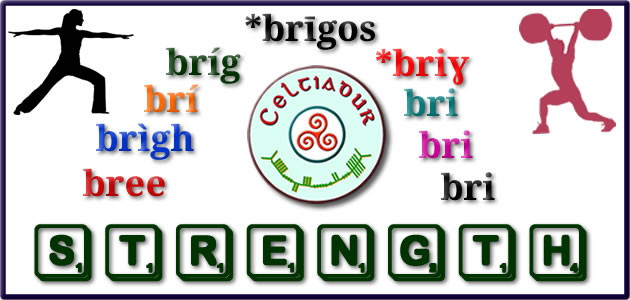
Words marked with a * are reconstructions.
| Proto-Celtic |
*brīgos = strength
*brīga = power, worth |
| Gaulish |
*brīgos = strength |
| Old Irish (Goídelc) |
bríg [bʲrʲiːɣ / bʲrʲiːɣʲ] = force, power, value, virtue, strength, vigour, vitality
brígach = powerful, mighty, strong
brígmar = powerful |
| Middle Irish (Gaoidhealg) |
bríg, brigh = power, strength, force, authority, vigour, virtue, might, value, worth, advantage, meaning
brígach = powerful, mighty, forceful
brígda = strong, vigorous
brígmar = powerful, strong, vigorous, lively, efficacious
brígrad = power, force |
| Irish (Gaeilge) |
brí [brʲiː] = strength, vigour; force, significance; influence, merit
bríoch = strong, vigorous, efficacious
bríochmar = strong, viorous
bríochtach = strong, vigorous person |
| Scottish Gaelic (Gàidhlig) |
brìgh [brʲiː] = essence, gist, matter, pith, purport, substance; meaning, sense, significance; point (of an argument); energy, force
brìghealachd [brʲiː.əLəxg] = substance, juiciness, pithiness, significance (in mathematics)
brìgheil [brʲiː.al] = meaningful, significant
brìoghmhor [brʲiː(v)ər] = meaningful, energetic, substantial, pithy |
| Manx (Gaelg) |
bree = power, energy, stamina, vigour, virtue, initiative, validity, animation, inwardness, glow, exhalation, drift, essence, gist, effect
breeagh = inspiring, vigorous
breeoil = dynamic, energetic, essential, impulsive, valid, vibrant, vigorous, active, powerful |
| Proto-Brythonic |
*briɣ = honour, dignity (?) |
| Middle Welsh (Kymraec) |
bri = honour, dignity, reputation, fame |
| Welsh (Cymraeg) |
bri [briː] = honour, dignity, reputation, fame, prestige, esteem, power, authority, importance, value, popularity
briaeth = honour, dignity
briol = honourable, reverent, dignified |
| Middle Cornish (Cernewec) |
bry = account, value, worth, price |
| Cornish (Kernewek) |
bri = distinction, esteem, importance, relevance, reputation, value, prominence
fowt bri = insignificance
heb bri = irelevant |
| Old Breton (Brethonoc) |
bri = importance, weight, authority |
| Middle Breton (Brezonec) |
bry = respect, consideration |
| Breton (Brezhoneg) |
bri [briː] = dignity, honour, respect, consideration
brient = privilege, prerogative
brientek [bri.ˈɛn.tek] = privileged
brientin = = privileged, aristocrat |
Etymology: possibly the Proto-Indo-European *bʰrḗǵʰ-o-s, from *bʰerǵʰ- (to rise, ascend, to be elevated, up high). Words from the same roots, via Gaulish, include brio (vigour, vivacity) in English, briu (energy, push, courage) in Catalan, brio (vivacity, liveliness) in Italian, brío (vigour, mettle, zeal) in Spanish, and brio (brilliance, panache) in French [Source].
Words from the same PIE roots include barrow, burrow, bury, effort, force and fort in English, and brenin (king), bwrw (to hit, strike, cast) in Welsh [Source].
| Proto-Celtic |
*nertom = strength, power |
| Celtiberian |
Nerto- = strength (?) |
| Gaulish |
Nerto- = strength (?) |
| Old Irish (Goídelc) |
nert [n͈ʲer͈t] = power, strength
nertaid [ˈn͈ʲer͈tɨðʲ] = to strengthen |
| Middle Irish (Gaoidhealg) |
nert, nnert, nirt = strength, might, power, ability, significance
nertaid = to strengthen, confirm, exhort, urge
nertaigid = to strengthen, confirm, encourage, grow strong, side with support |
| Irish (Gaeilge) |
neart [nʲaɾˠt̪ˠ / n̠ʲæɾˠt̪ˠ] = strength, force, power, ability, plenty
neartaigh = to strengthen
neartaitheach = strengthening, reinforcing
neartaitheoir = strengthener, abettor
neartmhaire = vigorousness, strength
neartmhar = strong, vigorous, powerful
neartú = strengthening, reinforcement, support |
| Scottish Gaelic (Gàidhlig) |
neart [̪nʲɛRʃd] = might, strength, force, energy, power, (alcoholic) proof, majority, most
neartachadh [n̪ʲɛRʃdəxəɣ] = strengthening, building up, making strong
neartaich strengthen, build up, make strong
neartaiche = strengthener, emphasiser
neartail = mighty, powerful, emphatic, forcible
neartmhor = mighty, powerful, emphatic, forcible
neartmhorachd = robustness, vigour |
| Manx (Gaelg) |
niart = strength, power, force
niartaght = strength
niartal = cogent, forcible, mighty, potent, powerful, strong
niarteyder = strengthener |
| Proto-Brythonic |
*nerθ [nɛrθ] = strenght, force, power |
| Old Welsh (Kembraec) |
nerthi = to strengthen, reinforce, fortify |
| Middle Welsh (Kymraec) |
nerth, nyrth = force, strength, power, might
nerthawc, nerthawg, nerthog = strong, mighty, powerful
nerthawl, nerthol = strong, mighty, powerful
nerthu = to strengthen, reinforce, fortify
nerthyd, nerthwr = fortifier, supporter, helper |
| Welsh (Cymraeg) |
nerth [nɛrθ] = force, strength, power, might, energy, vigour, hardness
nerthedig = strong, strengthened
nerthog = strong, mighty, powerful, potent
nerthol = strong, mighty, powerful, potent
nerthu = to strengthen, reinforce, fortify, aid, help, exhort, urge
nerthwr, nerthydd = fortifier, supporter, helper |
| Middle Cornish (Cernewec) |
nerth = might, power, strength, force |
| Cornish (Kernewek) |
nerth [nɛrθ] = energy, force, might, power, strength
nertha = to strengthen
nerthek = energetic, powerful, robust |
| Old Breton (Brethonoc) |
nerth = force, energy |
| Middle Breton (Brezonec) |
nerz, nerh = force, energy
nerzus, nerhus = vigorous, robust, energetic |
| Breton (Brezhoneg) |
nerzh [nɛrs] = force, energy
nerzhan nerzhañ [ˈnɛrzan / ˈnɛrzã] = to strengthen, reinforce
nerzhder = vigueur
nerzhek = drastic
nerzhekaat = to give energy
nerzhelour = dynamic
nerzhus = vigorous
nerzhusaat = to strengthen oneself |
Etymology: possibly the Proto-Indo-European *h₂ner-to- (virile, strong), from *h₂nḗr- (man, vital, energy). Words from the same roots include njer (man, human, person) in Albanian, άντρας [ˈandras] (man, husband) in Greek, noras (wish, desire, will, intention) in Lithuanian, nêr (lord, chief) in Welsh, and the name Nero [Source].
| Old Irish (Goídelc) |
láitir = strong, powerful |
| Middle Irish (Gaoidhealg) |
láitir, laitir [ˈl͈aːdʲərʲ] = strong, powerful |
| Irish (Gaeilge) |
láidir [ˈl̪ˠɑːdʲəɾʲ / ˈl̪ˠaːdʲəɾʲ] = strong, powerful, durable, tough, solid, forcible, loud
láidreacht = strength
láidrigh = to strengthen |
| Scottish Gaelic (Gàidhlig) |
làidir [l̪aːdʲɪrʲ] = strong, potent, emphatic, robust, substantial
làidireachd = strength
làidireach = strong, potent, emphatic
làidrich = make strong, strengthen |
| Manx (Gaelg) |
lajer = strong, potent, vigorous, hard, heavy, powerful, stark
lajeragh = to strengthen, strengthening
lajerid = potency, powerfulness, strength, vigour
lajerys = cogency, force, might, prowess, strength |
Etymology: unknown [Source].
| Irish (Gaeilge) |
cadrán = hardness, stubborness, obstinacy
cadránta = hard, unfeeling, stubborn, obstinate
cadrántacht = hardness, stubborness, obstinacy |
| Proto-Brythonic |
*kadarn = strong, powerful, mighty (?) |
| Middle Welsh (Kymraec) |
cadarn, kadarn, katarnn = strong, powerful, mighty
cadarnhau, kadarnaha = to strengthen, secure, fortify, safeguard
kedernyt, kedernit, cedernyt = strength, power, potency, might |
| Welsh (Cymraeg) |
cadarn [ˈka(ː)darn] = strong, powerful, mighty, firm, fast
cadarnhad = confirmation
cadarnhau = to strengthen, secure, fortify, safeguard
cadernid = strength, power, potency, might |
| Middle Cornish (Cernewec) |
cadarn = strong, stout, valiant |
Etymology: from Proto-Celtic *katus (battle), from Proto-Indo-European *kéh₃tus (battle), from *keh₃- (to fight). Words from the same roots include Hader (dispute, quarrel) and hadern (to quarrel, bicker, struggle) in German, and words for battle in Celtic languages [Source].
| Proto-Celtic |
*kriɸmos = strong (?) |
| Proto-Brythonic |
*krɨβ̃ = strong |
| Middle Welsh (Kymraec) |
cryf, kryf = strong, powerful, vigorous
cryfder = strength, power, might |
| Welsh (Cymraeg) |
cryf [krɨːv / kriːv] = strong, powerful, vigorous, intoxicating, tough, rich, fruitful, intense
cryfder = strength, power, might
cryfhau = to strengthen |
| Old Cornish |
crif = strong, mighty, vigorous, hardy |
| Middle Cornish (Cernewec) |
cref, crŷf, crif, crev = strong, mighty, vigorous, hardy |
| Cornish (Kernewek) |
krev = forceful, powerful, robust, strong, substantial
krevder = intensity, strength |
| Middle Breton (Brezonec) |
cref, creff = strong, powerful |
| Breton (Brezhoneg) |
kreñv [ˈkrẽ(w)] = strong, solid
kreñvaat [krẽˈfɑːt] = to strengthen, reinforce
kreñvder [ˈkrẽ(w)dɛr] = strength, power, might
kreñvlec’h = stronghold, fortress |
Etymology: from Proto-Celtic *kriɸ- (body) from Proto-Indo-European *krep- (body). Words for body in Celtic and other languages come from the same roots [Source].
| Proto-Celtic |
*trexsnos = strong
*trexsos = stronger |
| Gaulish |
Trexius, Trexa, Trenus = personal names |
| Primitive Irish |
ᚈᚈᚏᚓᚅᚐᚂᚒᚌᚑᚄ (ttrenalugos), ᚈᚏᚓᚅᚐᚌᚒᚄᚒ (trenagusu) = (?) |
| Old Irish (Goídelc) |
trén [tʲrʲeːn] = strong
treise = power, strength |
| Middle Irish (Gaoidhealg) |
trén = strong, powerful, strong man
treise = strength, vigour, power |
| Irish (Gaeilge) |
tréan = strong man, warrior, champion, strength, power, intensity, plenty, abundance
tréaniarracht = strong, forcible, attempt
treise = strength, power, dominance, force, emphasis
treisigh = to strengthen, reinforce, fortify
treisiúil = strong, forceful, vigorous |
| Scottish Gaelic (Gàidhlig) |
trèine [treːnə] = might, power
treise [treʃə] = strength, vigour
treun [treːn] = champion, hero, brave, strong, sturdy
treunar [treːnər] = strong man, champion, hero; very brave, heroic
treunas = might, power
treuntachd = boldness, courage
treuntas = strength, power, magnanimity |
| Manx (Gaelg) |
trean = brave, firm, heroic, intensive, mighty, stout, valiant
treanid = braveness, exploit, feat heroics, might, strength, valour |
| Proto-Brythonic |
*trex = stronger |
| Middle Welsh (Kymraec) |
trech = stronger, mightier, greater, superior, better |
| Welsh (Cymraeg) |
trech [treːχ] = stronger, mightier, greater, superior, better
trechedd = supremacy, dominance
trechu = to defeat, overcome, overpower |
| Cornish (Kernewek) |
trygh = conquest, victory, superior, triumphant, victorious
trygher = victor
tryghi = to conquer, vanquish |
| Middle Breton (Brezonec) |
trech = victorious, victory
trechy, trechiff = to conquer, prevail, overcome |
| Breton (Brezhoneg) |
trec’h [briː] = superior, victorious, victory
trec’hadeg = triumph
trec’hadenn = success
trec’hedigezh = defeat
trec’her = winner
trec’hin, trec’hiñ = to conquer, prevail, overcome
trec’hus = victorious |
Etymology: the Proto-Indo-European *(s)treg- (to be stiff, rigid, strong) or *treg- (strength). Words from the same roots include þróttur (strength, vigour, energy) in Icelandic, and idrott (sport, physical education) in Swedish [Source].

Sources: Wiktionary, Am Faclair Beag, Online Manx Dictionary, Teanglann.ie, eDIL – Electronic Dictionary of the Irish Language, In Dúil Bélrai English – Old Irish glossary, Geiriadur Prifysgol Cymru, Gerlyver Kernewek, Dictionaire Favereau, TermOfis, English – ProtoCeltic WordList (PDF), Etymological Dictionary Of Proto Celtic