Adventures in Etymology – Feathers

In this Adventure in Etymology we investigate the word feather.

Feathers

A feather [ˈfɛð.ə(ɹ) / ˈfɛð.ɚ] is:

  • A branching, hair-like structure that grows on the bodies of birds, used for flight, swimming, protection and display.
  • Long hair on the lower legs of a dog or horse, especially a draft horse.
    [other meanings are available]

It comes from Middle English feþer (feather), from Old English feþer (feather, pen), from Proto-West Germanic *feþru (feather, wing), from Proto-Germanic *feþrō (feather), from Proto-Indo-European *péth₂r̥ (feather, wing), from *peth₂- (to fly, to spread out) [source].

Words from the same Proto-Germanic roots include veer (feather, plume) and vlerk (wing, scoundrel) in Dutch, Feder (feather, spring, nib, penholder, fountain pen) and Gefieder (plumage) in German, and federa (pillowcase) in Italian (via Lombardic fedeara (feather)) [source].

Roger Federer (Switzerland)

By the way, the Swiss tennis player Roger Federer gets his surname from the Swiss German word Federer, which means ‘one who works with or trades in quills’, which are traditionally made from feathers [source]

Other words from the same Proto-Indo-European roots include πτηνό (ptinó – bird) in Greek, पत्र (patra – letter, paper, document, leaf) in Hindi, adar (birds) and adain (wing, fin) in Welsh, and appetite, petal, petition and fathom in English [source].

Helicopter

Incidentally, the word heliocopter also comes from the same roots, via French hélicoptère (helicopter), which comes from Ancient Greek ἕλιξ (hélix – spiral) &‎ πτερόν (pterón – feather, wing) – at least the -pter part does – see also pterodactyl (“winged finger”) [source].

Can anybody identify which birds the feathers in the photo at the top of this post come from? I found them in my garden.

If you would like to support this podcast, you can make a donation via PayPal or Patreon, or contribute to Omniglot in other ways.

Radio Omniglot podcasts are brought to you in association with Blubrry Podcast Hosting, a great place to host your podcasts. Get your first month free with the promo code omniglot.

The Fastest Way to Learn Japanese Guaranteed with JapanesePod101.com

I also write about words, etymology and other language-related topics on the Omniglot Blog, and I explore etymological connections between Celtic languages on the Celtiadur blog.


Celtic Pathways – Healing Medics

In this episode we discover the possible Celtic roots of words for doctor in some Germanic languages.

Doctores Oftalmologos

The Proto-Celtic word *leigis means healer and either comes from Proto-Germaic *lēkiz (healing, medicine, healer), or directly from the Proto-Indo-European *h₂leg- (to care for) [source].

Descendants in the modern Celtic languages include:

  • lia [l̠ʲiə] = healer, physician in Irish
  • lèigh [l̪ʲeː] = physician, surgeon in Scottish Gaelic
  • (fer/ben) lhee = (male/female) doctor, physician in Manx

Words from the same Proto-Celtic root possibly include leech (physician, healer) in English, læknir (medical practitioner, doctor) in Icelandic, läkare (doctor, physician) and läka (to heal) in Swedish, lääkäri (phyisican, doctor) in Finnish, and læge (doctor, physician, surgeon) in Danish [source].

Words from the same PIE root include religion and neglect in English, religione (religion) Italian, religie (faith, religion) Dutch, and négliger (to neglect, ignore) in French [source].

Incidentally, leech used to refer to a physician or healer in English, that is, someone who practised leechcraft (healing, medicine) using leechdom (medicine, remedy) and possibly leeches, and maybe a leechbook (a compilation of medicinal cures and remedies).

This type of leech comes from Middle English leche (physician), from Old English lǣċe (doctor, physician), from Proto-West Germanic *lākī (doctor, physician), from Proto-Germanic *lēkijaz (doctor, physician) [source].

Leech, as in an aquatic blood-sucking annelid of class Hirudinea, especially Hirudo medicinalis, comes from the same roots, but via Middle English leche (blood-sucking worm), Old English lǣċe (blood-sucking worm), Proto-West Germanic *lākī, and so on [source].

Radio Omniglot podcasts are brought to you in association with Blubrry Podcast Hosting, a great place to host your podcasts. Get your first month free with the promo code omniglot.


Celtic Pathways – Celtic Carpenters

In this episode we drill down to the Celtic roots of words for carpenter in English and other languages.

Moffett Mill

The Proto-Celtic word *karbantos means (war) chariot or wagon and is possibly related to the Proto-Celtic word *korbos (wagon, basket). Beyond that, its origins are not known [source].

Descendants in the modern Celtic languages include:

  • carbad [ˈkaɾˠəbˠəd̪ˠ] = chariot in Irish
  • carbad [karabad] = chariot, coach, carriage, wagon, vehicle, bier, jaw(bone) in Scottish Gaulish
  • carbyd = bus, coach, vehicle, bier, hearse in Manx
  • cerbyd [ˈkɛrbɨ̞d / ˈkɛrbɪd] = car, carriage, chariot, wagon, coach; clumsy fellow, bungler in Welsh
  • karbed = vehicle in Breton

More details about words for Wagons & Carts in Celtic languages on Celtiadur.

The Gaulish word carbantos (chariot, wagon) comes from the same Proto-Celtic root, and was borrowed into Latin as carpentum (carriage, wagon, cart), from which we get the Latin word carpentārius (coachman, cartwright, carpenter) [source].

Words from the same Latin and Gaulish roots include charpente (framework, build, structure) and charpentier (carpenter) in French, carpentiere (carpenter) in Italian, carpintero (carpenter, woodpecker) in Spanish, and carpenter in English [source].

Incidentally, in Old English one word for carpenter, and woodworker, was trēowwyrhta, or literally “tree worker”. This later became treewright, an old word for a carpenter, joiner or other worker of wood [source].

Radio Omniglot podcasts are brought to you in association with Blubrry Podcast Hosting, a great place to host your podcasts. Get your first month free with the promo code omniglot.


Adventures in Etymology – Luxurious Locks

In this Adventure in Etymology we unlock connections between the words luxury and lock.

Sofitel So Bangkok - Wood Element Room - 01

As a adjective luxury [ˈlʌk.ʃə.ɹi / ˈlʌɡʒəɹi] can mean:

  • Very expensive.
  • Not essential but desirable and enjoyable and indulgent.

As a noun luxury can mean:

  • Very wealthy and comfortable surroundings.
  • Something desirable but expensive.
  • Something that is pleasant but not necessary in life.

It comes from Middle English luxurie [ˈluksjuri(ə)] (lustfulness; sexual desire or attraction; copulation), from Old French luxur(i)e (lust), from Latin lūxuria (luxury, extravangance, lust), from lūxus (a dislocation, extravagance, luxury, excess, debauchery, pomp, splendor), from Proto-Italic *luksos, from Proto-Indo-European *lewg- (to bend, twist) [source].

Words from the same roots include lock, locket and reluctant in English, lok (lock of hair) in Dutch, Loch (hole, perforation, pit, gap, cavity, dungeon) in German, lujuria (lust, excess) and luchar (to fight, battle, struggle, strive) in Spanish, and gollwng (to releasse, drop, leak) in Welsh [source].

Incidentally, one word for luxury in Old English was firenlust / fyrnlust [ˈfi.renˌlust] which also means sinful lust, sinful pleasure, or extravagance, and comes from firen (crime, sin, torment, suffering) and lust (desire, pleasure, appetite, lust) [source].

You can also listen to this podcast on: Apple Podcasts, Amazon Music, TuneIn, Podchaser, Podbay or Podtail and other pod places.

The theme tune for this podcast is The Unexpected Badger / Y Mochyn Daear Annisgwyl, a piece I wrote and recorded in 2017.

If you would like to support this podcast, you can make a donation via PayPal or Patreon, or contribute to Omniglot in other ways.

Radio Omniglot podcasts are brought to you in association with Blubrry Podcast Hosting, a great place to host your podcasts. Get your first month free with the promo code omniglot.

The Fastest Way to Learn Japanese Guaranteed with JapanesePod101.com

I also write about words, etymology and other language-related topics on the Omniglot Blog, and I explore etymological connections between Celtic languages on the Celtiadur blog.


Adventures in Etymology – An Assembly of Things

This Adventure in Etymology is an assembly of words about the word thing, or something like that.

Pointless things?

Meanings of thing [θɪŋ] include:

  • That which is considered to exist as a separate entity, object, quality or concept.
  • A word, symbol, sign, or other referent that can be used to refer to any entity.
  • An individual object or distinct entity.

It comes from Middle English thing (thing, substance, object), from Old English þing (thing, matter, concern, event, meeting, court, case, reason, means), from Proto-West Germanic *þing (court, session, lawsuit, affair, matter, thing, object) from Proto-Germanic *þingą (time, date, meeting, assembly, council, case, matter, issue), from Proto-Indo-European *tenk-ó-, from *tenk- (to be suitable) [source].

So, its meaning changed from being suitable, to a suitable or scheduled time, to an assembly, to a specific issue discussed at an assembly, to issues, objects or things in general. Which is quite something.

There are related words in other Germanic languages that also mean thing, and other things. For example, ding (matter, thing) in Dutch [source] (and Afrikaans), Ding (thing, girl, boy) in German [source], and Déngen (thing, object) in Luxembourgish [source].

The Alþingi
The Alþingi

However, in Norwegian, ting can mean thing, court or assembly [source], ting means thing, assembly or parliament in Danish [source], and þing means assembly, meeting, council or parliament in Icelandic, and the parliament of Iceland is called the Alþingi – see above [source].

Other words from the same roots include tinka (quarrel, disagreement, shortage, lack, tight situation) in Finnish, tinge (to bargin, haggle) in Danish, þinga (to hold a meeting) in Icelandic, dungi (to employ) in Esperanto, and gedeihen (to thrive, flourish, prosper) in German [source].

You can also listen to this podcast on: Apple Podcasts, Amazon Music, TuneIn, Podchaser, Podbay or Podtail and other pod places.

The theme tune for this podcast is The Unexpected Badger / Y Mochyn Daear Annisgwyl, a piece I wrote and recorded in 2017.

If you would like to support this podcast, you can make a donation via PayPal or Patreon, or contribute to Omniglot in other ways.

Radio Omniglot podcasts are brought to you in association with Blubrry Podcast Hosting, a great place to host your podcasts. Get your first month free with the promo code omniglot.

The Fastest Way to Learn Japanese Guaranteed with JapanesePod101.com

I also write about words, etymology and other language-related topics on the Omniglot Blog, and I explore etymological connections between Celtic languages on the Celtiadur blog.


Adventures in Etymology – Spring

In this Adventure in Etymology, we find out where the word spring springs from.

Apple Blossom / Blodau Afal
Spring blossom on my apple tree

As a verb, spring [spɹɪŋ] can mean:

  • To appear.
  • To grow, to sprout.
  • To arise, come into existence.
  • To enliven.
  • To move with great speed and energy.
  • To leap over.

It comes from Middle English spryngen [ˈsprinɡən] (to spring, burst forth, shoot out, rise, emerge, appear), from Old English springan [ˈsprin.ɡɑn] (to leap, bound, burst forth, grow, rise), from Proto-West Germanic *springan (to spring, jump to, burst, explode) from Proto-Germanic *springaną (to spring, jump up, burst, explode), from Proto-Indo-European *sprenǵʰ-, from *sperǵʰ- (to move rapidly, to hurry) [source].

As a noun, spring can mean:

  • An act of springing: a leap, a jump.
  • A season of the year in temperate regions between winter and summer.
  • Something which springs forth, up or back.
  • A mechanical device made of flexible or coiled material that exerts force and attempts to spring back when bent, compressed, or stretched.

It comes from Middle English spryng [sprinɡ] (a spring, tide, new growth, source or origin, leap, jump, strike), from Old English spring [sprinɡ] (a spring [of water], ulcer, sore, pustule), from Proto-West Germanic *spring (a spring) from Proto-Germanic *springaz (a wellspring, fount) [source].

Words from the same roots include springen [ˈʃpʁɪŋən] (to spring, leap, bounce, jump, burst) in German, springa (to run) in Swedish, sprænge [ˈsb̥ʁaŋə] (to blow up, burst, explode) in Danish, пружити [prûʒiti] (to stretch out, extend, offer, give) in Ukrainian, and léim [lʲeːmʲ] (to jump, leap) in Irish [source].

Incidentally, in Middle English spring (the season) was referred to as lente/lentin, which comes from Old English lencten (spring, Lent), from Proto-West Germanic *langatīn (spring), from *lang (long) & *tīn (day) – so named because the days become longer again in spring [source].

In Modern English, this became Lent (A period of the ecclesiastical year preceding Easter, traditionally involving temporary abstention from certain foods and pleasures), and is related to lente (spring [season]) in Dutch and Afrikaans.

You can also listen to this podcast on: Apple Podcasts, Amazon Music, TuneIn, Podchaser, Podbay or Podtail and other pod places.

The theme tune for this episode is The Unexpected Badger / Y Mochyn Daear Annisgwyl, a piece I composed and recorded in 2017.

If you would like to support this podcast, you can make a donation via PayPal or Patreon, or contribute to Omniglot in other ways.

Radio Omniglot podcasts are brought to you in association with Blubrry Podcast Hosting, a great place to host your podcasts. Get your first month free with the promo code omniglot.

The Fastest Way to Learn Japanese Guaranteed with JapanesePod101.com

I also write about words, etymology and other language-related topics on the Omniglot Blog, and I explore etymological connections between Celtic languages on the Celtiadur blog.



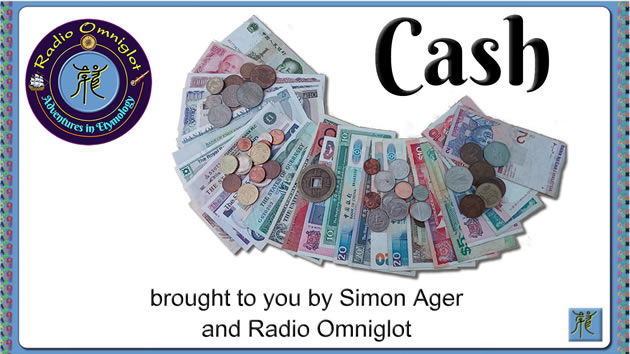
Adventures in Etymology – Cash

In this Adventure in Etymology, we are grasping the cash box as we look into the origins of the word cash.

Cash - part of my collection of coins and banknotes

Cash [kæʃ] is:

  • Money in the form of notes or bills and coins
  • Liquid assets, money that can be traded quickly, as distinct from assets that are invested and cannot be easily exchanged.
  • Money.
  • A place where money is kept, or where it is deposited and paid out; a money box. (archaic)

It comes from Middle French caisse (money box, chest), from Occitan caissa from Latin capsa (box, case, holder, repository, bookcase), from capiō (to take, capture, seize), from Old Latin kapio, from Proto-Italic *kapjō (to take, seize), from Proto-Indo-European *kapyéti (to be grasping), from *kap- (to seize, grab, hold) [source].

Words from the same roots include case, chase, have, haven, heave, heft and disciple in English, caja (box, case, bank) in Spanish, caisse (box, crate, cash register) in French, hebben (to have, possess, own, hold) in Dutch, and cuach (bowl, goblet) in Irish [source].

Hang on, how is disciple related to cash? Well, it comes from Middle English disciple (disciple), from Old English discipul (disciple, scholar), from Latin discipulus (student, pupil, disciple, scholar), from dis- (asunder, apart) and Proto-Italic *kapelos (one who takes), from *kapiō (to take), from Proto-Indo-European *kapyéti, etc. So a disciple or scholar could be one said to be who ‘takes apart’ ideas, knowledge, etc. [source].

There are many other words for cash and money in English, including brass, bread, dosh, dough, funds, moolah, readies, spondoolicks and wonga – do you know any others? [source].

By the way, this week there is a bonus Adventure in Etymology on my Patreon page.

You can also listen to this podcast on: Apple Podcasts, Amazon Music, TuneIn, Podchaser, Podbay or Podtail and other pod places.

If you would like to support this podcast, you can make a donation via PayPal or Patreon, or contribute to Omniglot in other ways.

Radio Omniglot podcasts are brought to you in association with Blubrry Podcast Hosting, a great place to host your podcasts. Get your first month free with the promo code omniglot.

The Fastest Way to Learn Japanese Guaranteed with JapanesePod101.com

I also write about words, etymology and other language-related topics on the Omniglot Blog, and I explore etymological connections between Celtic languages on the Celtiadur blog.

Unlimited Web Hosting - Kualo

Celtic Pathways – Gulls

In this episode we discover the possible Celtic roots of English and French words for seagull.

Gulls

The Proto-Celtic word *wailannā means seagull, and possibly comes from the Proto-Indo-European *wáy (oh! ah! woe! alas!), and maybe related to *waylos (howler, wolf) [source].

Related words in the modern Celtic languages include:

  • faoileán = gull, seagull in Irish
  • faoileann [fɯːlən̪ˠ] = gull, seagull, common gull in Scottish Gaelic
  • foillan = gull, seagull in Manx
  • gwylan [ˈɡʊɨ̯lan / ˈɡʊi̯lan] = sea-gull, fair maiden, glutton in Welsh
  • golan [ˈɡoːlan / ˈɡʊlɐn] = gull, seagull in Cornish
  • gouelan [ˈɡweːlãn] = seagull in Breton

For more about words for gulls and related things in Celtic languages, see the Celtiadur post: Gulls

The English word gull comes from Middle English gulle (gull, water bird), which was probably borrowed from a Brythonic language (Welsh or Cornish) [source].

The French word goéland [ɡɔ.e.lɑ̃] (gull, herring gull) was borrowed from Middle Breton goelan (gull, seagull) in the 15th century [source].

A more common French word for (sea)gull is mouette [mwɛt], which comes from Middle French mouette (seagull) from Old French moette (seagull), from maoe (seagull), from Old English mǣw (seagull) [source].

The Old Englsh word mǣw, comes from Proto-Germanic *maiwiz (seagull), from a non-Indo-European substrate, or is of imitative origin. It’s also found in Middle English as mewe (gull, seagull), in the archaic / dialectal English word mew (gull, seagull), in Dutch as meeuw (seagull), and in German as Möwe (seagull) [source].

Radio Omniglot podcasts are brought to you in association with Blubrry Podcast Hosting, a great place to host your podcasts. Get your first month free with the promo code omniglot.

The Fastest Way to Learn Japanese Guaranteed with JapanesePod101.com

Adventures in Etymology – Bottles, Boots and Butts

In this Adventure in Etymology, we find connections between words for bottle, boot and butt in various languages.

Balcony pix

Meanings of bottle [ˈbɔtɫ̩ / ˈbɑ.təl] include:

  • A container, typically made of glass or plastic and having a tapered neck, used primarily for holding liquids.
  • The contents of such a container.

It comes from Middle English botel [ˈbutəl] (bottle, flask, wineskin), from Old French boteille [buˈteʎə] (bottle), from Late Latin butticula (bottle, flask), from buttis (cask, barrel), from Ancient Greek βοῦττῐς (boûttĭs – a type of vessel), perhaps from Proto-Indo-European *bʰeHw- (to swell, puff) [source].

Words from the same roots include boot, butt (cask, barrel), and butler in English, bottiglia (bottle) in Italian, botte (boot, oppression) in French, botija (jug, vessel) in Spanish, butoi (barrel, cask) in Romanian, buta (butt, cask, stock, stocky person) in Irish, and búča (pumpkin, squash, head) in Slovenian [source].

Words for bottle in Old English included:

  • flasce [ˈflɑs.ke] (bottle, flask), which comes from Proto-Germanic *flaskǭ (flask, bottle), lives on as flask in English, and is related the German word Flasche (bottle, flask, flagon), fles (bottle) in Dutch, and flaska (bottle) in Swedish [source].
  • ampella [ˈɑm.pel.lɑ] (flask, bottle, flagon, vial), which comes from Proto-West Germanic *ampullā (flask), from Latin ampulla (a two-handled vessel with a swollen middle), from amphora (a large vessel, especially one made of clay with two handles used for storing and transporting wine and oil), from Ancient Greek ἀμφορεύς (amphoreús – jar with a narrow neck, amphora). It lives on as ampoule in English [source].

A related word in German is Ampel, which can refer to a traffic light, a ceiling lamp or a container which hangs from the ceiling (for a plant, etc.) [source]

You can also listen to this podcast on: Apple Podcasts, Amazon Music, TuneIn, Podchaser, Podbay or Podtail and other pod places.

If you would like to support this podcast, you can make a donation via PayPal or Patreon, or contribute to Omniglot in other ways.

Radio Omniglot podcasts are brought to you in association with Blubrry Podcast Hosting, a great place to host your podcasts. Get your first month free with the promo code omniglot.

The Fastest Way to Learn Japanese Guaranteed with JapanesePod101.com

I also write about words, etymology and other language-related topics on the Omniglot Blog, and I explore etymological connections between Celtic languages on the Celtiadur blog.

Unlimited Web Hosting - Kualo

Adventures in Etymology – Cluttered Klutzes

In this Adventure in Etymology, we find connections between clutter, clods and klutzes.

My kitchen halfway through renovation
My cluttered kitchen part way through its current renovation

Clutter [ˈklʌtə(ɹ) / ˈklʌtɚ] is:

  • A confused disordered jumble of things
  • Background echoes, from clouds etc., on a radar or sonar screen.
  • Clatter; confused noise. (obsolete)

It comes from Middle English cloteren (to form clots, coagulate, heap on), from clot (clot, ball of earth of clay), from Old English clot(t) (mass, lump), from Proto-West-Germanic *klott (clod, lump, ball), from Proto-Germanic *kluttaz (clod, lump, ball), from Proto-Indo-European *gel- (to ball up, amass, clench) [source].

Words from the same roots include cleat, clod, clot, cloud and klutz in English, Klotz (block, log, chunk, klutz) in German, klut (rag, cloth, patch, sail) in Swedish, klode (globe) in Danish, and possibly cludair (a heap, pile) in Welsh [source].

The word klutz, which in the USA refers to a clumsy or stupud person, comes from the Yiddish word קלאָץ (klots – wooden beam, log, block, oaf, blockhead), from Middle High German kloz (stump, ball), from Old High German kloz (stump, ball), from Proto-West Germanic *klott (clod, lump, ball), etc. [source].

In the UK, one equivalent of a klutz might be a clot, which is used to refer to a silly person, and not so much a clumsy person Other words with similar meanings are available. For a clumsy person, we might say butterfingers [source].

Some related words related to clutter include:

  • cluttercore – An interior design trend and aesthetic, popular in the 2020s, based on densely filling spaces with personal objects and decorative items, resulting in a vibrant and eclectic arrangement of contrasting colours and textures – a.k.a. ‘TikTok aesthetic’ [source]
  • clutterblug – someone who collects lots of things that have value or personal meaning, unlike a hoarder, who collects huge amounts of stuff, often of seemingly little value to themselves or others [source].
  • (to) declutter – The act or process of removing clutter; a decluttering; to remove clutter from, to tidy – a.k.a. (to) unclutter [source]. This is something I’m attempting to do at the moment in my late mother’s house, and my own house.

I am a bit of a clutterblug, and tend to hold on to things that might be useful one day. I seem to go through phases of cluttering, decluttering and recluttering. How about you?

I thought I’d just made up reclutter (the process of cluttering after a declutter), but apparently it’s a thing: “recluttering encourages us to discard our negative associations towards ‘clutter’ and create a conscious, more mindful relationship with our belongings, instead. Essentially, if something brings joy, purpose or personality to us and our homes, it’s worth holding on to, whether it’s ‘necessary’ or not.” [source].

You can also listen to this podcast on: Apple Podcasts, Amazon Music, TuneIn, Podchaser, Podbay or Podtail and other pod places.

If you would like to support this podcast, you can make a donation via PayPal or Patreon, or contribute to Omniglot in other ways.

Radio Omniglot podcasts are brought to you in association with Blubrry Podcast Hosting, a great place to host your podcasts. Get your first month free with the promo code omniglot.

The Fastest Way to Learn Japanese Guaranteed with JapanesePod101.com

I also write about words, etymology and other language-related topics on the Omniglot Blog, and I explore etymological connections between Celtic languages on the Celtiadur blog.

Unlimited Web Hosting - Kualo